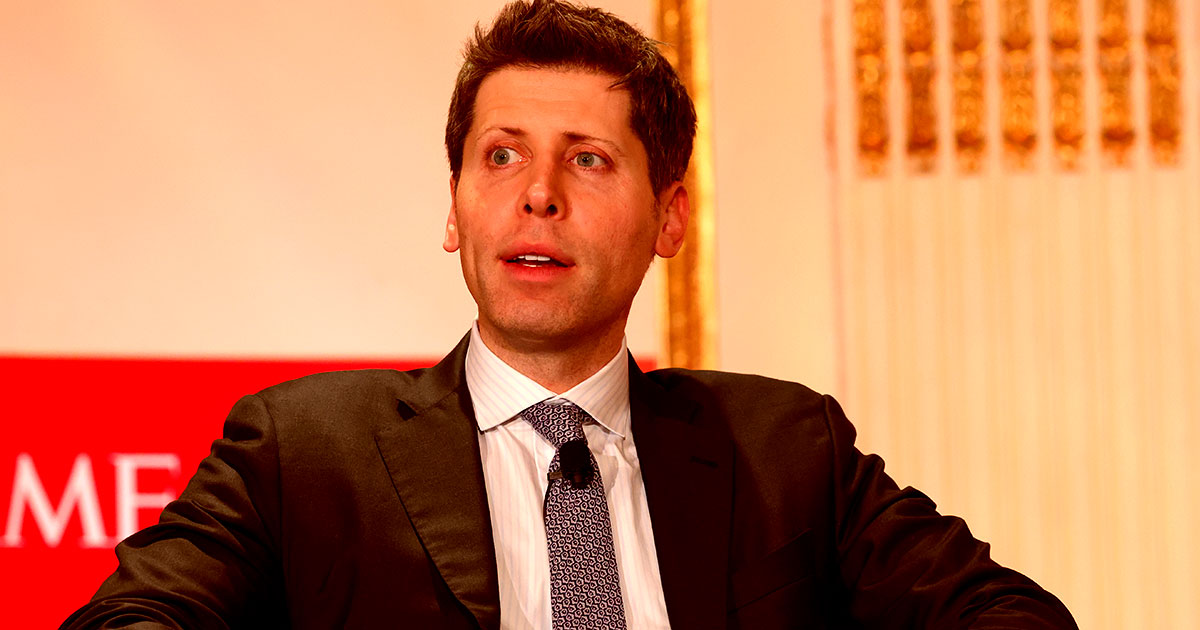
Sam Altman Says AI Using Too Much Energy, Will Require Breakthrough Energy Source
"There's no way to get there without a breakthrough," OpenAI CEO Sam Altman said, arguing that AI will soon need even more energy.
Futurism
38 points · by DyslexicAtheist · 2y ago · 91 comments
If you take the "350,000" H100s that Facebook wants by EOY, each of those can do 700W, which gives you almost 250 MW for just the GPUs. That sounds like a lot, until you realize that a single large power plant is measured in Gigawatts. All of Google's data centers combined are O(10 GW) which are matched with renewable power offsets [1].
Importantly, the world installed >500 Gigawatts of renewable energy in 2023 [2], mostly driven by PV Solar in China. The amount of potential solar and wind and other renewable-ish (hydro) outstrips even a 10x'ing of a lot of these numbers. But even for a single site, dams like Three Gorges are >20 GW.
There are real efficiency and scale challenges in doing AI in a single, large site. But existing power generation systems deliver plenty of power.
[1] https://www.gstatic.com/gumdrop/sustainability/google-2023-e...
[2] https://www.iea.org/reports/renewables-2023/executive-summar...
Efficiency gains should come first, long before they start looking at alternative energy sources.
And third: renewables need to be associated with its backup like hydro/step or ... batteries which cost a lot. Gas can't be taken in as it's not CO2-free. All that unless training and inference happen when there's the corresponding wind and sun shining. And I'm not seeing that happening right now.
> If you take the "350,000" H100s that Facebook wants by EOY, each of those can do 700W
Plus ~500W for cooling
> This report also analyzes prospective generation capacity in four categories — under construction, permitted, application pending, and proposed. More than 466,000 MW of new generation capacity is under development in the United States — a 13% increase over 2022. Sixty-one percent of capacity most likely to come online, permitted plants and plants that are under construction, are in solar.
China's growth in power capacity is non-trivially due to increasing demand. If the US or Europe or wherever suddenly wanted to build XXX GW per year, they could (modulo bureaucracy, which is very real).
The US or EU could likely do it, yes. If someone is willing to put up the capital to do it. The point of Sam Altman's statement is that he wants someone to do it.
I already pay for a GPT subscription, and its reliability is one of the worst of any product I pay for. The novelty keeps me paying, but I can't imagine building a business on it.
Employers will save health, logistics, HR, etc.
Governments will have to pay for unemployment
Just the same as always - privatize the gains
Those people no longer have jobs. That sounds bad, but consider they can now do something else. (Ad infinitum this is obviously a problem. But the history of technological development provides cause for optimism in the long run.)
through in most cases it probably will still not work/help society
I.e. from what I heard public defendants in the US are notoriously overworked, if an AI could help them auto prepare all the simple straight forward cases they could do a better job. But then this is also a good example for why it probably still will not work out well. As no one will pay for that tool or they will pay for it but then expect so many more cases to be handled that it might get worse instead of better.
The size some of the large language models have is just insane. To put it into context GPT3 is a Large Language Model (LLM) but GPT4 has like (handwaveing) 5+ times as many parameters. This means the energy cost is also at least that much larger for inference.
And if we look at training instead of inference it's a quite a bit more complicated (each iteration is more costly, more parameter can also require more iterations, but at the same time you might need to spend less time in an area of increasingly diminishing returns per iteration), but if we go with GPT3 vs. GPT4 the 5x+ increase of parameters lead to a 10x+ increase in training cost (of which a huge part is energy cost, through also amortized hardware cost; ~10M$ to >100M$).
Additionally there are various analysis steps you might do when creating new models which can be hugely (energy) costly.
And that is with GPT4 and with OpenAI any major increase in version seem to come with a major increase in parameter size so with that trend we are looking at energy bills in the (potential many) hundreds of million US dollar for training alone.
Another thing wrt. inference cost is that with my limited understanding currently the best way to reach AGI and also a lot of other tasks is to run multiple models in tandem. Through this model might be domain adoptions of the same model, so not twice the training cost.
---
Domain Adaption == take a trained model and then train it a bit more to "specialize" it on a specific task, potentially adding additional knowledge etc. While you can try to do so just with prompt engineering there a larger prompt comes at a larger cost and a higher chance for unexpected failure, so by in a certain way "burning in" some additional behavior, knowledge etc. you can get nice benefit.
Joking aside: the options are to turn it off or to charge what it should cost and given that no matter what it costs and no matter what the source if it uses too much energy the better solution would be to make it use less energy rather than to look for a breakthrough energy source because that also reduces the climate impact.
[0] https://www.wsj.com/tech/ai/microsoft-targets-nuclear-to-pow...
The final proof reading and decision still is done by humans, but before that automatic feedback AI is used to find things which need to be changed during planing, certification and highlight potential problem. I.e. eliminate as many rounds of back and force between agency and plant builder and in turn save a lot of time.
Through if the final proof reading is also done by AI or relies to much on AI this is a huge issue. LLMs fundamentally to their design sometimes (in the future maybe rarely) make mistakes in forms which for humans seem arbitrary, random and absurd (in turn they tend to also not do some of the mistakes humans tend to do). The problem is even if this mistakes become rare they always can be fundamental safety issues.
On one hand, LLMs do require significant amounts of compute to train. But the other hand, if you amortize training costs across all user sessions, is it really that big a deal? And that’s not even factoring in Moore’s law and incremental improvements to model training efficiency.
yes, at least as long as you constantly develop new AI models
and you still need to run the models, and e.g. for GPT4 that is alone already non trivial (energy cost/compute wise)
through for small LLMs if they are not run too much it might be not that bad
---
Generally I would always look for ulterior motives for any "relevant" public statement Sam Altman makes. As history has shown there often seems to be some (through in that usage "ulterior" has a bit too much of a "bad"/"evil" undertone).
To cut it short he seem to be invested in some Nuclear Fusion company, which is one of the potential ways to "solve" that problem. Another potential way is to use smaller LLMs but smaller LLMs can also be potentially a way how OpenAI loses their dominant position, as there is a much smaller barrier for training them.
AI inference is so costly at scale, one can easily see data centers start using 4% of total electricity, and in the next decade 8%. That will start to have severe effects on the power grid, basically require planning many years in advance to setup new power plants and such.
"Moore's law and incremental improvements' are irrelevant in the face of scaling laws. Since we aren't at AGI yet, every extra bit of compute will be dumped back into scaling the models and improving performance.
A lot of the 13 and 30bn parameter models are actually quite good, maybe not GPT4 but it can run on my M1 MBP without an issue, and a bit faster than GPT4 anyway.
I don't need a chat interface that is amazing at all things at once, I need it to be great at 1 subject at a time.
Why? I understand that for a normal website you always want to use the closest server possible, but for queries that take 30 seconds on average anyway, why does it matter if you're adding an extra 250ms to get it from the opposite side of the world?
If AI can legitimately replace human labor, why would anyone care if it takes an extra few milliseconds?
I want one which can instantly calculate numberwang[0] and get it right every time
https://www.aboutamazon.com/news/sustainability/amazon-renew...
Maybe Apple will have some ideas with the power/performance ratio of their chips compared to what's used in graphic cards.
- technically complex
- use cases uncertain
- except for crime/spam/other unpleasantness
- Nvidia is smiling
- cooking the planet
seems like it to me!
I have some legit usecases for Generative AI, it advanced my productivity across multiple learning areas by at least 2x.
Blockchain on the other hand, a pile of wannabe numbers in the air.