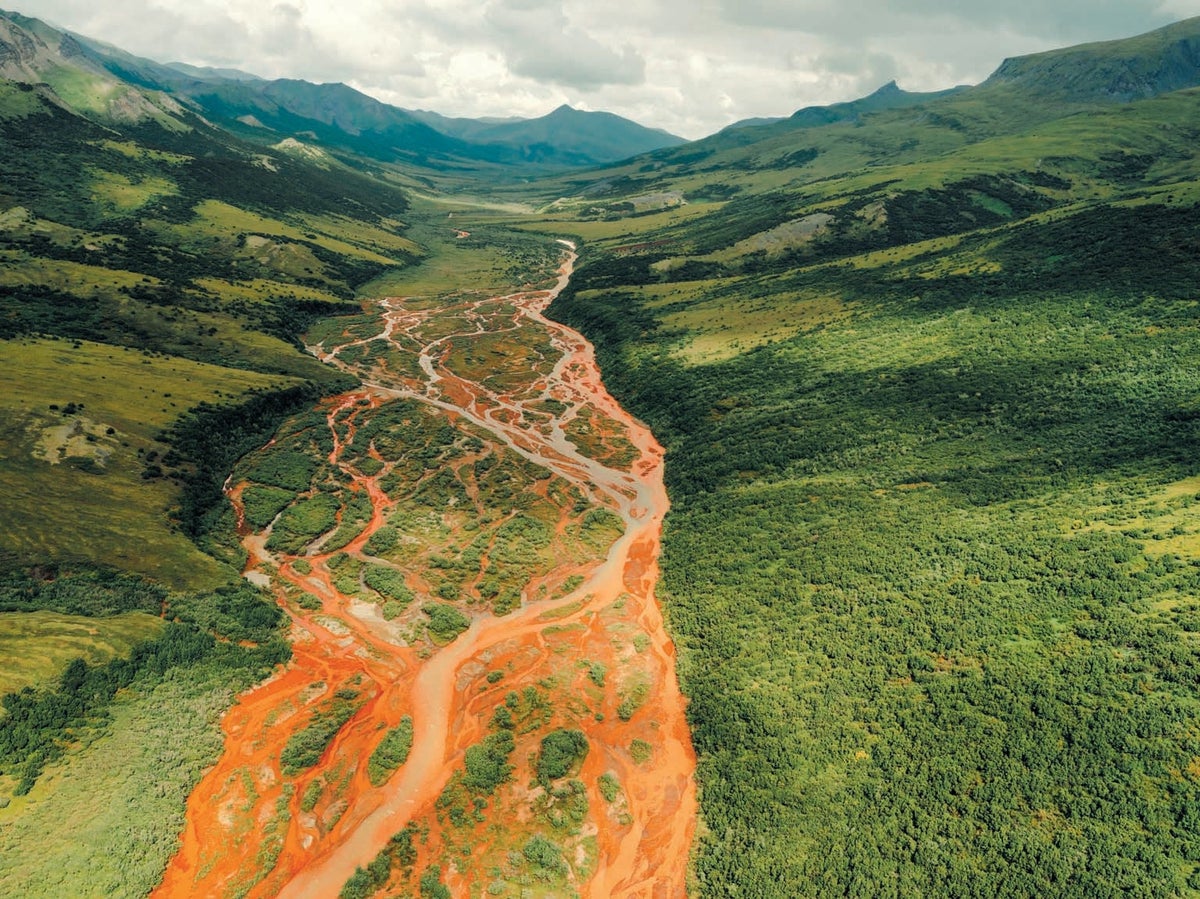
Why Are Alaska
Streams in Alaska are turning orange with iron and sulfuric acid. Scientists are trying to figure out why
Scientific American
117 points · by maciekmm · 2y ago · 75 comments
___
After reading:
> "Scientists who have studied these rusting rivers agree that the ultimate cause is climate change. Kobuk Valley National Park has warmed by 2.4 degrees Celsius (4.32 degrees Fahrenheit) since 2006 and could get another 10.2 degrees C hotter by 2100, a greater increase than projected for any other national park. The heat may already have begun to thaw 40 percent of the park's permafrost"
> "Some researchers think acid from minerals is leaching iron out of bedrock that has been exposed to water for the first time in millennia. Others think bacteria are mobilizing iron from the soil in thawing wetlands."
___
Other thoughts: iron bearing silicates often contain gold. New gold rush?
-
Things like this have surely happened before but not while there were so many people around
Extinctions have happened before too, but that doesn't make them good
Could a significant amount of gold be extracted from the water that way? It would likely be a much more environmentally friendly way to mine gold given that there would be no digging required.
That's the sci-fi dream: all the elements you could want end up dissolved in varying amounts in seawater. It's unfortunately a hard engineering problem.
Yes, it is causing this. And many more things in those regions and all the world, for more time than a single framed picture.
Further, right under the image at the top of the article: "Tukpahlearik Creek in northwestern Alaska's Brooks Range runs bright orange where permafrost is thawing".
It doesn't help climate's cause to be hysterical without actually reading things you want to critique.
Heck, I live 2000 miles south now, and we can see our local glacier retreating yearly with our own eyes. Also it's raining today. In the middle of winter. Not good.
> Scientists who have studied these rusting rivers agree that the ultimate cause is climate change. Kobuk Valley National Park has warmed by 2.4 degrees Celsius (4.32 degrees Fahrenheit) since 2006 and could get another 10.2 degrees C hotter by 2100, a greater increase than projected for any other national park. The heat may already have begun to thaw 40 percent of the park's permafrost, the layer of earth just under the topsoil that normally remains frozen year-round. McPhee wanted to protect the Salmon River because humans had “not yet begun to change it.” Now, less than 50 years later, we have done just that. The last great wilderness in America, which by law is supposed to be “untrammeled by man,” is being trammeled from afar by our global emissions.
Oh wait.
Sea levels have risen more than present levels in prior interglacial periods too, but that's another related catastrophe.
Second, and most fatally, yes there was a lot of vegetation there. There was also a time when there were plants on the antarctic. The sea levels were 20 meter higher back then, which may give you a clue it could be a slight problem, as you yourself indicate.
There were mass extinction events before. Natural or not, some people might say they would feel humankind going extinct or almost so is exactly what a catastrophe is, pointing out something similar has happened before doesn't make it any better.
So no, the narrative doesn't fall apart. Furthermore, it is not a narrative in the first place, it is a risk assesment based on scientific understanding. There is no drama, just facts and theories. The hand-wavy 'it is all natural thus its good because we live in a just world and that magically makes everything okay and eco-logical and stuff', now that is a narrative.
Time scales are huge, 1 year is different than 100 years than 100000 years than 1 million years.. what's "new" is very relative, come on.
You really want to still state today that global warming (to what permafrost thawing relates) is a narrative?
> Sea levels have risen more than present levels in prior interglacial periods too, but that's another related catastrophe.
Why you mean not? Does it matter if at that time fewer than 100 millions of humans inhabitated earth, and now we have billions.. and more than the number above will be threatened by sea level rise?
quelle surprise
Seems obvious now, doesn't it.
It made me re-think our whole approach to environmentalism. When we attempt to restore something, what are we restoring it to?
There absolutely are equilibria in nature, all over the place. The idea of that "constant imbalance" is always the rule is simply false.
Now, as a rule at some point in time either an external force will interrupt things, or an energy source that was maintaining the equilibrium will run out. So no equilibrium will last indefinitely.
But an equilibrium can be maintained for an awfully long time -- much, much, much longer than you or I will be alive. It's not like populations are always either growing or shrinking. Absent man, they're generally extremely constant (allowing for seasonal oscillations and similar).
And to answer your question: when we seek to restore something, it's generally to as close as we can to the state of equilibirum it would be at without the industrial effects of man -- a level of rich biodiversity. We're almost never completely successful, but we can still do our best.
Its amazing to me that so many ancient civiliaations had an understanding of cycles many thousands of years long, and understood that things change in cycles, as opposed to linear....
Take, for example the Pyramid of Ku at Chichenitza...
I went there in 2001 with a Mayan Elder named Hunbatz Men [0] -- He explained the nature of the Pyramid as the calendar:
The pyramid is broken into a number of architectural elements that define various aspects of the solar calendar: the indentations on the sides of the steps of the pyramid are divided to reflect the year, the levels represent divisional seasons, the steps inside the pyramid leading to the top is 72 and it represents the 72,000 year cycle of the plieades over head - the graduations in the face of the steps of the pyramid are the 28 days of their 13 month year. The top of the pyramid is the correct height that when you look down the groove on the top cube, they align perfectly to the horizon in all directions - and a bunch of of ther aspects of time tracking. Its an amazing celestial clock.
https://www.council-of-world-elders.de/en/members/hunbatz-me...
And then there are humans, always against change ;) But some is reasonable, e.g. when life threatening conditions change. I step out of my house in freezing temperatures, if I don't do something I'll freeze.. I don't start philosophizing about where to restore it to, just wanna be safe and warm again.
I don't get all the clever insights. Environmentalism is already such a stupid term imo, this is not about saving the environment at all, or trying to keep the world the same. It is just human warranted egoism, about saving us.
Holy shit. 10°C is currently the difference between NY and DC, or Ohio and the Gulf of Mexico, or Montana and Southern California...