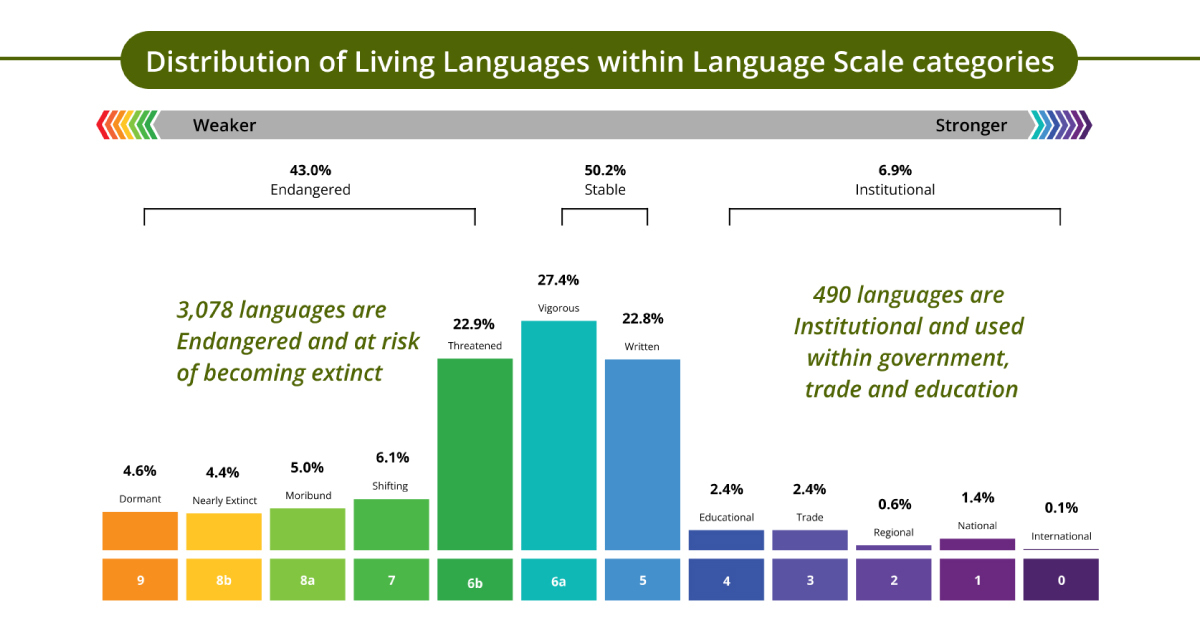
The State of the World's 7,168 Living Languages
Today, 43% of the world's living languages are endangered. This graphic shows the state of all living languages around the world.
Visual Capitalist
29 points · by jerryjerryjerry · 2y ago · 21 comments
additionally, books and written word doesn’t always equate to having saved knowledge. think about the tribe and kin concepts in many indigenous languages. entire ways of life can be lost. we know a lot from our europe’s ancestral indo-europeans lived from the reconstructions of proto-indo-european by way of the modern languages and written history but there is so much we do not know that is just lost.
Sure, things are lost, but were they valuable other than to students of history?
I detest this line of thinking because it assigns more worth to things that yield immediate results, or places a low importance on the impact of history.
Were Fermat's theorems valuable only to students of Mathematics, or did they inspire some of the greatest minds to later push the envelope in many unrelated fields?
Computing technology has a big part to play in this. It's still a huge pain to use RTL languages in many places. Bidi text is even worse. Keyboards, character sets and what not are still not standardized.
i agree, though, that computing could be sooo great for these languages if we moved past weatern paradigms
As more and more people from within different communities interact, the value of a common language increases and the value of the isolated language decreases.
The eventual equilibrium is going to be maybe 3 languages left, with each individual in the world able to speak at least 2 of them.
Any effort expended on keeping languages alive is pointless.
Pointless ultimately, maybe. But languages can even be revived from nothing to have millions of native speakers, see Hebrew.
But, it's a lot of effort and energy expended: https://en.wikipedia.org/wiki/Hebrew_language#Current_status
> The Haifa municipality has banned officials from using English words in official documents, and is fighting to stop businesses from using only English signs to market their services.[85] In 2012, a Knesset bill for the preservation of the Hebrew language was proposed, which includes the stipulation that all signage in Israel must first and foremost be in Hebrew, as with all speeches by Israeli officials abroad. The bill's author, MK Akram Hasson, stated that the bill was proposed as a response to Hebrew "losing its prestige" and children incorporating more English words into their vocabulary.[86]
With enough energy (time, money and influence), you can revive any language, even dead ones.
You can do that, and you can continue expending more effort into making sure it doesn't decline again, but eventually whatever is popular globally is going to dominate, even in the face of legislative actions that force the use of the language. Each generation will have less and less use (outside of forced use) for the non-popular language.
Even though Latin is extensively legislated for use in Law, and used popularly in the Sciences, it still died.
Arabic probably makes up 1/3 of those "7,168" languages.
I think the claim that there are "7,168" languages is a result of publish-or-perish.