113 points · by beardyw · 2y ago · 135 comments
They don't seem to get the nuance of the situation and can only see it in terms of black and white and following "the rules". I've personally seen this behavior a lot in the amateur radio community, where people were harassed or threatened for breaking some minor rule.
You should see what hooligans in Belarus and Russia get up to, now that is a legitimate problem:
I strongly disagree. Many jurisdictions call it theft to tap off electricity, even though no electrons are taken (https://en.wikipedia.org/wiki/Electricity_theft, https://www.ojp.gov/ncjrs/virtual-library/abstracts/power-th...)
I would think that using a transformer so that one need not physically connect a wire wouldn’t necessarily change that (it would if the law in question mentions that connection a conductor is needed)
This is a sort of transformer (a very bad one, but still one), so I think many jurisdictions still would call it stealing. Whether they would think it worthy of prosecution is a different question.
Stealing a grape from the supermarket vs robbing a supermarket of all its fruit and veg. There's bigger fish to fry and the world doesn't have enough time and resources to go after or worry about such things.
I suppose that one angle is not that one person is extracting a very small amount, it is that if you allow it then everyone can do the same.
When the punishment far exceeds the loss caused by the "crime" then it is absolutely unfair, it undermines the rule of law itself.
Just being arrested over it could be considered punishment itself. Especially if it's a young person who gets into trouble, it is traumatic for them. It is also sending the message that the system itself is unjust, and he/she might not think twice before committing a real crime, e.g. real theft or fraud when he/she grows up.
What about punishment as a deterrent? People can commit a crime many times and only get caught once. Should they be punished only up to the cost of the one crime they were caught doing?
love those crazy russian youtubers, they're always so reckless... they're fun to watch from a safe distance
In the case of piracy, the original owner still has their property. So I’m sorry but “theft” is simply the wrong word. The original owner is not deprived of their data.
In the case of the fence however, the original owner is indeed deprived of some modicum of energy. The energy is indeed *taken*, or removed from the original owner. Thus I do consider this “theft”. It’s also true that it’s a trivial amount.
Well, there is this cool physics/art installation of 1301 fluorescent tubes being lit by high-voltage lines [0].
There is the story I heard about early in the history of long-distance high-tension lines someone building an inductive coil to harvest electricity, and getting convicted of theft, which seem legit, since it is coupling with the lines and pulling more power than the grasses & ground would pull. There are also various references available online to cases, but the readily available ones don't seem to link to any court case (e.g., [1]).
I saw some back-of-the-envelope calculations about it being on the scale of 25 millivolts/mile, so you'd need quite a coil to get anything more useful than powering a bulb. Anyone with better calculations or actual measurements?
[0] https://jimonlight.com/2009/03/01/field-by-richard-box/
[1] https://skeptics.stackexchange.com/questions/23799/has-anyon...
For anyone wondering, it redirects to ```https://ak.oneegrou.net/4/6521518```, which seems to be flagged as adware. Tested and the page got blocked on Firefox for Android
The load in question here is an inductive load, coupled through the air to the transmission line through well known physical principles.
If caught, you could be charged with theft for sure.
This is regardless of what people are doing or not doing in Belarus or Russia.
If that was running all year round it would consume 0.6kWh of electricity, which is probably capacitive losses to the surroundings and would be lost anyway.
If it ever got to court, it would be thrown out instantly.
This is the same mentality behind thousands of bullshit complaints to the FCC by radio amateurs because someone broke a petty rule somewhere, and it's why I want nothing to do with the amateur radio hobby at all. The vast majority of them the FCC ignores.
edit: Someone posted https://skeptics.stackexchange.com/questions/23799/has-anyon... a bit down with the following comment that highlights this quite well.
>At least here in germany, it is unclear whether "stealing" via induction is really stealing, the corresponding law explicitly states that a conductor is necessary. There have been lots of urban myths about it being forbidden, but the fact is that near lots of high power mid wave radio stations you automatically "steal" lots of power, e.g. just by having a neon tube installed in the "correct" direction.
I’m not saying this is stealing, but it’s certainly not “harvesting loss”.
https://www.bbc.co.uk/news/magazine-13037808
A woman has admitted handling stolen goods after being accused of taking potato waffles, pies, and 100 packets of ham from a bin outside of a Tesco Express in Essex. But if something is thrown away, when is it illegal to take it?
https://www.bbc.com/news/business-53724620
Getting all your cardboard recycled may often seem like a pain, but there is big money to be made from all this so-called "beige gold". And sadly this is attracting criminals around the world.
Thieves are making a fortune from stealing used cardboard that's been left out to be recycled, and selling it on. This means that legitimate recycling firms, and the city and other local authorities who take a cut from their sales, are missing out on tens of millions.
2. Its a tiny amount of power
Both can be true. Taking a single grape at the supermarket is illegal but no one would arrest you for it.
Petty crime can have serious consequences regardless. In Germany we had a famous case, where a supermarket cashier redeemed a deposit receipt worth 1.30 EUR a customer had forgotten.
She was let go without notice for that and only got her job back after fighting through three instances. Only the highest court found the termination disproportionate and only because she had been working this job for 31 years.There was never a debate if this was stealing or not, just if the termination proportionate .
If every customer slurped one grape, eventually there would be no grapes. Death by a thousand paper cuts and tragedy of the commons.
https://www.whitehouse.gov/briefing-room/blog/2022/10/26/the...
And those are just the ones that are so obvious the POTUS needed to make a statement.
Corporations steal trillions through dark patterns, intentiona obfuscation, mailicious marketing, price fixing, collusion, fraud etc.
Every piece of personal data shared between every online entity I have no relation to, or awareness of - is stealing from me.
stealing, in this case is a broad, vulgar term.
If you don't like stealing - then you wont get any place in successful business it would seem, based on the observable, documented, litigated and governmental precedents throughout history.
The correct answer is that this is a contract dispute, not a state or federal dispute.
The electrical company leases a right of way for the lines across private property. There's a contract in place for that lease.
Does that contract have anything to the effect of "property owner will guarantee a stable, non-interfering electromagnetic environment in this right of way"?
Peter Gibbons: Ah no, you don't understand. It's very complicated. It's, uh, it's aggregate, so I'm talking about fractions of a penny here. And over time they add up to a lot.
If there's deliberate high powered jamming going on, it's a completely different matter.
You should ask a lawyer. /s
Never heard of them again, so I guess in the long run it was either cheaper to buy that data.
This data is quite valuable. You can reconstruct exact time (and region) when any video was taken.
https://en.wikipedia.org/wiki/Electrical_network_frequency_a...
Gets turned into an art project now and then: https://www.bbc.co.uk/bristol/content/madeinbristol/2004/02/...
If the current is indeed enough to cause the tube to glow, touching the air-end of the tube with your finger will increase the coupling with the overhead lines (you're salt water - good conductor) and the brightness will increase. Personally, I don't like to walk under HV power lines. I know it's safe. And yet, so very unsettling to think of the sea of power being waded through.
http://www.infoniac.com/environment/artist-created-network-o...
This exam question is based on a news story about a farmer using a coil of wire to power his farm.
https://users.physics.unc.edu/~deardorf/phys25/rwp/exam1rwps...
There may be no physical contact but induction still causes energy to be extracted from the line.
https://www.newscientist.com/article/dn7460-large-study-link...
Some sort of electrostatic attraction of pollutants is another idea that gets floated.
Your cellphone transmits at 1 watt and you put that at a distance of zero from your brain and reproductive organs.
If you are worrying about power lines you should worry about cell phones too
Now the disadvantages: most electrical equipment and the human body are not build to function in a continous (as in always present) electromagnetic field.
They literally are. The Earth has a continuous magnetic field, and has done for the entire history of the human race
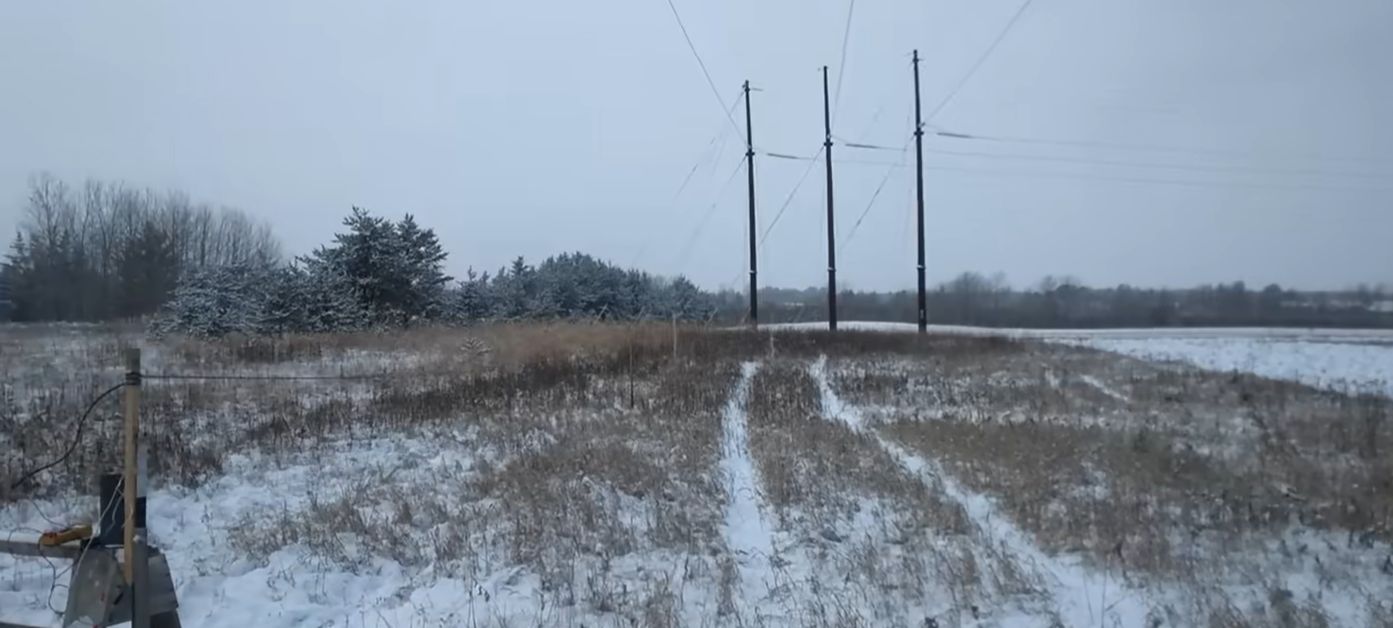
There's stories of farmers building coils to harvest power from powerlines to run their house or barn, but I'd be surprised if they were true unless the coils were built very close to the powerline.
https://www.industrytap.com/electromagnetic-harvesters-free-...
Some insights:
- The peak DC voltage seems to be around 1.15 kV.
- The time constant is around 440 s. If you were to assume a simple RC-circuit with a constant voltage source (which it probably isnt), you would end at around 100 Ohm for the resistor.
- The start of the charging curve is not at the same time as in the video indicating that some voltage was already present from experiments before the video
Also, I am pretty sure it is not inductive coupling but capacitive because of several reasons:
- It doesn't look like a coax cable but more like an ordinary thick wire.
- I am pretty sure he didn't ground the cable at the far end and thus did not create a loop necessary for induction. And if he were, inductive coupling with ground in between would result in a very large voltage drop - If it were inductive: A single loop covering that little area would need way more turns than just one.
tl;dr
Electricity kills all bugs and insects good and bad, lowering pesticide use. They also increase water evaporation, forcing plants to grow faster.
I would NOT do this in my hometown.
Doing this kind of power harvesting off transmission lines is a standard Electric Power university course exam question for intro to transmission lines courses.
I'm feeling like the initial analogy fit the premise better.
From a physics perspective It's not the same thing at all: with the water sprinkler, the water is lost no matter what for your neighbors. But with the electric field, there's no power loss unless you tap into it.
To get back to your water sprinkler example, it's as if your neighbors' hosepipe got trough your garden to get to his sprinkler: you can argue that this is a environmental disturbance to your garden, but that doesn't allow you to take water from the hosepipe for your own use.
This is equivilant to throwing an extra belt over the shift to power your own machine.
There's only so much power available and as more and more machines are driven there's less and less ommph to power more.
This is literally adding "drag" to the overhead power line and decreasing what reaches the end point of transmission.
It's not equivilant to scooping up photons that were being thrown on the ground anyway.
Also this is taking. This isn't power the gris would have lost anyway, you're coupling it on purpose increasing the leakage
The grid provider, however, did loose something, namely they have to burn more fossil fuels to overcome the increased resistance on the line.
"Velemu says: There was one case in Finland in The 90s, where someone did this to power their summer cottage. When Power company found, where the extra parasitic load came from, they sued the guy to hell and back again. This kind of load is actually actively measured by Power companies, since it is also used to find other failure modes on powerlines, and is easy to detect. Just don’t do it…."
In far field (like typical radio broadcasts), there's no "coupling" between the transmitter and receiver so the former just radiates its power and cannot distinguish whether it's being received.
In near field (RFID etc.), there is a coupling and the transmitter can definitely tell whether a receiver is present and absorbing the power.
Thus, and IANAL either, but IMHO harvesting from the near field definitely seems more like stealing, while the far field doesn't; is it stealing to effectively recover "waste energy" that would otherwise just be dissipated uselessly, and wouldn't cause any measurable increase in consumption from the power company?
I want to try this and see if it could charge a battery.