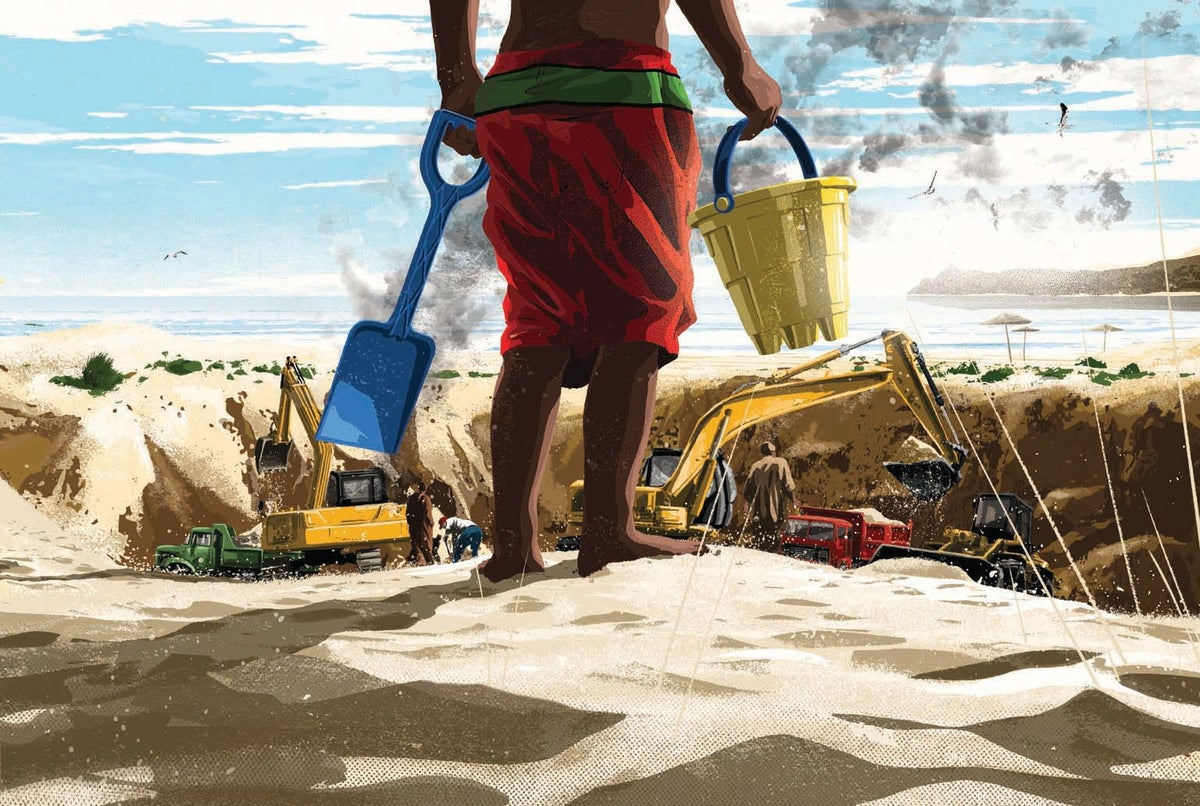
Inside the Crime Rings Trafficking Sand
Organized crime is mining sand from rivers and coasts to feed demand worldwide, ruining ecosystems and communities. Can it be stopped?
Scientific American
188 points · by PaulHoule · 2y ago · 111 comments
Everyday for decades, a young man rides his bicycle, with a 10 pound bag of sand in tow, across a national border. This draws the attention of customs nearly everyday and they search through the sand day after day and find nothing.
Many many years later one of the customs agents sees the man, and asks if he was actually smuggling something all that time?
The answer was: "Yes, I was smuggling -- bicycles."
https://www.imdb.com/title/tt15019036/ they made a movie about it
> The environmental impacts are substantial. Dredging rivers destroys estuaries and habitats and exacerbates flooding. Scraping coastal ecosystems churns up vegetation, soil and seabeds and disrupts marine life. In some countries, illegal mining makes up a large portion of the total activity, and its environmental impacts are often worse than those of legitimate operators, Beiser says, all to build cities on the cheap.
this sounds like a really hard problem to fix. i see there are researchers trying to estimate mining levels by counting ships[1], but even if we're able to get a heatmap of the problem, there'd need to be an enormous amount of cooperation between nations to certify sand provenance. damn.
https://eos.org/articles/satellites-spy-on-sand-mining-in-th...
It's much better to let Mother Nature crush the rocks through stream action. (Sort of hydroelectric, without the electric parts.) Your suggestion would only replace one environmental cost with a different one.
TANSTAAFL.
When I first read that my question was whether a different concrete formula or amalgam could work with smooth(er) sand, or if that's a hard limit that cannot be overcome. Does anyone know?
Strength of Cement - portland cement is typically used. Fire limestone to get lime, add fly ash and other additives for increased strength. Ratio of Water to Cement is important to get a complete reaction, but dont add too much water.
Aggregate - angular aggregates provide the cement something to stick to and distribute the stresses evenly. You want a well graded aggregate, including sand particles up to larger chunks of rock.
In my part of the world the aggregate is typically crushed limestone. Add clean sand for different mixes.
There are other chemical additives that will increase strength, workability, and the speed of cure.
Since reaction of water to cement is exothermic - on the really high tech monolithic pours they're using technology to carry away the waste heat. You want the whole mass to be at the same temperature to reduce the internal stresses.
There are actually spherical glass orbs you can add to your concrete if you want it light-weight. Floating concrete is a thing. This comes at the expense of strength.
is the ultimate example of a technology suppressed by regulatory capture.
You use tie in rods of rebar to bind one slab to another, not the aggregate because the aggregate does sh*t all for structural strength. It's more for the compressive strength.
Tbh you can make a form or concrete out of perlite and cement. It's light af, great for ship hulls when reinforced with steel. Still concrete,just doesn't need any sand.
And sandboxes for kids.
The landmass of Singapore itself has grown by 40% since the 60's through reclamation. There's always been lots of rumors about how the sand was sourced from neighboring countries.
So on the one hand it's an impending ecological disaster, and on the other its an economic catastrophe
Edit: it's one of the best scenes in Barry.
- https://www.imdb.com/title/tt7751636/
- https://cbselementary.fandom.com/wiki/Sand_Trap (best viewed with uBlock)
We export some types of sand from Florida to The Bahamas for use in concrete construction. We import other types of sand from The Bahamas to Florida for use in aquariums.
> The World in a Grain is the compelling true story of the hugely important and diminishing natural resource that grows more essential every day, and of the people who mine it, sell it, build with it--and sometimes, even kill for it. It's also a provocative examination of the serious human and environmental costs incurred by our dependence on sand, which has received little public attention. Not all sand is created equal: Some of the easiest sand to get to is the least useful. Award-winning journalist Vince Beiser delves deep into this world, taking readers on a journey across the globe, from the United States to remote corners of India, China, and Dubai to explain why sand is so crucial to modern life.
* https://www.goodreads.com/en/book/show/36950075
> The problem lies in the type of sand we are using. Desert sand is largely useless to us. The overwhelming bulk of the sand we harvest goes to make concrete, and for that purpose, desert sand grains are the wrong shape. Eroded by wind rather than water, they are too smooth and rounded to lock together to form stable concrete.
* https://www.bbc.com/future/article/20191108-why-the-world-is...
That sounds incredibly expensive.
One of the great virtues of modern concrete construction is that it's inexpensive compared to feasible alternatives.
I'll bring the glue, you bring the sand and we can glue the grains into more useful shapes.
Wow, that's all the article said about this? It's the crux of the matter.
Corrupt chinese construction projects may use cheaper coastal sand, resulting in so-called "Tofu-Dreg" buildings (豆腐渣工程) where the salt in the sand has corroded the rebar and the building just falls down. As I understand it, it's a major concern in China. Google for it.
They ship it in by sea on huge barges that are quite something to watch.
Not shipped in, pumped in: The source is less than a mile offshore, overlying a reef that supported lots of marine life, much of which is now being picked over by seagulls.
The hope is that friction and inertia will prevail for a few years against wave action and gravity. But, the project has its nose in the trough provided by the national and state taxpayers, and local politicians go along.
> tourism spend a lot of money on their beach sand
Not a factor in Solana Beach, the Chamber of Commerce is utterly supine on public policy issues. Rather, it's the owners of houses on the bluff top, where prices start in the high 7 digits, who drive beach policy: they all have, or want to construct, concrete armored seawalls. Like these:
https://www.google.com/maps/@32.9963108,-117.276439,3a,75y,8...
With an effectively unlimited legal budget to invent ways around the law and litigate against the Coastal Commission, and willingness to mob City Council meetings, incumbents keep their mouths shut. Local resistance has collapsed down to a few die-hards at environmentalist groups, e.g. https://sandiego.surfrider.org, fighting what amounts to a retreating action.
The city scoops up the sand off the boardwalk and loads it into trucks which take it a few miles away to Fiesta Island.
Why? Apparently it is contaminated badly enough by whatever is on the boardwalk, that they don't want to just push it back onto the beach (and back into the water).
Sargablocks[1] are one of the companies that are turning sargassum into cheap building materials
At an aggregate mine located in Brazil, the total expenses are $80-$160 per ton [1].
The price of sand at home depot is 5.96 for a 50lb bag, $238 per ton. My conclusion is you could make sand by grinding but it would cost 50%-100% more vs. digging up the beach.
[1] https://www.scielo.br/j/rem/a/8MW5dFZc5Vh6qMdnTqRKbfM#
Edit: Chat GPT thinks it would cost $62.25/per ton make sand from rocks.
Marginal increases in commodity price can greatly increase supply as previously uneconomic deposits/production methods suddenly become very viable.
And while some processes critically depend on concrete, others will get pushed to other non-concrete methods if price goes up.
https://www.tv20detroit.com/news/national/turning-recycled-g...
I don't think glass is appropriately pure for silicon - but that would probably be the only application for sand where it could possibly be economical to manufacture rather than extract and process.
Once you know what it is and how harmful it is to the ecosystem it’s hard to miss.
[1] https://static.scientificamerican.com/sciam/assets/Image/202...
The real world has always been this way. Minecraft is getting better and better at making dull real world activities fun.
There's a nation-wide real estate investment ponzi going on in China.
Literally building uninhabitable towers for the sole purpose of being a counterfeit "deliverable" of "real estate" as an "investment".
It's a financial markets regulatory problem, not a "we accidentally built too much useful real estate" problem.
https://www.newyorker.com/magazine/2017/05/29/the-world-is-r...
Also... Sand is expensive (in money and in environmental impact) to transport.
That's the epitome of dirt-y business!