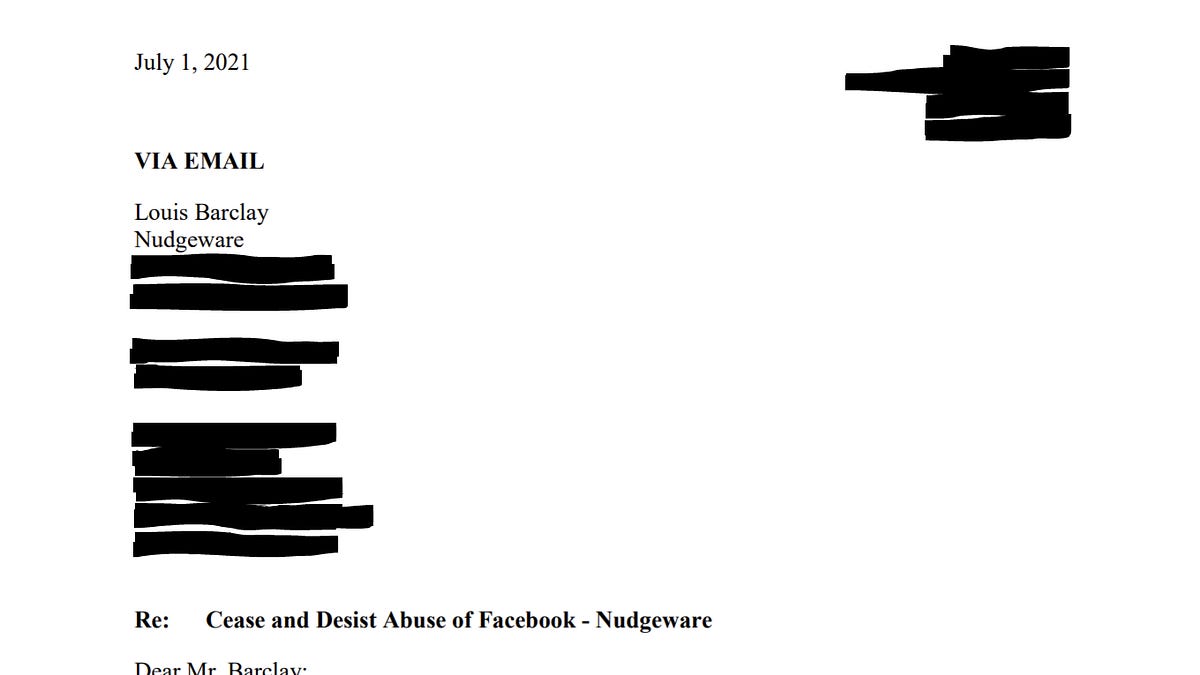
How to deal with receiving a cease-and-desist letter from Big Tech
Although this article isn’t related to any of the 12 Challenges so far, it’s on a subject I’m developing for a potential future challenge.
12challenges.substack.com
544 points · by louisbarclay · 2y ago · 202 comments
I am not a lawyer, but I've received several C&Ds for various things over the decades. The first one scared me to death. The second and subsequent ones did not, because I understood what they were: just the company saying "I don't like what you're doing".
When I receive a C&D, the first thing I do is talk to my attorney and go over what the C&D is complaining about. If I think I'm doing something that could be legally risky (which does not automatically mean doing something actually wrong), then I change that. Otherwise, my attorney acknowledges that the C&D was received and I ignore it. If they really have a serious beef with what I'm doing, they need to actually sue me. I have yet to be sued.
> Dealogic: A trusted partner to top financial firms worldwide
Oh well, I probably don't need to dig deeper to know what it does then.
- Google for creating a mention tracker I was distributing as a mac dashboard widget
- Netflix for creating a DVD barcode to Netflix queue ios app (they were trying to to antagonize their retail partners too much at the time apparently)
- Microsoft for abusing some of their early text to speech DLL's for a really crappy RSS to Audio "podcast" app (they were meant for server side telephony apps)
- LinkedIn + Salesforce for linking their data with a Chrome extension
- Hubspot for mentioning their Inbound conference and saying that my software worked with theirs
Thinking back now these are all quite old, I don't know if the companies have become more lenient or I've become more cautious.
That one was so ridiculous that I didn't consult my attorney at all about it. I just told the company to sue me. I never heard from them again.
Just for clarification, do you mean soiling your underwear or dealing with a C&D?
"We will pay you $10000 if you C&D" seems like pennies to them, much less than the cost of legal fees, a nice amount of cash for a personal project that hasn't monetized yet.
Or a job
"We will give you a job offer to work on X if you C&D your own work on X"
also seems like a great strategy. If someone has already demonstrated enough talent to be a threat to your company, it seems like it would make full sense to try to hire them.
I'm honestly surprised this doesn't happen more in the gaming industry with companies buying big name mods and hiring the mod writers.
I know a lot of mod writers would probably be opposed because they actually just want to make free stuff, but some would probably launch careers off of it.
That would be incentivizing bad behavior!
There is already a reward — they’re giving you a chance to fix their problem for free before they take you to court and sue you for damages.
----
Offering payment to an individual or entity to cease an activity they should not be engaging in can introduce several disadvantages and potential legal complexities compared to a standard cease and desist letter. Here are some considerations:
- Precedent for Payment: Offering payment for the cessation of an infringing activity could set an unwanted precedent. It suggests that compliance with the law is negotiable and can be bought, potentially encouraging the same or other parties to infringe in the future with the expectation of receiving payment to stop.
- Admission of Weakness: Offering money might be interpreted as a sign that you are not confident in the legal strength of your claim. This could embolden the infringer or weaken your position in any subsequent legal proceedings.
- Contractual Obligation: If the other party accepts the offer, it creates a contractual agreement. If the infringer accepts the payment but continues the activity, or if there's a disagreement over whether the activity has ceased, you may have to engage in contract enforcement rather than straightforward infringement litigation, which could complicate matters.
- Tax and Financial Implications: The payment could have tax implications for both parties and might also affect the financial statements of a company if either party is a business.
- Mitigation of Harm: Paying the infringer doesn't address any harm that has already occurred. A cease and desist letter often includes demands for remedies or damages for past infringement, which would not typically be covered by a simple payment to stop the activity.
- Negotiation Power: Once you've put a monetary offer on the table, it can be difficult to withdraw or reduce that offer without weakening your negotiating position.
- Legal Interpretation: The offer of payment might be interpreted by the court as an acknowledgment that the infringed party is aware that their rights are not clear-cut or may even lack merit, thereby potentially undermining the legal basis for their claim.
- Public Perception: If the offer and its acceptance become public, it might be seen as a company or individual buying their way out of a legal dispute, which could affect public perception or brand reputation.
- Binding Effect: If the offer is accepted, the agreement may prevent you from pursuing legal action for any past infringement, depending on the terms of the agreement.
The first time I got a letter for a trademark issue it seemed completely hostile and threatening. My lawyer said, basically, that it was no big deal and that they were in fact being pretty nice. We answered back and everything was resolved amicably. It actually turned out well because it made me realize we had not been paying enough attention and were unthinkingly referencing other brands instead of our own.
    * get comfortable reading legal documents, this will allow you to have more
      intelligent conversations with your attorney
    * don't let your attorney make your business decisions, one of their jobs is to
      point out risks, one of your jobs (owner/ceo/leadership) is to figure out how
      to mitigate risk but that is not the same thing as avoiding all risks
* learn to draft legalese, it will help minimize your attorney's billable hoursMaybe it's cheaper to have one on retainer. How much per month, if like a normal citizen your only daily legal risks are random megacorporations threatening you?
Should everyone in the US have a lawyer on call? Should we consider it a normal tax for being a member of the US legal system? An insurance everyone signs up for like drivers insurance and life insurance? Is this only a concern for software developers?
If you are comfortable with legal documents; have a law dictionary to understand what specific language means; and read historical case law on the topic in question, you will be well prepared to have a seat at the table with your attorneys.
For any functioning system, ultimately a business owner will need to decide (formally and explicitly, or informally and implicitly) what risk they're willing to accept to proceed.
What you're saying I think is that you should be informed enough to have an intelligent conversation with your attorney, and be able to make decisions on what risk they point out you're willing to take, and/or how you can mitigate it without just avoiding/shutting down?
Another tip. Hire an attorney who will teach you how to do this effectively. A simple rule of thumb is to consult with an attorney when you don't understand something. A good attorney will walk you through the issue, explain the possible ramifications, and (most importantly!) show you the standard response(s). Next time you can do it yourself. Also, you'll ask more focused questions the next time a novel issue pops up on that topic. That also saves money.
In summary, think of your attorney as a mentor not a robot to provide legal advice.
Man I wish the leadership team at the last startup I did understood that. They were too chickenshit to do anything their lawyer cautioned them against, and as a result we took no risks and got nowhere.
They know more about how this stuff really works than you or I ever will, and you won't be able to judge what risk you're really taking without that knowledge.
But, if I were operating "without a net" like that (which I would never do!), and I really felt that the C&D was about something I wasn't doing wrong, I'd be inclined to ignore it. There's chance that you'll end up being sued, though, so you should be prepared for that possibility. That means you'll need an attorney anyway, and it will cost more than consulting one about a C&D to begin with.
That's really the key. I used to work for a very small company that happened to have an attorney as one of the owners (there were a lot of cooks in that particular kitchen!). One day he came to me with a letter from a large RAM manufacturer demanding payment for a license on some technology I don't even remember. His only question was "do we use anything they make as far as you know?"
"Nope."
"OK. It's just a fishing expedition." Balls up the letter, throws in the trash and walks away.
Now whether it's a good idea to sue without an attorney, I have no idea. I genuinely don't.
A C&D costs the sender almost nothing and is not the same as actually being sued. Very rarely are they serious enough to actually file something. If that does happen you should get a lawyer at that point, but doing it before is just a waste of money.
The poster you are responding to just explained that most lawyers are too guarded to offer a useful evaluation of the risk, thus rendering their advice useless or low value.
A couple years later that section had legal consequences almost derailed a major transaction involving our company. We could have avoided the whole thing by checking with our lawyer first. Moral of the story: never sign any legal document you don't understand.
Remember that they probably have a list of hundreds or thousands of C&D's to send, and if you don't respond they would probably need to file a john doe lawsuit to get your identity from your ISP, and it's unlikely that all that effort is worth it to them.
Either way, my recommendation would be to find an attorney with industry-specific expertise to address the norms of your industry. C&Ds range from idle shake downs to definite pre-cursors to litigation. Without industry-specific knowledge, it’s hard to know which is which.
e.g. was just chatting with a fellow cease-and-desist receiver, Mohammed Shah, who finds comfort in using a different misspelling for the name of the lawyer harassing him, every time he replies
Great for morale
> The magazine often deliberately misspells the names of certain organisations, such as "Crapita" for the outsourcing company Capita, "Carter-Fuck" for the law firm Carter-Ruck, and "The Grauniad" for The Guardian (the latter a reference to the newspaper's frequent typos in its days as The Manchester Guardian). Certain individuals may be referred to by another name, for example, Piers Morgan as "Piers Moron", Richard Branson as "Beardie", Rupert Murdoch as the "Dirty Digger", and Queen Elizabeth II and King Charles III as "Brenda" and "Brian", respectively.[0]
> It doesn’t matter if you’re right. It matters if you have money, time, and willpower to go to court
There are some exceptions to this, but for probably 99% of cases, this is true
I’ve personally been on the receiving end of a litigious situation, facing a very wealthy individual. It did not go well for me, and had to swallow my pride/ego. This last bit might be the hardest thing to do
It is one thing to rationally know that the world is not fair. But when it happens to you, oh man, it’s not easy at all to take it
But one thing I don't understand every time there's a C&D story is why leave a paper trail to send the C&D to in the first place if doing something in a gray area? If I was creating some piece of software that is designed to give the middle finger to the man or facebook or whoever and/or benefit the public, I would just release the source anonymously on some random forum and it can't be stopped. Why create an official github repo with your real email and everything just to take credit?
To clarify, I mean cases like youtube vanced or the recent valve/nintendo portal mod issue, where its obvious some company might not like it, but I don't see why the projects couldn't have continued anyway if the authors didn't expose themselves to litigation. Or am I being naive about this?
People who get C&Ds must want to be known.
Many of the C&Ds came from people who were later indicted for defrauding the government, some of them in hilariously inept ways.
1. https://www.sba.gov/funding-programs/loans/covid-19-relief-o...
Honestly I wish I had used the LLC that I actually own to do the same thing. When the system is designed to promote cheating...
Maybe schooling could help with that.
100%.
I have a side hustle doing etching, engraving, and CNC-type things. The forums and groups for this kind of things are teeming with people who not just believe, but tell others, that copyright and trademark either don't apply to them for $reasons or doesn't even exist for things they found for "free" on the internet.
There's a reason why it takes several years of education and testing to become an attorney.
I’m not a lawyer, let alone a European lawyer, but I’ve heard that the drain-their-bankroll-with-spurious-motions technique that’s beloved by shithead corporations and their attorneys when they have no case isn’t practicable in most European jurisdictions. This is because even at the motion filing level, loser pays. So drowning you in garbage motions just gives your lawyer an easy payday.
Odds of the US adopting that system?
In general, not without a major change in the US attitude toward how businesses should be regulated and how individual rights protected to be more like Europe. I'll elaborate in a bit.
In specific areas of law the prevailing party can win attorney fees, but offhand I can't recall any areas where it is mandatory. It's up to the court to decide. Whether that is easy or hard depends on the area of law.
For example in patent law the statue says attorney fees can be awarded in exceptional cases, whereas in copyright law the statute just says it is at the discretion of the court.
The problem with making loser pays apply in general in US civil suits is that the US often relies on civil suits brought by individuals to enforce rights and regulations that in Europe would be enforced by a government agency.
Loser pays could discourage individuals from bringing such suits against larger more wealthy entities because a case is almost never completely open and shut.
(It would probably be impossible to weave a statute that prevents this kind of bullying while also enabling legitimate uses of C&D letters. So this is entirely fantasy.)
[1]: https://en.wikipedia.org/wiki/Strategic_lawsuit_against_publ...
I had written a small shareware app called JazAwake. It was designed to stop the Iomega Jaz drive from spinning down every two minutes or so.
They did not know who I was but the stakes were instantly very high. If they filed a suit, they would uncover my identity, realize I worked for them, and terminate my employment.
To make matters worse, I was relatively sure the demands were impossible to meet. They requested I stop distributing the program AND remove all traces of it from the internet.
Similar to the linked article, I spent 9-months responding to demand letters. To my own surprise, I was eventually successful in removing it from the internet. I had to send my own demand letters (which were nicer) to every website owner who mentioned or linked to a copy of the app.
Looking back, these companies can send these things out for no cost, looking for you to mess up by replying. If they want to sue you, don't worry, it will happen.
As my attorney once opined: if they really want to sue you, the first thing you'll hear from them will be about the lawsuit they filed, not a C&D.
Usually the terms of service you sign up to make it clear which jurisdiction disputes would be adjudicated in
For me, as a UK citizen/resident it was Ireland. Which is great since I've never been there, but I've heard their courtrooms are lovely in the springtime
It is certainly true that anyone can respond to a C&D letter. But whether you can do so without doing more harm than good is another question.
1. Ignore the letter: not recommended, as that will likely end in a lawsuit that you'll probably lose.
2. Comply: maybe not with everything (like if they ask you to do ridiculous things like give them a look at your finances), but at least stop doing what you're doing that triggered the whole thing in the first place.
3. Engage a lawyer and fight: but you're probably going to lose, unless you're independently wealthy, and/or can rally some legal-aid services that specialize in digital rights, as well as journalists and other powerful entities to help you.
And in all cases, if it's an entity like Meta, they've likely already disabled your existing accounts and banned you, and you'll never get them back.
Ask an attorney to know for sure, but if they have no case and are just being bullies, don't cave in.
That's dangerous advice, if you have anything to lose, and the C&D isn't obviously complete nonsense. Your adversary's lawyer may have causes of action that he chooses not to disclose just now.
1) Good problem to have. 2) If they had something, they wouldn't threaten you, they'd just act.
It's the risk/reward ratio. Unless it's worth reacting to, file 13 that shit.
So I wouldn't see a C&D as a guaranteed sign that they aren't willing to sue, but the threshold for "want you to stop and are willing to sue for it" is much, much, MUCH higher than the threshold for "eh, I'll send a C&D and see if this makes it go away, if not, not worth it".
It can scary to receive one, but once you unwind what the accusing party has to gain from it, you realize it has as much teeth as a tweet.
outside of official APIs or services
If they really want you to stop, e.g. because you're putting their core business at risk, they might consider it, of course. But they won't do it for random bullshit. They do have infinite resources to crush you - but even they don't have enough resources to do it to everyone who ignores their C&D.
Also, I would expect the likelihood of getting sued (by a company that's acting rationally - small businesses where you've personally pissed off the owner can be different) depends on whether they can achieve their goal. If for example their goal is to keep you from publishing details about a security vulnerability and public embarrassment, the motivation to sue you is likely to go down once the vulnerability is public and their behavior has been reported in the tech press, and continuing to press it will just continue to the Streisand effect.
This is why we need some version of Loser Pays law... Especially when there is a huge resource imbalance like a FB suing a lone dev.
A C&D letter? Nah, you're 100% safe (legally) to throw that in the garbage.
Of course, there's always a possibility that the party sending it follows through on the at-least-implicit threat of litigation.
Fortunately, I didn't need the domain, since I didn't want this headache or expense. (The domain name was a pun on "Orkut", intended for a site critiquing the emerging ridiculous influencer behavior, and I'd guess it was protected speech, but I never got around to making the site.)
But the experience didn't seem very Googley to me, so I initiated a domain name transfer to the Stanford email address of one of their founders, then told the nastygram people, so maybe they could have a talk about "Don't Be Evil".
They sent the C&D to my employer which made everything much more complex. I usually would have ignored it, but my employer's legal department was on my back about it, so I renamed the project to bitstring. For years my project was still top of Google search for "bitmatch". (I tried it now and I notice it's a different, Rust project, so the guy still didn't win in the end.)
I would love to get a lawyer's take on that, although I guess it would differ by jurisdiction - California and Ireland are probably the two key ones for most big tech
I don't do anything that could even be perceived as antagonistic towards Facebook. But I imagine it's something I could do. I don't have a Facebook account so I don't care if I get banned. But I do use WhatsApp. I could live just fine without it. but would/could a ban include a ban from Whatsapp? I guess I naively assume they don't know enough from my WhatsApp usage to link it to my identity. But of course a phone number is as close unique identity as they come.
Basically take everything you know about Julian Assange and combine it with Christopher Nolan's Batman movies.
Thank god for crypto.
[Indymedia was an open news collective, with a strong anarchist-socialist leaning]
Our "collective" had no formal membership, and no assets. We were all just volunteers who valued the platform and did some work to help out. These emails were always addressed to "To Whom It May Concern". Pseudonymity was the norm in Indymedia, and I was completely ignorant about the IRL identity of most colleagues that preferred to be pseudonymous.
They'd usually be complaining about Indymedia reports of the activities of some small businessman, often a builder. It would often be part of a campaign, i.e. there would be more than one article, by different people. So we'd collate the articles, and do web-searches; if the complaint appeared to refer to something potentially libellous; or involved some crime like inciting violence; or violated our posting T&C, like trolling, conspiraloon, or agent-provocateur, then we'd hide the article or comment; otherwise the site would have been deluged in spam. Hidden articles and comments didn't appear in lists. We had no one-button method for removing an article completely, we had to blank the article in the database. We even published a link to a page where you could view all articles and comments; none of these C&Ds ever referred to a hidden article.
We never replied to any of these C&Ds. We (or I) never hid an article or comment as the result of reading a C&D; I never thought the C&D had any merit. We took the "Ignore" route, and never suffered any adverse consequences; not even follow-ups.
So I don't share the author's opinion that you should never adopt the Ignore route. Perhaps we got lucky, but I'd have taken these messages more seriously if they had named me.
FTR, IANAL.
Louis has been on the frontlines of this unjustly lonely battle against big evil megacorps (META specifically) for the last few years.
If any lawyers are here that care about digital rights as coders then please reach out to louis because a coalition is needed to fight against C&Ds against independent, OSS, interop developers and their users.
Thank you Louis for writing this, I wish I saw this last year before nuking my OSS project out of an abundance of abject fear that this $800bn megacorp could ruin my life for what amounts to pocket change. This experience still hurts till this day.
RIP & Long Live Aaron Swartz