440 points · by pseudolus · 2y ago · 173 comments
Keys will often ring in the ultrasonic and poorly mimic the frequencies that a lot of bats use.
If you have a population of bats that hunt near you, the bugs will typically just drop. Like, just drop to the ground as fast as they can.
They know the sound of hunting bats and your keys may be just close enough to that sound that they think they're being hunted. So they do the best that they can to get out of the way and go with gravity. At least, that's my theory.
Fun little thing to do as a bet or with the kiddos.
Might be an urban myth, though it seems like it might just work.
At least I'm more scared of rabies than any government fine. By the time you know something is wrong, you're already a corpse that's about to remember to stop moving.
John said, “Listen, you can hear the jammer.” The what? “The jammer,” he said, “Watch the moths.” It turns out the moths, through evolution, had developed their own electronic countermeasures to jam the bat radar.
https://steveblank.com/2009/03/23/if-i-told-you-i%e2%80%99d-...
"If you peel a banana, take a bite off the top, and then poke your index finger in to the middle of it, it will split in to perfect thirds".
Upon trying this, I discovered it was not true, and my friend just wanted to see me stick my finger in a banana...
It's still technically possible it's a hoax but, boy, that's a lot of effort to provide fake content to support the hoax.
All this time I thought this was him being silly!
(For the record, the banana did NOT split nicely)
I'm still going to shake my keys at the next swarm I passby.
At one point for unrelated reasons I replaced light fixture in my room with more than 200W worth of strongest E27 Philips LED lightbulbs I could find (20*1521lumen).
Few flies gathered in the middle of the room as usual during the summer day. Then I turned on this light just out of curiosity. The flies dispersed within seconds, suddenly perfectly capable of not flying in circles. I don't think it was the heat or the discomfortably bright light just scaring them off. Even this amount wasn't as bright as sunny day. I think more light and more distributed light (not just comming from the direction of the window) fixed their navigational abilities somehow.
I speculate that the flies rely on a phenomenon called "optic flow" for navigating around obstacles. Basically the rate of feature movement perceived on each side of their head/compound eyes determines proximity to objects. Their vision is very blurred, so features need to be quite large, or at least contrasting. If you have a dimly lit room, with white walls, the whole space will appear mostly featureless to the fly, until they get close enough to the wall, and thus fly around in circles.
Perhaps they also use a fixed contrasting object as a reference point, like the light fixture (turned off) and return to it if they veer off too far into the "featureless void". If you turn on the light, the perceived illumination in the space is inverted. The light makes previously invisible objects around the room more contrasting for them to navigate about and to fly closer, even land.
I see this mostly with one particular type of fly that just loves going around light fixtures, maybe they're sensitive to the EM spectrum rather than visible light?
I don't think those circles are exactly perpendicular to the vertical direction. I think most of them are skewed.
I think it might be what other commenters are pointing out. That flies consider the brightest direction to be the sky, but if it's to the side (with respect to gravity) it messes up their navigation.
> Insects use the moon as a celestial compass cue to navigate, and mistakenly use artificial light sources instead
The paper states that it is the general brightness of the sky, even at night, compared to the ground that is the point of reference. So insect point top side at diffuse bright area and bottom side will be parallel to ground.
Might also explain why they don’t go directly to the light but eventually end up there circling it erratically, increased odds of bumping into a mate.
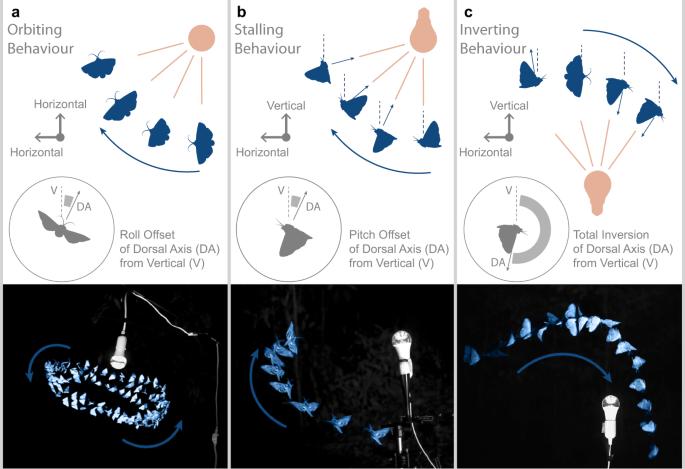
"In both field and lab conditions, insects rarely head directly towards, but consistently fly orthogonal to the light source. This refutes the fundamental premise of an escape response."
"An insect should keep a light source at a fixed visual location for maintaining its heading. Switching light position (Supplementary Fig. 5) shows that insects readily hold the light source on either side of the body."
It makes sense to me. Imagine you were an insect and you would use the moon for navigation. Would you really be flying directly towards moon? No, right? Then how could someone think that insects flying directly towards artificial light source is the basis for the theory that insects use moon as navigational aid?
This definitely refutes the theory that insects are trying to escape towards the light, because, as the article shows, insects don't head directly for the light, but instead move orthogonal to it.
But this doesn't mean they can't use moonlight to help with flying. The theory, as I understand it, is that they use a distant light source -- e.g. the daytime sky -- to maintain altitude. There's no reason they couldn't use the moon to do this too.
Again, they would not be flying towards the moon, they'd be keeping the brightest light to their dorsal side. Since the moon is distant, unlike a lamp, this would result in steady flight.
I'm not sure that it confirms whether they use the moon or not, but it seems like a possibility.
The moon is in practical terms infinitely far away, and no matter how far the insect flies it won't budge and stay as a stationary feature to localize by.
But do the same with a lamp that's only 3 m away, and keeping it in the same spot can only mean flying around it in circles, towards, or away from it, otherwise it'll move around a lot relative to the insect observer.
When the moon's directly overhead, this makes lots of sense. Fly goes around wherever. But if the moon's low on the eastern horizon, would we expect flies to mostly be facing upwards, and mostly flying west?
Depending on your precise navigation logic, you'll either end up with an increasing or decreasing orbit radius. If it decreases, you'll eventually crash into the light source.
If you're flying parallel to the ground (horizontally), you'd want the moon to be where your back is and you'd have a good change of flying straight. It's like when the kids say that the moon seems to "follow" them.
"Dorsal" means where the top part is, the insect's back, as it were.
The article talks about the ‘dorsal flight response’ being more about the overall alignment to the sky hemisphere, not the moon specifically.
“the brightest part of the visual field has been the sky, and thus it is a robust indicator of which way is up. This is true even at night, especially at short wavelengths (<450 nm)”
The way I thought about this before was that normally an insect would ‘keep the moon’ on one side to navigate straight, but artificial light messes that up and they end up spiraling around those light sources.
Which seems exactly the behavior that they have demonstrated in the research.
What I'm struggling to understand is how the insects then reach so close to the artificial light. Why don't they spiral the artificial light from a great distance like 1 metre or 2 metres away? I see the insects hovering like millimetres or centimetres away from artificial light.
> Wait, so it could be a parallax thing?
> The moon is in practical terms infinitely far away, and no matter how far the insect flies it won't budge and stay as a stationary feature to localize by.
> But do the same with a lamp that's only 3 m away, and keeping it in the same spot can only mean flying around it in circles, towards, or away from it, otherwise it'll move around a lot relative to the insect observer.
https://news.ycombinator.com/item?id=39195508
Seems a reasonable explanation to me :)
The insects you see are the ones that happen to get too close and thus their nav gets 'jammed'.
It's similar to planes navigating by compass. Works great, until you go up to the arctic circle, then you better have another nav source or you too will be flying in circles.
Haven't seen flying insects since last summer but if I think they kind of lose altitude the closer they get to the light source, which would be when their torso is less horizontally oriented.
Also this is just a guess but I imagine the closer they're to the light source and the larger the contrast between bright and dark is, the stronger is their tendency to get locked into the orbiting path as opposed to flying randomly.
I think that was one of the theories being investigated by this research. The paper demonstrates that it is the actual light (of the moon or stars or sun or artificial source) they use to orientate themselves in the horizontal plain BUT that is not navigation. With a "tilt" in their orientation they will fly in circles around the light but this tilt also causes inefficiencies in their actual flight mechanism so will cause erratic directional stability as their flight path rapidly changes their spacial relationship to the light source. Whatever their navigation imperative (heat, cold pheromones,smell, sight, sound) will be affected by this spacial relationship instability.
If I'm reading it correctly, insects don't fly toward the light, they turn the front of their body toward it. Under natural light, this helps them fly correctly ("maintain proper flight attitude and control"), but with artificial light they end up just constantly flying around the light source?
Google says dorsum is "back or top (dorsal) side". Kinda makes sense that they'd assume light means up.
But is it correct to assume that, if something is naturally possible (e.g., bioluminescence), and provides significant evolutionary advantage, the species will evolve it?
If so, why are we the only intelligent ones (so far)? Why didn't chimpanzees, sharing a common ancestor with us 7 million years ago, evolve intelligence?
I am sure there was enough webs that you could stuff several pillows with them.
I always wondered: isn't there a light color that we human see and that minimizes the impact on the insects? Say if we only used red light in the cities, would it help?
> The wavelength of our orange LEDs is 610nm, putting them outside of the spectrum visible to must bugs, but still well inside the boundaries of human vision. As a result, most bugs will not congregate around our orange light because they simply don’t know it is there.
That colour also feels reminiscent of a camp fire, which I've often thought could be related — a bug wouldn't survive long if it flew into fires.
But then if we know it, why don't we engineer the street lights to not attract insects?
What is more scientific than testing the hypothesis yourself? That's science; that's its essential joy and spirit and nature.
Have you reckon'd a thousand acres much? have you reckon'd the earth much?
Have you practis'd so long to learn to read?
Have you felt so proud to get at the meaning of poems?
Stop this day and night with me and you shall possess the origin of all poems,
You shall possess the good of the earth and sun, (there are millions of suns left,)
You shall no longer take things at second or third hand, nor look through the eyes of the dead,
nor feed on the spectres in books,
You shall not look through my eyes either, nor take things from me,
You shall listen to all sides and filter them from your self.
Someone else doing it is just reading.:)
And there's this moth outside my kitchen door
She's bonkers for that bare bulb
Flying round in circles
Bashing in her exoskull
And out in the woods she navigates fine by the moon
But get her around a light bulb and she's doomed
She is trying to evolve
She's just trying to evolve
Gunnin for high score in the land of dreams
Morbid bluish-white consumers ogling luminous screens
On the trail of forgetting
Cruising without a care
The jet set won't abide by that pesky jet lag
And our lives boil down to an hour or two
When someone pulls a camera out of a bag
And i am trying to evolve
Trying to evolveConsidering that insects don't have our fancy inner ear and can sense touch/pressure on a surface but cannot use this in flight, I guess it does make sense that they'd need some other way to orientate themselves; why grow another organ/sense when eyes already do the job! (Until humans come along and ruin it by discovering fire).
Like for example an outdoor dining terrace?
One fun thing you can do is relocate small swarms of bugs with a torch to another light source. So if you're being pestered, turn on a torch... and slowly walk the bugs to a different light source (a distant lamp for example). Then turn off the torch and walk back to where you were. The light will keep them there.
a bug zapper is a lot easier
Isn't the takeaway from this study that they aren't really, but rather that once they happen to come close to it they cannot get away from it anymore?
>Only one experiment that we know of has tracked moth trajectories to lights over long distances, and found only 2 of 50 individuals released 85 m from a light source ended their flight their flight there
I realize this is a small sample, but seems to suggest that if you placed a lamp in a field that 4% of all bugs within a ~football field in every direction would end up near it. I feel like that may mean placing a lamp 10 feet from where you are going to eat (or whatever) may actually attract more insects to that general area.
But I'm having trouble understanding some of their methods
Most "bug zapper" design are wrong. It should consist of a light source and a single grid perpendicular to the light source rather than surrounding the light source.
The light source should also be constantly varying to ensure the insects' tilt (and hence their circling behavior) will also change the radius of their circles.
Do insects desire food, or does the intensity of certain smells simply compel their mouth parts to start moving in a certain way?
Similar how the environment conditions after a rain can be the catalyst for ants nuptial flight [2].
If that's case the behaviors relying on it have been quite fucked up for some time.
Making a road trip in the light polluted northeast america, I was looking for stars in the darkest of forested of environments, and I could not find any stars anywhere. I am not sure if the clouds were there. But I realize I have not seen stars in a long time.
The introduction of this paper lists some other explanations that you may or may not have seen in the past and it says some have been disproven and some have not yet been tested.
The methodology and resulting graphics are interesting, but the underlying geometry of the effect is not really new or surprising.
seems there should be alternative navigation ways..