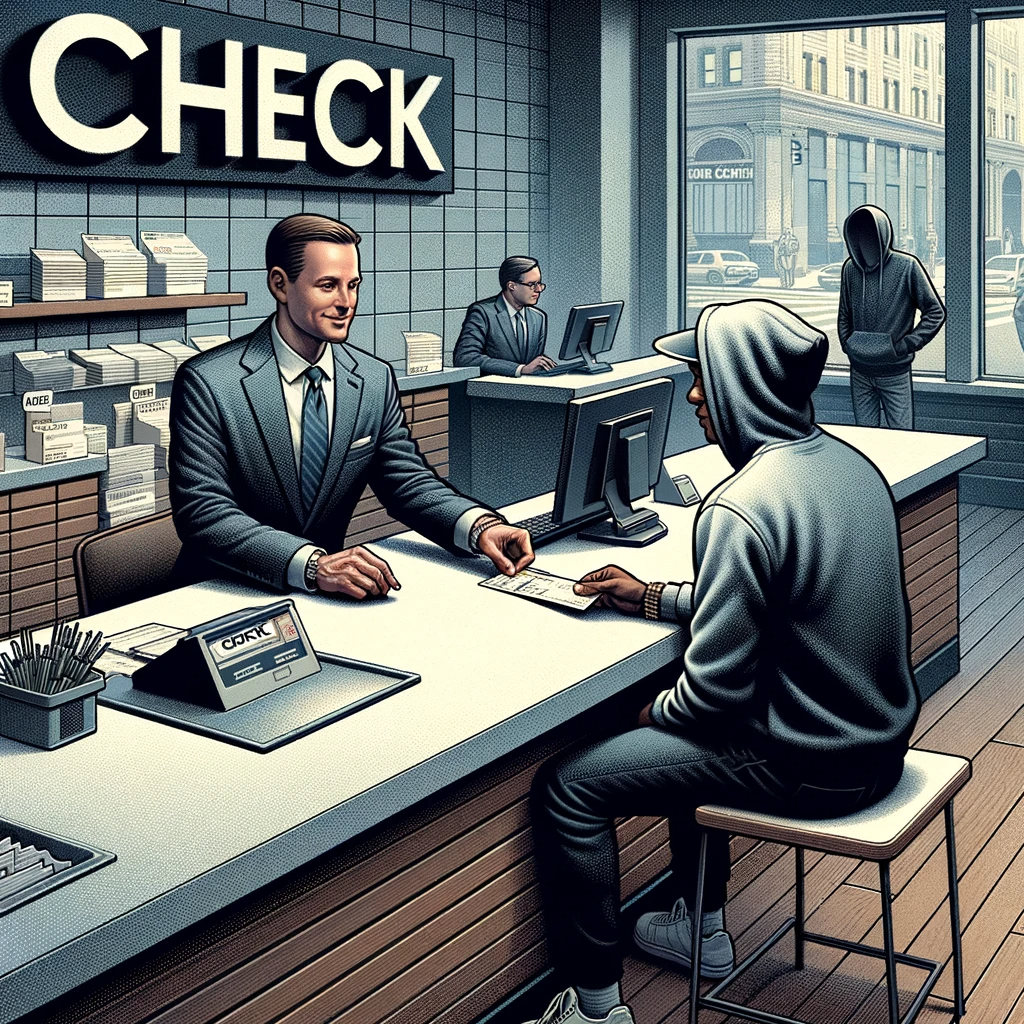
The business of check cashing
Check cashing, as a business, is a poorly understood "alternative" financial service.
Bits about Money
215 points · by admp · 2y ago · 323 comments
> One of the reasons I covered the checks as a payment method recently was to lay the groundwork for talking about some of the fascinating alternative financial world around them. In the main, this helps people at the socioeconomic margins turn payroll and other checks into cash (or otherwise immediately spendable value) in return for a fee. This is not how you, reader, probably deal with checks, and the existence of this industry / product have been controversial for many years.
So what's funny is that the topic is actually totally alien to me. But that's because I have only ever dealt with one or two checks in my life (when interacting with an American company paying interview expenses). And otherwise, I've never handled them at all. They just have been out-of-use in my parts of the world (Europe, Singapore, Australia) for at least as long as I've been economically active in them. From what I've heard, the US is going in that direction as well? So many younger people would have never handled checks there either?
But the paragraph just assumes that you would be familiar with checks in general, but not with check cashing. (Later on in the article, our author explains the basics of how well-enough-off people handle checks. So that's fine.)
Edit: reading further down, I'm ok with the tone of the article and don't share the concerns.
I was speaking from personal experience within a cultural context, so your perspective doesn't apply. Whether or not you've relied on paper paychecks in the US has far more to do with socioeconomic status than age.
If you want to check my 'poor people credentials': I grew up on welfare in (mostly former) East Germany. Nowadays I live comfortably as a programmer.
Poor people don't use checks in Germany. Some rich people might (still) use them for idiosyncratic reasons.
As for the benefits I just alluded to, they are in no particular order:
* Simplicity and security. You cut someone a check, it's effectively the same as handing someone a wad of cash but without the logistical, security, and social issues associated with handling wads of cash.
* Convenience. Checks are easy to use and require nothing other than a pen compared to other forms of transferring money, such as wire transfers or debit cards.
* Assurance. Cashier's checks are a special kind of check guaranteed by the underwriting bank. These are often used when large sums of money need to exchange hands with no hassle or problems (eg: real estate or vehicle purchases).
Disagree about the security. I just found out last month how unsecure the use of paper checks actually are because they expose your bank account & routing number.
I had an old checking account that was dormant and I hadn't written any paper checks against it for 10 years. What then happened was a landscape service asked me for payment for some work so I had my credit-card ready to settle the bill but they surprised me by saying they would charge extra 3% fee for processing the card. However, they said there was no fee if I paid by paper check. I didn't want to pay hundreds extra in fees so I used that dormant checking account to pay them with a paper check. They cashed my check the next day and I didn't think anything about it.
About a month later, I saw a mysterious "e-check" that subtracted money from my dormant checking account! It was not ACH; it was a generated e-check from a billing service popular with adult companies. So somebody from the landscaping company used the numbers on the bottom of my paper check to generate a fake digital check. The thief was on a website that let you pay for a subscription by creating an echeck; the web form would have fields for entering anybody's bank routing # and account #. (Example: https://solutionscout.com/payment-processing/e-check/)
When I talked to Bank of America about the fraud, I asked the customer service representative if there was any security setting that would prevent fake checks like that from deducting money from the account. He said "no". The fake e-check even had a totally bogus check # that was out of sequence with my real checks and he said their system doesn't verify the sequential #s. Literally, you're powerless to stop it and the only thing you can do is let the fake e-checks steal your money -- and then later file a fraud claim hoping to get the money back!
Paper checks are flawed with a critical security hole by letting companies generate fake e-checks. This means the more paper checks you write and release out into the world, the more of your banking surface area is exposed for you to become a victim of fraud.
Convenience: will be superseded by FedNow. Is already superseded by various apps.
Assurance: cashiers checks aren’t really relevant to this discussion. They’re not the same as a check, they might as well be a different product entirely, and they generally cost money to use for everyone except those who have fancy high value bank accounts.
I expect they will just become obsolete slower in the USA than other parts of the world.
Personal cheques are already obsolete in my country (New Zealand). And their usage looks to be sharply declining in European countries: https://www.statista.com/statistics/443677/cashless-payment-... or countries are trying to stop their usage (UK, Australia).
https://www.statista.com/statistics/1055578/check-usage-by-c... implies that the USA likes checks. 30 years ago NZ had over 50% of transactions by cheque.
Yes, checks have important benefits but the downsides (fraud, processing costs, credit risk) lead to them becoming uncommon and then obsolete in other countries. No reason the USA will be different.
Though I was surprised a couple years ago when I bought a new car. I thought I'd have to run to a bank branch to get a cashier's check to pay the balance (as I've had to do in the past). They were fine with just a personal check. I assume the finance guy had some means to verify I had the balance in my account.
And a big downside of checks is that it reveals your bank account and routing # in an ACH system where money can be “pulled” anytime from your account. Compare to an electronic money transfer system where money is pushed from entity to entity using a unique identifier, but can’t be “pulled”.
I ask because there is, as far as I can tell, no obvious way to do it. You could just as easily write an essay talking about carrier-provided phone financing, and it would expose a similar cultural rift where most Americans don't do that and are only very vaguely familiar with how it works.
Or is the glaring thing that you dislike here the clearly stated assumption that most of the readership is not like you? In which case perhaps we should simply request that authors not state such assumptions while they make them anyway in the interests of being maximally informative.
https://www.propublica.org/article/the-expendables-how-the-t...
Do you think this article is ineffective?
Moreover, a similarly sympathetic (and horrified progressive middle-class-assuming) portrait of a check cashing business and its customers would almost certainly read as incredibly condescending to someone who finds them a fact of life. The article quite clearly assumes its readers have never been temps, never been crammed into a van to work in a warehouse, and will be upset to learn the conditions in question. It just doesn't say so briefly, opting instead to bury the assumption.
Do you want to read an article that portrays your younger self as a victim so that readers can feel bad and maybe learn about the financial structure of check cashing? At the risk of making a large assumption, that does not seem like it would help you feel included.
Technology was supposed to reduce these barriers, but in a lot of ways it has magnified them, creating a new pseudo social caste system or perhaps just an extreme shift in the existing order. Noticing that the promise of the 1990s has fallen flat they turn to blind pushes for inclusion as an embarrassed justification for their position in this new order.
Suppose a business or individual accepts checks and electronic funds transfers for payment.
Are they going to apply their prior probabilities (your various -isms such as racism, etc), in regards to whether or not the payment will actually be successfully received?
Whereas an instant payment and confirmation via the use of internet and databases alleviates this motivation to discriminate.
> Compassion gets burned out of the owner and burned out of the clerk in basically the same ways that it gets burned out of everyone else in the neighborhood.
This reflects a false belief that people who live in poor neighborhoods are less compassionate. In fact research suggests that people living in poverty tend to be more compassionate towards each other than rich people are toward the impoverished. It's comforting for wealthier people to hold this belief, because it makes us feel less bad about our own lack of compassion.
And the point of the below paragraph seems to be that it's difficult or unpleasant to think about systemic injustice, so let's avoid it?
> And, not to put too fine a point on it, it’s really hard to expressively, passionately hate this business and not hate the young lady working in it, the decisions and life challenges of its customers, and similar. And if you hate one particular building in a poor neighborhood, and then start rigorously thinking about the liquor store, or the police station, or the supermarket, or the church, or the public school, or the home in the poor neighborhood, I think your mind will start going to some pretty dark places.
From what I recall, its less that the poor are more compassionate, instead they participate in _reciprocal altruism_ as a form of insurance against further loss. I remember this talk https://www.youtube.com/watch?v=AchISJUKfH4 -- poor people make seemingly dumb decisions because if they don't help their social network when it comes knocking, they're in effect _cutting themselves off_ from said network.
The middle class is more insulated from this effect because those with emergency savings don't often need to borrow $500 because of a broken car or need to house their recently homeless sister and children, so capital can accumulate more easily.
So the author is being anti-inclusive by defining precisely what they are talking about? I assume you've seen the XKCD about "15k people a day dont know what X is", you're committing the same elitist reasoning, that someone is an idiot for not knowing a thing.
Explicitly stating unfounded assumptions about your audience doesn't change the fact that they are unfounded assumptions. A whole hell of a lot of people in our country have relied on check cashing services regularly at some point, and believe it or not, many of us read blog posts just like them proper folks from polite society.
I nodded along whole-heartedly into the digression on banking and class in America. When you actually think about what's going on in these places, it's a wonderfully curious twist on our idea of "trustworthiness".
After hours of phone calls, I learnt that bank account numbers are recycled (!) after accounts are closed.. so the previous owner of my account number had tried to cache a cheque using a legitimate chequebook that they still owned.
Still amazes me that the system could be so insecure!
Even crazier, the merchant initiating the ACH had been refusing to cancel my subscription and my bank recommended just closing the account as the fix for that at the time. Partially because I wasn’t using it actively, I think there were other ways this just happened to be the simplest. But it didn’t work because of said reopening of account.
Also, the merchant got $0 as it was NSF. But bank charged a couple $35 fees IIRC causing the negative balance. They really didn’t want to waive them and I ended up talking to like 3 layers of management to get it resolved. I was just like, “of course it was NSF how/why would I leave a balance in a closed account? Why don’t you reject the ACH some other way? Your business logic is fucked up”
To me, the biggest issue here is simply "banks should not recycle account numbers".
As I was a broke student with few options, I ended up having to default on it, which did wonders for my credit rating for a good long while.
Cache invalidation is hard.
> In the case where [...] the government later comes to the conclusion that it didn't really want to pay them
If the government comes to that conclusion, and has a legitimate reason (e.g. you didn't do the work they paid you to do), they should have ample ability to take you to court to get the money back. By making the payee cover this risk, they're essentially paying for the untrustworthiness of other payees.
Many of the rules and regulations have come about because writing checks became a non-local thing. You'd send off a check to pay for a magazine subscription and it'd get processed somewhere far away, like South Dakota. They don't know who you are, so like the article said - writing a check became an extension of credit, and the writer needed some verification as to their creditworthiness.
Could you create your own paper checks? I think you can, as long as it looks/feels like a check and has all the info on it in the correct places. You don't have to use any security features to prevent check washing (but it's a good idea). You don't even need the magnetic ink, as the check will be optically scanned, with hand-processing as a fallback (they will attach a MICR correction strip).
https://en.wikipedia.org/wiki/Magnetic_ink_character_recogni...
Though I wonder whether you could just get an account where your deposited checks just take a while to clear (when the bank actually has the money)? And where any attempt at overdrafting would just fail?
Basically, a bank account where the bank does not extend you credit. A purely 'pre-paid' affair.
I guess the kinds of people who would want these accounts are on average not good customers?
(I know that they have these kinds of accounts in eg Germany where I grew up. But your average German is averse to taking on debt; so you just get average Germans signing up, instead of the adverse selection you'd have in the US?)
That's like......every normal bank account? At least in Poland, UK and Germany(as you mentioned). By default you don't get any overdraft, you can't go below zero so to speak. If you do(with an offline transaction that wasn't authorized live with the bank) then usually you get 24 hours to pay it off and start paying heavy penalties beyond that point.
Transfer most of the money to the savings account and then when getting declined buying food top up the card account and rely on it instantly being available. Having negative trigger each time going above the pre-planned spending for the month.
Hell, I still do it. I have one card for groceries which gives me a mental picture of how much I have spent on food given what day it is when it gets declined each month.
I would presume this comes from being the generation that grew up only knowing about debit cards. Most got a personal one at the age of 13 or so and never really used cash. Guessing it is even earlier today.
Didn't get a credit card until first time I was planning to rent a car when travelling knowing how much easier it would be.
I still don't use a credit card for that. I have a debit card that's part of Visa, so most businesses don't care whether it's debit or credit.
IME they eventually end up abusing it (repeatedly not paying the fees) and then the bank closes their account, at which time they move on. One way they strategically avoid or delay paying the fees if they can't / don't want to is by avoiding direct deposit. Then, you can either deposit the check (ready to pay overdraft fees and get account positive) or cash the check at a check-cashing (for a fee that will likely be less than the overdraft + overdraft fees).
No. Every normal bank account can go overdrawn. Try it: low value purchases or withdrawals are not transactional (they are eventually consistent).
Banks in Denmark are obligated to extend a basic account to all customers and usually do it with a debit card. Ie. no offline transactions and no transactions that can not be immediately cleared.
I don't know why you dismiss this. If you are from the US then be aware that EU and US banking systems are wildly different (where the US system is really good for the wealthy people).
If you are from EU, then it sounds like you haven't changed your banking situation or stayed up to date in at least 15 years.
Example: https://www.barclays.co.uk/current-accounts/basic-account/
I assume the debit card is configured to refuse offline transactions.
This is combined with the fact that no account supports cheques anymore.
> And then there’s one decision which I just love aesthetically: if you’re willing to wait ten days, Ingo will discount your fee straight to zero. Why ten days? It is past the window where fraud discovery will result in the funds being clawed back plus (ahem) a bit of annoyance tacked on as a product decision.
That's exactly what I would want to use, if I had to use checks. (Luckily, I don't ever have to interact with checks.)
I wanted an account that would not give me any credit. I did not want any credit.
But I also wanted the bank to do the mental arithmetic for me, and just refuse when I don't have enough funds. Instead of me having to carefully track my balance manually, lest I accidentally use any credit I don't want to.
(For context: I usually try to keep my liquid balance fairly low, and stick the rest into savings and/or investments.
It's ok for me, if a payment bounces every once in a while because of that. It's all about trade-offs. I can usually fix it pretty quickly by transferring some money from my savings account, or from my brokerage.
With an account that helps me there, by not offering any unwanted credit at all, I can manage my finances a bit more aggressively, instead of having to keep up some safety cushion against arithmetic mistakes on my part.)
See also https://news.ycombinator.com/item?id=39201675 for how that non-overdraft account works in practice for people who don't want to take on credit, but also don't want to have all their money in their 'checking' account.
I don't really care of it's AI or not. The picture is just strange. The empty hoodie just standing by the window, watching a worker who is seemingly undisturbed by it. The odd placement of the desks, the fact that all of the text is gibberish, but looks just close enough to real that you pause to examine it. Except for the big "CHECK" on the wall, which isn't something you'd actually see in a real establishment that cashes checks.
More and more, I see companies using art that they would refuse to pay for if a contracted illustrator turned it in. Seemingly because it's AI, it's like they become blind to how bad it is.
Also, yeah, this looks like a weird bank / accountant's tax office pastiche, not at all like a check cashing place.
It's patio11 though, all of whose writing on the nuts and bolts of finance are fascinating, so it's easily forgiven, heh
Edit: in fact I'm already 3 paragraphs in and so fascinated by the, typical for patio11, high level of detail combined with easy novel like readability, that I almost feel guilty for having piled on to criticize the awful AI image. But still, yeah, I agree AI images like this are actually worse than no illustration at all
Like, the article's good enough that it doesn't need an image. Or if you really think you need it, grab some free stock photo or clipart or something.
Or get good AI art. Don't settle for bad AI art.
Practice has shown the two to be inseparable, presuming you mean artistic value rather than market value. They inform each other. Furthermore, no valuable idea or piece of art can be owed to a single person.
It's crazy what occasionally got passed through. I remember a VP complaining about a failed deposit - the cheque image was a completely unintelligible scrawl of blocky black pixels - like white noise on an old TV. I explained why it got flagged by the software and that it wasn't eligible for deposit. They didn't care - uploaded it to the bank who happily cleared it for them with funds available instantly.
It's all about how big a customer you are, you're perceived risk profile and your relationship with the bank.
https://www.npr.org/2017/01/10/509126878/what-is-driving-the...
I use one of them.
Is their existence being hidden from people? I just googled "bank with highest interest rate" about a decade ago and the top result was a bank that ALSO had no fees or minimums their accounts.
Note that a bank not allowing overdrafts (e.g. by returning checks NSF if the account has insufficient funds for them to clear) does not guarantee that an account will never end up with a negative balance. In particular, you might deposit a check which is later returned (as NSF, or as being fraudulent) and not have enough money in your account to cover the check at the point when it is returned -- hence Patrick's point that checking accounts require the bank to extend credit even if the only thing you ever do is deposit checks.
At the time, I switched to one of those high interest low fee online banks. They still charged overdraft fees, but they were lower. I had actually tired to create an account there initially, but was rejected due to lack of credit. I had to create a credit union account checking account first to establish some credit before the online bank would do business with me. Note that I'd had savings accounts at a national bank and the credit union previously, but that wasn't enough.
I just checked and my local credit union still charges for NSF, but the online bank I use does not.
In fact, for a few years now, overdraft is legally required to be opt-in:
https://www.fdic.gov/resources/consumers/consumer-news/2021-....
The existence of lots of smaller banks, credit unions, and not to mention a bunch of huge online-only banks like Ally and Schwab somehow just doesn't register.
Essentially, it's a "stupid tax".
They recently tried to personalize their debit cards though, which caused them to stop being accepted by some merchants, since they're no longer identified as Visa (even though they still are). I now have to use ACH transfer for certain purchases, where debit used to work just fine...
They apparently did this for tap-to-pay support, which is so not worth it because who still buys things in person? Who would want to sacrifice the ability to make online purchases for that??
Huh? Why? Isn't the USPS a mail company? I don't get what that has to do with banking.
There’s no other department of the federal government with that coverage.
They also are quasi financial already as you can get a USPS money order.
It could also be pressure on American banks to treat their customers better, since the USPS is not burdened with a responsibility to generate dividends for shareholders.
The USPS is also not directly funded by taxes (though it is indirectly subsidized via it's tax status and sole right of access to mailboxes), and with the waning popularity of letter mail, would become more self sufficient in the long term if it branched out into other services
Other countries also combine banking and postal branches for similar reasons, like Japan (although it is in the process of being privatized).
On the flipside, they are one of the most ubiquitous ATMs in Japan and your local post office will double as a branch for JP Post Bank (which are everywhere).
Oh and it's nation wide too! Which is kind of important for a country where some banks restrict activities and branches to their direct locality.
Man. I wish patio11 would talk about Japanese banking more because to most American audiences that system is also just, completely something else.
First, there's the "pay by depositing to a debit card" racket.[1] "The biggest issue is the hidden fees. Some providers charge cardholders for common activities such as receiving paper statements, over-drafting, replacing cards, transferring money to another account, making withdrawals at most ATMs, and even not using the card for a period of time."
Then, there are things such as DailyPay.[2] This combines payroll, a debit card, and payday loans into one convenient fee-laden package.[3] Worse, not getting paid means trying to reach the intermediary's customer support.
[1] https://www.thebalancemoney.com/what-are-payroll-debit-cards...
[3] https://www.needhelppayingbills.com/html/daily_pay_services....
Account or not.
[0] https://www.canada.ca/en/financial-consumer-agency/services/...
I do vaguely remember the 80s and there was a fair bit of cheque usage along with those credit card duplicator things where the sales person takes an imprint of the card. Wild times!
(Imagine a business that occasionally mails random people $10.48 without asking them first.)
I found myself nodding along to a lot of the contents of this article, but I totally disagree with this part... it runs totally counter to my experience. To be fair, maybe my experience was the exception that proves the rule (or maybe things have changed since I worked front-line at a financial institution), but the expectation that you would be cold or unwelcoming to a customer (or prospective customer) based on class or perceived class was absolutely not the case. Like, I cannot stress that enough. Don't get me wrong, there were procedural safeguards such as "no checking account if you have <650 FICO", but you were expected to be welcoming to everyone who walked in the door and "they seemed poor" would certainly not be an acceptable excuse for snubbing a customer.
I'm extremely confused about the usage of the word "need", and the implication that this need for the line of credit is what generates all these downstream problems.
The person depositing a check wants the money soon, sure. And the check bouncing or not depends on the person writing the check. The person depositing the check "should" "just wait"? Like don't extend the credit? Credit card processors hold onto your money for this exact sort of reason!
Yes, there are trust considerations. But don't move money that is not quasi-guaranteed? Pay for money flow? Make the trust relationship between banks and not between atomic actors? Risks are risks are risks but saying that people should be unbanked because their checks will bounce... I guess it's weird to have these pieces of paper have so much trust associated to them in the first place?
Maybe the check network doesn't work as well in this model. Fraud is a whole thing as well of course. I guess in this model people trust checks enough to allow groceries to be paid by check. Just feels extremely suboptimal.
Often if you really need to do that, you’re better off taking the check the bank it was drawn on, often having to open an account there first. Still can take quite awhile.
But before computers and electric communication, this was the best and fastest way, and since the vast majority of transactions are legitimate, it works.
Pratchett’s Going Postal is a decent look at the system.
There is no “final clearance”. The owner of account can notice fraudulent check and report it months later, and it gets reversed.
I had this happen to me 25 years ago with Wells Fargo. I was on vacation and had a check drawn on the branch I was standing in front of - and foolishly thought it easier to cash it right the and there than wait to get home and deposit it. Boy was I wrong.
I’d also done this once or twice as an actual child in the early 90s and then it was not a problem.
Would you bank somewhere that held your payroll deposit for 6 months?
Besides that, I don't think they actually eat at McDonald's much. Their relationship with fast food is that they work there.
It has always confused me how simultaneously the US money system is operating in the most advanced interconnected economy imaginable which fosters innovation (bankruptcy laws in the US are designed to make it easy to try again, they encourage entrepreneurship) and yet.. the whole credit union, banking crash, over inflated economy has made them retain unbelievably archaic approaches to money on paper.
Checking for forgery, active forgery presumably underway, 3+ day clearing, "you're not from round here" risks, It's just insane.
Go to walmart, buy a stored value card, you can do dollar events with zero friction but present a cheque at the counter, and you're in the slow path.
It's positively ... Indian. It's like mainstream Indian bureaucracy levels of insane slowness. It's even had films with Whoopi Goldberg made about it (she is a cheque processor in some movie, doing it by hand at a 1970s vintage cheque processing machine. I think its "made in america" with Ted Danson)
For example, in this issue, a major reason why some people don't do value transfer through banks directly is the banks don't really like them (for reasons), the feeling is mutual (for reasons), and other people who do not have the same POV re: banks want to give those people money in a scaled fashion, which (unless they orient their operations around a solution) will frequently involve sending out checks.
* Banks don't want to do business with these particular people because they know them to be a bad business risk. They often know, via credit reporting methods, that the specific individual human standing before them has a history of cashing bad checks/committing fraud/whatever it is. Therefore, they decline to work with that person.
* The people who are bad risks for banks get rather tired of dealing with banks, both because constant rejection is tiresome and because bank employees make it very clear (though unspoken explicitly) that they are persona non grata there. By contrast, the people at the check cashing shop treat them better, so they would rather take their financial business there.
I get why you want the explanations and not just "for reasons", but both of these points are quite clearly spelled out in the article. So I don't really think the author deserves the grief you're giving him in this case.
The problem is poor people would need to pay for their bank (as banks need to make money other ways and from the middle class that will be credit cards and mortgages etc.)
The main thing Zelle gives us normal plebs is the ability to pay via routing numbers to businesses without incurring fees.
Possible before, easy now.
Anecdotally, I wrote a check to my landlord yesterday, because a few months back they claimed they never got the automatic bill-pay from my bank, and my bank said it was already sent, and weeks later my bank said the recipient refused to take it... Anyway, no party was ever able to tell me why an automated process that worked unattended for months suddenly stopped working for no discernible reason.
All financial infrastructure is a patched-together collection of systems spread across multiple different firms made of multiple suborgs with vastly different levels of observability into and understanding of their local part of the total system. For many routine problems, the cost of having a rigorous answer to “What just happened?” is far, far greater than the dollar amount at stake in the transaction. You’d need the equivalent of a federal agency doing an after-accident investigation to make headway, at the cost of millions.
So we chalk it up to gremlins and move on, for better or worse. (This is one reason why financial institutions have an operational losses budget. Sometimes the gremlins eat someone’s money. So you just charge it to Ops Losses and move on.)
Of course, I don't try to pay by check in a store. (Though I did write about a $30K check when I bought my last car and that wasn't a problem either--assume they have back-end systems to verify.) Getting rid of checks just isn't a problem I care about or want to devote any mental bandwidth to.
I presume they do some basic checks, but it’s really all down to trusting it’ll all come out eventually.
They’d much rather have a check than 30k in hundreds.
You don't care because you're an issuer, and a net beneficiary of retention of the funds in your control for those extra days of clearing.
This is only applicable to the unbanked, for the most part. Regular banks make funds immediately available when a check is deposited. Unless you're already on their radar for kiting.
I've never been told cash, but if I was, I would be happy to pay in cash.
Ironically India has a very significant amount of transactions cashless/electronic, pushed by demonetization and later covid. The government has been pushing hard for it for a while and I think they succeeded.
Uruguay is another economy which has gone all-in on cashless, shops and cafes had to offer 10% discount for card transactions when I was there 8 years ago, the idea was to beat out the tax-avoidance.
When this feeling occurs, why is the next step "wow the US sucks" instead of "there must be some good reason that I don't understand."
Same way that a country that never had anything before now won’t run copper telephone wires, and instead go directly to fiber backboned wireless.
slowness is a feature, not a bug, in some social situations. Most modern Americans have not experienced that kind of situation. One of the elements missing here is control - who has control over the transaction, and what are the practical methods to resolve dispute.
Cash is not great at scale perhaps, but it is great for the individual in times when trust is gone, where there is unequal power relationship, and where there is real corruption inserted into ordinary transactions.
As an American with some knowledge of history, I support cash, paper checks, and electronic transfer. without a doubt.
At every scale from muggings to home robbery to retail store robberies up to bank robbery and knocking over armored cars, cash handling imposes a security and risk management burden, with a particular component of risk of physical violence that is much less of a factor in electronic security risk models..
Or perhaps you're saying which one to use depends on what you want? But if there's an unequal power relationship, the person with more power (probably the payer) will usually choose. So to fix that, it's not enough for cash to be an option, checks need to not be an option. (Electronic transfers can be an option, as long as they're set up so that the payer can't unilaterally take the money back.)
In my own experience I have negotiated sales or contracts with others for non-trivial sums. It feels like most modern people are just going along with systems that require an intermediary and working devices. I feel it is not only important, but crucial, to have the ability to negotiate directly with a peer or others. That means without electricity or cell phone coverage, too. YMMV
There are already 400 participants who have signed on in less than a year of the network being live [3] (the list includes Chase Bank and the US Treasury), and the CFPB is already getting in front of financial institutions attempting to charge insufficient funds fees for instant payments when unnecessary [4]. There are substantial entrenched interests fighting it (The Clearinghouse and their competing private RTP network, credit card rails, etc) due to the revenue at stake (~3-5% of the economy running through this FinInfra), but as long as the infra uptake continues and it isn't sabotaged by policy and lobbying, it will deliver more efficient value transfer at scale. Also helps when merchants surcharge credit card rail payments when cheaper alternatives are enabled.
Tangentially, the unbanked stand at ~4.5% in the US per the Fed [5]. That should be driven to as close to 0% as possible, which instant payments contributes towards (getting funds to recipients faster with less float and necessitating less or no credit extension, depending on use case).
[1] https://news.ycombinator.com/item?id=36801491
[2] https://hn.algolia.com/?dateRange=all&page=0&prefix=false&qu...
[3] https://www.frbservices.org/financial-services/fednow/organi...
[4] https://www.pymnts.com/news/cfpb/2024/cfpb-proposes-banning-...
[5] https://www.fdic.gov/analysis/household-survey/index.html
[6] https://en.wikipedia.org/wiki/Unified_Payments_Interface
[7] https://en.wikipedia.org/wiki/Pix_(payment_system)
(humorously, you mention it's very "Indian" when UPI [India's instant payment system] is probably the gold standard success story [6] alongside Pix [7] in Brazil)
PayPal was around $290 / share in August 2021. Now $63 / share. Their business got larger in that time, not smaller. The market is front-running the end of the necessity (or general usefulness) of services like PayPal in the US. The stock is back to where it was in 2017, when PayPal was a far smaller business, and it's now trading for 14 times operating income. They better find a new, large business, fast.
Good riddance. Come for Visa and Mastercard next. $57B in combined revenue in 2023.
They had to compete with banks and Zelle, and did fine. I think Zelle is doomed.
Catching up with 54 other nation states really sums it up. That flywheel has been revving up since 1871. Slow start.
And yes, it is unfair to compare US financials to Indian bureaucracy in the wide: Indian financials are innovative. They "got" money early on.
The what? I don't know what you're getting at with this.
> Checking for forgery, active forgery presumably underway
I learned just last week that forged cashier's checks are a risk, which you can get burned by even if your bank makes the mistake. Forged Cashier's checks! Insane. The whole purpose of those is to ensure the money exists before issuing.
I remember with some clarity the moment that Chase Bank suggested that a letter of reference from my bank in Canada might ease matters and they'd just hold my check some extra time for their troubles. And I thought: I don't need to continue at this bank. There is a better than even chance that I can find a bank that treats me better than this.
That's what "you're not from around here" looks like.
Problem is most business checks are written against business banks.
I have a neighbor with a hobby of accepting and depositing forged cashier's checks from people who want to "buy" a car from him or do some other scam. He knows the checks will be counterfeit, so he leaves the money in his account to cover the the deposit and the $5 returned check fee. Then he posts them here:
Domestic checks barely exist either, the only way you'll ever see one is if the government owes you money for some reason but you haven't told them what your bank account number is.
In some places its "keep money local" and in others its probably confidence they won't be left holding the baby in a scam.
UK check guarantee cards helped solve some of this by security pantomime.
When I moved to a new place, I couldn't pay for anything with a check because I still had my old address printed on the checks and most stores wouldn't accept checks with an out-of-state address printed on it. This was ~18 years ago, so things may be different.
I guess I was doing it to service providers rather than stores though - most stores would much rather have had a card payment even back then.
You see a lot of people outside of the US try to talk about the US while having zero first-hand experience or real knowledge of it. It's very common behavior on HN and it's very common behavior on Reddit. They just repeat what someone else said as though it were automatically true.
My town charges a premium for tax payments on the web because they outsource it. So, yes, I pay by check.
"By number, checks declined at a rate of 7.2 percent per year since 2018, dropping to 11.2 billion [in 2021]."
That's about 35 per person per year.
It seems to be around 1.2 billion in France (17 per person), around 100 million in Italy, and much, much less in the other EU countries.
Overall for the EU excluding France about 0.25 per person.
https://www.federalreserve.gov/paymentsystems/fr-payments-st...
https://www.statista.com/statistics/443677/cashless-payment-...
In America, it's not like Indian bureaucracy levels of insane slowness.
I don’t doubt that you can reduce risk by e.g. using novel infrastructure which looks up the account number on the check then uses (for example) a debit card network to check the account’s currently available balance. However, even if you were looking at someone’s balance on their mobile app while they were writing the check to you, that would not suffice to guarantee that the check would not be returned as NSF. The bank can choose to NSF it for a variety of reasons, for example if they prioritize “today’s” debit card transactions over “today’s” checks in the posting order, or a check previously deposited (and included in that available balance) gets NSFed and yanked back by another bank.
They have to manage that somehow beyond a reputation system. Part of it might be the legal system - I believe check fraud is seen as more serious, with much higher penalties, in many countries, specifically because the system of checks wouldn't work without it.
since you're comfortable making a jab like that, would you mind linking me to specific passages that the Harvard lady failed to cite in her work? the whole scandal is so buried in surface-level coverage that i legitimately cannot figure out what she failed to cite.
They are exceptionally rare, to the point where many people have never seen one and fintech/neobanks simply don't support them at all. Unfortunately, some organizations/businesses do use them. They're particularly popular when some entity is required to pay you, knows your postal address, doesn't know your bank account, and doesn't care about your satisfaction with them. They just mail you a check and are done with it, making it your problem. As a bonus, they have a good chance of not having to actually pay you because you don't want to deal with the check or forget.
Of course, there is no electronic deposit either.
And while I'm talking about German companies above, US companies of course absolutely love doing this for the same reasons, meaning you have a foreign, USD denominated check. Hopping on a flight to New York and going to one of these check cashing places might be the easiest way to cash these, and could be comparable in cost to trying to do it locally.
“Not a thing” is a confusing idiom. It specifically means never happens, ever, but the idiom is frequently used in contexts where hyperbole is expected, so a literal translation accounting for the hyperbole might be something more like “I’ve seen it once, but it’s vanishingly rare”.
I wouldn't consider Germany to be avant-garde of banking in any sense.
Sure, back in the day of couriers carrying checks, it made sense that it might take a few days to know. Today, with the internet and electronic presentment, theoretically the whole system could be transparently replaced with one that can clear the vast majority of checks in seconds.
Banks could offer checking accounts to even the least creditworthy people simply by not extending them any credit.
In late 2023 FedNow was introduced, which should facilitate exactly that. But it's optional for banking institutions, and the US is riddled with small institutions that cannot or will not volunteer their capital to invest in the tech required.
Fact check: so false, as to call in question the author's good faith.
In most cases you mean the former.
TL;DR: Check cashing exists because banks don't want to deal with people who deposit checks with a high risk profile (whether due to fraud or lack of funds by the payer). Unsurprisingly, this risk gets priced into the product.
Dealing with bounced checks from such people often involves behavior that most of a bank's customers would consider somewhere between impolite and disturbing. Also, many consumers of check cashing do not have state issued IDs and may not be up for dealing with KYC checks.
The situation has gotten somewhat better for low income people in that government benefits are delivered electronically, without needing to cash a check and some emerging electronic payment options may improve it further.