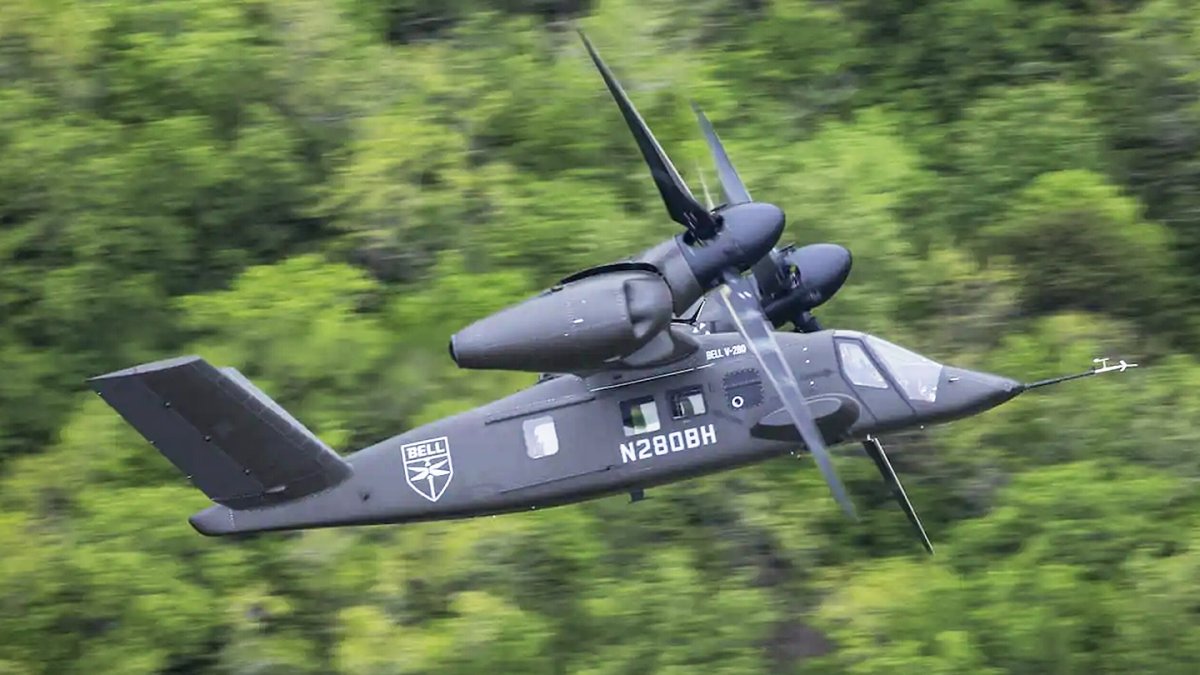
Bell's V-280 Valor Tiltrotor Picked As Army's Black Hawk Replacement
Bell's V-280 tiltrotor bests Sikorsky and Boeing's Defiant X coaxial helicopter to replace the Army's aging fleet of iconic UH-60 Black Hawks.
TWZ
44 points · by dralley · 2y ago · 58 comments
The SB-1 had constant issues due to the requirements of the program. Making a helicopter go that fast introduces a lot of complexity, to the point that the SB-1 was really not any less complex than the V-280. Essentially its only winning points were in better hover performance and a slightly smaller footprint but those weren't enough to justify having dramatically slower speed and half the range for an aircraft whose main purpose is to act as a transport.
https://pbs.twimg.com/media/FPmihf_WUAICL4y?format=jpg&name=...
In the mid-2000s, the Army decided to cancel the technologically revolutionary, expensive, and long-delayed RAH-66 and Congress allowed it to reinvest the RAH-66 money into known quantities like UH-60, CH-47, and AH-64 instead. We got whole new fleets of those aircraft with upgraded capabilities, and then we all saw how they were reliable workhorses over the last 20 years in Iraq and Afghanistan. I think that choosing the Valor reflects this lesson-learned. The Defiant was the riskier new technology while Bell's tiltrotor design is more mature after many years of feedback and optimization from V-22 operations. If we actually want to get something out of this program, the right decision is probably to "not let perfect be the enemy of good." The more mature design is probably going to be the safer one for aircrews and troops, the easier one to maintain, etc.
My remaining disappointment is that the Defiant reportedly had better hover power under high and hot conditions which is what we really needed in Afghanistan. The CH-47's much greater hover power compared to the UH-60 turned the CH-47 into the preferred (sometimes only) platform for air assaults and everything else. I wonder if we could have done very well by just continuing to iterate on and build more CH-47s to replace some or all of the UH-60s in our assault helicopter battalions.
That seems to be the Department of Defense's general approach these days, but I wonder if they are just fighting the last war. Against forces that are already massively outgunned, such as ISIL or the Taliban who generally had only rifles, explosives, and RPGs, improving technology generally doesn't help. Against 'near-peer' foes (the euphemism for China), it may pay to invest in the truly exceptional, ground-breaking technology - you don't want your ship or city defended by good-enough, economical fighters and anti-air; you want to see some X-wing fighters up there shooting lasers at their old turbine and missile buggies; you want what stealth bombers looked like next to the Soviet fleet.
That said, tilt-rotors are still a big step forward from standard helicopters.
I am not sure that having superior technology is critical to winning wars against "peer" competitors. The last time there was a full out peer-competitor bleeding edge war between major powers (World War Two) the side that invested in a few wonderwaffen that were supposed to eviscerate their larger number of enemies lost, and the side that invested in a lot of pretty good weapons and most importantly, the logistics and reliability to have these pretty good weapons actually show up at the battlefront won the war. It's hard to directly translate this into modern terms, but I would say that a few pieces of "exceptional, ground-breaking technology" wasn't what decided World War Two, so why do you think it would decide this hypothetical war?
As a counterpoint, NATOs strategy in the Cold War was to 'offset' superior Soviet numbers by having better technology - first by having more nuclear weapons, then by using the superior technology of precision munitions and the associated global navigation and sensor network (so the munitions can track their own position and locate their targets) as demonstrated in the Gulf War.
But by far the most important point:
> With the obvious caveat that if there ever actually is a shooting war with China on one side and the US on the other then the whole world is in serious trouble and there are no good options:
I think about that, and I never heard it said (so thanks): At the end of WWII, the leaders of the combatants thought that future large-scale war must be prevented because the improving technology would wipe out civilization, thus they created the UN, (proto-)EU, etc. That was 80 years ago.
A war with China may very well include, for example, missiles hitting San Francisco, LA, SD, Seattle. Even if the US won, it would lose badly.
Look at how fast the US went from Kuwait to taking Baghdad international airport in the beginning of OIF. I recall that the entire world was like HOLY CRAP and had no idea how good the US was at logistics up until that part.
“Infantry wins battles, logistics wins wars.” US Army General John J. Pershing, on battle in WWI
I think the consensus within the DoD by the mid to late-2000s was that the pendulum had swung way too far in the direction of technologically advanced but small and expensive, and there was a cultural revolution to swing things back in the other direction. Senior DoD and service leaders today are really a product of that.
I read a fresh opinion piece just yesterday arguing that we're still erring on the side of being too small and expensive, with which I tend to agree: https://www.defenseone.com/ideas/2024/01/pentagon-has-been-l...
Yes, the joke was that US military bought fewer and fewer, more and more expensive items, and soon the entire DoD budget would be spent on one plane.
The Defiant is pretty cool though and I hope there's a commercial future for it. It may be attractive for large multinationals to replace their corporate helicopter fleets with, or for industrial uses that need a helicopter with greater load-lifting capacity than most others.
* Current max speed of 345mph
* Current max range of 2,400 miles
* Capable of unmanned flight
* Helmet allows the pilot to see through the body of the aircraft using AR
Being much lighter / less capable than the v22, 30 years younger, and the Navy not being involved, help a lot with everything.
Is Johnson-McConnell still considered binding? https://en.wikipedia.org/wiki/Johnson-McConnell_agreement_of...
https://en.wikipedia.org/wiki/Alenia_C-27J_Spartan#United_St...
Looking at the Indo-Pacific theater, I think it's clear to everybody that there's a serious shortage of capable airlift and sealift assets across the board.
Actually it doesn't just call Johnson-McConnell into question, it would seem to defy the Key West agreement as well
The AH-56 Cheyenne stands out as what could have been an absurdly well equipped very fast helicopter. Speed, and a huge 360 degree underbelly turreted cannon would have been a ridiculous fire support craft. But it had a pusher prop on the back and the Air Force really really really didn't like that at the time (and was also probably hella jealous of the cannon too).
I'm not sure what makes me as ok with I am at eroding the air force's role somewhat. Some is probably seeing these great craft (AH-56, V280) & feeling like: if the army is going to have anything in the air, it should be great. It sure feels like the v280 is heralding in a massive shift in policy/what is permitted.
In any case, V-280 being primarily transport is for sure helpful. While the range might raise some eyebrows, it also means that V-280 can potentially more meaningfully self-deploy. That means less USAF strategic lift assets to spend on the army - USAF is pondering how it can keep forward bases supplied in the Indo-Pacific - strategic lift certainly has a role to play here.
I think the reality is that USAF realizes that trying to stonewall the V-280 will NOT meaningfully give it more budget, and that the V-280's capabilities means USAF gets more effective budget.
(In comparison, you can fit three Blackhawks in a Globemaster)
And this is the screwed-up state of DoD procurement in 2024 . . .
"But wait," I hear you ask, "why didn't Boeing supply a design of their own? Don't they make the CH-47"
Well . . that's a long story, but the short version is that the 47 was designed a long, long time ago, and it's a Vertol design, not Boeing. Editorial warning, but I'm not sure Boeing has the ability to design a whole lot, these days.
I don't think the wording here is quite right. The GAO has 100 days to decide if the protest is valid or not. If it is valid, then the program could be on hold for longer. The GAO could decide day 1 "nope, your protest is not valid" (they won't). Most likely it will be closer to 100 days of the program on hold, but it shouldn't be "at least 100 days".
But it also just any government procurement in general, where a protest is par for the course. Common amongst any large NASA procurement as well:
https://spacenews.com/gao-denies-l3harris-protest-over-ball-...
It is also happens often because even if a company doesn't think they have a valid protest the government will have to release more details of the proposals and so it is often used as a way to gain business intel.
It’s an osprey done with a smaller scope, less capability, and 30 years later (thus having drawn from the osprey’s design and operational experience).
This is for the Army, not the Marines
There is a little bit of controversy though about the fact that none of the other existing or proposed rotorcraft would be able to keep up with the V-280 (for escort duties), so probably they will be attaching some weapons to the thing. But it's definitely not intended to be a dedicated attack helicopter.
The real question is does it flip upside down if it goes belly first into water.
Taking "float" meaning can it land: The blades in the V280 are connected so one engine can drive both props. This thing can also glide AND/or auto-rotate if needed... so I think it'd be pretty danged safe with a competent pilot.
Do helicopters typically float?
That seems like a long time
They're both quite good at different missions.