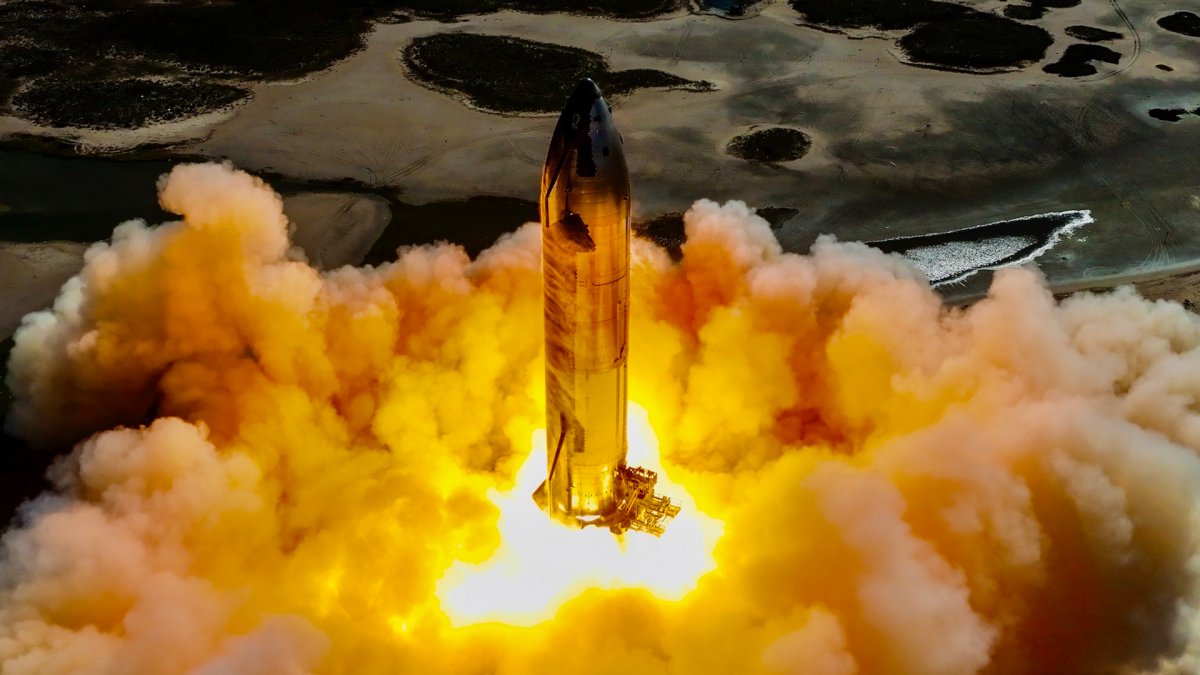
Military May Get Its Own SpaceX Starship Rockets For Dangerous Missions
According to SpaceX, the Pentagon has spoken to the company about procuring its own fleet of Starship rockets for sensitive missions.
TWZ
28 points · by ourmandave · 2y ago · 72 comments
Once the rocket is launched and full of the US gov's people/satellites/supplies/whatever, what difference does it make who owns it?
The US then contracted SpaceX to build Starshield, which is the same as Starlink but 100% controlled by the military. The US military will decide what Starshield can be used for.
With Starship, I assume the military wants to be able to decide where, when, and with what payload they can launch. If they were only contracting launch services, SpaceX might decline certain missions.
I'm pretty sure the US Government could have decided that for them as well. I haven't seen any evidence that they tried.
Or are you saying that the US could have stopped Starlink from being used to attack Russia (in the event SpaceX had agreed)? Again, I suspect that would have to be done via some new export control law.
Either way, the US military doesn't want to deal with the inevitable delays of the legal system. Much faster to just own the asset so you can do whatever you want.
From the military's perspective, war-fighting is their domain. Do we really want the US version of the strange drama around the Wagner Group? Blackwater was bad enough.
Along the lines of the other side asking themselves "is that rocket delivering cargo over there a military target?".
If SpaceX is 100% clearly non-military, then any SpaceX branded rockets delivering stuff aren't going to be (clear) military targets.
If SpaceX contracts Starship for risky missions, They would need to charge premium to cover loss of scheduled business and replacement in the case of failure.
In some situations, owning a dedicated vehicle could be cheaper than repeatedly paying this premium, even if SpaceX operates and maintains it.
If there is any military that could do it it might be the US military
I am interested on the logistics of fuel procurement tho, the fact that starship uses liquefied natural gas and oxygen makes for a great mix and rather simple to procure vs other rocket fuels
I guess the ship attitude & atmospheric drag can help to reduce the extra fuel needed to land the payload, but not right at the end...
When they first developed the second stage they did some low altitude test flights with just the second stage and it went miles into the air IIRC, albeit with no payload. It's possible that once they deliver the payload, the second stage might have enough fuel to fly back to some drone ship or something.
The second thing you need is protection of the warhead on reentry. Kinda not check, the reentry profile of slowing down as it does makes it an easier target for counter measures. It could release a payload which is capable of reentry on its own, but Starship offers little advantage here.
Third thing you need in a "practical" sense is rapid launching. If you're using it for a mutually assured destruction counter attack, it needs to be launched within minutes, as you only have 40 minutes from enemy launch before their nukes start hitting your launch sites, including any time for command staff to give the signal. A lot less with a submarine attack. Strong not check. Starship is huge so it has a long fueling time. Additionally it has a limited time that it can be fueled and be launch ready. You could maybe use it as a first strike, but you'd have to get a large number of them all fueling at the exact same time without anyone being curious why.
Really, orbit to payload rockets and ICBM share a lot, but the specific design constraints mean there's important differences.
It's payload capacity means it could possibly launch a large number of space based weapons, which is pretty scary. However there's little reason to use it as an ICBM specifically.
Very wasteful to use this even as an ICBM bomber though.
What it would be good at is delivering a lot of missiles to wipe every satellite in the sky.
Starship is poorly optimized for ICBMs though. Its WAY too big and probably way slower than ICBMs as well.
This is something that SF leadership isn't talking about, because a) the force is still dealing with all the anti Trump-driven jokes about Buzz Lightyear and space rangers and such from when the service stood up, and b) it's sort of like a military branch in 1900—when engineers around the world were working on heavier-than-air fight and it was expected sooner or later, but the Wright Brothers hadn't succeeded yet—stating that it will be the service that handles flying machines. Further, c) it doesn't want or need people joining right now to fly in space.
There currently is no military astronaut corps (as opposed to military personnel temporarily assigned to NASA), but there has been such twice in the past. Had Space Force existed then it would have been the service running the 1960s' Manned Orbiting Laboratory program, and the 1980s' Manned Spaceflight Engineer program.
Space Force already has had two NASA astronauts, and a reusable unmanned spacecraft in the X-37B. If the X-37 were manned Space Force would staff it, just as the service currently runs every other aspect of its missions from launch to in-orbit-operation to return.
To put another way, the reason USSF doesn't currently send people into space is not because there is some law or latter-day Key West Agreement stating that Space Force can't have its own manned spacecraft; rather, its only reusable spacecraft, X-37, isn't manned. Once it has its own manned spacecraft, USSF will be sending people into space. It's a lack of opportunity, not ability or desire.
Starships with SF ground and flight crews will handle scheduled launches of space assets, and perhaps one will be kept on constant alert for an urgent launch. We might even see the equivalent of SSBNs, nuke-carrying Starships doing rotations in cislunar space for second/third strikes.^1 People who miss the days when ICBMs were part of AFSPC may get their wish, sort of.
^1 Yes, I know about the Outer Space Treaty. I expect the US to depart from the treaty.
Those handouts were intentional incentives to invent tech the government saw a need for.
Regrettably for the government (and society), the guy who ended up taking advantage of those incentives the most ended up being a complete nitwit. So, we're kind of stuck with him until the government actually grows a pair and gives the SEC actual teeth, but too many nitwits are influential and would also be hurt by an SEC that does more than slap them on the wrist, so it's never going to happen
/Rant /personal opionions
I think the ideal for society would be for him to lose leadership over those companies and just disconnect from the internet/enjoy life, but I don't see him ever doing that
Entirely false. That's just a cheap hit on Musk.
His first company did not. X (which became part of PayPal of course) did not. Neuralink did not. His funding of OpenAI did not.
So what are you going to say? You can start a successful rocket company that delivers a lot of payload to space, people to the Moon or Mars, and you plan to not involve the US Government / NASA? Ha! Sure. Please research what the launch sector looked like before SpaceX, what were the options?
You're going to start or take over an energy company (SolarCity) and it's not going to cross paths with the government? Solar shouldn't be subsidized? Yeah ok.
You're going to deploy utility scale energy storage (Tesla), and it's not going to involve dealing with governments? Hmmm.
You're going to attempt the Boring Company, digging long stretches underground, and you're not going to involve the government. Right.
You're going to take on a bunch of the largest companies on earth in terms of sales (car companies), including some of the most politically connected (GM, Ford; both of which have rather notorious histories of killing competition using politics), and you're not going to help your customers save money by making sure they qualify for EV subsidies? Un huh.
I think there are reasonable arguments that solar subsidies shouldn't exist. But if you want to start a solar company what are you going to do? Not take them and also somehow contractually bar your customers from taking them?
These are weird arguments to make against a company.
Whatever accomplishment you want to make in the world, it's no excuse to be an ass.
If you have a company that makes bridges and the government hires you to make a bridge is that also a handout?
Only the company that did better work for less is guilty of being a grifter. /s
Wow, what terrible luck for that to keep happening!
I pray to god to be a nitwit like that.
Now, if were as smart as someone like me, he would agree with my politics and sensibilities.
What do you what the SEC to do about spacex?
the ROI for govt investment in spacex has been more than 10x which is a crazy number considering the amount vnc/hedge funds spend on trying to reach a fraction of those returns.
Additionally, this is survivorship bias. You can find lots of very risky investments that will pay 10x if they mature.
It's not regrettable for the US that we have the world's leading rocket launch company and the largest EV company (outside China). It's actually pretty great for us.
Ghandi was a pedophile, MLK was a wifebeater, Mother Teresa was a homophobe, Jefferson was slave owner, ect.