Business Advice Plagued by Survivor Bias
Advice from "successful entrepreneurs" might be unreliable due to Survivor Bias. What
A Smart Bear
122 points · by Garbage · 2y ago · 84 comments
> It turns out Jim started by combing through 1435 companies looking for good candidates for the book, and picked eleven.
This to not survivor bias! Call it selection bias if you want, but it's plain old data manipulation!
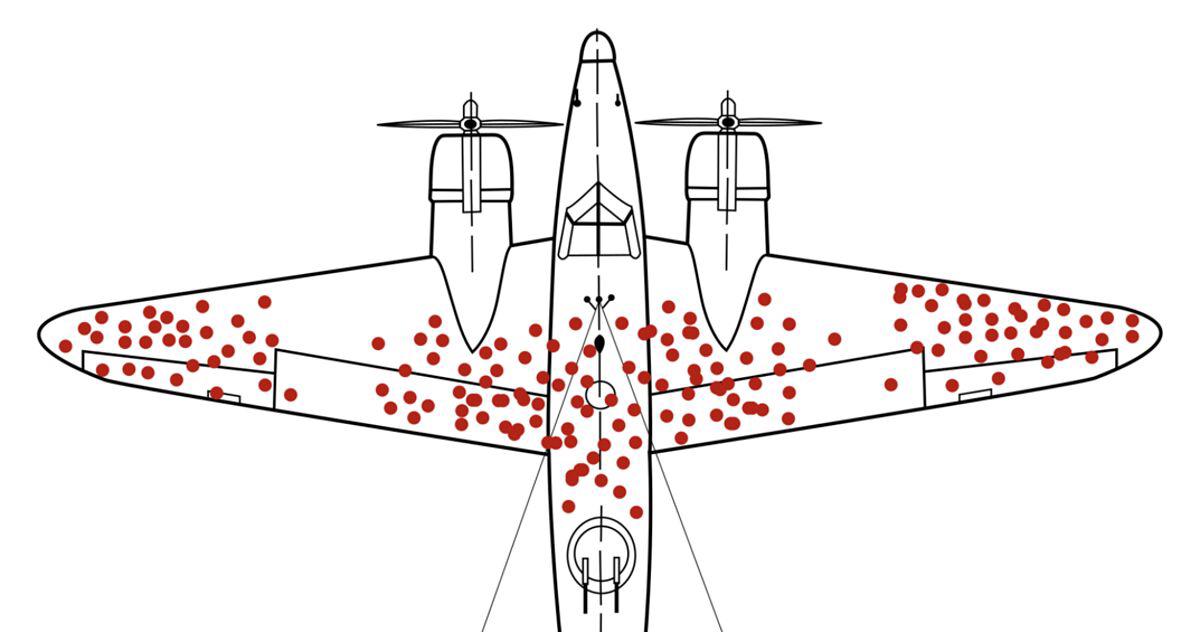
The airplane example is the canonical example but also ironic because it’s an example where there was a ton to learn from survivors. Their first takeaway was logically inconsistent but eventually they realized that places without bullet holes were the most important to armor. Because planes shot in other places survived. If no planes survived they’d learn nothing but instead they learned something useful from the survivors.
It doesn’t change that a WW2 fighter pilot would need some luck to survive but if he took the right lessons from survivors and armored his plane in the correct places he’d improve his probability of surviving.
One of my favorite pieces of business advice is since 90% of businesses fail, start 10 businesses and you’ll probably succeed. Of course that oversimplifies things but so does the original statistic . It’s also useful advice that helps you re-frame “luck” as stochastic risk that you can manage. And learning ways to lower probability of failure is a great way to manage risk even if there’s always some element of randomness at play.
That does not change the fact that the best thing you can do to tilt the odds in your favor is to choose your parents carefully.
Some other bit about being a movie producer. Guy said people ask how you can become a producer. He said it's impossible. No one will let you produce a movie unless you've done one before. But if you have even if it is terrible and flops, you're a producer and can get work.
Combine those two. If you have the want, low grade cunning, and persistence you can totally make a living starting businesses after your first disaster.
OTOH, if you assume we're not on average dumb or trying to get a rise out of you, you'll have a good time.
If I wanted to be really snarky, I would point out that words like "probably" actually have agreed upon numerical values (give or take), and 65% would often be described as "about as likely as not". [^1] Although it's close to the "likely" range, I will grant you. :P
[^1]: https://www.ipcc.ch/site/assets/uploads/2018/02/ar4-uncertai...
They definitely had a level of control over their fate.
The point of my remark is for B-17 crews, each pull is less risky, because they learned how to avoid getting shot down. For example, at the end of each mission, the crews were required to clean the guns. Some crews on the way back over the channel, would take their guns apart and clean them to save time.
One day, my dad said a Junkers was lurking near the airfield, and got behind the crews lined up for landing. Brrp! Brrp! Brrp! and down they went, without firing a shot in return. He said he never dismantled his gun before they were safely on the ground.
Crews who successfully survived 30+ missions were often rotated back to the states to train the next crews in how to survive.
It's especially interesting to hear advice from people who lack empathy. Maybe high performers giving advice to someone with a disability. Or someone who got lucky that credits their hard work and denies luck had anything to do with it.
I'm tired of it. I'll look at some advice just for curiosity, but I'm done trying. What happens, happens. No point in repeatedly wasting effort.
There are truths in there; success does take hard work, but hard work does not lead to success. Success takes perseverance, but perseverance does not lead to success.
Baking bread requires time, but having time does not lead to bread.
You can do all the work, you can have most of the ingredients, but without yeast you don't get bread. It doesn't matter how much time, perseverance, work or dreams you put in.
Finding the right advice is hard because unless someone can see what you are doing right, it's hard to know what is missing.
Yes, sometimes the yeast is luck. But even knowing that is helpful. Luck (aka chance) can often be improved. I was lucky to land in the job I did, but I am least put myself in the right place at the right time.
The worst advice is something you are already doing (hard work perseverence) without success. It's the equivalent of "what you are doing is not working, but keep doing it anyway" which is terrible.
But sometimes the advice you really really need is not platitudes that make you feel better, but hard hitting truths that (as a side effect) may make you feel useless.
-Good advice- that applies to your specific context, is hard to find. But it is invaluable.
The truth hurts sometimes, and empathy makes us want to soften that hurt. But advice is valuable if it's right, not just kind.
Of course its also possible to deliver good advice in such a noxious way that it's impossible to take seriously.
Business Advice Plagued by Survivor Bias - https://news.ycombinator.com/item?id=4314107 - July 2012 (1 comment)
Business Advice Plagued by Survivor Bias - https://news.ycombinator.com/item?id=768297 - Aug 2009 (36 comments)
Given X clients paying Y with the total expenses by Z as long as X * Y > Z the business can remain solvent.
Profitability, return on investment, scale, and whatever other metric you add changes this formula.
Get advice from a 2nd-hand source who has collected a bunch of 1st-hand sources and done analysis on them.
Same reason Wikipedia doesn't like primary sources; being a primary source doesn't mean you're correct. [1]
[1]: https://en.wikipedia.org/wiki/Wikipedia:Identifying_and_usin...
It is not going to make you sing like her.
So I’d go for advice to actual voice coach.
But there's a massive trend of people born wealthy to attribute their success to hard work, rather than giving any credit to the fact that they had a massive safety net if they failed at their ventures. Every billionaire was born a millionaire.
Taylor Swift had a huge amount of support, both financial and emotional, from her parents. Her parents weren't millionaires, but they were decently well off, enough that they could move her to Nashville just to help put her career on a launch pad. She's extremely talented, but talent alone is extremely unlikely to be enough. You have to be able to meet the right people at the right time in the right place. All that together takes money and flexibility, which aren't things you earn by just working super hard.
Not Musk. Not Jobs. Not Gates. Not Bezos. Not Oprah. Not Paul McCartney. And so on.
> Her parents weren't millionaires
Not Taylor Swift, either.
> She's extremely talented
I've heard her songs. Her talent seems mediocre to me.
> which aren't things you earn by just working super hard
You have to work smart. Working hard at the wrong things leads to nowhere.
That's 15 years of time to apply your own advice. Where's your billion dollars? How many "tries" have you made in that time? What do you think the odds of success are based on the number of failures?
We're not talking about middle class family home lifestyles and salaried jobs here, we're talking about SUCCESS which you seem to think has some obvious advice that just needs to be applied and also that you know who is dispensing the good advice. No personal factors, no luck right? Has that worked for you so far? Will you have a billion dollars by the time you're 50? In terms of % towards a billion dollars, where do you sit?
For example, see https://www.failory.com
It's so sad that people still believe this lie.
It creates a victim-blaming mentality of assuming that anybody that failed simply didn't try hard enough.
Sometimes, the success of a business comes down to just being at the right place at the right time. Sometimes, it's just a matter of having rich parents that gave you enough seed money that you could actually dedicate time to your business rather than having to work 40 hours/week just to pay the bills before being able to spend any time on your business.
Even if you were handed opportunities on a silver platter (ie. rich parents), you still had to put in your own effort somewhere along the chain to get the ball rolling.
If you never start, no matter how lucky or good your circumstances are, you will still be at 0%. Therefore, there's no success without effort.
Or to put it about another aspect
"Career advice plagued by survivorship bias." That souns equally stupid.
Also, if some rich person gives you advice and you follow it, they (and their friends) will be more likely to invest in your company because they agree and believe in their own advice and they don't want to see your startup fail because of them. There is ego at play.
If you're not successful (which is almost everyone) then you should not listen to advice from successful people because it doesn't actually work in your situation. Instead, you should listen to people who failed and understand why they failed. They'll tell you useful things like "find a niche where you can sell your product 100% word of mouth" because they understand how search engines and social media works against you when you don't have capital or influential social connections. And these failed entrepreneurs probably know one person who was able to launch a small lifestyle business like that. This is realistic and achievable and minimizes the role of luck.