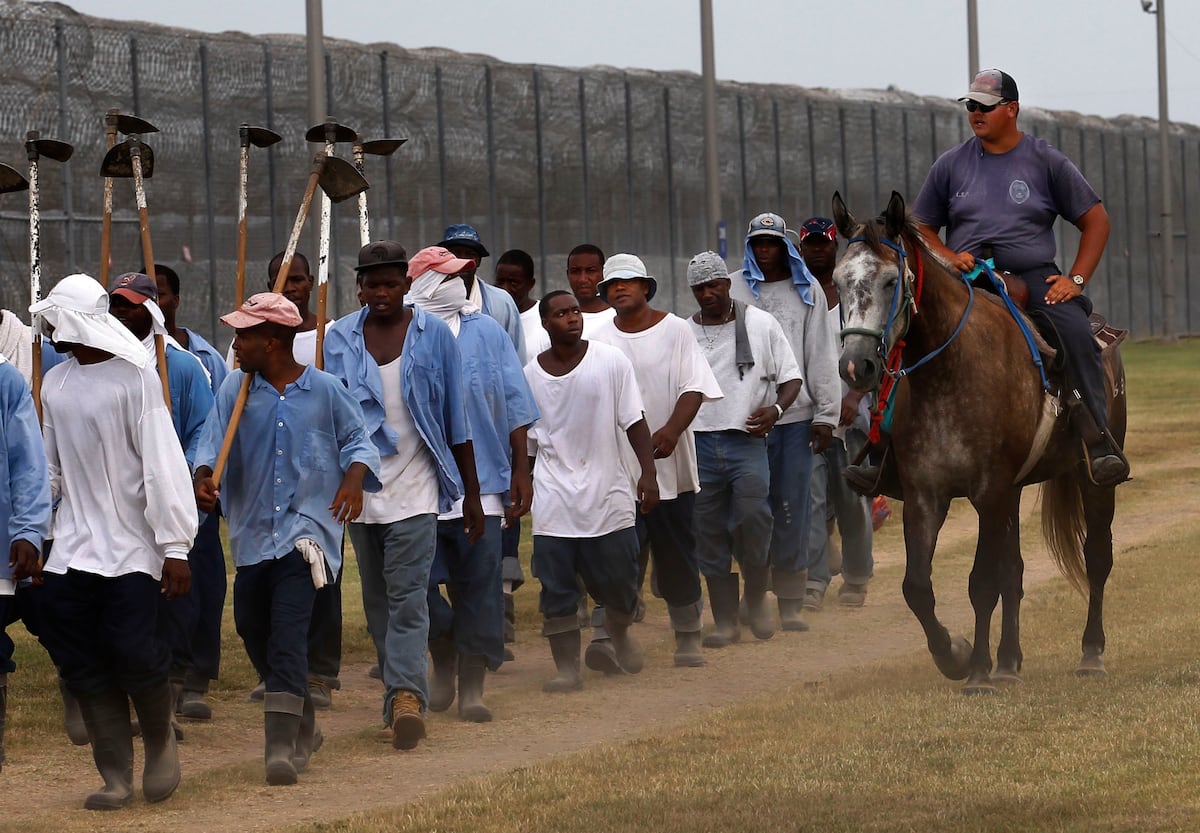
Prisoners in the US are part of a hidden workforce linked to hundreds of popular food brands
Enshrined in the Constitution by the 13th Amendment, slavery and involuntary servitude are banned – except as punishment for a crime
EL PAÍS English
203 points · by PaulHoule · 2y ago · 237 comments
I've been reflecting how this and similar prisons all (AFAIK) elapsed into the same dismal hellholes that 19th century sanitariums did. Eventually reformers die and are replaced by politically driven, officious beancounters.
Are these standardized exchange rates, Labor for [product]?
Does a South Carolina Felon have more buying power than a Nebraska Felon?
Whats their labor exchange?
A particular guy stood up and pitched his company solution. That company was called Unicor. The spokesman was well-spoken, had clear points, and was African American. The pitch essentially was, use prison labor for E*Waste, contracted via Unicor.
A second person stood up in the audience and called it what it was, in front of everyone. Privately, the two nearly came to blows back stage out of sight, shortly afterwards.
this is not fake in the USA, and even more not fake elsewhere in the world.
https://resource-recycling.com/e-scrap/2016/12/01/federal-pr...
“All day long they work so hard Til the sun is going down Mending all the highways and byways And wearing, wearing a frown You hear them moaning their lives away Then you hear somebody say: That’s the sound of the men Working on the chain / gang.”
Sam Cooke, 1960 https://youtu.be/zBn5aIfZElE
My my my my my my my my my my my my My work is so hard Give me water I’m thirsty
I tried to compute an estimate of the current percentage of the US population that's forced labor vs. at the peak of the pre-abolition slave trade, and from what I can tell, it's currently higher than it ever was back then.
People argue that what we currently have isn't the same or as bad, but present-day prisoners would point out that the current system is a form of eugenics: We keep a large percentage of reproductive-age black males locked up where they can't father or raise children. Back in the slave days, owners often chose who breeded with whom. Both are reprehensible, but you could argue either situation is worse than the other. At least the old policy didn't have the effect of slowly reducing / diluting out the black population.
Anyway, the US should ban slavery.
There are about 1.9 million people incarcerated in jail or prison in the United States today.[2]
The scale of incarceration in the US today is mind-boggling, but is itself under half the number of people enslaved at the height of the Southern slave economy.
[0]https://usafacts.org/articles/the-1860-census-counted-4-mill... [1]https://www.census.gov/library/publications/1864/dec/1860a.h... [2]https://www.prisonpolicy.org/reports/pie2023.html
Wikipedia says
>According to the latest available data at the World Prison Brief on May 7, 2023, the United States has the sixth highest incarceration rate in the world, at 531 people per 100,000
531 people per 100,000 works out to about half a percent. Meanwhile during slavery in the US, wikipedia says
>The slaves of the colonial era were unevenly distributed: 14,867 lived in New England, where they were three percent of the population; 34,679 lived in the mid-Atlantic colonies, where they were six percent of the population; and 347,378 in the five Southern Colonies, where they were 31 percent of the population.
Even in low slavery areas, the slavery rate is higher than current incarceration rates by several fold.
The first user made a wild, incorrect guess, and the rest of this subthread shows just how badly that can spoil discussion quality on a forum like this. Fortunately, someone linked an earlier discussion up at the top.
>I tried to compute an estimate of the current percentage of the US population that's forced labor vs. at the peak of the pre-abolition slave trade, and from what I can tell, it's currently higher than it ever was back then.
It's explicitly talking about "percentage" at the start. It would be weird if they silently switched to absolute numbers afterwards.
To tie this into eugenics I think you'd have to make the case that black people who aren't criminals are being unfairly targeted for imprisonment. Otherwise it's just a side effect of criminal behaviour, and criminals end up in prison regardless of ethnicity.
I'm not suggesting it would be difficult to make that case. But some people tend to disregard systemic bias, so it would seem that everything is fine. If you don't want to be imprisoned, all you have to do is stop acting like a criminal.
this is a fairly easy case to make, see, for example the reason for the current distribution of race in us prisons
As for it being eugenics, most prisoners are in for violent crimes or property crimes. Imprisoning people for stuff like failure to pay child support (modern debtors prison) is shameful, but not the sort of thing most US prisoners are in for.
From the 1860 census [1]:
Total Number of slaves: 4m
Total Population: 31.4m
Percentage of population as slaves: 12.7%
From the 2010 census [2]:
Total Population: 309m
Total Incarcerated Population: 7m [3]
Percentage of population incarcerated: 2.2%
OP is absolutely not correct, even if we are generous and assume every incarcerated person is forced into labor.
[1]: https://en.wikipedia.org/wiki/1860_United_States_census [2]: https://en.wikipedia.org/wiki/2010_United_States_census [3]: https://en.wikipedia.org/wiki/United_States_incarceration_ra...
Then wonder why we have such a high rate of recidivism.
It should also not be for the profit of private companies. They are maintained by our tax dollars, and the public should reap that benefit.
That’s odd, because the countries with the lowest rate of recidivism don’t have forced labor. “Lack of discipline” isn’t the reason most of them are in prison, it’s lack of skills and opportunity. Nothing about the prison industrial complex is fixing either of those problems.
It is subjecting them to a dog-eat-dog culture of violence though. Not exactly surprising people generally come out even less able to productively participate in society than when they go in.
I couldn't find any studies that specifically focused on involuntary labor; presumably some of the people in the linked studies were willing to work and not forced.
Work programs aren't magic, and they're certainly not going to cure sociopathy. They're a means to train and habituate people whose criminal behavior may have been significantly affected by their inability to maintain gainful employment. Of course we should continually try to improve them for relevancy and effectiveness.
Between racially-biased mandatory minimum sentences, forced prison labor, and the fact that felons lose their right to vote, the United States prison industrial complex is a system that truly isn’t far off from slavery.
https://en.wikipedia.org/wiki/In_Praise_of_Idleness_and_Othe...
Not really.
I hope you or your family are never hurt by a criminal. However, if that does happen, I assume you will be okay with the criminal going to a summer camp where they sing songs, play games, and eat bonbons. ;)
I haven’t been, but I’ve been close with multiple people who have been wronged personally (near-deadly assault, unprovoked, all cases unrelate) and they all came around quickly to not wanting any vengeance on the assailant, legal or not. I was surprised, frankly.
In all cases survivors just wanted to move on, and simply not hear about the perps.
It may be frowned upon; but, it's legal. Even in 1865, prison labor was scene as "acceptable" slavery. It's the exemption in the 13th Amendment to the U.S. Constitution: "Neither slavery nor involuntary servitude, except as a punishment for crime whereof the party shall have been duly convicted, shall exist within the United States, or any place subject to their jurisdiction."
Neat
Essentially, with the decriminalization was meant to come a whole host of support network and rehab and other programs (regardless of what you may feel about the viability of the same). Then COVID happened, everything was decriminalized, and all of the other stuff did not, or barely, got off the ground, and is playing catch up now. And the result has been entirely predictable.
> voluntary uptake of drug rehabilitation offers has been terrible as most skeptics suggested
As a paramedic who administers Narcan multiple times a week, I get this. But the rationale is "if someone is using drugs, is even a 2% (arbitrary number) entry into rehab a success? Certainly if compared to 0%".
Let's also be real, it's not the legality of harder drugs that determine whether people do them or not.
I'm entirely in agreement. Dealers and suppliers? Those are, and should (and in PDX are) be illegal still. Portland Police have to shoulder their share of the blame, too, here, not (just) the social constructs - Portland Police were some of the worst in the country when it came to things like BLM, Patriot Prayer, the Proud Boys and similar (and behind Seattle were one of the top per capita when it came to "number of officers who attended 1/6") and have been happy to "quiet quit" (worse, really) the last few years.
As for victimless crimes, do they really deserve prison to begin with and wouldn't we do better with alternatives, or perhaps even removing some of those laws entirely?
There are "victimless crimes" that are only victimless because everyone was lucky: a 3rd DUI, firing a gun in a crowded area but not hitting anyone, etc. Then there are crimes that have millions of potential victims: dumping toxic waste in a river, etc. It'd be an entire extra enigma the courts would have to figure out with every case. (I do think a big percentage of the "victimless crimes", like personal drug possession, should not even be crimes at all, but that's beside this point.)
Some even do so when there has been no conviction.
This is an industrial complex and they are the product.
There are exceptions of cause, see Norway.
We can discuss the negative incentives of having them do labor and how that might pervert our legal system (companies that benefit lobbying for harsher penalties on victimless crimes), but they are still denied their freedom regardless of which way that discussion goes.
Prisoners should be denied as much freedom as is necessary to protect the rest of society and no more. Forcing people to work against their will does not protect anybody. It is not legitimate to say that if we deny one freedom we might as well deny all of them, they aren't free regardless.
Also, I recognize that there are a lot of people in prison in the U.S. who shouldn't be there. I think our the way people end up in prison needs reform, of course. However, once there, the point is to punish people for doing something wrong, IMHO. "Rehabilitation" is not the point of prison.
Neither is a practical or morally justifiable answer, of course. Other than cases where defendants are sentenced to life without parole, most of the people incarcerated in the United States will eventually be released from prison (whether it be through parole or because their sentence has been completed).
A purely punitive prison system does nothing to prepare prisoners for their eventual release back into society. Which, again, will happen for most prisoners. Even setting aside the moral questions with that approach, you merely increase the odds of re-offending. How is that better for society?
Probably because satisfying your want for revenge isn't a good enough reason to have the big expensive system that is prison.
Presumably prison should be solving some wider societal problems.
Funnily enough, studies of families of murder victims where the murdered was sentenced to death show that they tend to disagree with you.
It "satisfies" for some very brief moment, but the loss is still there, and it doesn't make anyone's life better. It doesn't improve anything for anyone.
I'm reminded of American History X. A character is raging against everyone and anyone he has perceived has hurt him, his family, his home, his country. Immigrants, POC, whatever. He has responded with hate crimes, destroying grocery stores, forming groups of likeminded (or white) people.
His efforts end him in jail, and he's still raging.
And then a teacher asks him, says: "There was a moment, when I used to blame everything and everyone for all the pain and suffering and vile things that happened to me, that I saw happen to my people. Used to blame everybody. Blamed White people, blamed society, blamed God. I didn't get no answers 'cause I was asking the wrong questions. You have to ask the right questions."
Like what?
"Have any of the things you've done made your life better?"
They give voice to anger, rage, revenge (that's honestly a more honest word, in your case - you don't just want them punished, you want revenge on them). But none of those feelings improves anything.
- The prisoner should be able to freely choose to work or not to work.
- The prisoner should be able to choose whom to work for and be able to quit.
- The prisoner should be making the same wage as someone not in prison. This wage may be garnished by the jail to pay for prison (separate topic), but it should still cost the company the same as a non-prisoner laborer.
The bad things that are avoided are:
- being unethical
- making sure corporations don't lobby to expand prison labor - which could have the side of effect of criminializing things that most people don't consider crimes.
to wit; how often is prison product tested or monitored for tampering or expectorative adulterations ?
I'm very much appreciative of the fact that, though not mentioned, a growing number of fire departments are willing to overlook (certain) criminal history for hiring ex-inmate firefighters.
(To be clear, they are being paid far below minimum wage; it would be illegal if they weren't prisoners)
If this makes prison labor no longer economical, so be it.
If people outside those prison walls are forced to get a job, then the people inside those walls should be no exception.
> More than 76 percent of incarcerated workers report that they are required to work or face additional punishment such as solitary confinement, denial of opportunities to reduce their sentence, and loss of family visitation, or the inability to pay for basic life necessities like bath soap.
- https://www.aclu.org/publications/captive-labor-exploitation...
For example, in most of the states, there are prisons that are pay-to-stay, so prisoners basically go in debt while they’re incarcerated. This further troubles their debts, putting more pressure on them to take on work. Part of this debt can be written off by working on specific jobs that are sourced by local employers. There was a case of a woman I read about, how she’s paying off her pay-to-stay prison debt working at a wings place part time, while serving her sentence.
Since every state has its own laws and complexities, you get a bunch of scenarios that add up, which, in my opinion, are highly immoral.
But yeah, pay-to-stay imprisonment is a thing - https://en.wikipedia.org/wiki/Pay-to-stay_(imprisonment).
But it does mean that we could combat #2 by actually paying convicts working as part of a prison sentence the wage they'd get for that same job after release. Why are we paying convicts less than $0.50/hr[0] for jobs they'd earn $25-30/hr for? Because it benefits those local economies, but at the cause of driving up recidivism. Imagine if you were incarcerated, had the option of working (the majority of incarcerated workers are punished if they don't work), and if you did you'd have thousands in savings when released to get back on your feet?
> Neither slavery nor involuntary servitude, except as a punishment for crime whereof the party shall have been duly convicted, shall exist within the United States, or any place subject to their jurisdiction.
It may not be chattel slavery.
By the legal definition of kidnapping, putting someone in jail could be considered to be kidnapping yet everyone knows very well that it just isn't the same
We don't force deadbeat dads to work; we force them to make payments. You can sell assets, use savings, beg/borrow/steal, but you're obligated to make the payments.
If we assigned a job to deadbeat dads, that would be involuntary servitude. (Certain levels of avoiding child support payments being a crime, this is currently Constitutionally permissible, but uncommon.)
> By the legal definition of kidnapping, putting someone in jail could be considered to be kidnapping yet everyone knows very well that it just isn't the same
No. https://www.law.cornell.edu/uscode/text/18/1201
The second word in the definition is unlawfully. Putting someone in jail via due process is not unlawful. I know we all like to think of Congress as entirely feckless, but the interns writing the regs typically aren't idiots.
And I'm not a constitutional lawyer, but it seems to me that "except as a punishment for crime whereof the party shall have been duly convicted" qualifies "involuntary servitude", not "slavery". And in any case, lawyers like to err on the side of ruling out any possible misinterpretation, no matter how ridiculous.
If one was with a child, and the child saw a chain gang working, and the child asked "Are they slaves?", no sane person would say "yes" and leave it at that. You're being either daft or disingenuous, or both.
But it is, if unpaid, slavery.
> And I'm not a constitutional lawyer, but it seems to me that "except as a punishment for crime whereof the party shall have been duly convicted" qualifies "involuntary servitude", not "slavery". And in any case, lawyers like to err on the side of ruling out any possible misinterpretation, no matter how ridiculous.
No. The distinction between the two is that involuntary servitude covers being forced to work while being paid or otherwise compensated; a slave, in contrast, doesn't get paid. Both are forced labor, but one is slavery. US prison labor may be one or the other, depending on payment.
(An English teacher would also sigh at you for your parsing of the clauses, I suspect. Your interpretation would require a different arrangement of the commas, i.e. Neither slavery COMMA nor involuntary servitude except as a punishment for crime whereof the party shall have been duly convicted COMMA shall exist within the United States...)
> If one was with a child, and the child saw a chain gang working, and the child asked "Are they slaves?", no sane person would say "yes" and leave it at that.
Correct, because at a glance, you don't know if it's forced labor. Some states do voluntary work gangs; in some scenarios it's even considered a perk.
"If you don't work (or someone who loves you doesn't work for you), you don't eat."
The alternative is manifestly unjust: A prisoner who might have killed 20 people gets to just live life, and can't be ordered to even keep the cell doors clean.
The US 13th amendment says,
> either slavery nor involuntary servitude, except as a punishment for crime whereof the party shall have been duly convicted, shall exist within the United States, or any place subject to their jurisdiction.
"Except as a punishment for crime whereof the party shall have been duly convicted". Ie, you're in prison, and required to labour. It's slavery. It's right there in that US consitutional amendment.
There are different types of slavery. You may be thinking of chattel slaves, where a person is owned. A prisoner is not owned. That does not mean that someone who is not owned by another human, yet who is forced to labour, is not a slave: it's called de facto slavery or state imposed forced labour slavery.
See https://www.antislavery.org/what-we-do/state-imposed-forced-...
The wrong part is when you connect "X loses many of their civil rights" to "Y makes a greater profit", and now Y has a lot of money and an incentive to spend a fraction of it on lobbying for legislative changes that will send even more people to prison... which means even more money for lobbying, etc.
A few iterations of this feedback loop and you get a system which routinely sends people to prison for trivial things, which routinely sends innocent people to prison, heck even a system where the innocent people are officially advised to "confess" and accept a plea bargain rather than insist on their rights and risk 10x greater penalty if they are falsely convicted.
> With the passage of the 13th amendment in 1865, slavery was deemed unconstitutional. Involuntary servitude as a punishment for crime whereof the party shall have been duly convicted, was still explicitly allowed.