Espressif ESP32: Breaking HW AES with Power Analysis
Breaking the ESP32's hardware AES engine with a correlation power analysis (CPA) attack, recovering the full AES key from captured power traces in seconds.
Raelize
99 points · by transpute · 2y ago · 25 comments
In the 'unknown key' example it seems as though that trick is still used as well, but the text isn't very clear around that part - at least, not to me, but in the code it looks clearly as though that pin is still cycled around the AES encryption call. In a real world attack you wouldn't have that information, you'd have to figure out some way of determining when the AES engine is operational first. And then this attack would suddenly become a lot harder.
The ChipWhisperer Husky has an "analog pattern" trigger mode[1], which can help with this sort of thing.
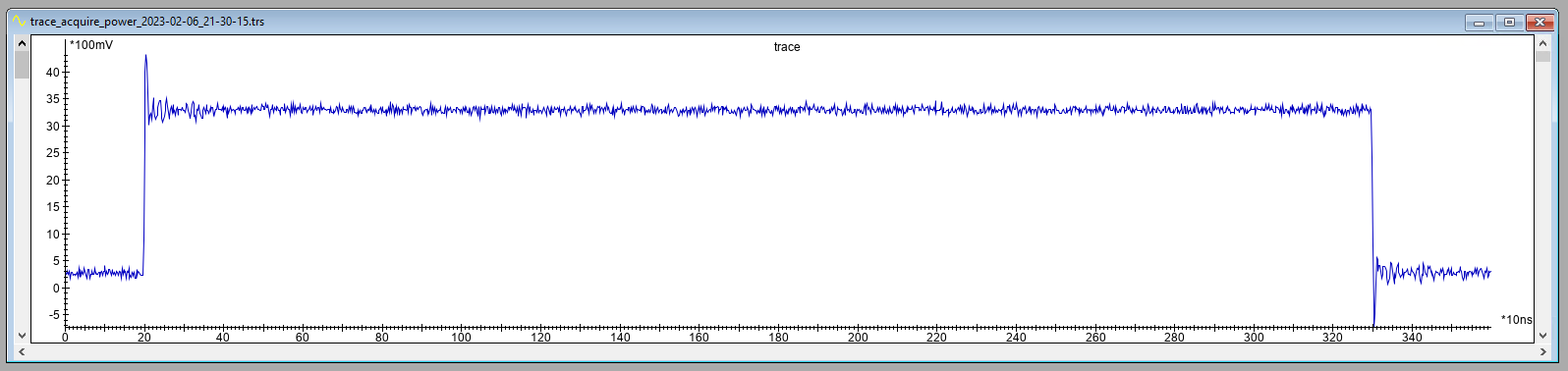
In essence, as far as I can follow the article what they've done is to first identify a sample in a block of samples taken after their own trigger goes off that has a high likelihood of leaking bits from the key by using a known key and running analysis to verify that that sample is the one to focus on. They then proceed to monitor just that one sample to retrieve an unknown key (this had a very high likelihood of working).
But that's - to me - the same as knowing exactly where in the haystack the needle is buried and then to proceed to prove this by uncovering it. Whether the needle was known or unknown doesn't matter any more at that point it's simply a way of proving that the extraction itself can work. But the hard part is to find an unknown needle in an unknown location and identifying the location without knowing the key would be a lot harder. The article reads as if you can extract any key from any ESP32 in a couple of seconds but I don't think it is quite that simple. Keep in mind that normally the flash of the ESP32 would be encrypted so you wouldn't be able to conveniently patch in a helpful trigger event around the encryption engine.
This is detailed in the paper that inspired this article, or in in this more recent blog post: https://courk.cc/breaking-flash-encryption-of-espressif-part...
There wasn’t even a discussion on why the particular AES configuration deployed was used or how it affects the process.
>Therefore, we decided, in similar fashion as Ledger’s scaffold, to make our own custom board where all the relevant signals are routed to dedicated pins.
Explaination or theory: someone else did it the same way.
>Throughout our research we used two acquisition techniques that are supported by our oscilloscope: normal block mode and rapid block mode. We used Picoscope’s Python bindings to communicate with the oscilloscope. We used their ps3000aRapidBlockExample.py as a reference to integrate rapid block mode into Riscure’s FiPy.
Sounds like they used what worked on their hardware.
Part 1: https://eprint.iacr.org/2023/090 How to break ESP32 AES with power analysis
Part 2: https://courk.cc/breaking-flash-encryption-of-espressif-part... How to do it for no more than $100
Part 3: This article Improving the performance
It is an interesting challenge to secure chips, and something I don't think anyone has a really excellent response to. Always interested in papers along this area.
Both features depend on HW AES keys.