After switching from 1080ti to 4090, this programmer wants to save lives by offering FREE services
Late last month, I received a message.
howardchen.substack.com
134 points · by coolwulf · 2y ago · 47 comments
I hope more doctors and physicists learn about NeuralRad, allowing the most advanced radiotherapy AI to benefit more patients and extend the lives of many.
I have decided to open user registration for use. Now, after signing up, you can start using this AI service immediately.
If you don't have the corresponding Dicom data for testing, you can click the Demo button on the platform, which will automatically open a case of a brain tumor MRI.
1. Longitudinal comparison of images over time for response assessment 2. Prediction of radionecrosis vs. brain metastases 3. Flags for hypertrophy or atrophy of normal organs (i.e. cardiomegaly, splenomegaly) Easy to do based on volume
1. We have already developed the module for the longitudinal comparisons of the follow-up MR images. The module is not yet published but you can see the follow-up tab on the top of the dashboard (now grayed)
2. There's an on-going research between us and Stanford hospital on the prediction of radiation necrosis vs. brain mets. Our publication could be found in last year's AAPM conference.
3. Sure that's a function could be added soon.
Thanks.
Hao
Best,
“Amateur” programmer fought cancer with 50 Nvidia Geforce 1080Ti - https://news.ycombinator.com/item?id=31449147 - May 2022 (329 comments)
In addition, I'd never, ever, not in a million years, consider any interventional or diagnostic strategy from a blog post, most of which is written in a language, any language, I can not readily understand. Not to mention, I'd like to see names, not 1337 h4xx0r handles ("coolwulf" is great if you're 12 and playing WoW as a Worgen Deathknight, it's not cool if you'd like to convince me to add more tools to my workflow), when I consider modalities.
As a sidenote: modalities like this one are common in modern radio diagnostics. Harvard, MIT, Cambridge with King's, Paris Cité, and a few more are working on evidence based (and Open Source/Open Algorithm) approaches to AI diagnostics, all of which seem to have their ups and downs in outcomes. All their services are HIPAA compliant and certified as such, run in-house, do not require me to upload vast amounts of radiographic data to a website operated in a country I wouldn't trust with my daily egg consumption stats.
We're not talking funsies at the 7/11 here. We're talking diagnostic and therapeutic decisions. Basing those on a black box "pinky promise, it works" approach, is pretty much how people get killed. Not to mention, it's a 1980s view of things, the "if I can see it, I can cure it" approach. Modern oncology means to diagnose based on genetic and sequential markers, develop individualized strategies, long before imaging modalities become important. And if they do, there's plenty of hard- and software out there to make our lives so insanely easy, why send our stuff to a graphics card in China?
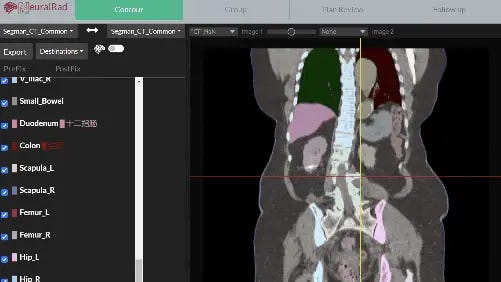
The radiation oncologist will outline the tumour and a few organs at risk manually. This segmentation algorithm would then steps in and outlines organs that the doctor would not have traditionally contoured. For a lung lesion the RO may contour the lesion and the heart but might not contour both lungs and the diaphragm.
We can then input these segmentations into a treatment planning optimization algorithm that sets the radiation beam angles and collimation to meet constraints that minimize organ dose and maximize tumour dose. So in effect the application of this sort of segmentation is to give more information to an optimizer.
Not that it doesn't have its problems! But I think it's important to note that the application is not diagnostic
Maybe consider looking at the science too?
(FWIW, I've started working on AI for radiology nearly a decade ago, and Chinese researchers have been leaders in the field for most of that time.)
1) NeuralRad could be running locally inside your own clinic. Currently, Stanford hospital, UTSW, Jefferson and several other clinics in the US are using it in house. In this configuration, the data never transferred outside the clinic.
2) The whole platform is HIPAA-complaint. All Dicom data are anonymized before submitting to NeuralRad server for inference if using the NeuralRad cloud server.
3) NeuralRad server is within US, not in "other" country.
Thanks.
No. Know how I know this?
Does that not indicate that he might have something useful here? Even if he has a gamer nickname and is based in China.
To clarify, we have several research collaborations on-going in US clinics.
But, hey, you do you. If you're comfortable subjecting yourself or your loved ones to this, by all means, do it. Without a decent sensitivity and specificity review, without an actual review in general, and without a corporation whose jugular I can cut if they screw up and murder my patient through a misdiagnosis, I'll stay away from someone's home grown shoe box medicine as far as I can. And I know all my serious colleagues will and are as well. It's not like that's the first person this week (or even today) trying to sell us one of those.
And if Chinese single-individual solutions with gamer nicknames don't worry you, someone who frequents Hacker News and is probably not dumb, I understand many of the issues we have with medicine and medical communication much better. I'm sure you're confident that you, or a loved one, will be correctly diagnosed by this thing. I am not.
[1]: these hospitals are conglomerate hospitals who will buy things to try them out. I have dozens of bullshit solutions my bosses bought in storage. Why do you think you're getting raked over the coals for every small issue? Why do you think health care in the US is that expensive)
Generally, I do very much oreder if projects like this, regardless of the field, do include a healthy number of very experienced people in the actual domain, here that would be oncologists and radiologists specialized in oncology. Otherwise, I always assume it is some potentially dangerous almost-right first principle thinking at play. IMHO there is not a lot that is more dangerous than this.
Well, Thalidomide, the aforementioned cryo scalpel, Paolo Macchiarini, and others have taught us, that that's never a good idea.
It's 2024. We're throwing our lot in with serodiagnostics over anatomical localization, a PET scan being the only thing we need these days. If we know it's a lesion and we can FNA it, we will, else there's enough serodiagnostically we can do, to build individualized treatment plans (or determine if there's even a reason to use them).
It's pretty fun to see the computer draw little circles around lesions. The Bruker solution (also Open Source and free, by the by) does this admirably well. But it's neither useful in diagnostics nor in therapy, since both don't really hinge on a circle around a lesion.
It seems plausible to argue that if you can afford a CT and a radiation therapy machine, then you probably meet the resource bar for the new family of techniques, but I just don’t have much of a reference point to judge.
I see a lot of parallels between what you just wrote and big data and AI applications in a field I know a thing or two about: Logistics and Supply Chains. Same things happen there, a smart system highlighting a problematic order or time period. Great, but identifying those never was the real problem to begin with. At the same time, all the potential of using better planning tools to enable people or to automate repetitice tasks to free up peoples time get somewhat ignored because those use cases are less sexy than automating, and solving, all those "problems" using AI... But tjis hype cycle will ultimately be replaced with new one, like those before it. And I will yell at some other hype cloud!
Maybe a title like "The story behind the NeuralRad organ and tumor segmentation cloud service" would be better.
(I see that the previous post you're referring to https://news.ycombinator.com/item?id=31449147 had a similar title and did extremely well, but maybe you just got lucky then.)