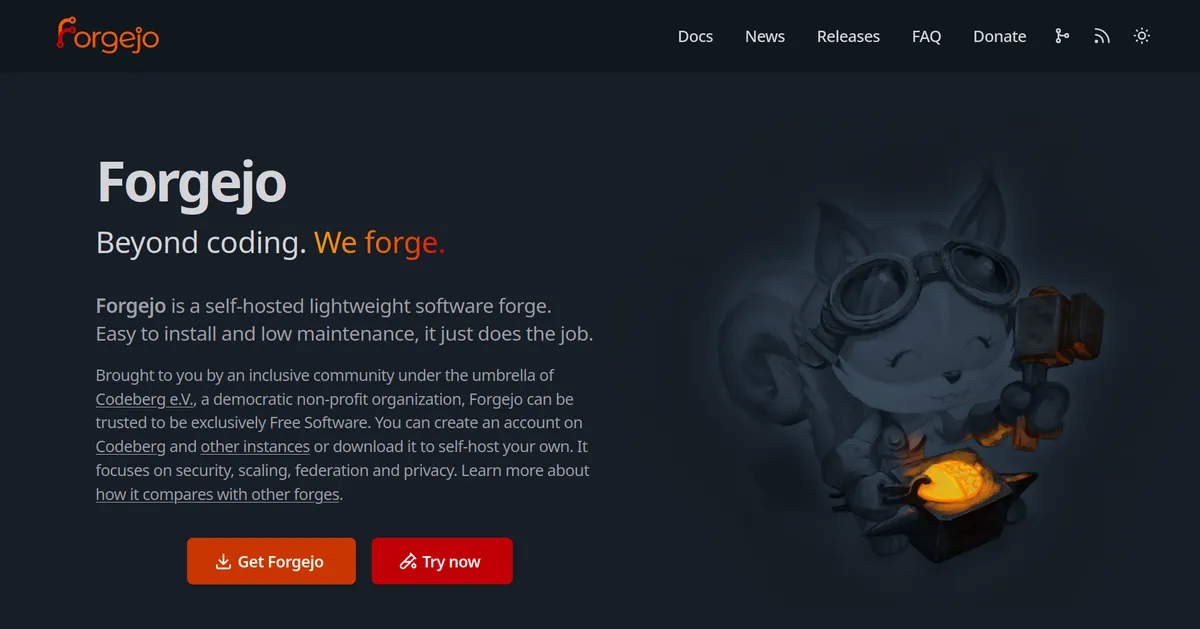
Forgejo forks its own path forward
forgejo.org
94 points · by todsacerdoti · 2y ago · 78 comments
Personally, given a choice between a project that enforces a CoC and a project that keeps creating new for-profit entities to hold the community's IP, I'll take the CoC over the concerning corporate structures.
As for GitLab, I'm concerned by the fact that the company has become weirdly enterprise-y of late. This might not affect the self-hosted version yet, but I wasn't willing to risk it. I ended up going with Forgejo as the option with the least concerning governance structure.
Going back one month (see https://about.gitlab.com/releases/categories/releases/):
Feb 7: CVE-2024-1250 (medium, privilege escalation), CVE-2023-6840 (medium, bypass branch protection), CVE-2023-6386 (medium, ReDoS), CVE-2024-1066 (medium, DOS)
Jan 25: CVE-2024-0402 (critical, unprivileged RCE), CVE-2023-6159 (medium, ReDoS), CVE-2023-5933 (medium, CSRF), CVE-2023-5612 (medium, info disclosure), CVE-2024-045 (medium, arbitrary change of ticket assignees)
Jan 11: CVE-2023-7028 (critical, arbitrary account takeover without interaction), CVE-2023-4812 (high, bypass MR approval rules), CVE-2023-5356 (high, privilege escalation from Slack/Mattermost integration), CVE-2023-6955 (medium, run commands in Kubernetes cluster from another subgroup), CVE-2023-2030 (low, commit signature validation issue).
Note that those are all GitLab issues, not issues with Git or SSH that affect the GitLab application. Running a self-hosted GitLab really keeps you on your toes...
There's also the behavior that others have linked in comments here about the fact that they have people designated as "enforcers" who edit/remove content and comments they don't like.
YMMV.
And as for "maybe it's not for you", I agree and that's what I stated. I wanted to bring it to the attention of other potential users who may also feel that it's not for them either.
Thanks for pointing this out and potentially saving people the trouble.
I don't know anything about Forgejo specifically though. I think it's good to have open-source projects trying to compete with Github and Gitlab.
Groups of people are politics. At some point you need to get over it.
Simple aesthetic changes and codes of conduct / political alignment for contributors are not enough for forks to become full things of their own. Even if they can help (branding, community, etc.). Or hurt (Forgejo is harder to pronounce. And CoC have potential downsides, possibly excluding good people, ironically, over banal minutia and hostile environment around being "not hostile" - like you saying he is "hung up" on it...).
Gitea was already a fork of Gogs, so why should contributors use this fork of a fork?
These forks (and direct clones) are like little political secessionary/independence movements, both making lofty statements and splitting would-be contributors. Sometimes it works out very well and they become full independent things of their own (GNU stuff), but it's fair to want to get on to see the actual engineering side of things.
So I only find it natural that a group of people who split off of Gitea took extra care to set up some kind of governance model.
Those who dislike the idea of a code of conduct can of course also contribute to Gitea or Gogs, or fork Forgejo, etc. This is free software after all.
With 23 open and 1.381 closed PR forgejo seems like an active project, it's in use at codeberg.org which means it isn't a random fork.
If anything, this is a prime example of what many people are concerned about when the topic of CoCs is raised.
It's true that Gitea could have had more openness about such forthcoming development, and I think the new company structure for lunny + techknowlogick will really help them with this and being more professional.
Gitea still has all the development resources and the vast bulk of all PRs. They're committed to MIT with no CLA, the lead developers are there, and that really matters.
In comparison, Forgejo to this point has dragged its feet to rebase its few (~100) patches onto each new Gitea release. Most of the changes are simply rebranding, plus some new moderation tools for codeberg. Although codeberg don't even run forgejo directly but yet another downstream fork.
So I think this hardfork will likely spell the end (or: rebirth) of forgejo. They haven't demonstrated much independent development so far. The worry about keeping some MIT independence is I think a sideshow, the latest Gitea is still MIT and with no CLA. So if forgejo may no longer be drop-in compatible, why would you switch to them?
I wish Gitea and Codeberg could be better friends. Gitea has had amazing success this year with adoption by Blender and other large projects.
It'd be pretty weird for non-software developers to join a non-profit association behind a git forge. And if that wasn't enough, joining the association also requires paying an annual fee.
If the existing leadership disappeared tomorrow though, how many would actually have enough free time and energy to actually continue running the ship? That I'm not sure about, but the capability is there if there is will.
Offering a managed service and paid support seems like a reasonable move to me, and would certainly benefit many small and medium organizations. The profit gained from business could also provide funding for contributors and maintainers.
I like the approach of taking money from corpos to make FOSS stronger. Hard-forking an already MIT licensed project for just another one is really bad for both side.
As a non-native English speaker, I can confirm that you are right. This happens all the time. I used to pronounce "Cache" as "kay-sh" for a decade or so (sometimes I still do)
I only know how to pronounce it because I speak Esperanto. forĝejo is pronounced "forge" like the English word) + "ayo" (like the "ai" in "aim", plus the "yo" in "yo what's up".)
Look at Ubuntu for a foreign name that is easy to spell. Forgejo reads like a typo.
Even sr.ht managed to get a better name
I recently did try to upgrade my Gitea instance to Forgejo but it wasn't a success. I've ended with just hard re-import of the repos, of which the hardest part was manually clicking all 'orphaned' repos.
Can't say anything (good or bad) yet of this whole situation, but Forgejo has a chance to be a bit better product... while it have the manpower and funds.
> the shackles of proprietary tools
Ahem.
Mirroring was working fine in Gitea, no reason it would be broken in Forgejo.
The whole ordeal reminds me of OwnCloud/NextCloud split: both are fine if you need the basics, OC is on the negative list for paywalling the already existing functionality, NC tries too hard to be Nero Burning ROM of webapps; both are shit nowadays.
I didn't like how the takeover of G. went, so when I had the opportunity, I tried to migrate to F.
The decision is up to you, though.
> Ahem.
(Genuine) Can't really understand it. Is it because it sounds like a Communist reference?
Straight: yep, tools.
Rhymes great with the intended meaning: corporate fools
Can be still used straight: >> A person or group which is used or controlled, usually unwittingly, by another person or group.
And finally can be used straight again: >> a foolish or unlikable person
Quite a lot of things are named in Esperanto like the cryptocoin Monero (coin), the watch brand Movado (movement), the last name of George Soros (will-soar, I'm not joking; his Esperantist father literally changed his family name to that)
Edit: https://forgejo.org/static/forgejo.mp4 [0]
[0] Linked from https://forgejo.org/faq/#where-does-the-name-come-from
Wouldn't that also be Gogs? https://gogs.io/
I remember when that one was what a lot of people were looking into, before the Gitea fork happened. It's odd to see how this has happened yet again, but I guess is a good thing that it's even possible in the first place, if there are indeed differing values and goals?
the name is horrible and that has real impact because people can't pronounce it, don't like it and forget about it. So the project will have low adoption and sooner or later will be abandoned. Name is only a factor, but IS a factor.
The devs don't owe anything, I'm just asking for a consideration.
Forgetto
Totally agree. Most[0] don't even use English ever in their life.
If you _really_ find the name problematical, fork it and rename it yourself. Though accept that you will be volunteering yourself for some admin and comms burden if anyone else uses your fork.
I can understand complaints about conflicting names, blatantly offensive names, and so forth, but names that could be pronounced more than one way? Nope.