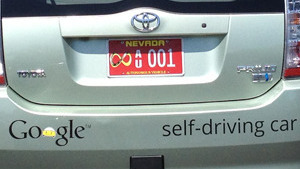
Google gets license to test drive autonomous cars on Nevada roads
Nevada also issues special red license plates for autonomous vehicles, includes infinity symbol.
Ars Technica
197 points · by aaronjg · 14y ago · 164 comments
If Google can work through not only the technical but the social and legal problems associated with fully auto-drive cars, it could literally change the world overnight. Instead of driving cars being a time sink, it could change into something along the lines of being in a room that goes places. You could sleep, read, play games, or otherwise occupy your time. It would literally give the nation tens of billions of hours in added productivity time. It could make the elderly more independent, eliminate drunk-driving, and a lot more. Very cool stuff.
Personally I think the biggest impact this will have is the energy usage one. Currently we stress about our abilities to meet future demands, but we aren't stressed enough to really innovate. Automated driving will definitely change that.
As there are better ways to harness energy and automate things people will move onto more and more productive work.
Finally we may reach a point where things like space colonies, settlements and other massive space exploration projects will make sense. Because we will have nothing else to do.
But, you're completely ignoring the economic framework we live in.
The problem is the people who own these automated systems accumulate more and more wealth, while the workers who once operated them get poorer and poorer. So 'nothing else to do' = 'living in grinding dystopian poverty', if nothing changes in our current economic system.
But delivery trucks will still need someone in them to make the deliveries. But what would change is that the delivery person could be doing things in the truck while on the rounds - this could be related or unrelated work.
Generally, if a technology transition releases a lot of productivity, it also drastically lowers cost of whatever is affected (delivered goods, which is everything). This, by rights, should free up a lot of extra money for people, which they can then spend on other things. The other things generally cause more economic activity somewhere else, which should create the new jobs.
But a portion of truck drivers will lose their job, with it never to return.
However, this can't be, nor should it be, stopped.
And here is the problem. What actually happens is the people who control "production" end up with most of this extra money.
And to avoid even more problems the delivery network could work with post offices to put these safes in place of P/O boxes. Australia Post already does this - you receive a package and they send you an SMS with the code to unlock the safe they've left it in. The delivery truck would just put the packages in the safe totally autonomously.
But when big paradigm shifts like this happen, generally a lot of people end up loosing jobs.
At least the packages that end up on the doorstep still require human delivery. Normalizing addresses and pin pointing the exact location still isn't quite good enough.
But yes, unintended consequences will surely make things interesting. The productive will become more productive, and the 99% will get that much larger...
Imagine that you ordered something from Amazon. You could choose from a bunch of different times, perhaps a dozen in a day, when the automated delivery truck would swing by your house. Your phone would make a noise, and you would go outside to grab your packages off the truck. It would be like an Automat (http://en.wikipedia.org/wiki/Automat) on wheels. You would somehow authenticate yourself and then grab your boxes from your assigned slots.
For example, here in Berlin we have a really good public transportation, which becomes more and more automated every year. In particular, short-distance (as well as long-distance) rails are almost fully automated these days, yet there is still a human sitting in the train's driver's cab for safety reasons.
In other cities like Frankfurt, there are even one or two non-human fully automated short-distance rails. Those are used more in the way we use an elevator, they feel less like trains.
Another example are airplanes, which are driven almost automatically these days, where the pilot is only really required for landing and, again, for safety in unexpected situations.
I think that cars are no different in that regard. There will always be some kind of "driver", although that person will have less and less to do with driving, and more with technical observation, safety, etc.
(As a side note, I think that putting so much emphasis on cars over other types of transportation is some kind of "US thingie". Here in Germany, cars are high valued vehicles, too, but they are generally not a symbol of freedom, independence, etc. Maybe I'm wrong in that regard, but that's my personal explaination of that strange car-centric view on transportation, which leads to so much excitement of self-driving cars, disregarding the amazing progresses in all other areas of transportation.)
In Germany, even in the more rural areas, you can typically walk 15-20 minutes to a town with shops, or get a bus even closer than that. That's not so in much of the US. If you don't live in one of the few walkable cities with decent public transit, you're gonna need a car.
If you think US urban planning is in a mess, come to India. I bet these self driven cars can't survive for even minutes on any street.
In India, you practically have to chase street dogs, dodge cricket balls, avoid kids playing on the road, find the road in a road of full of potholes, use breath control techniques to escape the stench and lanes are nothing short of mazes which you can't find a way out unless you've lived years in that area.
I am not sure if self driven cars can ever work here.
Actually now pilots usually don't land manually unless for training (and so on commercial flights usually only in perfect weather conditions) or when there is some serious problem (like engine not working).
BTW, very big part of recent plane crashes was related to human errors in cases which could be handled by autopilot.
You can't compare the car google is building with semi-automated transportation on rails or in highly regulated air space. It is using completely different technology.
Also humans are notoriously bad at supervising technology. I would much rather drive myself, then having to pay attention all the time and step on the break, if my car does something stupid.
No, I think they are certainly possible and I'd love to see some.
> You can't compare the car google is building with semi-automated transportation on rails or in highly regulated air space. It is using completely different technology.
This discussion was not about technology but about impact. Comparison with other transportation systems which are much more automated right now gives a better impression of the future than unjustified claims about self-driving cars being totally incomparable to anything else.
http://neurographs.wordpress.com/2012/03/20/social-impact-of...
You think it's illegal to scan edit and print just money? Wait till they make it illegal to print firearm parts.
I already have all the AR-15 parts in STL format.
It's not far until the fucking morons in politics whom have no idea of how information works decide 3D printing is in support for terrorism.
How long then until they realize that only intelligence can be outlawed to thwart this imaginary foe.
Oh, wait, the war on education has been in full effect for decades for this very reason. What is the best weapon against education? Poverty.
Keep them poor, keep them stupid.
And he next level of that weapon? When they start acting up, kill th economy to make the educated poor!
What do you think the 2008 crash was about? "the people have caught on to our lies! Quick! Kill he economy, make them worry about putting food on the table - that will shut them up!!"
It is not legal to manufacture firearms unless you are licensed. The ATF will freak out and confiscate everything if they get wind of you building so much as a zip gun.
Also I assume that if the GP is planning on 3D printing an AR-15 once it's feasible (already illegal), he is planning on manufacturing a fully automatic version. That would be manufacturing a "machine gun" and would bring serious jail time.
Are you that misinformed that you need me to cite my comment?
Or, do you, like most on HN consider themselves to be well informed and intelligent?
Then how about you do some research, look into the history of a large number of people and their careers:
Do you know how any of the following people came to be in their positions: (clue: you'd need to know what they were doing over the last 45 years)
GHW bush Cheyney Dov zakheim Rumsfeld Ashcroft Tom Ridge
If you know where these guys have come from and what they have been doing (more than just Wikipedia) you'd be a bit closet to understanding some of the things we are dealing with.
Rather than downvote, why don't you ask for information.
Until a few months ago, I had no idea that the technology was as far along as it is; it seems like they've cracked the hard problems already. That means it's a social problem now - and there's reason to believe that the biggest motivator in adoption of automobile technology (and related public policy) is the insurance industry. As soon as these cars are statistically safer than human drivers (and my expectation is that they may already be safer - humans are crap at driving) then there will be strong incentives to get them to the public.
First, people take awhile to replace their cars. I don't know the stats for this, but 10-year old vehicles don't seem atypical. The good news is that gives a chance for reducing costs. It was back-of-the-envelope calculation based on parts only, but one article I read estimated 5-10k would be added to Cadillac's self driving car if they introduced it by 2015. [1]
Second, there are still some hard problems to solve. According to Thrun, they don't have a solution for snowy roads that block the car's vision of the lane markers, and Cadillac's vehicle has the same problem. That'll also be a problem in areas of construction where line markers aren't accurately marking the road.
There's also some major regional challenges. In Pittsburgh, per a convention known as the Pittsburgh Left, a driver stopped at a red light will pause after the light turns green to allow the “first driver in the oncoming traffic... to make a left turn.” Thrun's team is working on collecting massive amounts of data to overcome niche issues like that, but is that something every car manufacturer will have access to?
I think we can also expect some legal barriers to be a problem. I don't have the best grasp on this, but from a RAND report I read it sounds like state tort law, combined with the complete lack of state or federal laws concerning autonomous cars, could create liability issues for manufacturers. Maybe that would necessitate some lobbying and court battles before manufacturers risk masses of autonomous cars? It's hard for me to tell how important these issues are because the biggest player, Google, isn't focused on the market now.
Ultimately you're clearly right, autonomous cars are definitely the future, but I'm feeling more of a gradual shift as problems are ironed out and the prices of sensors are reduced.
[1]http://www.extremetech.com/extreme/126841-cadillac-promises-...
Personal ownership of a self-driving car is a ridiculous concept. Why would the car have to wait around in the parking lot all day while you're at work? It could easily keep running around ferrying people places. And yet many people will want to own one simply because they think they should own a car.
I think the real future is a market for renting car time. Prices will be high during peak periods (morning and evening commuters) but cheap during the mid-afternoon.
The lack of a large up-front cost will likely drive adoption faster than many expect, especially given the new resistance to car ownership coming from younger people: http://www.theatlantic.com/business/archive/2012/03/why-dont...
I live in a city, as do pretty much all my friends. I walk almost everywhere and occasionally take a taxi when going out in the evenings. On rare occasions a friend with a ZipCar membership will ferry us out of town if we're going somewhere far. None of us actually own a car. We're the target market for the self-driving cars since we've already made the social adjustments.
True self-driving (as opposed to "licensed driver paying attention but not needing to hold the wheel") will be adopted very quickly.
Yes those are called buses and taxis. :) they already exist. they're dirty. and they're not always available when you need them.
One advantage to what you're proposing though is that unlike buses and trains you wouldn't have to put up with dirty, dangerous or rude people near you in the same vehicle.
>It is an illegal and controversial practice.[1]
I think we'll see self-driving cars soon enough, but I'd be surprised if the Old Guard of car manufacturers will lead the way there.
These things will become affordable if the demand is there.
If they keep making cars the way we are making the hybirds (http://www.greencarcongress.com/2011/06/lowcvp-20110608.html) then how will we get to the future?
It would be pretty awesome to use whatever materials that are lying around to make a car/transport device.
But while some cutback in safety features would be possible, I honestly think that the society will take the other option. Robots have no trouble making driving reasonably safe at much faster speeds than humans can. The advantages to society for raising normal road speeds past 200mph vastly eclipse that of reducing the cost of manufacturing the cars. So I think the future will perhaps see even sturdier cars than today, just to be able to survive hitting a deer (or even a cat) at high speed.
When it becomes mostly robots on the road, it will be possible to "program out" a lot of the emergent behaviors of traffic in congested areas.
This could make some of the political problems with upping the speed limit that much go away, though.
Excellent point about the non robotic obstacles. I really would just like to add mechanical failure. A perfect robot driver with a working car is one thing, but can that driver handle hydroplaning/tire blowouts/transmission failures?
- Safety. CPUs don't get distracted. - Far less stress. You wont worry about being cut off when you're reading. - Imaging able to go to sleep and wake up in a new city. Your ride is extremely smooth. - More time. Your trips are much quicker, because each path around each of the corners is perfectly optimized.
I am a roboticist who works on autonomous vehicles for mining applications, and I've always thought the two least obvious advantages are that a) autonomous vehicles will increase the utility of a single vehicle to the point that owning multiple vehicles becomes less necessary, and b) autonomous vehicles will increase the utility of road networks such that their existing capacity will be sufficient for far longer than expected under manned vehicle assumptions.
I am not sure I am ready or happy about this future. Maybe I am just old.
As a side note, I (illegally) took a video of it with my iPhone as I passed by it, but when I tried uploading it to Facebook it was denied twice because I used a copyrighted song as the background (Cars by Devo and then an obscure version of Crosstown Traffic by Living Color, which I thought would have passed the algos but I guess not).
Videos of interesting real-world events, such as a chance encounter with the Google car, are almost never improved by the addition of music, so I'd say just go ahead and upload without music.
Also, isn't Cars by Gary Numan?
I can't understand what business purpose it could possibly serve for Google. And if it is just a side R&D project, how come the shareholders do not revolt?
Also, there's the "Bell Labs" of it. How do you know what you can do unless you push boundaries into new places, which necessitate new ideas?
The idea that companies should stick to what they know and that shareholders should expect nothing else of them, is to me akin to the idea companies should be expected to fight progression/expansion for fear of losing the market they have.
Look at the RIAA. Imagine if they had more than a legal arm, but a research group. What if they had been looking into audio compression and transfer? They may have founded the first successful online music store, and before Napster. The industry could have its own iTunes, instead now they try to herd snakes back into a pen that can't contain them, with lawsuits. That, to me, is irresponsibility.
In pushing for new fields, Google pushes for new markets. And in being the popular party doing so, they're seen as "first" in many people's eyes.
They've already got a lock on online advertising. Now what happens when all you need to do to use Google to advertise your business is to hang a sign in the store window and wait for the automated Google Car to come by every morning to take a picture of it?
I'm willing to bet that they have the machine learning and AI capabilities in-house that car makers could only dream about, so it makes sense that google does this (See the Udacity course on the self driving car by Sebastian Thrun).
Asking why the shareholders don't revolt is extremely short-term thinking. Googles rate of growth from their core search business is already slowing, this would be an exciting way to speed it up again.
“I felt using the infinity symbol was the best way to represent the ‘car of the future,’ ” said department Director Bruce Breslow. “The unique red plate will be easily recognized by the public and law enforcement and will be used only for licensed autonomous test vehicles. When there comes a time that vehicle manufactures market autonomous vehicles to the public, that infinity symbol will appear on a green license plate.” [1]
I think there could be an element of marketing to it, too: Google labelled its self-driving cars to distinguish them from its StreetView cars, because people didn't notice the difference[2]. Moreover, they proudly label "Self-Driving Car" in big letters on their vehicles.
[1] http://www.nevadanewsbureau.com/2012/05/07/nevada-dmv-issues...
[2] A Thrun Udacity lecture I think
Not everyone has as much faith in these things as the HN crowd.
http://www.pcmag.com/article2/0,2817,2390602,00.asp
"Sergey Brin, a Google co-founder who has taken the self-driving car and other special projects under his wing, has he wants the self-driving car to drive a million miles without an accident. The company has also patented a "landing strip" for the cars, able to orient it or transfer information to it via short-range wireless technologies."
Also, the presumption that computers can get better at driving is wishful thinking. Good enough definitely, more efficient probably, but better? I don't think so.
From a technical perspective, the human brain is the best pattern matching processor in existence and when driving it's the edge cases that cause accidents ... a deer or child stepping in front of your car, bad weather conditions leading to muddy roads or glazed frost, potholes, traffic congestions, human-powered vehicles (like bikes) and the list goes on, with the number of variables and possible outcomes possible being really big.
And for instance a processor can't know your safety priorities. Say a child steps in front of your speeding car, would your risk pulling the wheel and going off-road to avoid the hit? I would. But what if your own son is in the backseat? Then I would hit the breaks and hope for the best. But what if you're going 90 miles on the highway and a cat steps in front of your car? Personally, I wouldn't even hit the breaks, even though I love cats, because sudden breaking on the highway is very dangerous.
The obvious alternative approach is to create a transport system where the environment is more uniform, controlled, closed, stable. For example, a system of underground tunnels or above-ground tubes. With some kind of train or individual cabins that can move within it. Like subways but more advanced, efficient and end-to-end. Imagine a single common inter-locked system that everyone could use to do both their local daily commutes, and long distance travel, and round trips to orbital stations (via rides in carrier ships like Virgin Galactic is planning, or something like a space elevator.) There is one particular project like this that I've heard of, that has these qualities, called Evacuated Tube Transport. I like the idea of it. It sounds elegant and efficient and scalable. But has some challenges of its own. (Last mile access, industry pushback, safety/failsafe in the face of emergency situations, etc.) There's a specific company called ET3 which is supposedly trying to flesh out and build an implementation of it.