1422 points · by Josely · 2y ago · 872 comments
I hope moving forward we can have multiple usernames and profiles. This would greatly increase privacy since we may have different identities in different social groups. Even on HN a lot of us have multiple personas. I find one of the big challenges is actually handling these different identities as most software only assumes you have one. Though it seems to be common on social media like twitter or instagram. But bitwarden still doesn't know how to differentiate microsoft logins lol
Edit: I'd love in the future to also see things like self destructing or one time links. I don't think these should be hard to implement, especially if one can have multiple usernames. Certainly a limit like 3 would be fine with the numbers, right? Personally I wouldn't be upset if multiple names became a premium feature but I'd strongly prefer if it wasn't. I get that signal still needs money (https://news.ycombinator.com/item?id=39446053)
To be fair to Bitwarden even Microsoft doesn't know how to differentiate between multiple Microsoft logins. As of at least a year ago, you can technically have different logins with the same username/email identifier, and different login prompts will behave differently.
They also are real shady with yubikeys. You can't set them as default but you can set "security key." So the process ends up being it assuming you want to use Hello (which breaks my Outlook... wtf), clicking use another device, security key, clicking next, then finally typing in your credentials. The next part makes me real suspicious since all the other dialogues go to the next page without clicking next. Why just this page? It's some weird dark pattern bs.
I'd call it malicious, but I think maliciousness requires intent. A chicken running around with its head cut off isn't really malicious if it runs into you.
I’d call them bugs, but they’ve been reported and didn’t get fixed.
I do wonder how telegram and signal are planning to finance it long term. Telegram is adding absurd paid features like exclusive animations, which won't earn nearly enough to cover the costs.
I wonder where signal is about keeping the servers up, since they hate federation so much.
Telegram is good, as you mention, to be relatively private in groups/chats/channels without a need to expose neither your phone nor even a nickname (unless you live in autocratic countries — will come to this later).
But it comes with costs. First, their p2p communication is not e2e encrypted by default. Not to say that all comments/group chats are not encrypted too, unlike let’s say WA.
Second, Telegram API. It gives too much information. You can do a lot with it: read history, track changes of usernames, etc. For example, it is quite easy to obtain an internal user ID and there are black market services and databases where they promise to connect that ID with phone number if that account ever had privacy settings switched off in the past.
Claimed that they kind of scrape all accounts and pair ID for those where privacy settings set poorly. Even if you change it later — your internal ID and that scrape will state forever.
Third, Telegram was funded by Russian government since Durov had issues with SEC. He raised money from different Russian state-owned banks like VTB, issued bonds which are traded in Saint-Petersburg stock exchange, and even take some money directly from Russian government though a Qatar proxy-company. Not to say, that there are cases when TG was involved in criminal charges against people (the most famous one is story with Ryanair plane being forced to land in Minsk to arrest Lukashenko’s critique) and it was never directly addressed and explained by company how exactly those people was caught and how company protect against “SIM card replacement” cases (Signal at least inform me everytime my peer logged to new device).
Selecting between Signal with AFAIK no known cases of charges in dictatorship countries like Russia, funded by non-profitable charity, and TG without default e2e encryption, public API and Russian-state funding, is quite obvious for me.
https://en.wikipedia.org/wiki/Blocking_of_Telegram_in_Russia
They also make it difficult to hide your pseudo identity from your phone contacts. I’ve had all the “discover contacts” settings turned off, and simply reinstalling the app caused people to be given my username without my consent. Settings somehow magically switched themselves back on and I couldn’t turn them off until after the damage was done.
There was no confirmation prompt. Pretty sure this happened to me more than once.
Please don’t ever compare Telegram with Signal.
The real problem with cellphones is that a lot of privacy-threatening issues are literally one fat finger away. And clearly, that's a feature, not a bug. That's why I prefer to work and message on my laptop anyway.
but again, Telegram has been, in many practical ways, much more privacy-oriented than all the other messengers, exactly because you don't have to share your phone number to participate in groups and chats.
Such as?
I mean I'm all down with the idea of tech companies respecting our privacy. But here we are, complaining that corporations that are at least trying (and that are operating at a loss since their conception for our convenience) aren't giving us "Snowden hiding in Russia" level of security out of the box, for free, just because we deserve it. All while we could easily implement it ourselves for like $8 and with no online trace whatsoever.
It's like, Tails Linux exists, but FUCK GOOGLE for forcing me to Ctrl+Shift+Delete in Chrome if I want to erase a cookie. I'm so significant and certainly not a criminal, why do they hate me so much??
For me, there’s two big reasons for this:
Signal chats are E2E at all times, while Telegram is only E2E when you explicitly create a “secret chat” with whoever you’re conversing with. I don’t fault Telegram too much for this, because they still provide the option to use E2E for everything, but Signal gets brownie points in my book because they just do it by default without getting in the way of the User.
Secondly, as far as I know, Telegram uses their own in house encryption techniques as opposed to industry standards. I am not at all knowledgeable about encryption or cryptography— I only know what’s required of me in my job (basically the bare minimum), and so I don’t actually know whether this is anything of serious concern. It could very well be that Telegram’s encryption techniques are just as effective as the established norms, but I do see the general consensus trending towards “roll your own encryption = bad, use established norms = good”, which is primarily what I am basing my opinion on here.
To further detract from my own point, it actually seems like Telegram might be using “established norms” for encryption nowadays anyways [1], although I couldn’t really tell from the brief description I read on Wikipedia.
Overall, I think Telegram is perceived as being less secure than Signal primarily because of the reputation Telegram has for implementing their own in house encryption techniques, even if they don’t use those techniques anymore— their name has become associated with their known history of using ad hoc encryption.
[1]: https://en.m.wikipedia.org/wiki/Telegram_(software)#Architec...
Telegram has e2e encrypted chats but only on mobile and not on desktop for some reason.
I didn't realize my comment rose to the top. When I had written this I had also written this comment[0] which was the grandchild of the top comment at the time. It has a bit more details on my thoughts/reservations of federation. tldr is mostly about avoiding centralization. This remains an open problem and I think it is far too easily dismissed. But federation isn't solving the problems people want it to if it's federated like email and web browsers. That's just mostly centralization with all the headaches of federation.
And to anyone complaining about lack of federation, what's stopping you from running your own Signal server? Sure, it won't connect to the official channel, but is that a roadblock? Even Matrix started with one server. This is a serious question, is there something preventing this? Because if the major problem with Signal is lack of federation, I don't see why this is not solvable building off of Signal and not needing to create a completely different program. Who knows, if it becomes successful why wouldn't Signal allow a bridge or why can't apps like Molly allow access to both the official and federated networks?
Why ? Have you tried ?
> Each version of the Signal app expires after about 90 days, after which people on the older version will need to update to the latest version of Signal. This means that in about 90 days, your phone number privacy settings will be honored by everyone using an official Signal app.
Which is also an example of a challenge for open ecosystems where everyone can create apps.
I understand that it doesn't outweigh the benefits to everyone, but it is a valid reason.
My understanding is that Signal (the app) is private, not anonymous, centralized, and closed.
The underlying protocol is open and could be used for an open ecosystem, but I didn't think Signal aspired to do that.
The important distinction is that it's not decentralized like XMPP or email, which is a conscious decision: it would become very difficult to change it to add new features and they'd be left behind by closed-source competitors (see: XMPP).
You are right about that. There used to be an open source build called LibreSignal
Moxie Marlinspike made clear [1]: You may inspect the code. You are even allowed to compile it. You are not allowed to connect your self compiled client to our message servers. We are not interested in a federated protocol. Make sure your fork creates its own bubble that does not overlap with Open Wisper Systems. Stop using the name Signal.
[1] https://github.com/LibreSignal/LibreSignal/issues/37#issueco...
https://github.com/signalapp/Signal-Android https://github.com/signalapp/Signal-Server
There are forks like Session which doesn't require a phone number to sign up
But yes, it's also very hard. The bitcoin protocol didn't start out that way. It took a lot of knocks and bruises to get to the point they could upgrade all the servers in the federation.
Interestingly, the method bitcoin came up with allows protocol changes to fail, meaning the bulk of the federation never takes them up. Everyone gets a vote, and it only succeeds if the bulk of the federation upgrades. Perhaps from Moxie's point of view that's unacceptable, as it means he is no longer the dictator of the protocol.
Nonetheless, it is possible to design a protocol so it can be upgraded relatively quickly. Even if you don't do add "quick transition" features to a protocol transitions can still haven. IPv6 will replace IPv4. But as Moxie says, it's painfully slow.
It's private, centralised and the network is closed (e.g.: non-federated), but the source code is public and open source. I think that for the server implementation they do code dumps every once in a while, rather than continuously keep it public.
My mom couldn't receive signal calls on the backup phone I gave her. I had disabled auto-updates since apps break UI sometimes and she gets confused by things moving around.
When I visited, I opened the signal app and was told I had to update.
The Signal team is incredibly clueless and arrogant toward its userbase. It seems to simply not have occurred to them that many people rarely/never have wifi, may not be on AC power when they are on wifi which means the phone may not check for / apply updates, etc.
In the US, cellular is often expensive and slow.
In underdeveloped countries where software like Signal could be really important, all this is even more true.
We get shit crammed down our throats to protect the most obscure edge cases for the smallest percentage of the most vulnerable users - such as not being able to sync messages between devices - but then they pull shit like this which has a huge impact for people in rural areas and underdeveloped countries?
Refusing to deliver is inconvenient.
Mint will sell you a plan for 5GB of data for $15/mo. Its not that expensive to have a basic cellular plan. And that's assuming you're not poor enough to have your cellular plan almost entirely subsidized. And also assuming you're pretty much never anywhere with wifi.
In the vast majority of markets in the US it'll take a minute or less to download, it'll probably take more time unpacking on your device and installing.
I have not investigated this at all, but I have enough faith in Signal/Whisper Systems to be optimistic.
The problem something like this solves is to raise the bar somewhat and discourage a fraction of those who would.
Done right, that fraction will be significant.
The conclusion isn't that Signal should be closed-source, it's that Signal's servers should not trust the clients not to be tampered with. So after 90 days, they will remove phone numbers from the protocol for users who have hidden them, breaking old clients, which is fine. What is the alternative solution you're thinking of?
The French use « », Italians use ‘regular’ “quotes”, etc.
Strangely enough, this is the first time I see your style of quote, in two decades on the Internet.
Wouldn't say it's "common", because IIRC that's only the case in Germany and Austria.
https://op.europa.eu/en/web/eu-vocabularies/formex/physical-...
Six degrees will still exist.
(funny weird thing is that with HD2's server issues due too demand, one way to harvest this would be to create a fake LFG host game and have tons and tons of accounts bang against your HellDiver-Pot - and get whatever you can scrape from that?
---
OK - I actually went down this hole the other daty... you look at the reddit thread on helldrivers for LFG - or the discord...
So on reddit, you just put .json at end of thread - DL the entire thread as json, now you have reddit id, location, play style, etc, details AND their friendcode on HD2... but since they can individually generate random friend codes on any game/system that allows such... you have a breadcrump (with enough attention span to just correlate all the shared info between these friend codes and data received...
still - even with random friend codes - six degrees is still available, easily.??
---
I deeply hope they do a Tech Talk on the post-mortem of this lauch success spiral - its fascinating....
But one thing I am really interested in, this is based on the Autodesk Engine, I know they co-dev-dog-fooded, but I hadnt really known of this engine at all... what little I do know, is that - its amazing...
But I'd really like to know more about the arch and overall traffic flows etc of this game.
Its beautiful see "problems" like this explode in like ~2 weeks.
What do internet traffic graphs look like since growth, per carrier?
Its a code, inviting other people to speak to you.
My reaction to the article was that they're using a lot of words to explain this change. That suggested to me that maybe they aren't being completely candid.
I've never used Signal, because (a) I don't want to rely on a smartphone, and (b) I don't want to use my phone-number as my ID, because it's traceable. I can't work out from the TFA verbiage whether this change addresses my concerns or not. That in itself is concerning, to me.
Regarding (b), yeah that's still a bummer, though, depending on your country of residence, you can get throwaway SIM cards for free and use that.
The former C++ programmer in me wants to call them "user pointers" but that would just confuse people who haven't learned pointers.
Why is it so hard for Signal and Telegram to not require a phone number as an account identifier?
I don't need to verify anything by phone or even email. If I lose the password, the account is lost, so be it. I'll create a new one.
If I really want to, then I'll set up email/phone.
Given that Signal does not have access (by design) to much information about their users when they use the service, they can't really fight spam once accounts are created. You could do spam detection on the client and privacy-preserving voting in order to ban spammers, but the UX would be very poor and that opens a whole new can of worms.
Even if that leaks, the handle should be changeable, and the spam issue could be completely mitigated by having a tab for first time "message requests" separate from the normal inbox.
I can't take a private messenger seriously when they require an identifier that's linked to your government-issued ID in many parts of the world.
Well that's a whole separate rabbit hole.
Governments shouldn't be requiring something as simple as a SIM card and phone number to be directly linked to a government ID. The right to privacy is a hell of a thing and the only reason a government would require this is to be able to spy on or track everyone.
I had a spare SIM card that friends and family use when visiting from abroad. It's been unused for 90 days and has been deactivated. The number is lost, and irrecoverable. A friend had created a (second) Signal account with this number and can no longer log into new devices.
As a more mundane example: If I accidentally drop my phone into a river, the SIM is gone forever, and so is that line.
Sure, you can have a contract line which allows recovery. Depending on where you live, these can be several times more expensive than a regular pre-paid line.
E.g. in the US, Mint Mobile is $15/mo. and is prepaid in the sense that you buy blocks of months at a time. But if you lose your SIM they'll still send you another one with the same phone number.
So no, if you lose your SIM you don't necessarily lose your number, even if it's prepaid. That only happens if you're buying your SIM as an "anonymous" one-off purchase, which is not what most people do these days. Not to mention the increasing prevalence of eSIMs.
You lose your SIM? You go to a branch, verify your identity, and get a fresh new SIM for your line. There's no more straightforward and surefire way to recover any other type of account as of today.
Email isn't easier to recover at all unless you own and control it which nobody does.
It is easy to create a new email, but not so easy to create and keep a new phone-number.
Edit: this is not actually a serious problem for me, don't worry! Rather, I think it's funny. And honestly I kind of like having the numbers required, it's a good idea. It does remove a lot of the vanity from usernames.
People need to get trained out of (even informally) assuming they can identify someone because their username looks familiar, and this is a great way to do it.
With notable exceptions, i’m sure, being username69 and username420 and a few others (a similar phenomenon happened in magic the gathering, when they introduced limited edition 500 print runs of cards with the serial number stamped on them, and the only ones you can really sell or command a good price for are 1, 69, 420 and 500)
Because friend codes were so popular on Nintendo.
Hey add me real quick, my id is 12716472-83647281746-8172649! Or use the hash code, 0x28A56ED9! Super easy to remember, way better than giantrobot22 or vel0city66.
There's also the "weedlordbonerhitler69" issue. A user name that seemed hilarious at 16 likely seems less hilarious at 26.
If users were identified with a hash derived from an input user name you could type in "weedlordbonerhitler69" and what would be displayed is a hash on the client side. The contact add UI could simply return the UID for the input username. So you could give out the UID or username and another user could still add you.
Unless I got the wrong end of the stick, that's exactly what they are not doing.
Or tons of (mistaken) conversation requests?
... notes HN user jenny91
I don't want backups for IM. I don't want my counter-parties to have backups for e2e encrypted IM. I don't want IM to last. Why record every conversation on your permanent record? It's nuts.
For me, having a searchable record of everything said defeats the whole purpose if IM and e2e encryption. I'm sure the NSA like it.
Reasonable people may differ on it.
That's not your choice to make.
I don't want to be randomly assaulted on the street, also not my choice to make. Doesn't make it ok imho.
The encryption key is in cleartext on desktop and the SQLite db is right next to it: ~/Library/Application Support/Signal/config.json
Sadly, from what I’ve seen in similar threads online, it seems the devs are opposed to backups in principle (they believe that chats should be ephemeral and backing up is antithetical to this).
"No one can read your chats, including you." — Signal
Still, I feel it's much more inconvenient than it really needs to be; the correct UX is a button press.
For people worried about having not consented to other peoples backup. They could implement ephemeral-only chats, or backup-excluded chats where both parties have to agree to changes.
For me this is a requirement to call a service a private service because in Germany at least every phone number is connected with a persons identity. To get a phone number you need to connect it to an identity using a identity card
Phone numbers should have NEVER became an ID. Incredibly hypocritical of Signal to claim "privacy focus" when the lowest layer of the system is literally the least secure identification method we have.
I had two SIM cards dedicated to online crap - one for important stuff like banking, another for social media and such.
both have expired after ≈ 3 months of inactivity, when my 2 week trip unexpectedly took 4 months. those SIM cards weren't physically inserted into my phone - I used to do that once a month to call someone and get billed a few cents so it would remain active, until that trip.
there's no way to get those phone numbers back and it's been an enormous pain the dick. I hate this fucking system, but I hate the fact that fucking everything requires a phone number even more.
Personally, I am totally baffled by this.
Due in large part to C3's positive influence, Germany is at the forefront of privacy issues and legislation on so many areas, except for this one, which ends up turning into a massive backdoor in the whole edifice. Okay, we can't ask for a copy of your identification card... we'll just use a telephone number or SIM code or something trivially tied back to your IMSI (like an app store account or IMEI) instead. Because of the absurd 2017 law, these are equivalent to your government ID card.
I really don't understand why Germans put up with this while simultaneously pushing so hard for positive changes in every other aspect of online privacy. Especially when so many other developed Western countries do not tie SIM cards to identities: Netherlands, Denmark, Finland, Iceland, Ireland, US, UK, Canada, and many many others.
It's like a giant `sudo gimme-your-identity` backdoor in all the other data collection protections. And nobody seems to care about closing the backdoor.
Anyways - why does nobody care?
Simple: most don't feel this being an issue.
Some may even say that they "don't have anything to hide" and there goes the erosion of privacy, bit by bit - by the time someone notices "ok, this may become a problem" - it'll be too late :(
Sure, but what's incredibly weird is that many Germans do feel that almost all other digital privacy matters are an issue. It baffles me that they treat this one particular issue differently for some reason.
I wonder if this is some kind of mass-psychology exploit, like it doesn't occur to your average nontechnical person that the ID requirement makes your Apple app store account, and every app you use it to install, equivalent to your government photo ID.
Even if this is true, how does that benefit Germans?
Nobody's seriously talking about blocking all SMSes at the national border.
That's the entirely wrong cause and effect.
The obvious root cause are a world war and the DDR.
C3 is the catalyst that turned that caring into actual tangible results. Or at least a big part of the catalyst. Their level of political effectiveness is extremely unusual in the hacker world. I'm glad it has been a force for positive change.
That said, it has limits. And I have heard rumblings before about the telecom giants (DT) being an insurmountable political obstacle. So hacker culture has more political influence in Germany than elsewhere, as long as it doesn't upset the telecom giants.
If we take privacy issue, it can be divided into 3 segments:
* Privacy of user data. The basic level. When you use Google or Apple, they collect data. Even if you minimize all settings — data is still collected. This data is used to train models and models is used to sell ads, target you or do anything else you have no clue about (like reselling it to hundred of “partners”).
* Privacy against undesired identification. Next layer of privacy. When you want to have some personal life online without sharing much about you. Like Reddit, anonymous forums, or Telegram (to some degree).
* Privacy against governments. The ultimate boss of privacy. When you want to hide from all governments in the world your identity.
Signal was perfect at first layer strong but not perfect at 3rd layer (e2e encryption, no data collection to share nothing with governments who seek for data, good privacy settings, always tell you if your peer logged to new device to protect from cases when government operates with telecom companies and use sms password to make a new login), and almost non present at 2nd because they have no public features except group chats where you share your number.
Now they in one move close gaps at 2nd layer — you can hide phone number and stay fully anonymous, and strength their positions in 3rd layer, leaving the last piece open: government still will know that you have some Signal account.
As for me, this setup solves 99,999% cases for regular people in democratic and semi-democratic countries and address the most fundamental one: privacy of data and actions online.
Yes it is not perfect but barrier for government to spy on me is that high that I reasonably can believe that in most cases you should never be worried about being spied, especially if you live in some places which are named not as Iran or Russia.
The only scenario, in my perspective, you can want to have a login without phone (with all sacrifices to spam accounts, quality of peers and usual troll fiesta in such places) is when you want to do something you don’t want ever be found in your current country.
But in this case, IMO, Signal is the last worry you usually have on your mind and there are a lot of specialized services and protocols to address your need.
Because of your mentioned points I would never recommend Signal, and rather point to Briar as a messenger and group/broadcast platform. Currently, it's still a little painful to use and e.g. QR Codes would already help so much with easing up the connection and discovery/handshake process.
But it has huge potential as both a messenger and a federated and decentralized platform.
I use Signal because I am a "nothing to hide and I like to own my privacy as much as possible" type online person.
Signal == more peace of mind just generally in this online world we have.
That isn't true anymore and hasn't been for years. Signal collects your data and keeps it forever in the cloud.
This sounds like a bunch of bullshit.
But for solutions, can't you just buy a voip number? You just need it for registration and then can dump it. I'm sure you can buy one with cash or zcash if you're really paranoid.
While in the US I don't have to show my gov ID to get a phone number, I don't know anyone who buys a phone with cash except international students. So practically everyone is identifiable anyways. But I'm not sure this is a deal breaker since all I'm leaking is that I have registered a Signal account. AFAIK Signal only has logs of an account existing and last online with 24hr resolution (which avoids many collision deanonymization methods). Even paying with cash is hard as I'm probably caught on camera (but these usually get flushed).
So I'm legitimately curious, why is this a dealbreaker? It doesn't seem like a concern for the vast majority of people, and the problem Signal is solving is secure communication for the masses, not the most secure method possible with unbounded complexity. It's being as secure as possible while being similar in complexity to the average messenger.
No, how would my uncle in the countryside of Vietnam do that? He doesn't have a credit card -- not many here do. He doesn't speak English -- can you find a website that sells voip numbers in Vietnamese? Buying a voip number from a provider in Vietnam has the same exact KYC requirements as buying a SIM, so it is still tied to your government ID and registered forever.
Also buying a VOIP for 1 month costs something like $10 from a quick Google. Average salaries are like $1.50/hour. Nobody is going to pay an entire day's salary to buy an VOIP number they throw for a month just so they can register anonymously for chat.
So, not you can't "just" buy a voip number unless you're a rich Westerner. But who needs privacy more? People in liberal democracies or people in places like Vietnam (literally an authoritarian country where people are routinely imprisoned for speaking against the government)?
> I don't know anyone who buys a phone with cash except international students.
Everyone buys a phone with cash here because few people have credit cards, since there is no such thing as "credit ratings" and it is easy for people to disappear from their debts. There are more people in Vietnam than any country in Europe. We all use smartphones and messenger apps here, too.
Anyway, this thread is about Signal, and JMP numbers work with Signal, which is why I suggested it.
What if I lose my phone and want to login again on a new one. Don't they send a verification code to the number again?
Since we’re discussing not providing your phone number out of privacy/security concerns, I assume that “registration lock” and PIN are on the table, which would anyway block you from registering again using the same number after loosing your phone.
Hence, the situation is the same as with your mobile phone number: no backup, no luck.
The reasons they need it aren't really that dubious to me: they want to create a service that actual people will actually use, not just weird privacy geeks who never gave up on PGP. Using phone numbers allows for the kind of user discovery that most people expect in 2024, and requiring them inserts a barrier to mass account creation that can keep spam accounts down to a manageable level (especially given the whole point is they can't do content-based spam-filtering in the way that makes email managable).
Personally, my understanding is they've always been trying to develop the maximally private usable chat app, which requires some compromises from the theoretically maximally private chat app.
Do people really expect to still exchange phone numbers ?
Fundamentally I don't want people to call me nor SMS me (that's for spam only), most messaging services will allow contact exchange through a QR code inside the app, and if everything else fail an email address will be the most stable fallback.
Well, an even better barrier to reduce spam would be Signal to require some official ID of people...
Looks like you're thinking about key exchanges as opposed to phone number exchanges.
Ever heard of user nicknames?
I'm not giving a chat app free access to all my contacts - and that includes things like Whatsapp
Do not be sprouting on about things that you do not understand.
But sadly I don't have contacts either!
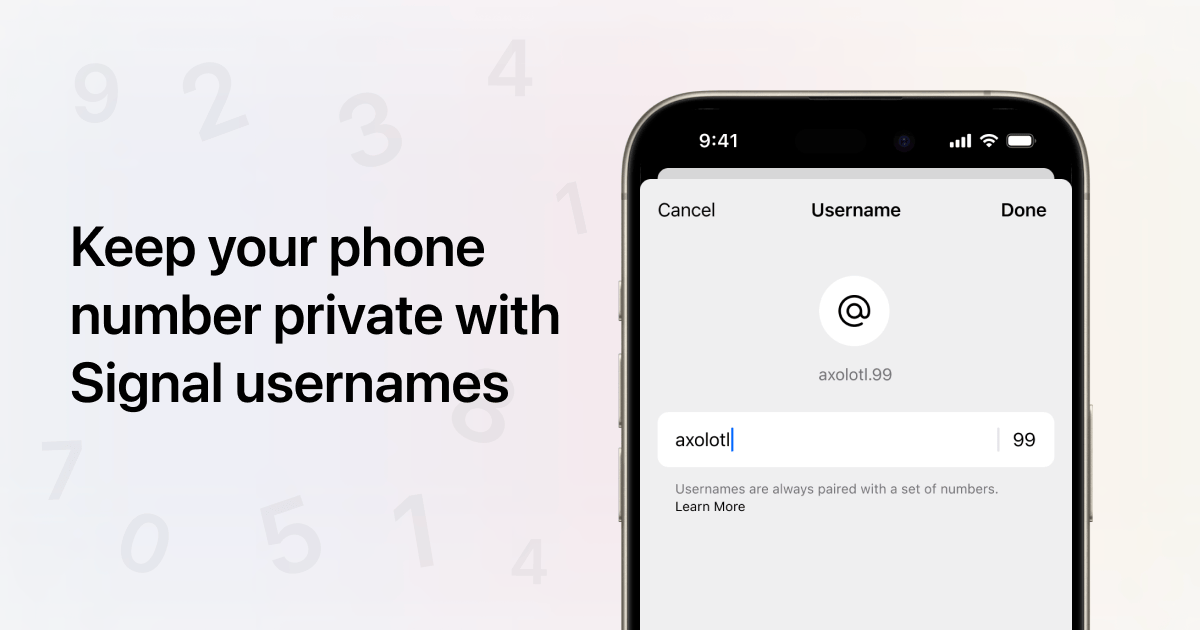
"Usernames in Signal do not function like usernames on social media platforms. Signal usernames are not logins or handles that you’ll be known by on the app – they’re simply a quick way to connect without sharing a phone number."
Also, this is not finally the feature Signal users actually want - not having to sign up for Signal with a phone number and using a username instead.
This new "feature" does very little to make signal more secure or private.
I hope it will allow creating groups without forcing members to have their phone numbers shared with everyone.
> Note that a username is not the profile name that’s displayed in chats, it’s not a permanent handle, and not visible to the people you are chatting with in Signal. A username is simply a way to initiate contact on Signal without sharing your phone number.
Other services do this too. For instance, you can sign up for some services with an email, and that's what you use to sign in, and you might be able to find other people by email if they let you, but you don't necessarily get shown someone's email on their profile, just the display name in their profile. And (in a well-designed service) you can change your email address at any time.
Later explaining "you can have multiple usernames" is easier then trying to undo that conception. People are familiar with it. Your username is how you identify yourself on the computer in every context when it's not obviously your phone number.
Agreed. I don't own a phone of any kind, and would love to use Signal, but alas I can't because you need a telephone number, or a level 65 Necromancer to do the magic to sign up without it.
* Magic: https://www.techbout.com/use-signal-without-phone-number-sim...
Why are then not just random when you go to the share screen.
No real reason to let a person pick it
>Your profile name remains whatever you set it to.
Spam is indeed a hard problem to solve, but the issuance of phone numbers is not designed to be used as human identification.
Not every app needs to cater to every single human and potential use case on the planet.
Signal v7.0.0 with phone number privacy - https://news.ycombinator.com/item?id=39413417 - Feb 2024 (107 comments)
It's interesting to compare this feature to Session, where you also have randomized identifiers, but they identify you globally, and there's no way to give someone a handle to you that isn't linkable to other conversations. It sounds like Signal now offers that, which is actually the first time I've been intrigued by Signal.
Heh, I donate monthly to the Signal foundation but still get the occasional notification in the app to do so. In some sense, I am paying them anonymously :D
Whatsapp added this recently and it is very convenient. You can link a companion device in the same manner you sign into WhatsApp web.
A kind of hacky workaround (that I used to use for both signal, WhatsApp and others) is to set up a server with matrix bridges running and bridge your signal, WhatsApp etc. so then you can install the one matrix client on all your devices.
But as most apps do support multiple devices these days, bar signal, it doesn't feel like it's worth the effort. And I seem to remember the signal bridge in particular being a little buggy.
Also, WhatsApp recently added this feature, so the expectations from potential new users who switched is now there.
[0] https://community.signalusers.org/t/allow-android-ios-device... [1] https://community.signalusers.org/t/allow-android-ios-device...
(I guess theoretically you could run something like PostmarketOS on a phone to run the desktop app, but you know what I mean.)
What I'd love to have is the ability to connect my phone and my laptop to the same Signal account, have them automatically sync chat history between each other, and then in the future if I add a new phone (e.g. because I've upgraded) my phone can sync from my laptop and get all of my message history.
Do you know why this limitation?
It’s not clear to me if it’d be possible to prevent the “contact joined Signal” messages if someone else has the phone number in one’s contacts. That would be a huge thing.
For a little more historical context, with this change Signal has now solved the problems that became widespread during the protests in Hong Kong in 2019 — someone else (authorities) adding random phone numbers to their contacts list, opening a chat app (such as Signal or Telegram) and finding if that person uses that app. Telegram solved this swiftly by adding more privacy controls, [1] while Signal had other priorities.
I know this is great and groundbreaking seemingly. And that it was and more was already there in Telegram, for years.
This is just unfortunate if it has been implemented like Telegram and it seems it has.
I should be able to dictate that “if I initiated communication” to “username” or “from my username” my phone number should not be linked to it even though the other person has my phone number in their address book saved, because that doesn’t mean they are a friend or even if they are I might not want to know that or chat outside the username.
I will try to access the beta (pretty sure it’d be full by now) and test how it goes but I hope it has not been implemented like Telegram after taking all these years.
Though I like that they have essentially nuked vanity username rush and grab in the bud. Kudos.
Yes, agreed. This doesn't stop an adversary who knows your phone number and identity (such as a surveillance state) from linking communications under your username with your real identity.
It just means that people don't need to give their phone number to someone just so they can communicate via Signal.
I think this can lead to people having a false sense of security.
A free-to-use global communications platform that doesn't censor, respects user privacy from the ground-up, and is run by a non-profit foundation that is faithfully dedicated to its mission. https://signal.org/bigbrother/.
We should support it. If you haven't already, then consider signing up for a recurring donation to the Signal Foundation. I try to give what I can afford, because I believe that digital freedom is essential for the progress of all humankind, https://signal.org/donate/
Without such projects, our civilization will stagnate and die in darkness.
Given how tightly they control development, disallow third-party clients, disallow federation, disallow self-hosting servers, have a history if disallowing use without google play and have hid huge development features from the public (mobile-coin) despite being open source. etc;
The idea that it's a great undertaking of our time is so bombastic that it's guaranteed to be false even if you truly believe that they are completely altruistic (which I'm willing to believe but it's not coming easy to me based on the above).
"What's better"? Matrix. Which seeks to solve all of my points, the only thing lacking is market share which honestly is partially caused by these "easy to use" services which trade off everything else, which also consumes developer mind-share even if you're unwilling to acknowledge that. (devs are motivated to solve issues for friends, family and themselves if they are exposed more frequently to systems and services that are sub-par).
https://blog.koehntopp.info/2024/02/13/the-matrix-trashfire.... explains why Matrix is lacking market share, and I think Signal's decision to be aggressively closed is due to a justified fear of becoming that.
I've criticized Matrix before for their "protocol-first" approach and "too neutral" stance towards clients (which they've changed somewhat it seems; previously [1] was a table of clients with no clue what to choose, now it at least has "featured clients"). I feel they repeated the same mistakes as XMPP, which has not improved their client list.[2] Protocol nerds will say that's a good thing, but all it really does is ensure your protocol remains marginal because most people just get confused. People choose software, not protocols.
But you can write a high-quality client and a specification and allow people to write their own apps. IMHO Signal is needlessly restrictive. Sure, focus on your own implementation and the quality of that first. 100% the right decision. But there's no reason to not at least allow some things down the line. Signal is just a few months shy of their tenth birthday – they're well past the "ensure the quality of our official client"-phase.
It complains that cyberfurz.chat is a "server with profanity in the name".
...why?
If I am working with a source who gets frustrated by the impenetrability of communicating with me because I insist they use matrix while they're not technical and likely impatient, then that person will be much more likely to use a fallback method such as SMS or email, and they'll do it without warning. It's legal risk, period. My job is to make sure that they can share information with me as easily as possible and during a particularly sensitive period of that person's life, usually. Matrix, as a sibling post highlighted well, is too difficult for this use-case. That is an enormous failure for a use-case of sensitive information sharing.
While I think there are better services to be private and secure from a technical perspective, there's one killer security and privacy feature that Signal has that on one else does: usability. It's pretty hard to get my grandma onto Matrix, but it isn't hard to get her on Signal. The truth of the matter is that you can't have private and secure conversations if there is no one on the other side. So while I really do like Matrix and the like, I think of them as more alpha or beta type projects. I don't find that the bashing of Signal is helpful (like we also do with Firefox) because all it does is creates noise for people that don't understand the bashing is coming over a nuanced and biased point of view (we're mostly highly tech literate here on HN, it is a bubble. But people still read our comments that aren't). End of the day, if we aren't getting 1 click server installs (or literally everyone is a host), federated systems are going to become highly centralized at some point. PGP's always failed because the easiest way to hack a PGP email was to reply that you couldn't decrypt. It wasn't appropriate for the masses even when it wasn't difficult to use. Don't get me wrong, I love Matrix, but it's got a long way to go to get mass adaptation.
Fwiw, I remember a user awhile back offering a bounty for a decentralized pathway in Signal[0]. The idea was to create an AirDrop like system to help with things like local file sharing but then extend the project forward to create a mesh network. Seems like a reasonable idea to me. I think it may be more advantageous to try to push Signal in the right direction than rebuild from scratch. I'd highly encourage people with other opinions to participate in the Signal community because it is a crazy echo chamber in there and for some reason the devs treat it as a strong signal.
An analogy is the U.S. is a two-party system, but most would consider this significantly different than the one-party system in North Korea or Russia.
A federated system with a few large players is still much better than a centralized one.
Signal is very much in the same area of: "trust us".
With a caveat that they also say: "here's a bunch of information on why you should: but you can't really verify any of it and we have proven bad faith before- also we have an army of people who will pile-on if you call us out for not being actually verified, so, just trust us- we are the secure messenger and all those scary things are just so we are easy to use".
Matrix did an interoperability talk on FOSDEM (https://fosdem.org/2024/schedule/event/fosdem-2024-3345-open...) and it's basically confirmed (https://www.wired.com/story/whatsapp-interoperability-messag...) there was some experimental work done on connecting WhatsApp (and ergo every other Signal protocol compatible app) and Matrix.
> It is unlikely that we will ever federate with any servers outside of our control again, it makes changes really difficult.
> ... I understand that federation and defined protocols that third parties can develop clients for are great and important ideas, but unfortunately they no longer have a place in the modern world. ...
Also, hasn't Moxie basically left Signal?
I truly believe they are altruistic, although it is unrealistic to expect that to last forever.
By the way, some of the claims you made about their "bad actions" are actually false. And Matrix is still incredibly annoying to work with for "normies" and only recently got first-class E2EE and retention policy, both things needed for a secure chat experience. And btw, those things aren't deeply supported in the ecosystem, and also it doesn't have client feature flag alerting (to allow good intentioned clients to de-facto report they don't support certain security features).
I do think Matrix (or something like it) is the future, but it's certainly not the present.
Matrix also is just not particularly private. Servers control and know far too much about users, and pretty much no mainstream client enables E2E encryption by default. Matrix is an impressive piece of technology, but it has a long way to go before it's as usable for an average mobile phone user as Signal is.
It's not just any open-source project.
It's a privacy-orientated open-source project.
They could at least BSL the server code and allow others to verify the server code and host but not compete.
[0] I don't even use Signal. My tack is to isolate and contain my "mobile phone" device as much as possible (when I'm home it generally stays next to the door on a charger). Whereas Signal has been designed around that single device as a critical part of my life. When I can sign up using only a username, and use Signal from a native client or web browser without any sort of Android device in the picture, then I'll be interested.
> If you think running servers is difficult and expensive (you're right), ask yourself why you feel entitled for us to run them for your product.
I don't want to be too negative on Signal since they do some good work and I do use it.
But freedom? No. It is another completely proprietary platform. A better one, but still proprietary, so the antithesis of internet freedom.
For example just earlier this month the Signal client overnight stopped working on my old Mac because they decided to no longer support older OSX releases. So I can longer use it on that machine, my primary desktop.
If Signal was in any way open or free (as in freedom) I'd just compile my own client to speak an open protocol and be back in business. But no, Signal is just a proprietary service with a proprietary client.
Isn't the source code available? What's preventing you from compiling your own copy?
https://github.com/signalapp/Signal-Android/blob/main/reprod...
Why can't you run your own? Sounds like it is not entirely open. (Never looked into it, so would be interesting to understand what is missing.)
> But you can compile the app and desktop clients yourself.
This has been talked at length here in HN before, they prohibit any clients other than their proprietary binary distribution.
If that has changed, I'd be thrilled. Can anyone point at it having changed?
> older OSX
How old OSX are we talking? Is it older than current Xcode with Sonoma supports? If it's that, then you have your answer. If you want to daily drive and older machine Linux or even Windows should be fine, but this is not really the way with Apple hardware - if it was, Xcode would make this easier for the developer. For reference, you can still build for Windows Vista using current Windows 10 SDK - I haven't tried Windows 11 SDK, so not sure how things are there.
I always like to remind people that you can also donate through your employer and many will match. This is a great way to multiply your donation and everybody wins. Your org is going to donate x amount a year anyways and so might as well "vote" on where some of this money goes.
Edit: Ok, ok, I was wrong, signal does have advantages over whatsapp.
I'd get a chuckle out of comparing that with the privacy of Whatsapp.
WhatsApp requires you to give it access to all your contacts (your entire address book) in order to use it at all. This information is uploaded straight to Facebook’s servers where they’ll inevitably use it to place your WhatsApp account in a social graph so they know who you are based on your contacts. I found this to be unacceptable so I uninstalled it.
FBI doc on what messaging apps can provide via subpoena pulled by a FOIA request...
https://propertyofthepeople.org/document-detail/?doc-id=2111...
> Message Content: Limited*
> * If target is using an iPhone and iCloud backups enabled, iCloud returns may include WhatsApp data, to include message content
Your own link does not say that. At all. It directly disputes that.
2. WhatsApp tries to get every user to accept the option to backup messages and photos to Google Drive, where they sit unencrypted and accessible by Google. Even if you reject that option yourself, your correspondents are likely to have enabled it (if only just to stop WhatsApp from nagging about it) and so your messages are available for Google to read. Example of why this can be bad: https://www.vice.com/en/article/zm8q43/paul-manafort-icloud-...
3. Google Photos asks WhatsApp users if they'd like it to back up their WhatsApp photos. Even if you reject that option, your correspondents may have enabled it and so your photos are stored online unencrypted and accessible by Google.
4. Why should we limit what Google and Facebook know about us? Google and Facebook influence our behaviour for the benefit of their paying customers. Their computer systems are too powerful for our minds. They work against us, not for us. Companies like Facebook will come to be seen like tobacco companies, except that the harm is as from mind altering drugs. There is a documentary on Netflix called The Social Dilemma which explains this well. The polarisation of societies and the spread of conspiracy theories are some of the effects. The only defence is to disengage.
5. Read about Chinese-style social credit to understand why you want companies like Facebook and Google to know as little about you as possible. This is a good overview: https://nhglobalpartners.com/wp-content/uploads/2021/10/chin...
WhatsApp provides an option (off by default) to encrypt the backup with a password so that it cannot be decrypted by Google.
For instance, I would love to see picture sent to me by my spouse automatically saved to camera roll. Signal has no option for this because it could put the privacy of me and the sender in jeopardy.
My camera roll is for photos that I have taken. If I want to put something from someone else in there, that's a decision I will pro-actively make. Other apps shouldn't be doing that for me.
Fwiw, I want this feature too. And others. I've submitted feature requests in the past. I even asked that usernames add QR codes and links. I'm not sure if I was heard, but hey, the feature is there and even some of the echo people were against it.
Otherwise, it'll always be niche. I'm never getting non-technical friends and family to adopt a messaging app that isn't unified for SMS and secure messaging. When they say "users might not know they're sending insecure SMS messages" - fine, you own the client. Make the client bright red with a flashing "INSECURE MESSAGES" across it for all I care. It's not hard to inform a user in 2024 that they are sending a less secure message.
Er, what? So no one you know uses Whatsapp, FB Messenger, Telegram, Google Talk, or anything else? I suppose it's possible that's true, but even if so, you and the people you know do not represent the common-case user.
Absolutely unacceptable.
Same with prioritizing stories, stickers and crypto payments as core features of Signal when that's not what most of their users care for. Meanwhile there's still no official way to port your existing chat history on PC and iOS to your new device, or support for Android tablets. Obviously, stickers are more important.
Obviously, the cryptographic guarantees of the two systems aren't even close to comparable.
This mechanism may not be ideal for all users, and it's possible that Signal has now outgrown it, but without it, there would be no Signal as we know it today.
That said, the complaint around this is usually that people don't want others to know that they use Signal. And unfortunately there was no way to _really_ do that (until now), because if you open your chat list, you'll see all of your registered contacts. But in the 7.0 release, we added the ability to hide yourself from being discoverable by phone number at all. So for people who don't want anyone else to know that their phone number is registered with Signal, they now have that option.
How can a privacy oriented company not see the privacy implication of this? Sometimes, you want to be forgotten by some people, and Signal is telling them you are still there and active on that number. I remember reading a story about someone getting into real trouble for that.
Without "usernames", the proper way to handle it would have been to not let anyone know you are on signal when they look up your number. To get into contact, send a message, then the recipient will receive a notification with the message and an option to rely. If the recipient doesn't respond, from the sender point of view, it should be as if the account didn't exist.
But I think it's inexcusable that these sorts of notifications could essentially allow someone to circumvent blocking done by one of their contacts. If I've blocked someone via my phone's default contact blocking mechanism, and then I join Signal, and that person is already on Signal, they should not suddenly be able to contact me... and even be explicitly invited to do so on their end!
I wouldn't be surprised, though, if neither Android nor iOS gives regular apps access to the blocked contacts list. So I'm not really sure how an app like Signal could solve this problem.
great, but what about all of those people that installed before 7.0 and had it already happen to them? "oops" doesn't help. at. all.
yeah, you need to authenticate to delete the account (aka deregister). How else would they verify that you are the owner of the account you want to delete?
> We've discussed at length why this is not possible, but if you have more thoughts then please visit the forums. Please try not to open duplicate issues in the future, even if you feel like something is important.
I wonder why this is "not possible"
People seem to be asking for a way they can join Signal without their number showing up in the registry of Signal users. This is why it's "not possible".
edit: This may have changed today. I'm now seeing an option that lets me hide my number from the registry. This means that even someone with my phone number will not be able to message me on Signal, which seems like a good deal to me.
https://support.signal.org/hc/en-us/articles/360007061452-Do...
Settings > Notifications > Notify When > Contact joins Signal
https://www.kitklarenberg.com/p/signal-facing-collapse-after...
I know some people defend Signal out of ignorance or loyalty, but I suspect there are some paid shills for Signal now. I don’t see how anyone with a bit of security awareness (which is the reason to use Signal instead of whatsapp) can justify using a phone number as an ID in 2024..
> Note that if provided with the plaintext of a username known to be in use, Signal can connect that username to the Signal account that the username is currently associated with. However, once a username has been changed or deleted, it can no longer be associated with a Signal account.
The "no longer associated", I will need to get Signal word for that, right. (You cannot cryptographically prove something was deleted, right.)
But it's good enough I guess
You'd have to take their word that this wouldn't change, though.
It’s probably the only piece of privacy friendly software I’ve recommended to older relatives that actually stuck. It’s not fancy, but it’s solid, simple and does what it’s supposed to.
(emphasis mine)
Couldn't Signal just brute-force all possible usernames in order to connect them with their accounts?
All in all, it seems usernames are just as public as anywhere else and the encryption part sounds like snake oil. Ok, maybe once more they try to protect the username table (or its equivalent in the zero-knowledge proof algo) from getting probed too often by means of an Intel SGX enclave or something, but I wouldn't want to trust SGX either.
aes starts at 128 bits
Either way, I was not talking about brute-forcing a single username. What I suggested was that Signal could loop over the space of all possible usernames. Every other name would be a hit (i.e. exist) and reveal the account ID, possibly even the phone number, of that user.
Hell, couldn't regular users do the same? The blog post at least doesn't mention anything about rate limits when probing usernames.
Interesting choice. I’m guessing most people might just use the last two digits from their birth year, to make it easy to remember.
Now that I know it still needs phone number I assume it will need to be unique so my use case fails.
For the record, I am still a happy Signal user and a monthly supporter, thank you very much.
It was great, then it focused on monetization at the cost of other things.
I still kept it because I could simply share an handle and talk with strangers over the internet on my phone/laptop. There won't be that need anymore.
I hope this feature puts pressure on Whatsapp to implement the same.
So I'd argue monetization here is not a top issue
I used it for the convenience.
Until they focused all their energy, time to monetization features. The quality of rest of the app began to deteriorate.
What alternatives can be used instead, something that is easily accessible/available to the general public but not easy to obtain to create mass users?
For signal that would be harder to implement since it's more focused on 1o1 chats instead of groups, maybe if spam gets out of hand they could use a grey-listing approach like Instagram does where users outside your network get moved to the "message requests" inbox by default.
I’m still nervous about making new accounts in case it triggers some process to lock me out of my one account that I don’t have a phone number for. I couldn’t join the baldurs gate 3 discord to find people to play the game with because it required a phone number on the account, which I was already forced to use for my work account.
On the other hand, I’m glad they actually do enforce their rules, unlike Telegram (which is a haven for scammers, pedos, radical communists, open market drug dealers, and terrorists, not to mention the soul-depleting interactions I’ve had overall with chat rooms there)
Sorry, what?
As it stands, if you let someone use your computer and you have signal desktop, they can see all your E2E texts. Desktop computer sharing is much more common than the devs acknowledge. Also there have been several high profile cases of federal agents squatting on a confiscated laptop, keeping it awake and eavesdropping on signal group chats without the other participants’ knowledge. See the evidence in the FTX trial as a recent example.
I'm a python programmer, and I have zero experience changing the internals of an electron app, but this is a big deal to me.
Also consider that, a sufficiently motivated private threat actor is likely going to break a pin, there's not enough entropy there, or they'll hit you with a $10 harbor freight pipe wrench until you tell them the pin.
For everything else, bitlocker, LUKS, or equivalent is more than sufficient and battle tested for those uses. Yes there are ways of breaking both, conditional on XYZ, etc, but, they're good enough. It does force you to multiboot, but that's good practice anyway, no reason someone using your computer should be using your root partition in 2024.
https://www.alexbilz.com/post/2021-06-07-forensic-artifacts-...
I would rather make this a feature of your desktop environment / window manager. Then you have this functionality for all apps, and the apps themselves don't have to make that functionality.
Edit: actually maybe what you're looking for is to have multiple accounts on one computer. Then every user has their own desktop environment with their own apps and data and apps are not shared among users.
From https://signal.org/blog/signal-is-expensive/
> We use third-party services to send a registration code via SMS or voice call in order to verify that the person in possession of a given phone number actually intended to sign up for a Signal account. This is a critical step in helping to prevent spam accounts from signing up for the service and rendering it completely unusable—a non-trivial problem for any popular messaging app.
I'm not sure why you need to assume that it will be linked back to your real identity; I haven't seen anything that indicates any motivation to do something like that. I'm all for being cautious, but being overly cynical can lead to letting perfect being the enemy of the good.
> I'm not sure why you need to assume that it will be linked back to your real identity;
I’m not assuming, only North America (edit: and some European countries) doesn’t require an ID for a phone number (1), and even in here, you would use it in other services that are linked to your real ID like banks or paying the phone bill online. The concept simply boils down to as soon as you find an account’s phone number, it’s a game over for that said privacy.
(1) https://www.comparitech.com/blog/vpn-privacy/sim-card-regist...
You completely misunderstand what kind of privacy Signal aims to achieve. Signal protects you from eavesdropping and data hoarding, two major privacy issues with solutions like Facebook Messenger for example.
They do not and have never claimed to offer a service where “privacy” means nobody knows who anyone is, it isn’t Tor and I wouldn’t want it to be.
If you don’t like the goals and design choices of Signal, just use another service.
There are benefits of the choices they’ve made, namely ensuring that most users of the service are “real people”, which I think is great. It’s not a social network, it’s a messaging app between friends that solves issues presented by alternatives like SMS or Instagram; that’s it.
<https://www.nfcw.com/2022/10/20/379863/south-korea-to-roll-o...>
If you read the thread the linkage between a phone number and a Signal account cuts down on fake accounts significantly - which has nothing to do with "social media" but it does have a lot to do with SPAM as you've incorrectly stated. I understand why it's not ideal, but there are tradeoffs in both directions. It's unlikely that usernames are going to expose users more than they currently are if they're already using Signal. And it's also unlikely that this new feature changes much, but I welcome the ability to prevent users from associating my known number to my Signal account. In this way the security model has improved considerably.
Governments won't go on a crusade against Signal as long as they keep records of who is using their platform to commit crimes.
Signal won't commit to being an anonymous platform likely for that reason.
It may decrease privacy philosophically, but it isn't nefarious.
If you want a private messaging platform with zero prerequisite identity, use Briar.
You can keep it as an option.
> decrease spam by requiring some other source
Phone numbers never been a good way to counter spam, just look at social media, you can buy phone numbers in bulk these days, not to mention spam might work in social media because there’s the concept of “public space” where everyone shares and talk, so it does make sense for some bad actors to spam or even trying to influence others, that’s not the case in messaging app, because first I need to know your “unknown” username that I can’t see it elsewhere, and second, the efforts are worthy for such unsolicited message, which in case it was, you can get a burner to send it. The point is requiring a phone number to counter spam doesn’t work, and it doesn’t make sense either for messaging apps.
> If you want a private messaging platform with zero prerequisite identity, use Briar.
Well, personally I don’t use Signal, never will in its current state, but they always try to promote it as privacy messaging app while still relying on a broken system known as GSM.
It doesn't decrease privacy. It decreases anonymity which is distinctly different.
> If you want a private messaging platform with zero prerequisite identity, use Briar.
Or Session which is a fork of Signal that runs it's own network using standard PKI instead of a phone number for identities and a decentralised message delivery/onion routing system.
You either end up discriminating against users who have to use VOIP for whatever reasons (and there are legitimate reasons) by blocking VOIP numbers, or your barrier to entry for spammers is almost negligible. It's not a good system.
If you want to prove that users are humans, use a webcam and an id, or delegate the task to some bigcorp who already has a similar system. If that's too much for you in terms of privacy, you shouldn't be attempting to prove that users are humans in the first place. Maybe you should prevent spam via product driven solutions, e.g. whitelisted contacts.
What experience do you have to have gained this confident knowledge?
Obviously doesn't include warrants they may have received where a gag order is in place, but you can see from the responses they do publish that they only store phone number, initial registration date, and last connection date.
This sounds terrible. Are they saying that your phone number will still be visible to anyone running an unofficial app, even if they didn't have it before?
Is it enforced by the protocol or is the number just "hidden" by the official app?
And it doesn't show any messages that came in on the phone during that time, so you're missing context and in practice you just have to use the phone for everything anyway.
Amen.
Guess I'm not signing up for Signal then.
Seriously though - this has always bothered me. They build the "most private" communications service ever, yet require one of the most identifying pieces of your information in order to use it.
If I didn't know any better I would swear it was a surveillance honeypot.
Can someone explain how this doesn’t leak information? If I add someone via username and I randomly guess their phone number, does Signal leak it after the fact?
Further down it says:
Selecting “Nobody” means that if someone enters your phone number on Signal, they will not be able to message or call you, or even see that you’re on Signal. And anyone you’re chatting with on Signal will not see your phone number as part of your Profile Details page – this is true even if your number is saved in their phone’s contacts.
So I think what they mean is if you've been chatting with someone before this update and they have already linked your phone number and signal account then setting to nobody won't revoke that.
However if you initiate a chat with someone new using your signal handle, even if they have your phone number stored, they won't know it is you.
Otherwise it seems like it would be easy to brute force someone's phone number!
Still I would love that this feature generated QR codes without the unique disposable username in human readable form.
Does it defeat the protections then to add a range of phone numbers in contacts and harvest username/phonenumber combinations?
It's 2 swipes to block and delete but a problem I never had to deal with before on Signal.
All of the current messaging apps are spyware in one form or another.
Why can't they function without access to the entire contacts list?
Contrast to MSN, which kept your contacts on the server, as well as information about your account, groups, your plaintext messages, etc.
I have always wished to integrate a similar method in our phone first booking solution to keep the number private beetween host and particpant.
Very inspiring!
I was tired of reading all the comments on here about how 'google search' is terrible, I now believe it and will be looking into all the suggestions here.
>Hide-Your-Number(tm) option!
>still need a number
LOL just install Session and SimpleX (and, for 'droid Chads: Briar). If P2P voice/video skeeves you then get mullvad or proton or something vpn. Why is it the normie will do all kinds of torturous steps like phone and identity verification to install instacoom...
... but they just refuse to install Session and copy/paste an identifier to add contacts (assuming non-locality, else there's QR), complaining it is "too hard whine mew!" Normies make dragnet surveillance so easy!
How about no phone numbers for registration at all?
Then let your phone number receive the spam instead?
It prevents the creation of an unlimited number of signal accounts by a single user with no cost to the user but cost to signal and other signal users.
edit: Your are probably right in that it does not change the risk of spam for a single user, as you could guess the phone number or just iterate over all known phone numbers and try to connect to them.
requiring phone numbers only solves the cost problem for signal(The company/legal entity) and lowers(hopefully) the amount of spam that would get send.
I have no idea how to get my extended family on a Matrix homeserver without extensive handholding. I can barely figure it out myself and I was a huge XMPP nerd that ran my own ejabberd server for years.
I just laughed reading this. I never used Signal, for obvious reasons, so I wouldn't know, but was it really the default? And people were using it as supposedly private messenger? That's unbelievable.
I have SMS, Whatsapp, Signal, and Threema installed, and it's a hot mess of disparate networks. I hate it.
Long-press the send button.
Thankfully, your experience is not universal. It's still the primary means of communication between me and the majority of my friends, technical and non-technical alike. I believe they've walked back (or, at least, not committed to) that crypto project - at least, I haven't heard anything about it in so long that I barely remembered what you were referring to.
I'm skeptical of crypto too, but this sounds like an over-reaction that is cutting off your own nose to spite your face.
Think of how many systems innocently ask for phone numbers as a hard requirement for account creation (under the guise of DFA). Think of all the restaurants that innocently ask for it “so we can text you when your tables ready”, or when you buy a shirt at Banaba Republic, “can I get a phone number”. Like seriously, WTF?
In reality it’s now the defacto method to identify and reconcile your records across ecosystems.
Apple needs to create throw away phone numbers like they’ve successfully done with email addresses. I expect this to be their next iCloud+ offering.
I tried element, somehow that keeps kicking him out, or I need to validate new sessions or something.
Also, Signal loves to claim how secure it is, but they will never dare to tell you that participating in the Android and mainstream mobile systems nobody is secure. Especially not on Google Play. If the government wants to spy on you, they WILL! It does not matter if they can't decrypt your messages because they will be sucking the data right off your phone with invisible screenshots and AI transcribing the text or by other means like key logging. There are people who claim Pegasus does not even need you to click on some link anymore, all they need is your phone number. And Pegasus is for sure not the only thing out there.
Signal and others create the illusion of privacy, there is no privacy on any smartphone with any kind of mainstream OS. Probably not even on the "hardened" de-googled Android forks.
Or sama's crypto eyeball scanning thing? (WorldCoin?)
What this does is provide a casual level of privacy. It gets us parity with the phone number hiding in tools like telegram.
update: only on android. turns out there are quite a few caveats for backup. See https://support.signal.org/hc/en-us/articles/360007059752-Ba...
Same story with the PIN signal requires if you haven't used it in a few hours. It's the same as your phone PIN and there isn't anywhere you can change it, so it's just security theater.
This is not the Signal PIN. It sounds like you have the Screen Lock option enabled.
https://support.signal.org/hc/en-us/articles/360007059792-Si...
I doubt that's a habit many people will develop for a setting they didn't even know existed.
https://support.signal.org/hc/en-us/articles/360007059752-Ba...
The process to transfer the history is to scan a QR code displayed on the new phone by the app on the old phone.
Well, the camera on my old iPhone is broken. The phone has 3 other working cameras, but I cannot switch which one the app uses…
What happened to those arguments now? Were they bullshit this whole time?
Because I know I don't have that skill set or time. I do have however some big fat red flags on using it because it was opted for by an entity whose entire existence is based around backdoors and spying.
Honestly i find it absurd that some folks say just because something is open source it's automatically safe. The vast majority of us whether the project is open source or not lack the skill or capacity to pick up on a well obfuscated hole. Hell even the best of us aren't that good.