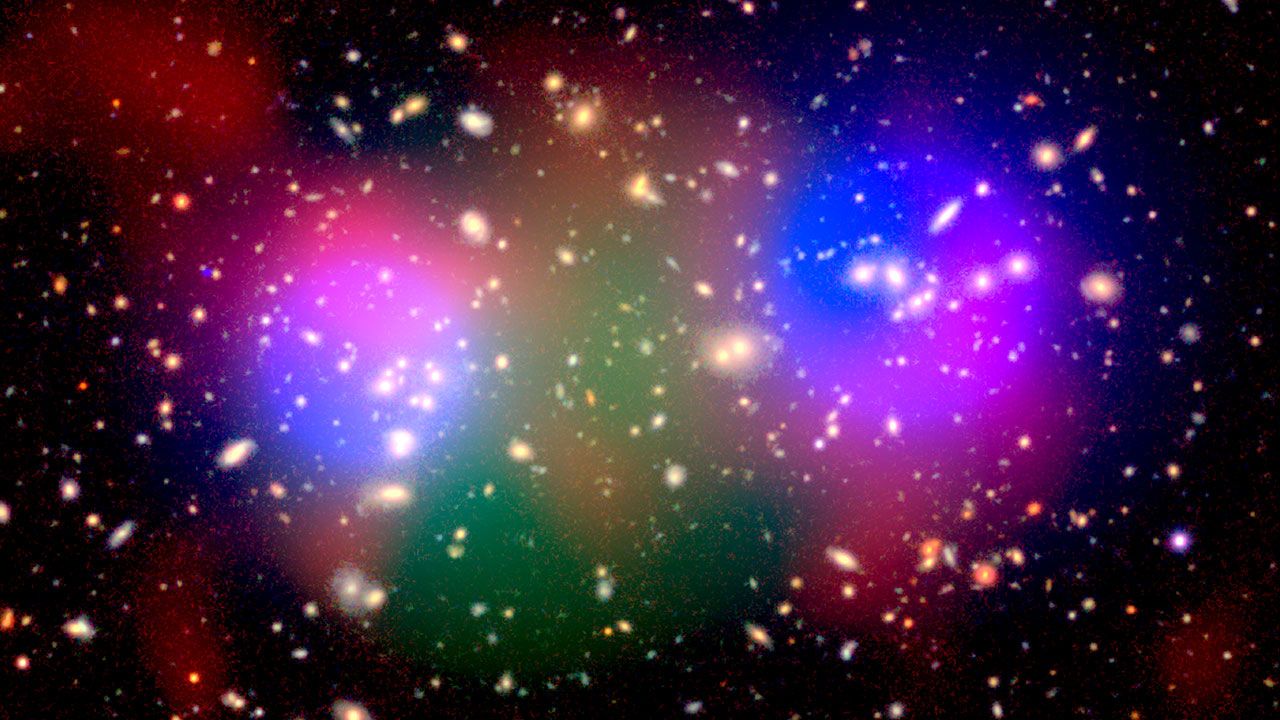
There may be a
The invisible substance called dark matter remains one of the biggest mysteries in cosmology. Perhaps, a new study suggests, this strange substance arises from a
Live Science
128 points · by clockworksoul · 2y ago · 98 comments
The AI stuff in the book is also really interesting.
Also, let's not forget that Vinge coined the term singularity.
https://www.mit.edu/people/dpolicar/writing/prose/text/think...
The units here are pretty silly. They are only talking about proportions, so they could have gone with banana-equivalents, and it would still have worked.
In any case, my point in the comment was that the unit is arbitrary, they are only talking about ratios. So any unit (or no unit at all) would do.
Note that they've correctly not bothered with providing equivalent quantities in each unit - 5 kilograms is 11 pounds, not 10 pounds. This doesn't matter, because the ratio 10 to 2 is equal to the ratio 5 to 1.
But it does raise the question of why they provide pounds at all, and if they're going to, why not just say "for every pound (or kilogram) of matter, there are roughly 5 pounds (or kilograms) of dark matter".
https://insidetheperimeter.ca/a-mirror-universe-might-tell-a...
Highly recommend for anyone into this topic.
But to answer your question anyway, if a proton did decay then yes, it would be to a positron plus something else.
Alas, my understanding of physics is only enough to look like a kook, which almost entirely prevents serious answers from people capable of providing them.
Wikipedia gives examples for other conservations https://en.wikipedia.org/wiki/Conservation_law?wprov=sfla1
> Remember that voltage is always expressed as a "potential difference." You can't measure the absolute value of voltage because everything is invariant when you add a constant voltage everywhere. That expresses a symmetry just like time translation invariance.
> When you bring in the magnetic field this invariance or symmetry can be generalised to a bigger gauge invariance transforming the electromagnetic potential as a vector field. Charge particles are also described by fields such as Dirac spinors, which are multiplied by a phase factor under the action of this symmetry, making it a U(1) invariance. Electric charge is the conserved quantity that Noether's theorem gives for this symmetry.
It sounds like violating this would mean that there was an observable difference between "zero electrical potential" and "nonzero electrical potential".
Temperature is another quantity that is usually measured solely in terms of the difference between two states, but -- apparently unlike electrical gauge -- in that case there is an absolute zero point which is distinguishable from other points.
It might be interesting to ask what would be conserved, but isn't now, if there were a temperature invariance analogous to gauge invariance.
Then conservation of energy would not be a thing, I suspect it would actually destroy all conservation laws, and the universe could not exist.
> what would the universe look like if there was a small non-zero charge density everywhere that couldn't be fully cancelled out?
Nothing. You would not be able to tell. You can only measure a difference in charge, you can not measure absolute charge.
But it would have to be utterly uniform in all directions.
Without symmetry, such as in conservation of momentum, you’d be able to create and destroy energy arbitrarily. Maybe like magic? Let’s say there were no proton/electron charge symmetry. That could mean atoms would be unstable. Maybe do some imagineering from this point!
I don't think I misread the article. Currently we expect dark matter to be neutral. So if we assume the statement is correct, what would then happen to the positrons and it's charge?
Doesn't HN have a policy mandating original sources?
even outside of anticompetetive practices, When the price of a fundamental good drops like that, new industries and new uses become viable. Sometimes the market then grows to the point that you make more money than you might expect
"The invisible substance called dark matter remains one of the biggest mysteries in cosmology."
Gee I wonder why. Maybe it's because your goofy dark matter model is so broken you're borderline just making s** up.
...
"This symmetry would help explain why dark matter and regular matter have roughly the same abundances."
So 1 is "roughly the same" as 5, or is this an orders-of-magnitude comparison?
Edit: and engineers are as precise as they are paid to be.
> Mathematically, the 80/20 rule is roughly described by a power law distribution (also known as a Pareto distribution) for a particular set of parameters. Many natural phenomena distribute according to power law statistics. It is an adage of business management that "80% of sales come from 20% of clients." [1][2]
Cosmology error bars can be very big, depending on the measurement. 500% difference is certainly bigger than some, but since the vacuum energy density appears to differ by a factor of 10^60 from prediction, it's not necessarily a show stopper. Arguably the biggest discovery in cosmology in the last few decades is how much we do not understand at all.
"I am not interested in a more accurate value." said no scientist ever.
It's just easier to measure small things using big tools than to measure big things using small tools, hence astronomy has a disadvantage. Another one is that it isn't easy to create any experiments.
It's really not an exact science...
I think this is the first time I've ever heard someone use this phrase in reference to an actual science
i saw a video addressing it the other day:
Of course it could be that cosmology is wrong.
There was a time (until 99 years ago) that the Milky Way was the universe.
That's true, and physicists are actively working on that possibility, too, under the umbrella term "modified gravity".
A 2 hour long liberal movie adaptation of Hollow Knight. Release date: before Silksong.
It is not all that applicable, but it is interesting to think about and there are people studying it