Things I Don't Know About AI
The more I learn about AI markets, the less I think I know. I list questions and some thoughts.
blog.eladgil.com
248 points · by todsacerdoti · 2y ago · 92 comments
As we all know, Transformers are very expensive to train and run because their compute cost is quadratic in context length: O(N²).
If newer model architectures like RWKV, Mamba, and various others, which incur cost that is linear in context length, O(N), prove as successful as Transformers, the demand for compute for a query of N tokens would decline from O(N²) to O(N).
For a sequence with N = 100,000 tokens, it would mean cost dropping by a factor of 100,000×. That's not peanuts!
The implications for all market participants would be significant.
I don't know, who cares. How much good training data is there that correctly exercises 100k context windows?
All the costs and complexity are tied up in authoring good training data, not compute. 1 person can invent an alternative easier to train architecture. 1 person cannot author 100k context window instruct examples with the same quality as the 4k ones. It will still take thousands of people for 100k just like it took 1000s of people for 4k windows, image labeling, etc.
No it's compute. Post-Training by Human reinforcement is not necessary. Anthropic employs RLAIF and it works just fine. Some don't bother with reinforcement learning at all and just leave it at fine-tuning on Instruction-response pairs.
The work being done to pre or post-training data is insignificant in comparison.
You don't need 100k instruct-tuning examples. The vast majority of instruct-tuning data is nowhere maxing even a 4k context.
100k pre-training runs would probably be very helpful but the thing stopping that from happening even in domains that regularly match or exceed that context (fiction, law, code, etc) is the ridiculous compute it would require to train with that much context.
Phi-2 has shown that a very reasonable compute budget can produce a phenomenal model if the data is pristine and well chosen, and the model is trained well.
This should indicate for you how much the problem really is the training data.
The attention component that's quadratic is a relatively small portion of compute.
First of all, by "a factor of 100,000×" I mean a model-specific factor, call it c, of 100,000x, but looking at what I wrote I can see how it could be misinterpreted. Second, as sequences become longer, the quadractic component will become more important.
I'm not sure I understand the intended interpretation of this. Concretely speaking, if it cost CoolAI 100k seconds of compute to process a sequence of length 100k, it would not take them 1 second now.
I agree that as sequences become longer, the quadratic component will become more important. But as models get bigger, the attention component also becomes less important.
For example, to take a concrete model (say Llama-70B), it takes about 1.4e16 MLP FLOPs (70 billion * 100000 * 2) to process 100k tokens. The attention component takes about 6.5e15 FLOPS (80 [layers] * 100k [sequence length]^2 * 8192 [hidden dim]).
So even if attention turned constant it would reduce runtime by about 30% with today's model at 100k sequence length.
You can use K-V Caching to get rid of a lot of the quadratic runtime that comes from redundant matrix multiplications, but after you have cached everything, you still need to calculate the dot product k_i * q_j with i,j being index of the tokens. With n tokens, you will get O(n*n).
But you have to remember that this is only n^2 multiplications. It's not exactly the end of the world at context sizes of 32k, for example. It only gets nasty in the hundred thousands to millions.
Here is the source I used: https://sebastianraschka.com/blog/2023/self-attention-from-s...
My source is me :) I work at PyTorch on ML compilers.
If you don't believe me, perhaps you'll believe Karpathy's diagram (and the general discussion in the thread): https://twitter.com/karpathy/status/1658161721251602432
Also hi horace.
But no, FlashAttention already solved the memory requirements of attention. RingAttention is primarily useful for parallelizing across the sequence component.
These are actually O(N*M) where M is independent of inference time context length, but it controls the actual amount of information that gets retained during inference. Ignoring that factor of M is misleading.
The "linear" models I'm aware of have a cost of O(N * M), where M is the amount of information retained _per token_ (with some exceptions that store less state but still have intermediate computations for some M about the same size as the others, and with less state you necessarily have forgetting issues and can't scale to unbounded sequences anyway).
Contrast that with a transformer, which has a cost of O(N^2 * M), where M is still the amount of information retained _per token_. Dividing the two you still find a multiplicative speedup of O(N).
For accurate cost estimates or any number of other use cases, yes, the M is critical. When comparing architectures (or when talking about a single architecture with the current implicit conversation happening that whatever you say is meant to be taken with respect to other architectures) it's conventional to note that the M term always appears as a multiplicative factor beyond the rest of the costs. You drop it because it's obviously there but it's just visual noise that doesn't help you understand where the models sit with respect to each other. You only include it if it's relevant, like if you found a way to get similar performance with a smaller M.
It's kind of like how we always drop the log term on a hash table (equivalently, we work in the "word RAM" model of computation), but bignum algorithm papers carefully consider every log(log(log(N))) that crops up. It's relevant in some contexts and not in others. You can't ever include enough context to fully represent your thoughts to another person, so you truncate somewhere, hopefully capturing the essence of what matters.
If you consider NP-complete as the intersection of NP, which is a decision problem, and NP-hard which a decider function isn't possible; look at the success of heuristics between those two sets.
Existential quantifiers on the second order terms in NP is the same thing.
Over Parameterization can be thought as less lossy compression and attention can be thought of as improved retrieval or as additional expressiveness by not missing out on as many outputs using binary output.
You can consider how LLMs tend to append, resulting in telescope reduction as one of those approximation reductions.
But this is due to the combinatorial optimization, which is far more difficult.
Another way to think about it is that PH is equal to the set of boolean queries on a concurent random acess machine using exponentially many processors and constant time.
If your datasets have the Markovian property and are close to ergotic there are options, but you probably wouldn't need to resort to attention and over parameterization in that case.
The word sense disambiguation problem is probably another lens. That is harder yet but may be a way to think about what I am trying to explain.
Think of the tokens as symbols, and of the vocabulary as a finite alphabet of symbols, in a formal system.
In other words, no, it would NOT necessarily prove P = NP.
If you consider NP second-order existential logic, meaning that given x, you will get a y, While there may be many true values that aren't y, it will help
Attention, which requires feed forward networks, which approximate a DAG, you can think of attention as run time reweighing to change what y value is returned.
PH is a query expressible in second-order logic, which would allow for 'for any' at the second level.
The reduction in the general case to just logarithmic time: O(n log n), would cause issue, there will not be any movement from quadratic time to linear time without massive new discoveries.
It is inherent from the restrictions of ANNs having binary output.
Considering FP and FNP vs P and NP may help as they make that property clearer than the concept of second-order existential logic does in some contexts.
Generally though, I don't think that's quite the same. Collapsing all O(N^2) problems down to O(N) would collapse the hierarchy and prove P=NP, but it's blatantly impossible and would prove a lot of falsehoods too.
PH, or the polynomial hierarchy is the collapse I was talking about, but note I was talking about global and not individual or families of instances.
Schaefer's Dichotomy Theorem shows that HORNSAT is solvable, given those constraints.
I found this paper useful as it reframes it as topology which is helpful to build it intuitions, at least me.
https://arxiv.org/abs/2307.03446
Of the proposed linear self attention like solutions I have seen, they tend to approach it more from what can be reduced the clustering problem.
A lens for that is FTA vs FMEA, being thought of as top down vs bottom up.
Top down is cheaper but may miss things, bottom up doesn't miss things but can result in combinatorial explosion.
This paper covers some optimization problems that are NP-hard to approximate to within a given approximation ratio.
Being able to do so would show P=NP
https://dl.acm.org/doi/pdf/10.1145/321958.321975
But that is under the assumption that increasing the self attention window was to improve accuracy, not to trade accuracy for efficiency.
While this paper is about casual inference and not PAC learning, it is the reason most 'causal AI' is just stocastic search and event trees.
"It is important to note that the scale of investments being made by these cloud providers is dwarfed by actual cloud revenue. For example, Azure from Microsoft generates $25B in revenue a quarter. The ~$10B OpenAI investment by Microsoft is roughly 6 weeks of Azure revenue. This suggests the cloud business (at least for now) is more important than any one model set for Azure."
The most interesting implication in the short term is that the impact of model availability on cloud provider choice is more important than the models themselves. Will organizations choose Azure because it offers GPT-4, or AWS because it offers Claude?
This also explains reciprocal VC structures whereby e.g. Amazon invests billions in Anthropic while Anthropic in turn promises to spend billions on AWS cloud resources. Anthropic gets a higher valuation and broader distribution, while AWS gets more customers. It would be a fascinating outcome if the predicted oligopoly in fact ends up as several exclusive partnerships.
Revenue isn't what is important. Profit is since profit is the money you have after costs to invest. But since cloud is highly profitable as it is, the point still stands I suppose.
> It would be a fascinating outcome if the predicted oligopoly in fact ends up as several exclusive partnerships.
I thought people were predicting independent silos? Where highly profitable and cash rich companies like apple, microsoft, google, facebook, etc own their entire stack or exist as their own ecosystem. Where the likes of apple does everything in-house - AI, cloud, OS, chips, etc. The whole she-bang.
Eg which AI infra approach thrives relative to the big clouds?
What new architectures are needed for agents vs transformers?
Etc...
Lots of stuff to figure out....
For example: * Read the Bloomberg GPT paper - they create their own tokenizer. For specialized domains (finance, law, medicine, etc) the vocabulary is very different and there is likely a lot to do here, where individual tokens really need to map to specific concepts and having a concept capture in several tokens makes it too hard to learn on limited domain data. * Data - so many ways to do different data - more/less, cleaner, "better" on some dimension. * Read the recent papers on different decoding strategies - there seems to be a lot to do here. * Model architecture (SSM etc). If you speak to people who aren't even researchers, they have 10 ideas around architecture and some of them are decent sounding ideas - lots of low hanging fruit. * System architecture - ie likely to see more and more "models" served via API which are actually systems of several model calls, and there is a lot to do here. * Hardware, lower precision etc likely to make training much cheaper
It's reasonably likely (again, guessing < 50% > 20%) that this large set of levers to pull become ways to see constant leap-frogging for years and years. Or, at least they become choices/trade-offs rather than strictly "better".
Right now at least people seem to decouple some measures of how smart the model is from knowledge base, and at least for now the really big models seem smartest. So part of the question is well is how insightful / synthesis centric the model needs to be versus effectively doing regressions....
The future is model graphs with networked mixtures of experts, where models know about other models and can call them as part of recursive prompts, with some sort of online training to tune the weights of the model graph.
Some of the domains are so large that a specialized model might seem niche but the value prop is potentially astronomical.
Architectures matter a lot less than data. "Knowledge" and "reasoning" in LLMs is a manifestation of instruct-style data. It won't matter how much cheaper training gets if there is limited instruct data for use cases.
How do you make 100k context window data for example? Still need thousands of people. Same with so-called niches.
Maybe it turns out to be a complex coordination problem to share the data. That's bad for equity investors and giant companies. Anyway, all of this would cost less than the moon landing so it's practicable, you don't need cheaper, you just need risk-taking.
The obviousness of the path from here to there means it's not about innovation. It's all about strategy.
If Google could marshal $10b for Stadia it could spend $10b on generating 100k context window instruct style data and have the best model. It could also synthesize videos from Unity/Unreal for Sora-style generation. It would just be very hard in an org with 100,000+ people to spend $10b on 10 developers and 10,000 writers compared to 400 developers and 3,600 product managers and other egos. At the end of the day you are revisiting the weaknesses that brought Google and other big companies to this mess in the first place.
Anyway I personally think the biggest weakness with ChatGPT and the chat-style UX is that it feels like work. Netflix, TikTok, etc. don't feel like work. Nobody at Google (or OpenAI for that matter) knows how to make stuff that doesn't feel like work. And you can't measure "fun." So the biggest thing to figure out is how much technical stuff matters in a world where people can be poached here and there and walk out with the whole architecture in their heads, versus the non-technical stuff that takes decades of hard-worn personal experiences and strongly held opinions like answers to questions "How do you make AI fun?"
Bring back text-based adventure games.
This also speaks to why OpenAI, Google and the other developers will struggle to create anything that feels like fun: they will chase obvious stuff like this, they will think its similar to all problems. And in reality, you don't need any testing or data or whatever to know that people hate reading in video games, the best video game writing is worse than the average movie's screenplay, that most dialogue is extremely tedious, so why are you going to try to make it even worse by making it generated by an AI?
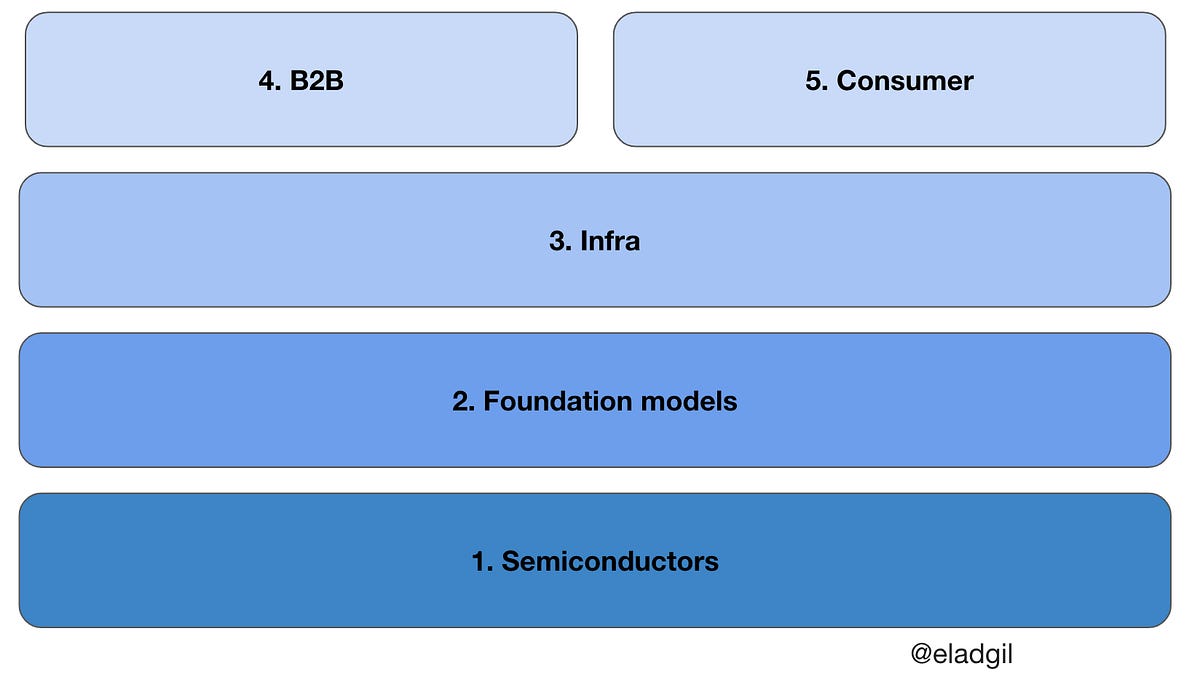
For LLMs, Character and ChatGPT are arguably two vertically integrated consumer apps (with some B2B applications for ChatGPT as well)
The second problem is more obvious, but not talked about in concrete terms yet. As these technologies mature, the legal, policy, and social constructs around them will also mature, and will shape the future of what is coming as much as any technical or business decision. Some examples:
- Imagine if courts really find that these models are in gross copyright violation and that model builders will need to work through a scheme similar to sampling in music in order to do their work into the future. Not only will it dramatically increase the cost of model development, but will drive some of the work to alternative sources of data if it's cheaper. What effect will this have on these models?
- Suppose these models are found to be reliable enough for certain mission critical work (healthcare, defense, etc.) and they lead a user down a path that results in harm or death? Who's at fault? Suppose it becomes a liability of the company offering the model? How does the insurance market respond?
- What if these models become good enough, and the automation around them as well, that we start turning them into fully automated agents that make up a significant part of our economy? Do people still have jobs? Or will these things just become the equivalent of hiring more people into an economy and we work in a blended AI/Human Intelligence world? What happens when these things decide to tank capital markets or choke supply chains?
- What about the long-term use of these models by individuals with severe mental impairments or psychological issues? What happens when those models go down, or produce a response that's not liked, or there's a loss of historical conversational data? What about otherwise normal people who end up down a path of social isolation?
- There's an entire legal market about to be created for remote-work fraud where somebody just replaces themself with one of these models for 90% of their work. It's sci-fi utopia, but fraudulent if you misrepresent who's doing the work in many cases.
- Some company, somewhere, will crack the nut on figuring out how to improve the speed and performance of these models, and build custom hardware that offloads the entire effort onto rapidly commoditizing systems. When multi-modal LLMs and diffusion models come preloaded on disposable $.10 SOCs that are put on cereal boxes and in Birthday cards, we'll be well beyond every one of these questions. But we'll be firmly in a different future.
We have yet to encounter most of these things to the point that as a society we have to build responses, and that itself points to the immaturity of both these technologies and the use cases for which they will be adopted.
Which cloud to pick and why aren't consumers spending thousands of dollars getting the complex systems in place to use this stuff aren't even the problems that are going to become interesting in the next 10 years.
So much this. I think a lot of people overlook this aspect so much. I wonder if we'll see a corporate push to make people think of individual instantiations of LLMs as being their own entities, for scapegoating purposes. It's completely ludicrous, but you know they'd just love to point a finger at Machine #73583 and make that take all the blame.
an airline already tried this.
"Air Canada argues it cannot be held liable for information provided by one of its agents, servants, or representatives – including a chatbot. It does not explain why it believes that is the case. In effect, Air Canada suggests the chatbot is a separate legal entity that is responsible for its own actions."
https://www.forbes.com/sites/marisagarcia/2024/02/19/what-ai...
https://www.theguardian.com/world/2024/feb/16/air-canada-cha...
We may look back on 2022/3 as the last time we had a training set that was clean. The fact that it was already polluted with SEO garbage will be a quaint problem.
I have a completely un-worked thought that the music industry might have some clues. As music becomes more and more entrenched in codified process ie pop culture music. It all starts to become very generic.
I'm starting to notice that music is returning to the old way of discovery. Where you hear music from a 3rd party that is playing it and ask them who that is. There is no longer a good bubble to the top source like radio because the corps have cannibalized themselves with production line pop music that has to play on their vertical stack of companies or be licensed. Seems the stuff I find now is some artist with less than 100k followers like (I'm guessing) back in the pre internet days.
This suggests a sort of cultural event horizon beyond which AI cannot see. Five years from now, the way actual people talk and think about a new topic will be drowned in AI content, creating a gulf between reality as people actually see it and the AI universe. Unfortunately for many people their reality is already slated to become AI-mediated.
I see a lot of uninformed people claiming this is going to doom AI though.
There is a tribe with a long history of ritual cannibalism that has developed a genetic modification(mutation) that prevents them from getting this disease.