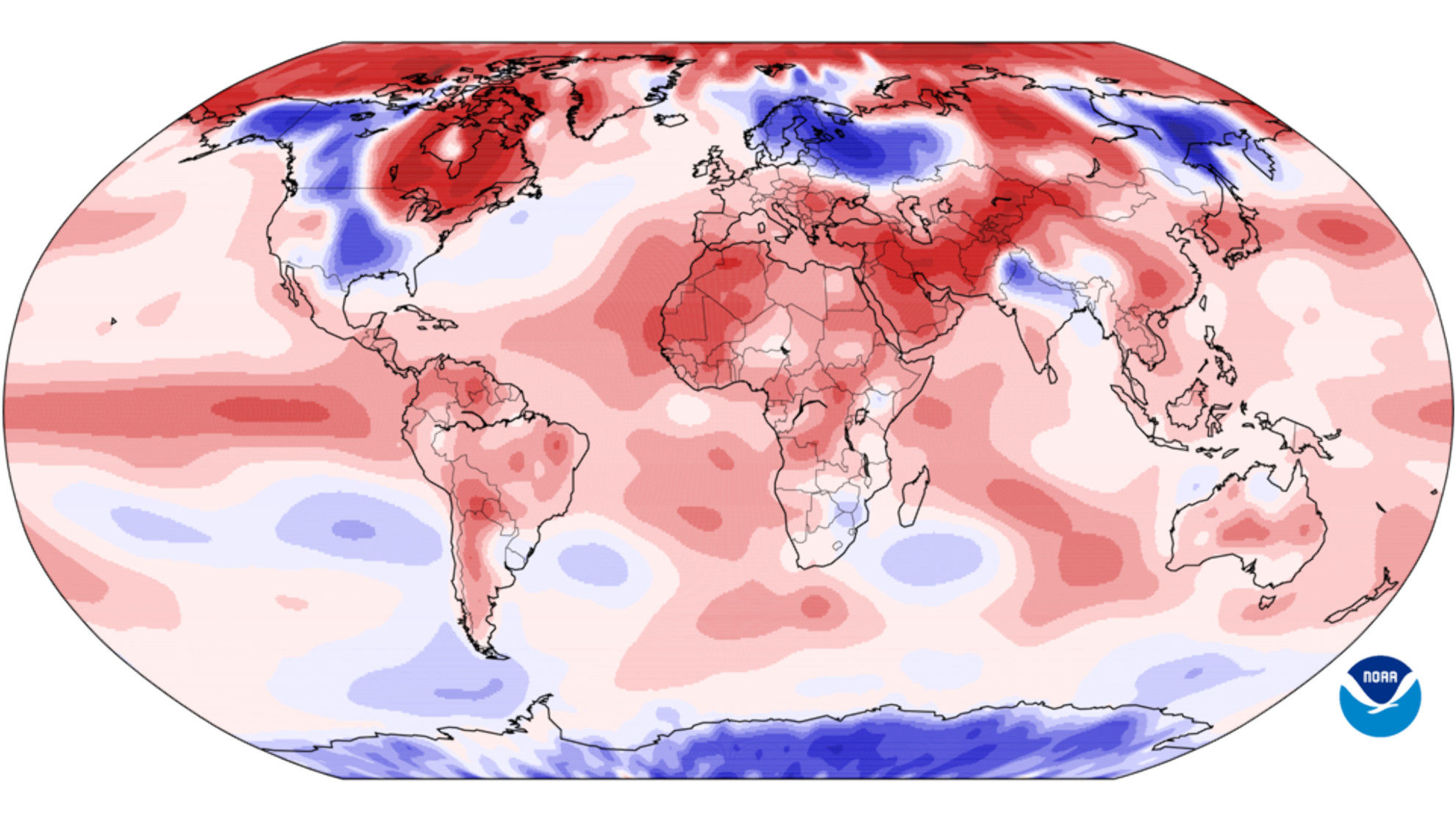
Earth just experienced its hottest 12 months in recorded history - The Weather Network
January has already broken temperature records, starting this year off on-course to break the global records set in 2023.
The Weather Network
275 points · by GeoAtreides · 2y ago · 406 comments
Do others here feel similarly? Do you think these trends are reversible? Is technology the solution? Something else?
I guess my real question is: how do you incorporate all of this change into your worldview and outlook?
I've accepted it though. I don't doomer at people unless they ask. I can't do anything about the situation. I've voted for green parties and politics my whole life. If I have blame it's not for denialists, it's for all those politicians who know and accept the science but did nothing, they didn't have the guts, being voted in again was more important.
It does make me sad to see so many HN comments rolling out the same stupid "I don't trust the data" arguments that were pretty thoroughly debunked within the scientific community 10 years ago, yet still feel the need to jump on every thread about it because the whole thing makes them so angry.
I've heard scenarios put as mild as a reduction in real GDP growth, which is just a non-issue compared to the risks people want to shoulder to mitigate climate change.
> I've voted for green parties and politics my whole life
These people tend to be anti-nuclear in my experience; so I'm not sure from your comment if that strategy is a good idea. Environmentalists have been some of the more effective lobby groups for locking in fossil fuel use through 1980-2020 when we really should have been transitioning to nuclear power.
First time I've heard that, everyone else says "this will kill anyone experiencing it for more than a brief period, meaning hours or minutes depending on the details".
Solution is only easy on a scale of one person, "move elsewhere", or rich societies, "stop working outside and install aircon inside", which isn't so easy for anyone working in agriculture or much of Africa and India.
If environmentalists are so effective, climate change would have been a higher priority over those decades. It seems likelier to me that there's other, more convincing reasons we haven't rolled out nuclear at a huge scale. For example the following are typically more convincing and applicable to nuclear as well: high costs, high political risk, fossil fuel lobbying.
The hypothesis of doom that I subscribe to is that it'll cause cascading effects that destroy parts of the existing ecology (this is already happening) and then the same to our food supply faster than we can react to. I don't worry it's going to mass cause temperatures that kill me directly if that's your implication. It'll be social collapse far away from where I live that will spread.
I live in a safe country that gets about 80% of its power from renewables. But we don't build those wind turbines here and we certainly don't mine for their materials, if the supply of stuff goes awry we'll be just as buggered as everywhere else.
Failed crops on a global scale may result in widespread famine and war. Crops can fail as a result of not enough rain, too much rain, not enough insects, too many inspects, all kinds of climate related things.
I remember reading during covid that there is not some massive food cache somewhere with the government ready to bail us out if they need to. That we are basically living season to season.
Green party in Germany forced the country to close down its nuclear reactors and use coal instead, increasing the emissions.
Closing down all nuclear plants was first decided on in the year 2000, 24 years ago. It were the Liberals (FDP) and Christian Democrats (CDU/CSU) who rescinded that decision in 2010, only to later reinstitute it in panic after the Fukushima meltdown happened.
Those reactors that got shuttered hadn't had any safety inspections in years, they had no viable fuel left and not even the owning energy companies wanted to operate them any longer than absolutely necessary, so they would have been shut down even without the Green party in the current government.
That the now missing nuclear baseload had to have been replaced with coal, well.. Thank the Christian Democrats for that. They're the ones that favoured building out coal, slowing down the build-out of renewables as much as possible, at every chance they got.
Isn't this how democracy is supposed to work? Isn't it, as a general rule, preferable that politicians fear being voted out, and so do the things that the voters want, so they get reelected? The alternative seems to me for a politician to say one thing in the campaign - what the people want to hear, and then do something else when elected - what he thinks is best. Some do that, but they're not loved for it.
I am pretty sure that even when or if politicians do not care about the voters, they still do not do the right thing, but some other wrong thing, like enriching themselves.
What you are in fact complaining about is that politicians elected by other people did what those people wanted, instead of what you wanted. While not laying the same complaint on those you voted for - greens. They obviously did right to listen to their voters - you and people you agree with.
It's not about the guts of a chosen few. It's about humanity overall. If we do not care about the environment, billions of us, a handful who care will not, can not change much.
Under the assumption of perfect information, yes. Politicians should be afraid of doing unpopular things that will not get them re-elected.
A problem that exists down there, outside the internet bubble of information overload, is that people _aren't_ reliably informed. A human in a vacuum without access to accurate information will never spontaneously guess that they should care about the environment.
A politician's decisions are informed by voter preferences. That's good.
But the voters, themselves, how should they know whether to care or not care about any particular subject they're not experts in? Who do you trust? Where does information come from?
Well, there isn't a widespread decentralized information effort. It's not billions of us independently doing investigatory work. It is a handful of us, a small relative percentage. Voters can't all be experts. They have to trust some smaller group.
If we all voted together it might be different. Though I doubt it, to be honest.
It seems to me, Greta Thunberg is(was?) in the spotlight because her mothers celebrity status in Sweden, granting her easy access to free PR.
As the world gets hotter, some people will benefit. Those people will try to stop any serious attempts to reverse course, especially when the next generation comes (to them, the current climate is normal - why would we want to spend lots of money to revert it to the way it was hundreds of years ago).
A 2/3/4 C rise in global temperature is going to happen, and humans might put the brakes on, but they will never put it back the way it was.
I think CO2 emissions are going to decline – not fast enough to prevent a 2/3/4 C rise in global temperatures – but I think that rise could well be just a temporary thing for a few centuries, after which the climate goes back to what it used to be.
People are trying to limit CO2 emissions – not hard enough, but they are trying – and renewable electricity, electric vehicles, etc, are in the long-run going to win out because even if you don't care about CO2 emissions at all, they have other advantages.
Our ancestors survived ice ages.
>> I've voted for green parties and politics my whole life.
You are part of the problem why we are burning coal instead of using nuclear power.
I’m not sure if you are actually serious. They did not have billions of people relying on a very brittle global economy back in the day. They did not have cities with millions of people and an enormous infrastructure to keep these people alive.
The worst projections, at least, are off the table: we're not headed for 6 degrees of warming, we're on track for 3, and I strongly suspect we'll end up closer to 2 degrees of warming.
That is going to be terrible. People will die, wars will be fought, and we'll see the largest migrations in human history with all the attendant political upheaval and barbarity, but we'll still be here. Humans as a species are going to make it.
For me, I found it helpful to go and work in climate. So long as I wasn't actively working to solve the problem, I was driven mad by the knowledge that we were heading for disaster.
Curious, can you say what you switched from and to?
It might be two degrees warmer this century. Life will go on just fine. Possibly better in some ways and places. No problem, relatively speaking, compared to the hazards our ancestors face.
If it warms 5C, we might have a real problem on our hands. I don’t think we can predict that, and I don’t think it will happen over 100-200 year timescales.
Many people seem to think there will be mass die offs, the ocean will become unsurvivable acidic, and crops won’t grow. I don’t think any of that will happen anytime soon. I think there is a very strong “doom” instinct in humans to think this is the last generation, the end of times. This is just the latest manifestation.
Humans have already caused many mass die offs. Go into a forest today and try to catch dinner with your bare hands and you'll find it is near impossible. Yet it used to be possible - that's how our ancestors lived.
Us inventing aids like the bow and arrow has depleted the wild animal population enough that we now couldn't survive without such aids.
If we bumped to 1000ppm carbon, would the earth warm 5C? That’s a technical question. We don’t know exactly how sensitive the climate is or what feedback mechanisms are at play. I don’t lose sleep over it. But I’m just trying to give my perspective to counter some of the doom, since the doomers are very active online.
I am quite worried about the world we are leaving them and when they are about 80 in 2080 the world is predicted to be hell. I would not be surprised if they decided not to have children themselves.
I read that in France the number of vasectomies among 25-ish is exploding. This may not be a good indication, though, because vasectomy was not popular in France in the first place (and still requires z 4 month cool down time, by law)
That and preparing them for it is exactly what I'm capable of. Kids from religious fundamentalists will come on their own, whether the worlds needs them or not.
My ~recent ancestors endured hardship that would push me to my limits but it was their daily existence. They fought in the American Revolution, they fired the first shots at the Whiskey Rebellion, they were directly involved in the Civil War, and on it goes, up to my father and his brothers and my brother and myself. I hope that my own children can find resiliency. I'm not sure what the point is otherwise.
Even American conservatives, for example, appear to acknowledge that climate change is occurring. Their current spin is that no major economic changes are required now (inaction is fine!) because they believe that technology will find a way to address an even warming globe. I think a lot of people choose to believe that to avoid doomerism.
We will see how they'll will feel about it after they'll grow older and they will need help from other people and those people won't exist.
Imagine humans during previous ice ages, no space heaters and The North Face jackets still having babies. We're so coddled in comparison.
Look at the warming forecasts and how accurate they’ve been (they haven’t).
Then look at the error bars on predicting the impact to weather (they are all over the place).
A reaction like not having kids because the world will end places way to much confidence in predictions that little probability of being correct.
Everyone is free to have children (sometimes - unfortunately) so it is a personal choice, even if it seems hysterical to some.
One of the crackpot ideas will be that an earlier civilisation managed to mess up the entire planet, but that's so ludicrous that they will conclude it was most likely a weird asteroid impact or something like that.
Also, note the last section of your linked graph is a vertical line on that scale. It still would be if you zoom in to 50 million years rather than 500 million. Anthropomorphic climate change is a vertical line even if you zoomed in to 5 thousand years.
The issue we really face is that the needed change is fundamentally incompatible with the way wealth is accumulated on the top today, how growth is expected and required at every step.
That means the first change that needs to happen is purely mental: Either we march into doom to make a bit more money for the richest or we restructure our system so it doesn't need growth to provide wealth. And once we have that mental change the next harder step will be convincing the powers that be to implement it.
We are now farther in terms of the mental question than in say 2010, but things move too slow and many people have not fully realized the existential nature of the problem.
> In this study, we conducted a representative survey across 125 countries, interviewing nearly 130,000 individuals. Our findings reveal widespread support for climate action. Notably, 69% of the global population expresses a willingness to contribute 1% of their personal income, 86% endorse pro-climate social norms and 89% demand intensified political action.
And an interview of the authors [2]
[1] https://www.nature.com/articles/s41558-024-01925-3
[2] https://www.carbonbrief.org/interview-why-global-support-for...
This is an amount of money we could just create by monetary policy or Quantitative Easing as the like to say. Nobody needs to get poor when money is spend.
One example, is rooftop solar. Rooftop solar is very, very, expensive compared to utility grade solar. A dollar that goes to subsidize residential rooftop solar is a dollar that would go much, much further if it was used to subsidize utility grade solar or wind.
Another example of poor decision making is Germany which decided to start shutting down nuclear power plants while they were still burning coal. So last year hard coal and lignite still produced 35.3 percent in German power production (compared to 35.2% from renewables. (https://www.cleanenergywire.org/factsheets/coal-germany). Before the phase out of nuclear, it generated about 25% of the electricity. It is all really hard to believe...
1) Does the extra cost of rooftop solar go to installers doing a lot more manual work per panel?
Installers who need a source of income to live anyway?..
2) As I see it a lot of the pollution in the world is due to fear of people loosing their jobs. One could scale down many sectors, or more aggressively shift to a greener economy, if it wasn't for the fear of people/voters loosing their jobs.
-- So when considering options I think one needs to give smaller weight to salaries ("somone had to feed that person anyway") and more weight to natural resource extraction needed...which is the "real" cost. Basically count further CO2 emissions invested, not work hours.
That article is from January 2023, so the numbers in there are 2022, not last year, and even then it says that nuclear produced only 11.7%. In any case, comparing to the official numbers[0], those seem to be closer to the 2021 numbers than the actual 2022 numbers: 31.3% coal, 6% nuclear, and 44% renewable. For 2023, coal was down to 26.22%, nuclear (which was only phased out in April) was down to 1.5%, and renewables were at 56%. Nuclear has not contributed more than 20% to electricity generation since 2011[2].
[0] https://www.destatis.de/EN/Themes/Economic-Sectors-Enterpris... [1] https://www.smard.de/page/home/topic-article/444/211756 [2] https://ag-energiebilanzen.de/wp-content/uploads/2023/10/STR...
Polls consistently show that people think someone somewhere should do something as long as it doesn't actually cost them any money.
"IPSOS found that just 25 percent of Americans said they’d be willing to pay higher taxes to address climate change. A 2019 Reuters poll asked specifically whether respondents would pay $100 to fight climate change and only a third said yes"
If we turned off the fossil fuel tap today, I think life on earth would get markedly worse for humans, with negligible/no impact on fauna.
Ask people born in a former soviet union country who they thought "won" WW2. It is not likely in any scenario that the US would be in the middle of a Nazi world order if Pearl Harbor wasn't attacked, calling it a miracle is disgusting.
Fwiw I have direct family that fought in WW2 in the Pacific.
A sad outlook is that we are all rich people living charmed lives that are not at risk so we can bury our heads in the sand. We aren’t the people who will die from our mistakes.
Well my bills will be glad to know this, although it's news to me.
>the world's average salary - in PPP dollars - of $1,480 a month, or almost $18,000 a year
EDIT: We also can't really seem to get our act together and collaborate across the planet.
The hope is that we don't get to a place where positive feedback really pummels us and find some sort of equilibrium. It's hard to say and these are the sorts of games we should not play. If the earth completely changes into a human or life unfriendly place our technology won't save us.
Another bit of hope is that the planet has been warmer in the more distant past. I think we're technically still in an ice age.
A huge part of the economy has been voluntarily stopped, which is insane to think about, nobody would have thought that was possible before the pandemics happened.
> A huge part of the economy has been voluntarily stopped
Huh? Covid was tearing up northern Italy before it landed in the US and we did nothing to prevent it. Our politicians were telling people not to buy masks.
Trump sent shit tons of ventilators to Florida for no reason.
We allowed people from places that had confirmed cases of Covid to come into the US, they just had to make a layover.
The WHO refused to call Covid a pandemic until it was way too late.
Nursing homes were decimated. Schools decided that stay 6-feet apart meant "do nothing, its fine".
People were eating horse deworming paste instead of getting the vaccine. People lost their fucking shit over mask mandates.
Maybe you weren't in the US?
The water is missing in other places, Italy's north heavily depends on mountain water for their farming. This is going to be a very dry year. Either forcing them to lower the quality of real Italian pasta or again increasing the prices. Also wine from the whole region will not do well this year.
In french the fragil botanical environment is changing so much that their cheese doesn't reach the usual quality anymore.
This sounds like little things maybe, but those are huge traditional markets dying in front of our eyes.
Things are changing very rapidly. I don't know how or why there would be any optimism about this.
They explained the moisture in the air was at record levels this year because the sea surface temperature was 1.5 C above normal. We all knew the moisture was at record levels because Brisbane (in a temperate zone) was getting sustained levels of humidity that exceeded the levels experiences in the far northern tropics, 3000 km away. Even on a relatively mild day at say 30C, you could not walk up a hill without being drenched in your own sweat. Since their weather models had never see humidity like this sustained for weeks and weeks (it was an all-time record yesterday), they were wrong. It's doubly surprising because were in a El Nino, which should bring dry spells.
The result of all that rain was continuous storms lasting for week, at the peak bring category 3 cyclone winds (exceeding 130 km/hr), concrete power pylons being blown over (never happened before), power outages for weeks in some areas, flooding and deaths in metropolitan areas. Most of came without much warning because the aforementioned models were wrong. It's been a wild ride.
What blows me away is in West Asia the sea surface temperature was 5 C above normal this year, over three times what we are experiencing. I can't imagine what that is like.
We will find ways to adapt and survive.
What will happen, and what is in fact already happening : food gets more expensive, people have to migrate because their current location is no longer viable, more disasters, and more conflict resulting all of that.
Humanity is not going extinct any time soon. But what sort of world do you want to leave to our kids? Should our objectives be not a tad higher than “oh well, life will be worse but at least as a species well still exist”?
Also note that while we have only started “writing” since a couple of thousand years, and indeed keeping track for less than that, we do have the natural record. That may not be as precise as the written record, but there is a lot of it over a very long time. That natural record puts boundaries on previous temperatures.
You’re entitled to feel that you don’t want to change your ways for the benefit for others. That is not ideal but it’s the rules. Don’t deny and invent false narratives to prevent feeling guilty though.
People have migrated all throughout history. Humans walked across Siberia wearing animal skins to get to North America. I think they'll be fine if they have to take a bus or a plane to a new country.
There has been conflict all throughout human history. Currently it is at a historic low. Likewise, there have been disasters. Floods, volcanoes, earthquakes. This is not new.
Yes, you should strive to leave your kids in the best situation possible, but you do that by locally improving your situation to be as good as possible. You cannot control the global food production or natural disasters or the climate. Nobody can do that. Everyone will have to work on setting themselves up in the best situation possible, which, incidentally, is all we have ever been able to do.
Where does someone get the courage to just lie like this?
There will still be permanent changes to the biosphere, but there is no reason to feel doomed.
> As Freymann details, these efforts include “constructing the largest water transfer system in human history; expanding and raising nearly 6,000 miles of sea walls along its coasts; building a strategic grain reserve larger than the rest of the world’s combined; carving wetland flood basins in the centers of its largest cities; restoring coastal wetlands to act as buffers against storms; and relocating hundreds of thousands of ‘ecological migrants’ in low-lying areas.”
Reading your question made me think of this article.
It seems like a lot of time was wasted decades ago in the US on not transitioning away from fossil fuels or trying to become carbon neutral, but that's crying over spilled milk. I'm not going to doom about the effects of something that mostly happened before I was born; that's almost like becoming an alternate history theorist.
> I guess my real question is: how do you incorporate all of this change into your worldview and outlook?
To answer your question directly, I just hope more of my generation (generation Z) does less climate change denial or doomerism, and does more voting and climate change activism. And not just for feel-good policy like planting trees, but climate change adaptation, like China.
[0]: https://www.brookings.edu/articles/unpacking-chinas-climate-...
This is going to be a cynical take by HN's standard. It actually reinforce some of the fundamentals of humans beings that our ancestors has somehow understood far better than we do today.
It is that "Interest" matters. Needs are driven by interest. You cant just say the world is going to end in 100 years time and we need to stop eating meat and turn off all heaters etc etc. You also cant tell company to stop earning money or lower profits margin just because of "Good". What technology do however is that we innovate so others cant say NO.
We are now at a time where non-fossil fuels, or Wind and Solar is cheaper, and will continue to get cheaper in the future. The economy of scale is there. To the point unless the Government TAX on non-fossil fuels, the pure force of this momentum meant it is only a matter of time. I use the term non-fossil fuels because renewable doesn't include nuclear, personally I am a big fan of GE BWRX-300.
All in all in am actually quite optimistic. We are slowly solving it.
Both of these events were rare and they were AMAZING and everyone was either taking out their sleds or spending the day at the beach.
We have also always had floods at the Rhine river.
How do you even know what is normal weather? Can you specify an exact time when you think the weather was normal?
>> Do others here feel similarly?
No.
>> Do you think these trends are reversible?
Reversible to what? Like it was 50 years ago or 5000 years ago or 50 million years ago?
>> Is technology the solution? Something else?
People have been living anywhere from freezing arctic to hot arid deserts. We seem to be good at adapting to our environment.
Sure, humans can survive without agriculture but not billions of them.
I think the pressure for drastic, technical solutions will mount sharply and ideas like that solar shade will be seriously considered.
Two questions:
1. Is climate change averted, and a non-issue? Or has it just been pushed back for a little while?
2. What does life on earth look like, when 90% of the people you know and depend on today are just gone?
And it isn't so expensive to turn things around. An estimated 100-200% in global GDP is needed to reach carbon net zero by 2050. Annually we need to spend 2-6% of GDP to get there.
Remember every bit of Co2 not emitted counts
If US Congress wasn't red, we would be moving considerable faster in the right direction.
My only advice is that we need to fix the monetary system first or else we'll never be able to escape the cycle of deception. We'll never know what is real or not real or who we can trust or not trust.
Once we have a functioning monetary system based on hard money, only then will we be able to see what problems are real and come up with innovations that solve humanity's real problems... Who knows, that might include climate change...
Our current political reality is fake and we can never get to the truth while our monetary policies distort incentives. Almost all narratives nowadays are founded on deception and they compete against each other for mindshare... Once they cross a certain threshold, it's too easy for certain narratives to use monetary incentives to reinforce their own propagation; a powerful ecosystem of government organizations develops around the narrative and then private companies follow suit to get their contracts.
There are literally no honest narratives even in the running at this point. Once honest people see how the sausage gets made in the centers of power, they lose the heart to push their honest agendas. Only deceptive agendas remain.
Today, I'm not even in a position to answer the question of whether or not climate change is real and caused by humans because I cannot trust the current system or the 'experts' in relevant fields to provide me with that information. For all I know, the promoted experts could be 'incentivized' to the eyeballs to lean in a certain direction.
I cannot trust them because I cannot trust the system which selected them. I'm an expert in my own field and I've seen how the sausage is made there. If that's how it works in my field, why wouldn't it work the same way in other fields?
If I am to go by my own experiences of modern political organizations, I should believe the opposite of what the experts say.
People are getting involved and putting their ass on the line to stop this madness. At a great cost, given that cops regularly maim and sometimes murder ecological activists trying to stop ecocidal projects (see NDDL / Sivens / Sainte Soline).
We have a choice to make: destroy capitalism and its consumption lifestyle, or let it destroy humanity and millions of other species. I strongly recommend watching END:CIV, a 20-year-old documentary that hasn't aged a bit.
Ecological problems are not coming for us in the 2100s. They're here now and keep getting worse.
The previous, continuous trend upwards for decades was already bad enough, with extreme events becoming increasingly common and extremer. You have a complex system, you apply a continuous big enough pressure to it, and you get global average that is slowly rising up even if some days look normal, and, somewhere, somewhat, some days, weird things are happening. And the very concept of positive feedback loops causing that this problem is not worsening in a linear way. That is a very bad trend, that it would just take time to hit around me.
But the doomerism part doesn't come from just there. It comes from the human world. Not doing anything about it, big money making big disinformation campaings to avoid normal people to take action, big capital and top industrialized countries not doing anything about that, and adding even more disruptive activity (along with some token measures that are not in the same order than the others), official global climate organizations being taken over in front of everyone, smaller countries are being sued for taking measures to minimize impact. There is no will to fix this, to stop worsening the situation.
So you have a system that is being disrupted in big scale for decades, that is taken out of its inertia and balance by that continuous and increasing push, you start to see that it is slowly getting out of control. And there is no will to take out that push, at most you get some Newspeak way of ensuring people that something is being done. And when things really becomes desperate, we won't have decades to wait for a slow, orderly unwinding to have some effect. So some desperate extra push on a system that we still don't understand will be sold as idea of geoengineering, moving the system towards a new, even more unstable situation.
There is where my doomerism lies, not in the symptom of a string of broken records.
More concretely, though, I do think there's some technological levers that can be applied towards CO2 reduction & capture, bioremediation, and adaptation. I don't think they're the optimal answer - the optimal answer was us recognizing we're spending on credit a hundred years ago - but I think they're the answers we're going to use, so that's where most of my effort is.
I've mentioned this elsewhere, but - I got a job a while back that I think helps move the world in the right direction, and my god has it made a difference in my ability to handle all this. It's still not easy to look at, but it's easier when you're not burning all your energy on something orthogonal to what you actually care about. If you can live with the lower pay, I promise it's worth it for the improved ability to sleep at night.
Also would be very helpful to look at the worst case predictions and what that would entail hundred years down the line.
Its not cool but it really not that bad. Definitely not apocalyptic.
Its also worth it to consider whats the alternative because every version of an alternative is exponentially worse (communism and/or luddite primitive feudalism).
We should be doing more about wetlands restoration. I think it's a no brainer that a substantial part of the problem is the eradication of 85 percent of global wetlands since the 1700s but it largely goes unnoticed because, I don't know, not enough hopelessness and sense of personal guilt to relate to?
I don't get it. But my life sucks and refuses to stop sucking and I am unlikely to live too much longer, so whatevs. Y'all run around screaming and flailing your arms like Kermit the frog if that's what floats your boat.
Only if mosquitoes are eradicated.
I think the panic will come soon though then it will just be too hard to ignore. Might be too late to do much about it by then.
This much is guaranteed, regardless of if the oft-cited apocalypse comes to fruition.
But let's put that aside. Let's put aside the fact that the mechanisms involved are demonstrable and simple enough for children to understand.
Even as laypeople, we can observe that in the past ten years there's been year after year after year of once-in-a-century catastrophic weather events. The odds of these being unrelated anomalies decrease every time. Unprecedented heat waves and forest fires across the North America, all the way up into the arctic, with entire towns burning to the ground. Deadly ice storms in Texas. God-sized hurricanes. In isolation these could be hand-waved away - in aggregate, they clearly point towards catastrophe.
No one really ever wants to discuss this, the issues with the data, the missing data, the statistical techniques used to fill in that data, how the models are derived, the funding situation with climate research and the quality issues with all of it.
It seems like the only acceptable answer is the sky is falling and we're all going to die.
Maybe both things can be true: there is a man made effect on the climate and it's difficult to measure and a lot of the research quality is poor.
Perhaps humans have adapted to difficult climates throughout our entire existence.
Perhaps the models that predict the end of the world are a bit extreme, and there are conflicting interests.
Maybe, just maybe - everything will be ok.
I just can't be bothered with this kind of fear-mongering. Guys, you'll never guess what happened! We collected a bunch of measurements and one of them was the biggest! Oh, no!
Anthropogenic climate change is real. It sucks, and we’re experiencing the results of it today. If you do not believe this, please consider who the experts on this very complex topic would be (climatologists, meteorologists, etc), and listen to what 99% of them are saying.
There's broad disagreement about the role humans play in this process, and our ability to influence it one way or another in any meaningful way.
There's also broad disagreement about the efficacy and implementation of policies aimed at tackling climate change.
As Richard Feynman said, science is the belief in the ignorance of experts. When there is a medially and politically forced consensus, it leads to "intellectual tyranny in the name of science".
One single scientist who disagrees with the notion that humans are primarily responsible for climate change would already show that there is no consensus, strictly speaking (Science is about questioning the majority belief). And there are hundreds of very reputable scientists who have disagreed with this over the years, and there is a lifely discussion around this, but those who control the political narratives make it appear there is none. Belief in the majority is not scientific, it's political.
If 90% of the human population on earth would just disappear tomorrow morning, would climate change just stop and become a non-issue? Or would it just be pushed back for a little while?
Please re-read my original comment.
I'm saying that there's disagreement about the degree to which humans are contributing to global warming, and can influence climate change, one way or another, in any meaningful way.
For example, 30% of Americans believe in astrology, but I would expect very few hackers on here do.
So you can't solve the problem yourself, you need the help of people who are uninterested in helping you or catastrophe awaits. There's no more perfect rationale as precursor to authoritarianism today.
Why cry over spilt milk? Go outside, enjoy life, the weather is nice. You can show me a million graphs from authoritative sources that demand respect in academic circles, so long as me and my lover can prance through a meadow picking wildflowers I'm not worried about it. I'd like to live in the real world for as much time as I have on this earth as I can. I can't save the world, I'd rather not get my blood pressure up looking at pie charts telling me I'm doomed, all I can do is accept that I live in a changing environment and enjoy the beauty of the world. It is still really beautiful out there you know.
Your passive attitude, which equates to plugging your ears, closing your eyes, and shutting off your mind, is the same attitude that allows genocides to be committed while you "prance through a meadow".
To be clear, I go outside and enjoy life daily. The difference is that I accept the mountains of evidence that say we must, individually and collectively, adjust our way of living to preserve this benefit for our children. And no, the weather isn't always nice; the last several summers have been choked with wildfire smoke.
Most of the companies that HN looks up to are fueled by consumerism.
I'm scared the best case scenario will end up being "the world gets so hot it kills enough people to stop getting hotter." I don't know a lot about climate change but I don't thing the Earth will simply reset when enough people die, considering the melting ice caps won't just unmelt because of that.
There is no way of organising an economy that will allow it to support having the demographic of net producers significantly outnumbered by the demographic of net consumers. This is an economic problem, but only in the sense that if you want people to have access to good and service then you need people willing and able to produce those goods and services is economic problem. If you have a demographic collapse, then you don’t have that any more, no matter what system of economic management you’re using.
The idea that we need depopulation is also about as intellectually and scientifically valid as the voluntary extinction movement is, yet somehow a lot more people seem to think it has some credibility.
Overall most of the population growth now is younger, larger generations replacing older ones, with the demographic pyramid looking like a sausage being filled with meat.
World population will peak by 2086 at ~10.4bln.
(and dozens if not millions other things, neither of which is harder than depopulation)
I believe there was also a noticeable effect from the pollution decrease when global shipping dropped during covid, you had less cloud cover from ship trails, and more solar radiation reaching the surface.
https://www.nature.com/articles/s41586-022-05122-0
2022 Nature article on the phenomena.
Eventually, many of these processes become depleted and global average temperature starts to rise.
Imagine this wasn’t deviation from average, but absolute values and ignore the blue/red colors. Then notice the trend — it is getting warmer through all the 20th century. I think, I can easily see a trend line already from 1910.
If you look at the charts again you'll see the temp. has been rising more and more in response since the industrial revolution.
As a peer comment noted, you can ignore the 0 degree line, the article uses two different epoch markers, these are just arbitary convention.
The red portion of the graph starts later because of the arbitrary temperature they decided to use as the 0 point.
I really find it hard to believe you can compare temperature measurements “globally” before 1950s with any sort of consistency or accuracy. Today’s infrared thermometers for fevers have a 2F accuracy. You’re telling me that you can calculate temperatures from around the world pre-1950s and trust that it’s consistent and accurate?
Consistent and within an envelope of accuracy, sure.
Today we can even compare high resolution, many measurement point global tempreture distributions against what would be projected if we only had the same stations from the 1850s - 1950s.
Recall that pre GPS navigation was highly reliant on accurate time pieces which were highly reliant on accurate tempreture, humidity, air pressure readings. From the 1850s onward there are highly reliable records from scientific grade instruments at trading ports about the globe.
You're right to be skeptical and we can't. There isn't even a single "global temperature" today. There is, for example, a global surface temperature measured by satellites and ground stations, except where there is cloud cover and no ground stations. It is extrapolated in such places based on mathematical models. Also a satellite passes only so often across certain area (or takes low resolutions photos if at geostationary orbit) so data is further extrapolated in time. And that is only the surface. What about the depths of the oceans and the thickness of the atmosphere? Is this what is meant when they make claims like "hottest 12 months" on record? If yes, it tells you nothing about true "global temperature".
"Global temperature" today is a mathematical construct, a model based on limited sensor data. A LOT is extrapolated in that model. How exactly you do that affects the results you get.
We don't have consistent measurements across the thickness of the atmosphere and depth of the oceans. There are sporadic measurements, like satellite measurement of cloud cover temperature and knowing how high this cloud cover is, but what's going on below and above? It's all filled in by "the models". Models people wrote to behave how they expect they should behave.
Based on the laws of thermodynamics, the heat equations, understanding of heat flow, yes.
And 2F spread ain't right, doctors use rather precise instruments that need some experience to be used correctly though, we have one at home too for kids since wife is a doctor (not a pediatrician but its manageable).
Yes. Believe it or not, the average of multiple calibrated measurements is more accurate than some random off the shelf consumer electronics. My laptop display has a delta E of about 20 out of the box. If someone calibrates it they could bring it down to 5, most likely. I have no trouble believing an actually decent panel can achieve less than 3.
I can probably finagle a way of measuring haemoglobin with my kitchen equipment and some reagents I order off eBay. I might even get one sig fig out of that. That doesn't mean the literal bottom shelf crap I use is going to be the absolute limit of possible precision.
I mean, what kind of argument even is that? "I can't make similar measurements using the equipment I have at home, therefore climate scientists must have either no idea what error bars are or are lying"?
edit - good example, Toyota. Right around the 70s/80s they became a massive multinational exporter. This is enabled by pax Americana and neo-liberal free trade policies which, for example, allowed Toyota to import to the US in large numbers and also build factories inside the US itself, multiply by several other companies in several other countries, massive growth. Before this time global trade was far more limited.
https://www.toyota-global.com/company/history_of_toyota/75ye...
If we take the stock market as an analogy for energy (and hence pollution) there is just a massive explosion starting around 1980. people forget that the stock market used to be kind of boring and went down alot. https://www.macrotrends.net/1319/dow-jones-100-year-historic...
edit - another good one. The US trade balance. I.e. the rise of the foreign nations who had "interesting" currency policies and manufacturing exports designed for the US, in order to get USD so they could participate in globalism, buy oil (sold mostly in USD), and modernize. https://en.wikipedia.org/wiki/Globalization#/media/File:U.S....
Also GDP of the Asian Tigers https://en.wikipedia.org/wiki/Four_Asian_Tigers
It is not clear for how long this pattern will persist. There is the issue of tipping points in what is a very complex dynamic system (atmosphere, oceans, permafrost, polar regions etc.)
The everyday analogy is boiling water in a pot. As we slowly inject heat at the bottom of the pot, the patterns of water motion change a lot as the temperature rises. First some occasional air bubble, then some visible currents, eventually just a chaotic, unstable, mess.
Now if only the frogs inside the pot would stop gazing at the gently rising air bubbles and realise that this is not all there is to it, future frogs might be very deeply inconvenienced...
Not to mention desertification and a lack of regenerative farming practices.
There's also pollution in general.
While climate change is concerning, recorded history is a pretty narrow window and there's evidence to support warmer periods in Earth history.
The effects of proposed measures are also very concerning and are pretty warped to outright insane. Especially the bits intertwined with the cult of vegan.
A result of the foods or a result of obesity facilitated by them? What is the evidence basis for there being clinically significant changes in hormone levels in the population at large?
I myself am on testosterone replacement therapy, though my low levels were probably from a brain injury. I’m a very different man when my levels are correct, and have straight up embarrassed myself when they haven’t been with how I’ve acted.
I agree with the person above, it’s a much bigger problem for the human race itself than global warming and nobody seems to give a damn.
I know you didn't mean it that way but...lots of people will die and it is not funny.
Don't despair: we can fix this! Hackers and engineers are in a good position to help here. There's lots to do in decarbonization that will directly help, while also working on interesting problems.
This Noah Smith article has a great overview of the situation, the progress, and the next steps: https://www.noahpinion.blog/p/a-bunch-of-handy-charts-about-...