The Time Everyone “Corrected” the World’s Smartest Woman - Priceonomics
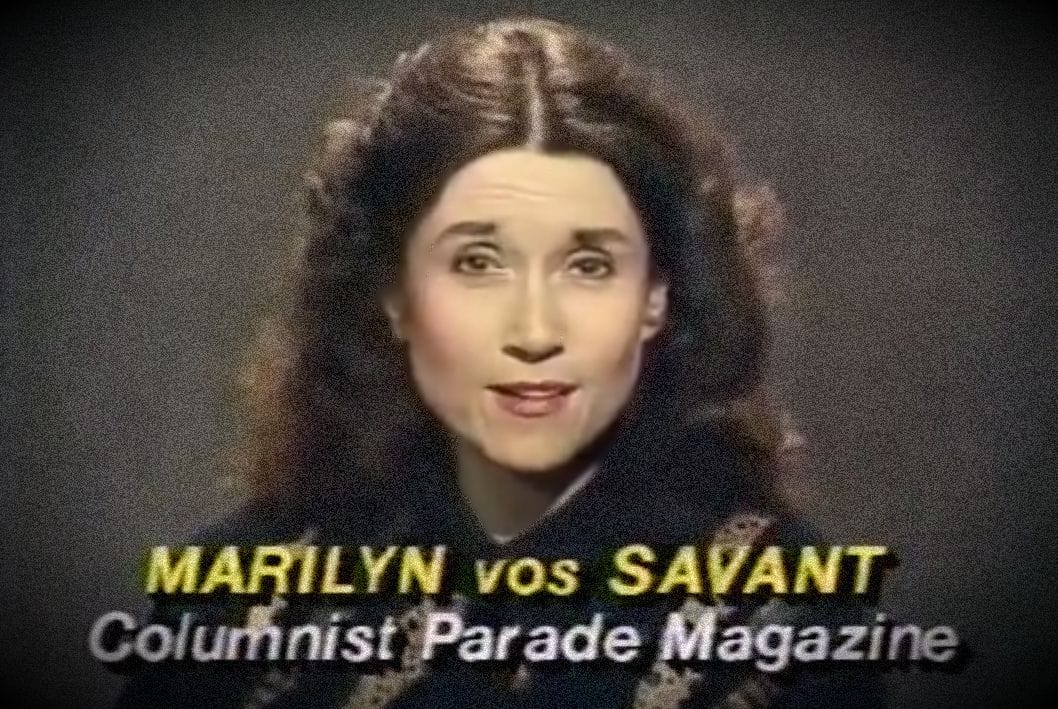
In 1990, Marilyn vos Savant correctly answered a probability puzzle in her column for Parade Magazine. And then, the world called her an idiot.
Priceonomics
101 points · by hecubus · 2y ago · 316 comments
I have little sympathy for the "ambiguous question" defence. Not only is Marilyn's interpretation grammatically valid, it just wouldn't make sense in the context of the game show for the presenter (who knows where the goats are) to ever open a door to reveal the car and give you the option to switch. The game would be reduced to "does Monty feel like gifting you a car or a goat today".
Furthermore, Marilyn's own explanation of her answer makes it very clear that she interpreted the question as meaning that the presenter will only ever open goat doors. And all the attacks seem to focus on her grasp of the math rather than her interpretation of the problem question.
To be clear, I think it's perfectly reasonable for a person to interpret the problem the other way without thinking too much about it, and casually throw out an incorrect answer. But I would expect an academic to devote at least another 30 seconds of thought to the problem before publicly excoriating a woman known for her high intelligence.
The problem posed is that you have three closed doors, behind one of which is a car, and behind the other two are goats. You get to pick one of the closed doors, and will win whatever is behind it (you want the car).
One of the doors you did not pick is now opened, revealing a goat. You therefore now know the car is either behind the door you picked or behind the other closed door.
In this setup, the question is: if offered the chance to switch your selection from the door you initially picked to the other closed door, should you switch? Does it make a difference?
Mariyln Vos Savant said switch. The peanut gallery (some statisticians who should have known better) said it makes no difference - with two doors left you've got a 50/50 chance of winning the car whether you switch or not.
First off, you can run multiple simulations of the game (with random positions of the goats and car), and prove for yourself that always switching is a better strategy, so it's sad that anyone would insist that it's not, even if that seems logical.
The simplest way to explain why switching is the correct strategy is this:
When you make your initial selection, you have:
a) A 1/3 chance of selecting the car, and
b) A 2/3 chance of selecting one of the two goats
So, 1/3 of the time you selected the car and will therefore lose if you switch, and 2/3 of the time you selected a goat and will therefore win if you switch. Switching will therefore be a winning strategy 2/3 of the time.
Obviously if the host reveals the car then you've lost, but we're not talking about such a case. Regardless of whether that is happening some of the time, there is always a 2/3 chance your initial pick was wrong and you'd be better off switching.
In my experience the most _intuitive_ explanation is to simply ramp it up to 100 doors, with Monty opening 98 of them, to make it clear that switching offers you the benefit of all unopened doors.
Another explanation:
After initial selection there is 1/3 chance car is behind your door, and 2/3 chance it is behind one of the other two doors.
When one of the other doors is opened revealing a goat, we NOW know (new information to be taken advantage of!) the 2/3 chance represented by those two other doors lies with the unopened one.
So, your choice is stick with original choice which has 1/3 chance of being correct, or switching to the other door which you now know has a 2/3 chance of being correct! Obviously you switch.
The big lie to "with two doors left it's 50/50" is that opening doors makes no difference. You're original choice had 1/3 chance of being correct, and you can't go back in time and change that.
After the player picks a door, the host states out loud, "we started with 2 zonks, you picked one door, so there must be at least one unchosen zonk... and I'm going to show you one behind door #X (door opens with zonk)... now, would you like to switch?"
Wouldn't make for good TV but it describes what is actually happening. Knowing that the host will always show an unchosen zonk is the key to realizing that opening that door has no impact on the player's odds (1/3 originally, 1/3 after the reveal, thus switching is 2/3).
Some time back in an HN thread about programming languages I read a response in a thread about inference which said that a particular feature doesn't really save on typing. And it seemed ludicrous. Until I realised the author of the comment has seen the word "typing" (which everybody else in the thread is reading as "The thing you do with a keyboard") and they're interpreting it as "The thing the compiler does". And yeah, with that perspective of course inference isn't saving typing, all your variables still have types, we were just happy because we spent less time operating the keyboard to write a program. Their comment was not wrong and we weren't correcting them, we'd just understood things differently!
Edited to add, link: https://news.ycombinator.com/item?id=36593110
But, in fact, that is the way the real show worked. He was more likely to give you a car when he hadn't given away any cars for a while. And Marilyn's description of the problem included no information about whether or not Monty offered to swap doors rarely, frequently, or always, or about the previously observed outcomes depending on whether or not the contestant took the bait. And she surely did not say that Monty was a robot and had no interest in what happened on his show.
The way the game actually worked is like how poker and life work until proven otherwise. Every high-stakes game has a sucker, and if you do not know who is the sucker, it is you. Read the story in which a NY Times reporter interviewed Monty about the controversy and you will learn how it really worked.
The offer to switch doors is part of the problem statement. You can't justify your decision based on the possibility in the real game that you might not get the offer to switch (which would mean that when you do it might be an intentional red herring).
Even if there's a 50% chance there are all goats, or a 75% chance, you still switch. That reduces the overall probability of a win, but it doesn't affect the relative probability from switching. The only reason you might not want to switch is if the first choice had been forced, such that there was an above-random chance that your first pick was the car.
No, but it would make perfect sense for him to open a door at random and - if doing so reveals the car - tell you sadly that you've lost as a disappointed klaxon plays. Indeed this is almost the only possible way that the initial door opening could realistically make sense in a game show; if it works in any other way, there's no tension when the first door is opened since there's no risk!
There certainly is. It's a high-stakes scenario and the door-opening presents new information. It makes the conclusion feel less certain.
Revealing the car would conclude the game, of course. Unless the contestant were holding out for the better goat.
I would consider both interpretations equally valid. If anything, in law we have the "rule of the last antecedent" (phrase/clause modifies nearest antecedent noun) so that the hater's interpretation could be more correct if based only on this rule.
This language is ambiguous: "host ... opens another door, say #3, which has a goat."
The two options are Marilyn's interpretation of the door always containing a goat (invariant version), or that one door he opens (say #3) just happens to contain a goat (hater's version) but it could have contained a car.
As suggested by someone below, a much clearer formation could have said "host opens a door with a goat, say door #3" to avoid this particular ambiguity.
There's also the issue of usage of "which" signifying a non-restrictive non-essential clause.
You still have the intended problem as a subproblem, so this is just a distraction and not a serious objection.
To use the 100 door extension some people find helpful: If Monty always reveals the 98 doors that don't contain goats, then 99% of the time (every time you picked a non-car door), the other door will have the car. If Monty is opening a random set of 98 doors, then 98% of the time Monty will reveal the car, 1% of the time you'll have picked the car on the first guess, and 1% of the time the car is in the other door. When you're in those 2% of cases where no car is revealed, you have a 50/50 shot of being in either of the 1% states where that happens.
None of it makes sense because it is not a real game show, it is a thought experiment.
Hosted by a real Monty Hall: https://en.wikipedia.org/wiki/Monty_Hall
It even had the gag prizes like goats (or, as in the photo from the wiki page, a llama)
Dear Steve:
Thank you for sending me the problem from "The American Statistician."
Although I am not a student of a statistics problems, I do know that these figures can always be used to one's advantage, if I wished to manipulate same. The big hole in your argument of problems is that once the first box is seen to be empty, the contestant cannot exchange his box. So the problems still remain the same, don't they. . . one out of three. Oh, and incidentally, after one is seen to be empty, his chances are no longer 50/50 but remain what they were in the first place, one out of three. It just seems to the contestant that one box having been eliminated, he stands a better chance. Not so. It was always two to one against him. And if you ever get on my show, the rules hold fast for you -- no trading boxes after the selection.
Next time let's play on my home grounds. I graduated in chemistry and zoology. You want to know your chances of surviving with our polluted air and water?
Sincerely,
Monty
https://web.archive.org/web/20100408200824/http://www.letsma...
Hall understood the problem, giving the reporter a demonstration with car keys and explaining how actual game play on Let's Make a Deal differed from the rules of the puzzle.
When I first heard about the puzzle, I struggled with the solution precisely because I kept making assumptions about the puzzle based on my knowledge of the show. It wasn't until I thoroughly read the question, setting aside those assumptions, that I realized it is materially different from the show and I was able to really understand the solution.
The “monty hall problem” (in the form stated in the article) is really a trick question, since it hinges on some assumptions which is never stated.
Even when stated correctly, the problem is a fun and counter-intuitive problem. But when leaving out critical information, you create a very differet problem of guessing what the unstated assumptions are.
Also, Let's Make a Deal has been revived and canceled many times, and has been on the air since 2009.
That is, did the wording as it was originally printed unambiguously define the problem to be solved, or was it ambiguous enough that some people who got it wrong got it wrong for the right reason?
Like many others, I completely missed that when Monty opens a door to show you a goat, he always shows you a goat. I think under close inspection, the problem doesn't actually allow you to interpret otherwise. But, should a problem like this depend on parsing and identifying the ambiguity, or should the problem be defined with explicit details about the door opening?
Given how many otherwise extremely smart people have misunderstood the problem, I am still unsure whether this was an intentional choice in framing the question. I got it wrong and thought Vos Savant was wrong until I read one of the replies in her follow-up article (yes I read this when it first came out!) said they wrote a computer program and reproduced her results. The program implemention worked because they correctly modelled Monty's behavior. I think when people end up writing the program out the ambiguity becomes more obvious.
Suppose you’re on a game show, and you’re given the choice of three doors. Behind one door is a car, behind the others, goats. You pick a door, say #1, and the host, who knows what’s behind the doors, opens another door, say #3, which has a goat. He says to you, "Do you want to pick door #2?" Is it to your advantage to switch your choice of doors? Craig F. Whitaker Columbia, Maryland
Yes; you should switch. The first door has a 1/3 chance of winning, but the second door has a 2/3 chance. Here’s a good way to visualize what happened. Suppose there are a million doors, and you pick door #1. Then the host, who knows what’s behind the doors and will always avoid the one with the prize, opens them all except door #777,777. You’d switch to that door pretty fast, wouldn’t you?
-----
Yes, the question as posed by a reader was ambiguous but Marilyn made a very reasonable interpretation based on what someone at that time would probably tend to know about game shows. And she even gave an explanation (using more doors) that I find tends to work with folks combined with the explicit assumption that the host will always pick goats.
I parsed that as "50% of the time, monty opens another door and it has a car and you win immediately, and 50% of the time, monty opens another door and it has a goat". In retrospect I think my brain just sort of pictured that and proceeded to assume there was no reason to switch, and it wasn't until I read some answers (not her explanation) that I understood I was wrong (and I went through a lot of anger, like many of the commenters, and thought she was very wrong before that).
If there had been exactly one more sentence saying "monty always opens a door showing a goat", I'm pretty sure I would have recognized that. BTW I was familiar with the game (I liked Jeopardy better, as Let's Make a Deal was a fairly dull show) and I don't think they had a game that was identical to the problem as described.
Why would you think you won? You didn't choose that one with the car and you aren't offered the opportunity to switch to the open one, only the closed one. The only interpretation which makes sense is that he always shows you a goat.
There is no randomness in this sentence. The door has a goat, not a car.
Then again, you might read it as an example outcome. But even if the door was chosen randomly, it would not justify the 50%/50% answer.
Independently of that, assuming that the host chooses the door with the car and the goat with 50% probability each is the same mistake that confused so many, you cannot always assume uniform probability only because there are 2 options.
(I wanted to point out the flaws in your thinking because this has also been a confusing problem for me)
edit: this is wrong, dekhn was right, see below
So I see the second order problem a bit differently: it's not "was the statement unambiguous", it's about what you do with the (possibility of) ambiguity: do you assume you can't be wrong and therefore others must be, or do you try to figure out whether you were solving different problems?
https://blog.xkcd.com/2008/09/09/the-goddamn-airplane-on-the...
There appears to be problems that make it easy for people to assume the worst of others.
And on a side note, I discovered about 6 months ago that mythbusters actually did this experiment. At the end of the day, few things work better than seeing something happen in real time.
> And a very small percentage of readers feel convinced that the furor is resulting from people not realizing that the host is opening a losing door on purpose. (But they haven’t read my mail! The great majority of people understand the conditions perfectly.)
https://web.archive.org/web/20181118225305/http://marilynvos...
The problem statement is just a mess:
> You pick a door, say #1, and the host, who knows what’s behind the doors, opens another door, say #3, which has a goat.
even tiny edits like:
> You pick a door, say #1, and the host, who knows what’s behind the doors, opens another door which has a goat, say #3.
or even
> You pick a door, say #1, and the host, who knows what’s behind the doors, opens another door, say #3, which he knows has a goat.
make it clear that the last phrase is describing an invariant of the problem, not an artifact of the illustrative hypothetical.
> You pick a door and the host, who knows what’s behind the doors, opens exactly one of the two remaining doors according to the following algorithm: if both doors contain goats, he picks a door at random, else he picks the door he knows to contain the goat.
Marilyn even made this explicit in her answer, writing that the host "knows what's behind the doors and will always avoid the one with the prize" [0]. So readers were arguing her answer was wrong even given this understanding of how the show works.
[0] https://www.newspapers.com/article/the-missoulian-the-monty-...
The host has to always open the door, too. Else-- if your strategy is always to switch when shown a goat, the host can choose to only show you a goat if you have already picked the car (which would cause you to lose 100%). Or various mixed strategies.
This is one of those problems that is hard to grasp at baseline, but a little harder to grasp because the situation isn't fully specified. As a result it tends to create a lot of controversy, like the one about an airplane on a treadmill.
https://en.wikipedia.org/wiki/Monty_Hall#Monty_Hall_Problem
(But vos Savant stated in later columns that most of the critical responses she received assumed that the host was obligated to offer the switch, so they were genuinely confused by the paradox.)
Imagine the extreme scenario with 999 goats and 1 car. You select the first door, the host opens 998 doors at random, leaving your selected door and one other. Two scenarios are now possible:
1. There was a car in the 998 doors that got opened. Tough luck, you lose the game automatically now (game resets).
2. There was not a car in the 998 doors. In this scenario, you are still advised to switch.
Edit - I guess I misremembered a simulation I once did about it.
A nice goat fetches up to $1000 to according to a quick google.
Or look at this case analysis for the three element case. https://news.ycombinator.com/item?id=24714612
You can get intuition by understanding that the cases where the game is ruined are only the cases where you didn't choose the car.
How so? The problem is typically presented as a single trial, with nothing that clarifies the intent of the host.
There's the Monty Hall problem and then there's the "can I get away with falling back on claiming the question was somehow wrong after embarrassing myself by getting the Monty Hall problem incorrect" problem. No one who claimed it was unclear or ambiguous did so before getting it wrong.
It's really tiresome to have to always pretend to assume good faith when it's really clear what's going on.
> Monty Fall Problem: In this variant, once you have selected one of the three doors, the host slips on a banana peel and accidentally pushes open another door, which just happens not to contain the car. Now what are the probabilities that you will win the car if you stick with your original selection, versus if you switch to the remaining door?
> Monty Crawl Problem: As in the original problem, once you have selected one of the three doors, the host then reveals one non-selected door which does not contain the car. However, the host is very tired, and crawls from his position (near Door #1) to the door he is to open. In particular, if he has a choice of doors to open (i.e., if your original selection happened to be correct), then he opens the smallest number available door. (For example, if you selected Door #1 and the car was indeed behind Door #1, then the host would always open Door #2, never Door #3.) What are the probabilities that you will win the car if you stick versus if you switch?
Suppose after you make your initial choice, instead of opening a door, Monty simply asks if you'd like to switch to BOTH the other two doors, such that you win if the prize is behind EITHER of them.
That switch is intuitively a great deal, giving you 2/3 odds. The only way you can lose is in the 1/3rd case where you already picked a winner. The original scenario is equivalent to this, since by revealing a goat Monty is allowing you to pick "the best of" the two doors.
---
Often people who don't like this problem complain that actually Monty, with his knowledge of the winning door, may be trying to trick you into losing. Maybe he offers this trade conditionally based on whether you've already selected a winner. Of course, this wouldn't support the most common intuitive answer of "it's 50/50", either, making this a bad excuse. If we accept this behavior from Monty -- not stated in the problem -- it becomes a very uninteresting problem based on whether we are dealing with Evil Monty who only offers the trade when it's a bad one (stay wins 100% of the time), Friendly Monty who only offers the trade when it's a good one (switch wins 100% of the time), or somewhere in the middle. It has no analytical answer. So for this to be a solvable problem at all we must assume we are dealing with Fair Monty who offers the trade all the time, or at least, offers it at random times not based on the contestant's initial pick.
If Monty always opens a door, and uses his knowledge of which door has the prize to ensure that the door he opens is always empty, then you should switch, because he's providing you with extra information about which door has the prize.
However, if Monty changes it up and sometimes doesn't open a door, or opens the door with the prize, the whole problem changes. If he only opens a door and offers you the chance to switch when you've picked the door with the prize, you should never switch of course. If he opens a random door and might reveal the prize (after which he obviously won't let you switch anymore), switching doesn't change your odds. I think a lot of people see it as one of those two situations.
It's amazing how even seeing the probabilities written out, or running simulations, doesn't really make it easier to truly understand the result.
In other words, at the final round, you are presented with two doors. Ignore the fact that you already chose one, and assume you were starting at this point: you enter the game, see two doors, and need to pick the one you think hides a car. So intuitively, your odds of choosing which of two doors has the car are 1/2.
It's hard to really understand why it matters that the previous rounds occurred at all — why it matters how you narrowed the selection to these two doors. I don't think the 1000 door version makes that easier to understand, because the same thing is true there — if you come into a game, see two doors, and are asked to choose between them, it's very hard to understand why it matters whether in a previous round there were 2, 3, 10, or 1000 doors — there are only two now, when you make your choice.
It's not hard at all. Humans are not perfectly rational beings. It's not purely about odds, it's about emotions and psychology. In a version where there's no previous selection and it's 50:50, than I pick one and live with it. In the canonical example, the previous selection means that the contestant has already staked their claim, and changing it to the loosing door would have a different emotional response than a simple 50:50 shot with no previous selection. There's a reason why Roulette shows you the last X spins and whether they're odd/even, red/black... because humans make the assumption that the last disconnected data point somehow impacts the current one.
You're also glossing over the fact that there was a 1:3 chance you picked the right door to begin with, and 2:3 chance the "other" door was right. The last round isn't 50:50, as you so claim, because there was prior information
This is the same reason why the 1000 door example helps explain things; because the math is fundamentally the same, yet significantly more imbalanced. We can also think about how we'd feel about our selection in the 1000 door version, which is likely significantly less confidence, and therefore more likelihood of switching. Whether it's 3 doors, or 1000, the math still say switching is optimal, and our psychology and emotions deal with the choice of switching different in each case.
Had to vs happened to makes a big difference.
Had he opened them at random and by (extremely small) chance they happened to be empty, the odds are quite different.
Does it really change anything?
If Monty opens the door by chance there are 3 equally likely cases: There's a 1/3 chance you picked the car and Monty shows you a goat, 1/3 chance you picked a goat and Monty shows you the other goat, 1/3 chance you picked a goat and Monty shows you a car. So if Monty shows you a goat you have equal probability of being in one of the first two cases.
If Monty doesn't open the door by chance then he never shows you a car. So 2/3 of the time you picked a goat and Monty shows you the other goat.
But if you had chosen a door with a goat, then Monty has no choice at all, he must open the only door with a goat that you didn't pick. It is a leak.
From other hand if Monty picked a door by random, he would not leak his secret, but he might open a door with the car accidentally.
You had a 1/1000 chance of picking the right door at once.
Monty had a 1/1000 chance of opening only empty doors.
He had a 998/1000 chance of opening a door to a car, but that didn't happen.
So it's either of the other two cases, with equal probabilities.
If he used his knowledge to never open a car, the 998/1000 case wouldn't exist, and there would be a 999/1000 chance that the door he left unopened had the car.
There's 1/3 chance of picking the car. 1/3 of the time you pick the car, switch, and lose. 2/3 of the time you pick a goat, switch, and win. Why? Because 2/3 of the time you picked a goat, Monty shows you the other goat, so if you switch you definitely get the car.
I never liked the 10^x other doors version either. My thought was, what say me and a friend play a the same time, and pick the same initial door? If I NEVER change, and he ALWAYS does... I'm still going to win 1/3 of the time, and if Monty always shows the goat, ONE OF US has to win, so if I'm 1/3 by not switching, he HAS to be 2/3 by switching.
The problem stated with 3 doors is hard, with 5 is still not quite there for many. 100, 100, 10_000_000... becomes almost absurd.
In the tree it becomes blindingly obvious that the probabilities are.
That still leads to the wrong answer, because he is retiring one of the losers, leaving a 50:50 chance of getting a prize.
I came up with another way to visualize it that made more sense than increasing the number of doors, but it requires that one accept the fact that your chances of winning are 1/3 if you don't switch, and you know Monty always shows a losing door.
You don't need to model all three door choices. Just say you pick Door A, not Door 1. The first door you didn't pick is B, and C is the other door. Then map the prize behind each of 3 doors, and whether you stay or change your answer.
Then count the number of successes for change versus stay. Spoilers: It's 3/6 vs 2/6.
... this revealed a major flaw in my intuition that helped me to grasp it. I had subconsciously been assuming Monty sometimes opens the door revealing the prize instead of always opening a goat door. When I coded that into the simulation, of course it broke (because the player was now playing foolishly, looking at the prize and intentionally choosing the closed door that definitely still had a goat behind it).
So 2/3rd of the time you have a 100% chance of a car if you switch, 1/3rd of the time you have 0% chance of a car if you switch. So switching is a 66.7% probability of a win and is the 'inverse' of if you picked the car right on the first guess or not.
The choice of which door Monty Hall shows you is constrained and isn't an independently random event since he never shows you the car when he opens a door.
You can also laboriously go through every event and "bifurcate the world" and then add up the probabilities, but you need to be careful about how you do it:
    1.  assign the car to a door (there are three possibilities)
    2.  have the contestant pick a door (there are now nine possibilities)
    3.  handle which door Monty Hall shows (this is tricky because for the three permutations in #2 where the contestant picked the car, then the door Monty Hall picks is unconstrained and so the world splits, but you are slicing a 11.1% chance in half for ~5.6%, while for the six permutations where the contestant didn't pick the car, Monty Hall is constrained so those remain 11.1% chances (at every level the probabilities have to add up to the probabilities before them and you can't violate 100% when you sum across all of them).
    4.  then have the contestant either switch or not switch and cut all your probabilities in half again.
    5.  now color everything according to winning or not and sum it all up.
4. then have the contestant either switch or not switch and cut all your probabilities in half again.
If we switch deterministically we end up with 6 cases (leaves in the tree) with probability 1/9 where we win. 6/9 = 2/3!
If we switch randomly then we do split probabilities again, and end up with 6 cases with probability 1/18. 6/18 = 1/3.
Which door is opened to reveal a goat is totally irrelevant, as either would (under the absurd supposition) increase the probability of the initial guess to 50%. In other words, an increase to 50% would be guaranteed from the very beginning. So a contradiction is reached with the obvious fact that initial prob is 1/3.
The fun is in not explicitly stating every unconscious assumption you have about the problem.
Without additional assumptions this original wording is not clear, it could be that the host always shows a goat, then one should switch, or the host shows something at random and we just look at the cases where he shows a goat, then it doesn't matter.
That’s what the sentence says: “and the host, who knows what's behind the doors, opens another door […] which has a goat”.
> or the host shows something at random and we just look at the cases where he shows a goat
Nothing says that the host opens a door at random. Quite the contrary, we know that the host has a perfect knowledge of the situation.
If it says he opens a door, and it has a goat, then you’ve learned nothing about the remaining two.
It doesn't matter. Because the problem explains what happens: he opens a door and reveals a goat.
That is crucial information. There's now only one goat and one car left. But the choices have not been shuffled: you're definitely still pointing at your original choice.
What were the odds that your original choice is a goat? Two in three.
If you picked a goat, what is guaranteed to be behind the other door? A car.
So what are the odds that behind the other door is a car? Two in three.
You should switch.
The only problem you are being asked to solve is the one described only in the words of the problem.
That's actually what this is all about. This is a learning exercise, not just about probability, but about comprehension of what the problem as described exactly says.
That's what makes it so enormously valuable.
They address every single (meta) concern I've read here.
This is implicit in the "100 doors, MH opens 98 of them" construction discussed in the article but making it explicit makes the idea quite clear and intuitive, even with just 3 doors.
I'm moderately sympathetic to the idea that this constraint is not immediately obvious from how the scenario is described, and could technically be ambiguous in some versions. I do think most people will agree that it makes sense to infer this constraint once you think about it. Obviously if he opened the door that you initially picked and it was a goat, you would know to switch to one of the other two (and have 1/2 chance of finding the car). (Or, more absurdly, he could just open the door with the car and you could choose it directly). Or you could imagine a game show where MH can choose to open a door or not, in which case the problem is not well-posed, because you would need to know how he makes the choice.
The second part I agree with, but not the first part; because it sounds like you're saying MH is required by the rules to reveal a goat. But the problem works fine if he always opens a remaining door at random and it happens to be a goat.
I'd say it as: once you had chosen a door, Monte was required to open some other door. And the door he happened to open, for whatever reason, had a goat.
Wouldn't that work?
1. you picked car first, he picked the first goat
2. you picked car first, he picked the other goat
3. you picked first goat first, he picked the car
4. you picked first goat first, he picked the other goat
5. you picked other goat first, he picked the car
6. you picked other goat first, he picked the first goat
You happen to know that he picked a goat, so you can eliminate 3 and 5, but the remaining four possibilities are still equally likely. Half of them let you win by switching. This is also the "MH stumbles into a door on accident" variant that others have mentioned.
Another way of getting intuition about your version is to realize that, if he might have shown you a car, then the fact that he has opened a goat is evidence against the hypothesis that your first pick was a goat, because half of the times you choose a goat he would open a car, whereas if you chose a car he would have to show you a goat every time. It eliminates some of the ways things could have turned out if you started on a goat without eliminating any of the ways things could have turned out if you started on a car, so the former is relatively less likely in retrospect than it was before MH opened the goat. More obvious in the 100-door case: if your first pick was a goat, then the fact that he hasn't shown you a car after opening 98 doors at random (or equivalently leaving one door closed at random) either means that you were very lucky in the first pick and got the can (in which case it's easy to open 98 doors without a car) or he got very lucky in his random choices. Most games played in this way (98%) would end with MH revealing the car, and the fact that you don't happen to be in one of them only tells you that one or the other of you got very lucky. The probabilities work out that the two options are equally likely.
Certainly, that constraint is important to the final solution.
I wonder if anyone has gone through every episode of "Let's Make a Deal" where this scenario occurs and look at the empirical distribution of switch/not-switch.
(Note: this analysis does depend on the constraint that MH doesn't open your first pick door! Edit: actually the answer also becomes equal odds if he can pick any door, regardless of whether it was your first pick or the car. In that case, 1/3 of games will not complete, and the rest will be 50/50 between the unopened doors.)
No one would design a game show like that, so it means the question only has sense if interpreted as "Monty always opens a goat door".
I'm happy that she's real and as smart as portrayed. But what really impressed me is how calmly she received all the negative feedback and personal insults. No matter what, she never lashed back. I have a feeling that's authentic too.
I could not grasp the probability maths (still shit at it, sorry Ms Von Savant) but I could write a program to experimentally demonstrate it, so I did.
In QBasic. Because that's what we had and we were happy.
The way the problem works started coming together in my head as I coded it. The code’s structure reflected the problem’s structure. I realized I previously misunderstood something about the problem statement. Later, I read someone saying many mathematicians got this problem wrong because of how it’s worded.
So, it may be challenging, not because probability was challenging, but because it was unclearly specified. That’s the cause of many software errors, too.
People who get it wrong are usually projecting some implied understanding onto it, which is why they get it wrong.
Which is the point of the problem. It's designed to reveal this tendency in analytical thinking leading to unexpected outcomes. You get it wrong, you're gobsmacked, you understand why, you gain some enlightenment from it. It's fun to be wrong in ways you later understand. (This is one of the thrills of programming: that moment during debugging when you shriek with joy: "YES, IT BROKE!")
The fact that it also exposes the way some overly confident people lash out with anger that exposes other biases is the point of the article, I think.
It was years before I understood the actual lesson here -- both the probability lesson and also the way it hints at the fundamental truth that in life, binary choices may have been weighted in ways you don't understand, perhaps by the people asking you to make the choice.
But in the iterated game of "you pick door, and host chooses whether to show a goat or to let you open the door you initially chose" I don't think you (or he) can get better than 50-50. If you chose the correct door initially, then he can try to trick you into switching by opening a goat-door. But if you chose a goat-door, then he can let you open your selected door (or offer some other deal -- $1,000 cash or the door you chose). If he only shows the goat-door when you have selected the car-door, then you should never switch, so his optimal strategy is to show a goat-door when you choose a goat-door 1/3 of the time, so you basically get no information from his actions.
The "always switch" solution imagines this as a one-player game rather than a two-player game, with Monty Hall actively trying to sabotage.
Doesn't Monty reduce your win chances to 33% just by never opening a goat door?
The Time Everyone “Corrected” the World’s Smartest Woman (2015) - https://news.ycombinator.com/item?id=17686279 - Aug 2018 (112 comments)
Marilyn vos Savant and the Monty Hall Problem - https://news.ycombinator.com/item?id=9078660 - Feb 2015 (142 comments)
Game Show Problem (1990) - https://news.ycombinator.com/item?id=6386289 - Sept 2013 (31 comments)
The topic of the vitriolic responses to Marilyn is not boring.
It’s a great problem for illustrating the importance of simulation in statistics. By breaking off into pairs, half of whom played the switch strategy and half of whom played the stay strategy, we did hundreds of trials and found empirical evidence in favor of Marilyn’s answer. Furthermore, by actually playing the game, whatever any ambiguity in the wording of the problem was quickly resolved.
>> Despite her status as the “world’s smartest woman,” vos Savant maintained that attempts to measure intelligence were “useless,” and she rejected IQ tests as unreliable.
The word "maintained" is a link pointing to this blog post, reproducing an interview of vos Savant [1]. In the interview, vos Savant is quoted as saying:
>> Not that IQ tests are useless. Far from it.
______________
[1] http://sailom.blogspot.com/2007/04/are-men-smarter-than-wome...
The game show host isn't going to reveal YOUR chosen door - that would ruin the whole game.
Likewise, the host isn't going to reveal the CAR and end the game immediately without a winner - it's bad television.
So the host opens a third class of "irrelevant goat door" in order to offer you the suspenseful proposition that is sure to get millions on the edge of their seat - switch or stick?
In the case of 3 doors there is only 1 irrelevant goat door. In the case of 100 doors, there are 98 irrelevant goat doors, driving the point home further.
We have to assume the host knows which are irrelevant. All irrelevant goats are eliminated. Which means the probability of the car behind your door is 1/n and the probability of car behind the remaining door is always (n-1)/n. Always. Given this assumed behavior of the host.
Knowing the above gives you a clear empirical advantage for modeling and inference. Why would you reject knowledge that may be directly relevant to the question at hand?
Turns out, instead, she's the G.O.A.T.
- Savant's Monty: The host knows where the car is, and wants to prolong the game. Switching wins 2/3 of the time.
- Ignorant Monty: The host has no idea where the car is. Revealing the goat was luck and your odds remain 50-50.
- Malicious Monty: The host knows where the car is, and wants you to lose. The fact that the host didn't reveal the car means that you have the right door. You'll have no chance of winning if you switch.
Nowhere in the problem are Monty's knowledge and motivation stated. When explained, most go along with the assumptions that Savant's argument introduces. When the actual Monty was asked, it turned out that he was usually ignorant. And the malicious scenario demonstrates how different the answer can be.
The fact that all three answers are consistent with the statement of the problem means that it is indeterminate.
There was sufficient evidence for Savant's Monty -- the car was revealed 0% of the time, not 33 or 66% of the time.
Fun Facts which I think I'm remembering correctly: it wasn't always a goat, they would have other random animals behind the doors as well and because of the laws regulating game shows, the goats were actually a prize, for which you would receive "the cash equivalent" of the goat, if you picked that door. But because the goat was the prize, they couldn't force you to take the cash-equivalent of the goat, if you really wanted to keep the goat. Which was a big headache the handful of times it happened, because the goats were a rental.
Malicious Monty, however, can exist. He only ever opens a second door when you've picked correctly, but when you haven't simply accepts your choice.
The problem was stated correctly and clearly, though, as long as you assume that Monty is not a person, has no motivation at all, and as part of a math problem simply wants to reveal a goat after you've made a choice and has the means to do it. That's Savant's Monty: the Monty that doesn't add significant features to the question.
I was, however, wrong that Monty was ignorant. By his own statement, he always knew the answer. But whether or not he was on your side depended on his mood. And he applied various forms of pressure to get you to make the right, or wrong, decision.
Therefore the problem was not stated correctly. A correct statement needs to not just state what you witness, but the counterfactuals about possibilities that you didn't witness.
"and the host, who knows what’s behind the doors, opens another door [..] which has a goat."
The question is clear: The host (1) knows what is behind each door and (2) always shows a goat. It's clearly a determinate problem.
You're right. The problem is stated multiple times in the article. As is usual, most of the statements do not address knowledge. But Marilyn's own statement did. However she did not address motivation.
Monty himself claims that his motivation varied depending on his mood. The actual game had more complications. And his statement about the real game was, "My only advice is, if you can get me to offer you $5,000 not to open the door, take the money and go home."
You can find the article I got that quote from at https://www.nytimes.com/1991/07/21/us/behind-monty-hall-s-do....
Well you do have that guarantee -- as it is stated in the problem. It's clear that no matter what door you open, you will be shown a goat.
Though I'm not sure I've ever considered the Malicious Monty, only the other two.
The host does not really have any agency here.
The rules are intended to confuse people and trick them into thinking both remaining doors have the same probability. I can see how this would favour the house on average because once people committed and chose a door, they are invested and would tend not to change their mind. But the host’s actions have no effect. And even then, this might be an intuition, but does not provide any understanding as to what exactly happens.
(Although there is one variable I don't know the answer to: I don't know if they always give you the offer to switch. Sometimes I believe it's a different offer, "Keep the door or take this money out of my hand". The host being able to choose which offer is made shifts the odds a bit, because the host may be choosing the offer based on whether you've picked the right door initially, and may be making that choice in a biased or randomized way. There's hidden data there we don't have as observers).
"Marilyn vos Savant and the Monty Hall Problem (2015) Problem (2024)"
That thread wouldn't be about the problem, or about the decades ago backlash to the correct answer about the problem, but about the backlash to how everyone in 2024 semantically picked apart the problem.
I lived though the initial backlash and it was annoyingly entertaining how high level mathematicians tried to show how she was wrong. Now everyone is trying to use semantics to show how they are right--or at least not wrong.
I don't know which is worse--pompous incorrectness (then) or pedantic semantics (now).
My character hinges on that understanding now.
Here's Monty Hall himself on the subject: https://twitter.com/kareem_carr/status/1749463327464456644
For the 3 different scenarios, switching is the correct choice in 2 instances. Not switching is the correct choice in 1 instance. 2/3 chance that switching will help you to win.
That person wrote a program and proved her right, while all these stuffy old men got just downright testy with her - one even getting misogynistic with here. It was gross to read about.
But good on the teenager for actually sciencing it.
It is the described problem that matters.
There was so, so much writing like this at the time, people saying "well, if...".
If you didn't notice, "Savant" means smart.
So is it just a coincidence? Karma? The pressure of carrying such a name drove her to smartness?
Marva Watkins in Chicago, Illinois, writes: What is your real last name?
Marilyn responds: It's "vos Savant," which was my mother's maiden name and is my own legal name. (My mother's maiden name is just as real as my father's boyhood name.) My maternal grandfather was Giuseppe vos Savant. Coincidentally, he married a woman named Maria Savant, my maternal grandmother. Growing up, I never thought about "Savant" being a word, too. I'm sure that people with the name "Miller" don't think about it, either! By the way, my mother changed her surname to my father's surname when she got married, which was traditional at the time. I use her name, and my brother uses his name.
https://parade.com/418148/marilynvossavant/marilyns-surname/
It reflects some broad understandings of the 1980s and what we valued.
Marilyn vos Savant was born Marilyn Mach on August 11, 1946, in St. Louis, Missouri, to parents Joseph Mach and Marina vos Savant.
... so only 50% coincidence.
> “Now,” he says, turning toward you, “do you want to keep door #1, or do you want to switch to door #2?”
There are some implied assumptions. You need to know that the car is randomly placed (or that your door choice was made at random), and that the host always has to show you an empty (ok, goat) door before offering you to switch.
Under those assumptions, the winning odds of the switching strategy equal the odds of your initial pick NOT being the car.
You don't need to know this.
> and that the host always has to show you an empty (ok, goat) door before offering you to switch
You know this through the line, "Then, the host, who is well-aware of what’s going on behind the scenes." If you can't understand that a game show host won't spoil the game they're hosting, that's on you and a good opportunity to pick up common sense.
Because he did it this time?
Amazed this nitpicking is still going on; it's illustrative.
Only if there are three doors - or rather, only if the host eliminates all but two doors, one of which is the one you chose.
If there are, say, four doors, and the host eliminates one, your odds of success on switching are not 3/4.
I completely get all the explanations but it just feels too weird.
The idea is supposed to be that Monty always reveals a goat. He does not pick a door at random to reveal before offering the choice to switch. If you pick door A, and the car is in door B, he will reveal door C and ask if you want to switch. If you pick A, the car is in C, then he will open door B and ask if you want to switch.
Expanding it to 100 doors with Monty opening 98 of them and then offering you the opportunity to switch should make it very intuitive. Let's say you pick door 7, and Monty then opens every door except your door and say, door 48, all revealing goats, then it should make you think "Wow...very odd that he didn't reveal door 48...there must be a reason he skipped that specific door".
Make it 1,000,000 doors. You choose door 1. Monty opens every door except number 423,901, and all the doors he opened had goats. You're tired and hungry because all you've done for 4 days is watch Monty open doors to goats, but you should certainly be thinking it's odd that he skipped that one specific door. You should probably switch, though maybe take a nap before claiming your car.
That is:
- the setup of the system matters.
- The state of the system at the point of the decision to switch matters.
- The choices don’t get re-randomised.
So the probabilities assigned to the original choice (and the remaining alternative) still count.
If the host had closed a curtain over the stage and randomised the remaining doors, then it would be 50:50.
But he didn’t. So you’re still in the probabilities of the original choice.
One of the goats has been removed. The car and one goat remain: you know this for sure.
You are being offered a door knowing that behind it must, necessarily, be the opposite of your original choice, and the probabilities have not been reset.
If you originally picked the goat, that door absolutely has a car behind it. And there's a 2/3 chance you picked the goat originally. So by inference there's a 2/3 chance the door has a car behind it. You should switch.
I didn’t get it until I had written a simulation to see it for myself though!
Showing you the goat is the event that, as you say, guarantees that the other door has the opposite of your original choice behind it. Because nobody closed the curtain to shuffle the choices.
One of the things I think people struggle with -- and I struggle with -- is that probability isn't about hypothesising about a single event that happened and how it might have happened. It's about encapsulating all the possible ways a single specified scenario can play out in a single expression.
Monty shows you a goat this time, but this means Monty always shows you a goat. There's no scenario where he is unable to show you a goat. Just like you always only pick one door. And there's always only two goats and one car.
(Full marks for username choice)
* When you choose your first door, the chance the car is behind that door is 1/3, for obvious reasons.
* When Monty opens the goat door, nothing actually changes that is relevant to your odds. He is always going to open a goat door, whether your first choice is a car or a goat, so it's basically irrelevant. He hasn't move the car, he hasn't given you any information you didn't already know when you made your first choice. So the odds of your first choice being correct can't have changed. They are still 1/3.
* The only possible outcomes are that your first-chosen door has the car, or the other remaining door has the car. The probability if your first-chosen door having the car is (still) 1/3, and the probabilities of all possible outcomes must add up to 1, so the probability of the other door having the car are 1 - 1/3 = 2/3.
There is quite a lot of ambiguitiy in how this is phrased. So the host knows what is behind the doors, but how does this affect his choice to open another door?
Does he always open another door, or does it depend on what is behind the door the contestant selected?
Is the second door selected by random or will it always be one with a goat?
The implicit rule is that the host: 1) always opens one of the other two doors, regardless of what is behind the selected door. 2) deliberately opens one of the two doors which doest have a car behind it.
"[The] host, who knows what’s behind the doors, opens another door which [...] has a goat."
So he always shows a goat. If he opened the door with the car then the game would be ruined.
People go digging, usually pretty hard, to find insults to use as capital in whatever point they are trying to make. In this case, yes, she received a lot of criticism and ad-hominem attacks for her correct answer. But she wasn't really criticized for being a woman, despite it being repeated multiple times in the article.
Look at the given list of people who wrote her angry letters and what they wrote:
     Ph.D
     Ph.D
     Ph.D
     Ph.D
     Ph.D
     Non-doctorate professor?
     Don Rivers from Sunriver Oregon who made a sexist remark.
Nobody is saying she was criticised for being a woman, though. What they are observing is that it was the basis of and the tenor of attacks on her character, intelligence, certainty etc.
It was nasty and it really happened, is all I'm saying. Are we better? I hope so. But I don't know that I think so.
This is what makes discussions about discrimination so hard- it can be very subtle. And it can include situations like this one, where we don’t have a test environment where we can compare responses to the article written by a woman to the one written by a man.
FWIW, Sunriver is a resort community outside of Bend. It's not the middle of nowhere, it's filled with tech industry vacationers and wealthy retirees.
edit: I know it works out on paper, but if I put myself in the situation, I know that if I decided not to choose again that is a choice and I am re-choosing the same door.
Imagine the thing with 100 doors and imagine the host isn't opening any doors, but just telling you what's behind them and it becomes pretty obvious.
If there are only two choices remaining, I guess I don't understand the assertion that there is still a 1/3 chance of winning.
Suppose you were new to the contest and were allowed to put money down on the choice at the point that there were two doors left.
Then you repeated the bet every new contestant.
Would one door would be more profitable than the other?
That would be a completely different game. The goat doesn't get reshuffled. The doors that remain are not random and most importantly, you know which door you picked in the first round. It doesn't become a 50:50 chance just because there are two doors, as the goat isn't distributed over those two doors, but across all three.
Imagine 1000 doors. You pick one. In round two you are asked if you want to stay with that one door or pick all the other 999 doors at once. What do you do?
Case 2: Suppose there are n doors and Monty knows what is behind every one of the doors. You choose one door at random. Monty deliberately opens (n-2) of the remaining doors from the left to right, skipping the door with the car. Then he asks you if you want to switch. Should you switch or not?
Whether n=3 or n=100, it seems to me that it does not matter whether Monty Hall has complete knowledge or zero knowledge of the location of the car. You are required to make a choice under the condition where there is only one other unopened door and all the other doors did not reveal a car. The player's original choice was correct with probability 1/n and the probability of the complementary event must be (n-1)/n. The player's strategy of switching will result in a win with probability of (n-1)/n.
Worded more carefully, the answer is more intuitive, and this is probably why there was controversy surrounding it.
The naming is taken from an actual game show, which perhaps confusingly seems to have been a third variant on the same problem, using more steps and trick monetary incentives to make fore more exciting viewing.
I found working through it to be really rewarding, you might too.
Spoiler alert: consider how Monty's choices are constrained by what he knows, and how the player can capitalize on that.
It's not 50/50 because the choice wasn't random.