114 points · by geox · 2y ago · 106 comments
I cannot see that sort of rapid rebuilding anywhere I know. I live in a house that is about 60 years old. I have friends who live in houses centuries old. Not come across anyone who needs to change very much to cope with climate change, apart from things to reduce emissions (mostly installing heat pumps can be difficult)
The built environment also needs to handle a lot of variation anyway.
I can certainly see a drastic impact in some places: low lying land (I would be very worried if I was Dutch or Maldivian. I might be quite worried if I was living in Norfolk) , but its not everywhere.
Flash flooding is getting worse in the UK, partly because of climate change (look at how wet February was for south east UK) but also because a lot of urban areas are being paved over.
but to a throw away comment:
> installing heat pumps can be difficult
Yes, yes they can be, but also they also are not the cheapest way to save carbon.
Insulation makes a much bigger impact, that includes external wall insulation, and better glazing. its up to 2x cheaper.
Nonetheless, very few places are affected with a decade. The vast majority of people live in places that will not be badly enough to need rebuilding any time soon.
I am hoping that this is a UK problem and the rest of the world is mostly not as crazy. Not that I have high hopes of that.
> Yes, yes they can be, but also they also are not the cheapest way to save carbon.
Cost effective solutions are not profitable, so are not backed by lobbying and marketing.
> Sufficient impact to require rebuilding houses or other buildings on a single decade scale?
Didn't Texas suffer a major snow storm a few years ago? The houses, electrical distribution network, people's clothes were unable to handle the situation and if I'm not mistaken there were deaths.To me this is the much bigger issue than us humans adapting. For us to adapt it demands a lot of labour, and associated costs, it will make life harder but it's doable.
Nature doesn't have this ability, animals can't get together in an assembly and find technological fixes to support them living in their environment when it changes, they either move to another area where they are adapted to (if it exists) or they die.
The current rate of extinction is between 100 and 1,000 times higher than the pre-human background rate of extinction. What we're going through will be an extinction event on a timescale and severity that will be closer to the Permian or Cretaceous extinction, which resulted in the species death of 95% and 78% respectively, and caused by apocalyptic scenarios; meteors and volcanos effectively suffocating the planet. Never before has a single species been responsible for such destruction on Earth.
I suspect humanity will survive whatever future is yet to come. I just hope we managed to preserve a substantial percentage of natural diversity through that process.
This also makes it harder for many species to adjust to climate change and habitat loss as it is much harder for them to migrate.
[1] https://www.swissre.com/media/press-release/nr-20210422-econ...
I read GP as talking about the positive impact on GDP of rebuilding, and with the intent of pointing out that GDP is a flawed metric.
It’s the difference between going into debt for medical school versus going into debt to pay the high interest your loan shark demands after you ran up gambling debts.
[0]: https://en.wikipedia.org/wiki/Parable_of_the_broken_window
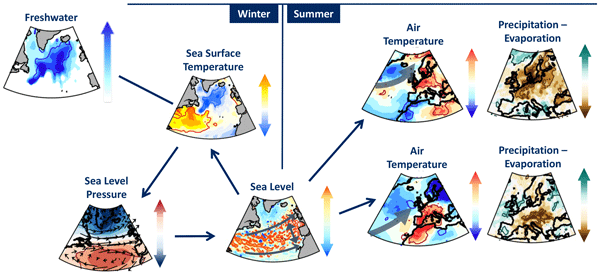
More ice melt => More fresh water in the Atlantic => cold surface anomalies in winter => sub-polar winter storms => heatwaves in Europe in summer
Mostly not predicted as models do not have fine enough grid resolution to show the movement of freshwater into the Atlantic, which happens via "narrow" channels.
Most of Northern Europe isn't like most of Siberia or Canada (e.g. Berlin where I live is at the same latitude as Newfoundland. Toronto is almost 9 degrees further south. Winters are mild here, summers quite hot and humid.
The reason for that is the gulf stream which works by hot water flowing towards the arctic, cooling down there and then flowing back. So, we get a lot of hot tropical sea water that keeps things warm. What happens if the arctic water has a lot less ice in it and warms up?
People have of course modeled that and one possible outcome is a mini ice age in Europe. Another possible outcome is accelerated melting of what remains of glaciers and return of some tropical flora and fauna that as evidenced by fossil remains, used to be common in Northern Europe. It all depends. Both have happened in the past. It's hard to predict based on a sample of one. And technically the dumping of epic amounts of CO2 in our atmosphere has not happened at this scale and speed before.
One thing is certain, summers are getting quite toasty in Southern Europe. It's slowly turning more arid, dry, and hot and it isn't that nice of a vacation destination because of it. 32 degrees Celcius is pleasant. 42 degrees just isn't.
Or, perhaps not:
The Source of Europe's Mild Climate
The notion that the Gulf Stream is responsible for keeping Europe anomalously warm turns out to be a myth
https://www.americanscientist.org/article/the-source-of-euro...For context this is mostly from Richard Seager from back in 2002
https://ocp.ldeo.columbia.edu/res/div/ocp/people/seager/
https://www.atmos.washington.edu/~david/Gulf.pdf
and there's still a consensus forming, but he has the chops and he has a point .. there are comparisons to be made to the Pacific North West and being on the trailing edge (spin wise) of a large continental mass.
Will at least be an opportunity to explain how Science actually works, and about chaotic systems I guess...
----
Still, one immediate question is how this impacts the rest of the year, since there's an (on the surface) obvious feedback loop here... (an answer to which might or might not be forthcoming...)
Surely you mean complex adaptive systems.
Nothing surprising, but nice detailed wind patterns and one more brick in our understanding of climate change.
https://www.abc.net.au/news/science/2021-01-25/making-your-h...
https://www.abc.net.au/news/2024-02-15/home-design-changing-...
So there might be a natural path to taming the problem as heating systems are replaced for end of life reasons.
Though, Swedes would still suffer it temperatures reach 30C as it's still above average highs.
No, it seems you're right. The highest temperature ever recorded was 38C in 1933. It hasn't been broken since then.
- the risk of temp drops after plants started to sprout -> bad harvests
- snow is a great water reservoir, having the snow as rain leads to floods, results in lower ground water levels and droughts -> bad across the board and also impacting agriculture
- the permafrost in the alps is melting -> mountains litterally fall apart
And we see all that already for years now.
Edit: As rain goes rather quickly into rivers, and from there into the sea, it also compounds the fresh water issues mentioned in the article. Melting snow does so much slower, meaning it goes into ground water. Not having snow anymore really disrupts the water cycle in regions that had snow before.
> (the risk (of temp) drops) after (plants started to sprout)
The risk drops, why does it cause bad harvests? Otherwise, what is the "temp"?
The presumably intended reading:
> (the risk of (temp drops))
is nonsensical on a different level: risk always exists. It's the change that's interesting.
This is just about geometry...
https://www.scientificamerican.com/article/how-being-wobbly-...
So if you were ridiculously reckless and wielded enormous power, you could try to reduce Earth axial tilt so that there are no more seasons. Problem : this also makes the equator even hotter and poles even colder.
(With even more effort you could try to increase the tilt even more, I'm not certain about all the implications, but it seems to roughly swap equator and poles ??)
Without that kind of (did I mention reckless ?) power, our future instead seems to be of the opposite of what you are asking for : in a bad case scenario, we might end up the current Ice Age (that we lived in for the last 2.6 Ma, and which roughly corresponds to the oldest known tool industry that pretty much separates us from other animals), returning the Earth into its (more) normal state, which also involves the equators and maybe even the middle latitudes being uninhabitable for Humans and maybe even for mammals in general.
So we might face a bleak future where our descendants are trying to survive in weird jungles (?) of the Siberian coast and Antarctica, where, unlike the current jungles, summers are indeed "constant light and winters completely dark". I have some doubts about whether any civilizations can rise in these conditions...
December 2023 in Stockholm was pretty much _average_
https://www.smhi.se/polopoly_fs/1.203578.1706190685!/image/t...
And January a bit below average:
https://www.smhi.se/polopoly_fs/1.204720.1708930291!/image/t...
February is on track on being above average with a record early spring.
I appreciate many people feel an obligation for humanity to minimise its effect on climate change, but the way I see it, change is constant. If we don’t cause an extinction event, earth will do it just fine without us.
The best result for humanity is if we get off this rock asap and improve our technology. The quicker we do this the better. If we have to ruin earth and its beautiful climate in the process, so be it.
Is the climate nicer and grass really greener on Mars?
This is completely delusional; even if we nuked our planet with our complete arsenal as "efficiently" as possible, earth would STILL be more human-habitable than Mars.
> If we don’t cause an extinction event, earth will do it just fine without us.
But we are, clearly.