274 points · by gamegoblin · 2y ago · 218 comments
When I worked in AWS S3, I spent a lot of time in Excel. Even as a dev, it was the fastest way to explore data, build models, and share forecasts with business partners. My Excel usage was plagued by slow performance, poor cloud integration, and no first-class Python support. I loved the richness and responsiveness of Excel, but I had to give up too much power to get it. This felt like a false choice, so 3 years ago I started working on it.
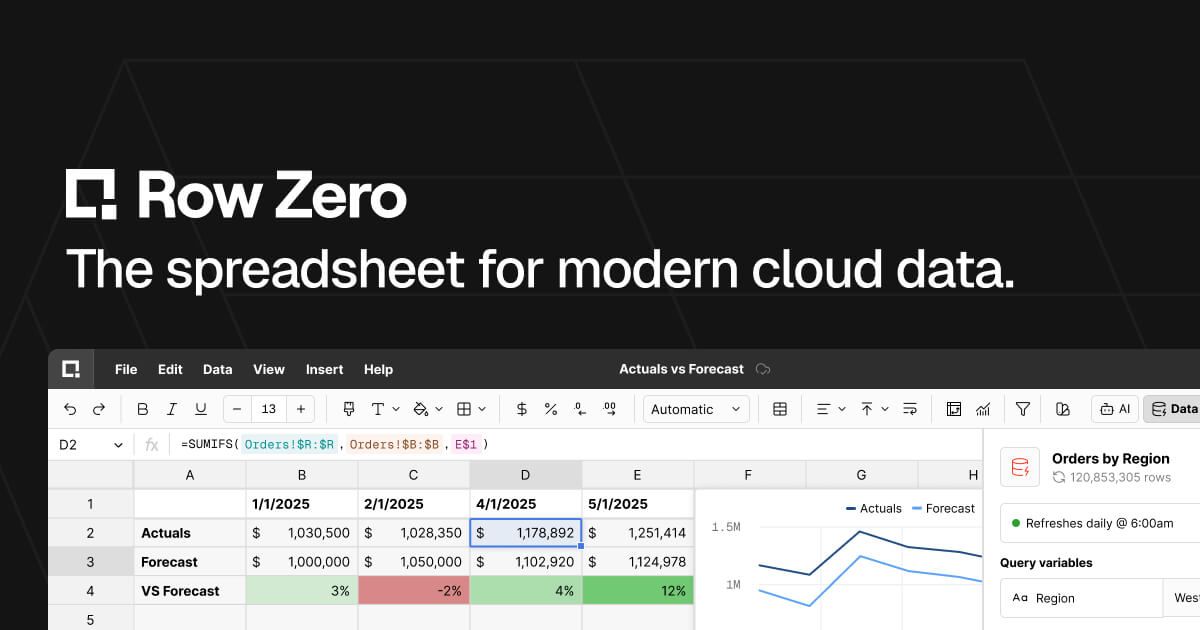
Today we're launching Row Zero. Row Zero looks and feels like Excel and Google Sheets, but 100-1000x faster. You can easily import gigabytes of CSV, JSONL, and Parquet files or connect directly to Snowflake, Redshift, Postgres, and S3. We also support Python natively. You can call Python functions that return pandas data frames and manipulate the results directly in the spreadsheet.
Under the hood, Row Zero is a high-performance columnar engine written in Rust. Running in AWS lets us scale compute up and down and import quickly from S3 and Snowflake. When you open a workbook, we place it in the AWS region closest to you so it feels as snappy as a desktop application.
The app is built by 5 ex-principal engineers from Amazon S3, Tableau, and Airtable. We're the team that wrote the file system that powers S3.
We've been in beta for a year. Use us to refine big CSVs, build complex financial models, create dashboards, and share large data sets. We're also a killer Snowflake/Postgres client. Give us a try and let us know what you think.
I can't see how to adopt this at an info-sec minded financial services firm that would otherwise love to pay you for it.
For example, the docs show the product wants static creds for a Postgres database or signed URL for S3 bucket instead of leveraging best-practice service-to-service identity and access management.
Maybe you support what I want, and I didn't find it at first glance.
This either ...
(a) needs to support modern dynamic or token-based authentication (e.g. Oauth2.0 client credentials grant, JWT, or for enterprises ideally CSP native IAM in Azure/GCP/AWS such as share S3 by cross account bucket permissions policy instead of signed URL, etc.), or ...
(b) allow firms to operate this themselves so the spreadsheet is run in the firm's security context, no creds are shared and data never leaves.
As you are running in AWS, providing this to run in AWS IAM context could solve it, but it's likely worth your time collaborating closely with FS firms that have solved cloud-native infosec at scale for the world's most demanding regulatory environments such as GSIFIs/GSIBs, since if you can do that, it's secure for anyone. Similar for HIPAA or FedRAMP.
If your customers can be fully best practice compliant within these regulatory regimes without having to lower their standards or get exceptions to use you, then it's above the bar for pretty much everyone.
// Full disclosure: Although using all 3 of AWS, Azure, and GCP, I was an AWS CAB member for half a decade (as principal engineers you likely know what this means), with a native-AWS preference.
We also have dedicated hosting options for our Enterprise tier.
If there's a specific data source you'd like us to support OAuth integration for, let me know, and we'll add it.
That seems like a huge privacy hole. It sounds like you're offering spreadsheet-as-a-service, where you scale up AWS spot instances based on query size.
Are you able to be “NSL-proof”?
This means, if you are served a national security letter with a gag order saying to turn over my data without telling me, can you?
If you are not NSL proof, are you able to demonstrate who from your firm can, and cannot, by technical guarantee not by policy in the “signed agreement” sense, see my data, and can I see in an audit log any time and every time any of those people do see my data?
>I can't see how to adopt this at an info-sec minded financial services firm that would otherwise love to pay you for it.
Else this applies for us too.
Your funding slide heading right here.
His partner was a manager, not an engineer, per https://www.geekwire.com/2024/former-aws-engineers-raise-3m-...
Personally I don’t like this sort of puffery in funding slides nor announcements.
I'm Grant Slatton, founding engineer at Row Zero, and before this I designed and led the team that built S3's new filesystem, ShardStore (check out this paper https://www.cs.utexas.edu/~bornholt/papers/shardstore-sosp21...). Our other Row Zero backend engineers (Breck, Erich, Greg) were all on the team.
Our frontend guy is ex-Airtable.
1) Signup for an account
2) Create a workbook
3) Click share and put in friend's email
4) They get an invite
5) Now they need to sign up
6) They can edit my doc
I'm not a paying customer (or even a user... I just heard of this), so take this with a grain of salt, but what I'd love to see is a super-friction-less way for me to share a doc and make it editable without others needing accounts. Cut out as many steps as possible above. Doing this can be a great tool for marketing... what's better marketing than easily collaborating on a spreadsheet on a site that my friend is already using and that already looks very similar to tools I'm familiar with?
This requirement brings a very difficult mix of challenges around security, privacy, regulatory compliance and business priorities.
As a toy / personal project it could work, but realistically this is unlikely to ever materialize in a way that you imagine.
Currently, the only way to do this from Excel (e.g. saving a snapshot of an analyst's current dashboard that they just built) is through a macro, which then starts the (understandable) descent into Excel's External Content and Trust Center permissions hell.
We have gotten a lot of requests for write-back-to-DB (Snowflake, Postgres, etc) so will be adding first-class support for this feature soon that will use the same connection creds which are stored encrypted in KMS and are not viewable to people you share the workbook with.
Would love to chat about your use-case if you want to reach out to us at contact[at]rowzero.io
https://techcommunity.microsoft.com/t5/excel-blog/announcing...
Would like to see a more detailed comparison than the one they've got in their blog, though.
Are you compatible with excel functions?
If we're missing any formulas you need, message me at breck at rowzero.io and we'll add them (usually within 24 hours).
I'd be looking very much forward for: data validation, conditional formatting (including heatmaps) and - what gSheet doesn't offer natively, multiple choices cells via data validation or values from another column/sheet.
<s>I was surprised I couldn't way to view a spreadsheet as a DataTable, or back as a DataTable</s> (LE: found later how in documentation). And no sticky/frozen header row, ugh.
Cherry on top would be gSheets like SQL flavoured QUERY.
LE2: to add the wishlist, a potentially killer feature to/for some, dashboard type of sheet, with minimal/layout options –rows & columns blocks that can host charts & text (headings & paragraphs), with global filters – it would add a feature or two complementary to what gSheets offers. And at some point maybe, comments - per sheet or column only.
If you're open to it, email us at contact[at]rowzero.io and we would love to do a call to talk about your use case, what features you want, etc. We love doing customer calls and adding delightful features.
Some things are literally 10000x faster because we are internally using algorithms with better asymptotic complexity than Excel, but there are a few edge cases where we are maybe only 10x faster
(but we are always working to improve that — half my job is just analyzing flame graphs and grinding out perf improvements)
I think putting that on the site would save business customers a lot of evaluation time.
If you need a supercomputer for 30 minutes, we can get you one.
Would you be ok with a new file format or do we need to save to .xlsx?
How important is Python in a desktop version? Would you need integration with conda or virtualenv?
How much do you think we should charge?
I would love a performant desktop excel replacement - I miss using excel 2003 - it has been downhill ever since...
That said, I'm clearly not the target market for this product though I believe there's some degree of frustration with how poorly modern excel works with many files now which this product may address.
I would guess that making this a light-weight and performant (not electron) desktop app (ideally portable so installing it wouldn't require admin access) with substantial feature parity and compatibility with excel would be a big deal - I'd install it right away...
2. A lot of our sheets use VB/macros so a scripting language is pretty useful. Not sure about the other stuff.
3. No idea, around the price for an office 365 seat?
python in the app needs to be wholly self contained so whatever the backend it uses, it's separate from anything else on the system.
charge through the nose for desktop clients because of how much it costs in development and support time. people who want native clients so it's not up on a cloud somewhere for whatever reason can pay for that privilege.
Your product looks great.
Would you mind helping me understand the differences between RowZero and something like Equals.com?
They are all ultimately just different UIs on top of Arrow.
They're complimentary tools. We can take data out of the spreadsheet and put it into Polars instantly (you can do this in the Python code window if you want), etc.
Regarding why not implement our spreadsheet built on top of those: spreadsheet allow for heterogenous types in columns, so that requires a lot of extra infrastructure to manage, whereas Datafusion and Polars require homogenous column types.
I feel pretty confident saying that probably 5% of the world's economy runs on VBA macros that were started by some eager worker that was tired of doing repetitive tasks and wondered what that "Record Macro" button did. I've heard that same story personally from so many users, about how they learned to code by hitting "Record Macro", doing something and looking at the resulting code. Their macro then grows and grows and ends up powering the entire business, but becomes an unmaintainable mess.
If you add the ability to record macros and maybe a VBA -> Python cross compiler, that would probably be killer for a lot of people. Though honestly, I've seen some stuff in VBA that's probably best left alone (e.g.: a self-rewriting VBA macro).
That being said, I'm sure your biggest hurdles are going to be cultural rather than technical. Excel is just so ingrained in so many business. But I genuinely wish you best of luck and am rooting for y'all!
We'd collect data sets from various sources (like public filings from the SEC) and the we'd send them over to different research teams to enrich the data in various ways.
That company was very Excel heavy - which made sense, we had data entry, accountants, and other people who worked in finance.
My CTO told me a story about how one day a member of a research team asked for a new computer. The old computer worked fine, but the employee wrote a VBA script in Excel that would crunch data... and wouldn't finish until 3 days later.
This employee wanted a new computer so that he had one to use while the other one was crunching data.
We ended up taking his VBA script and putting it into our codebase.
I think they were using file system calls with some tools to rewrite the file directly. But IIRC it's possible to do it just via the API.
This is like running into issues with non-converging iterated calculations...
I never understood two of Microsoft's owngoals:
1) The lack of a migration path from workgroup (LAN) to client-server for Access et al. So dumb. SQL Server should have become a first class citizen of Access. Or Access become a viable front-end end to SQL Server. Where swapping JET and MSSQL was a drop-in no-brainer. (Maybe that happened later...)
2) Not unifying tabular data. And then make Excel and Access "modalities" (?) for accessing that data. Lotus' Symphony (successor to 1-2-3) was so awesome; hybrid database and spreadsheet. aka The Correct Answer™. And Symphony was on DOS! (Lotus' Improv was even cooler. I wish I knew why it didn't succeed.)
I guess all this ML data pipeline Parquet NumPy stuff finally separated tabular data from how it's used. Yay.
I haven't used the Microsoft stack in anger since late '90s, when Java emerged, so maybe the .Net/CLR reboot mooted my complaints.
I never had the chance to use Borland's tools (Paradox, QuattroPro) in anger, so don't know if they did any better.
Spreadsheets are hard to do and even harder to do right, so congrats on launching—although given your backgrounds I don't think you ever lacked the manpower to let this be a technical challenge ;-)
My initial reaction:
* It does feel pretty fast
* but spreadsheets on the browser always represent an inferior UX
* the data tables / formula tables are a solid idea
* no self-hosting outside of Enterprise makes switching to this harder than it ought to be
* limiting the free plan to 3 sheets feels like a strange decision
What do you mean by this? Inferior to a standalone app? Inferior to some other design in general?
Attempting to import from various sources (urls and upload) and it fails:
https://i.imgur.com/YV865bw.png
It also stalls for a really long time arttempting to link to large CSV URLS... and it fails on JSON.
This 37kb CSV file took over a minute to load:
https://i.imgur.com/tHN4Wq0.png
It has ONE ROW.
I assume im holding it wrong, the local CSV has thousands of rows:
https://i.imgur.com/fujf1p5.png
---
I had to reload the session to get it to allow import, and this 37... and it took 24 seconds to import the data:
https://i.imgur.com/LnFIgL3.png
Linking to a URL and hitting import it thinks for a bit or fails....
What makes the free tier different here? Are you storing free data in a different area with many less restrictions on who has access to it? How do I know what I upload is safe from being analyzed or sold? Are you using this data to train any data models but only in the free / pro tiers that aren't SOC 2 or HIPAA compliant?
Can you please answer the question about how our data is viewed and or used internally?
The biggest issue that I think I would run into in my organization is that all of the spreadsheet lovers are Excel die-hards and they refuse to even use Google Sheets, not to mention something else that isn't Excel.
But maybe they could finally be convinced to stop complaining aboutrequesting huge files with something like this...
The use-case you describe is exactly what we built it for. There are a lot of people who have data that is no longer human-scale and won't fit into Excel, but they still want to use their Excel skills.
We love Excel and spreadsheets, but when working at AWS we found we just had too much data to fit into it.
https://www.youtube.com/watch?v=VI_riscmviI&list=PLJsVF3gZDc...
Its Martin Skreli (yes that one) -- but see how fast this guy is with excel... this is what I imagine when I think of excel power users...
(But also, he does a lesson in DD on investing and doing calcs in Excel - so aside from awesome Excel input, there is good investing info here - recall this was the guy that bought a medical company and immediately raised the price 7,000% or some such (he then bought the Wu Tang Album whilst imprisoned)
I imagine many professions won't be able to use Excel in 10 years based on this trend.
perhaps via some more "accountant friendly" app than SQL?
That said, I suppose that's partly the goal of this product... a visual/faster alternative to SQL though I personally avoid putting big data in excel, I just (as an accountant myself) carve out subsets from SQL and then peruse it via excel to identify whatever transactions/activity I need to analyze since the web interface for the ERP is such slow steaming garbage...
I'm more in search of a better excel than an excel which can handle big data as I suspect many users will somehow, no matter how well this is built, make it slow/terrible whereas an SQL based approach could be multiple of orders of magnitude faster....
You generate 1gb of critical financial data...that most of your Excel die-hard users can't actually use because their computer can't handle it.
How does your org complete any work then?
Working on this spreadsheet engine has been one of the most exciting, complex, and stimulating engineering experiences of my career.
Feel free to ask any technical questions about the product. We're really proud of what we've build and what's on the roadmap!
Tech stack:
Everything runs on AWS
Frontend: TypeScript + some Rust compiled to WASM, our own virtualized custom canvas magic
Backend: Rust, Apache Arrow
The biggest tech challenges... where to start.
1. As with any editor application, Undo/Redo is devilishly hard
2. A spreadsheet is modeled as a Directed Acyclic Graph where cells depend on other cells down to some root cells. There are a TON of fascinating graph theory algorithms you can bring to bear here. Some of the hardest problems I have ever worked on. My whiteboard looks like an insane person's with crazy arrows between cells and stuff.
3. Sometimes there really is no magic bullet and you just have to run benchmark, get flamegraph, chip away 3%, repeat, do that 100 times and you are very fast. Gotta grind.
What made you choose this tech stack? I'm especially wondering about Rust, was that something you had familiarity with before so just went with that? Did you evaluate a few different options and decided that would best fit this use-case?
(I have very minimal familiarity with Rust, I'm just wondering here.)
I interviewed at a spreadsheet company (for a frontend role) and they asked, "how would you go about determining what cells need a border when a user clicks an individual cell, clicks a cell and selects multiple cells, clicks a cell next to an already selected cell." Fascinating problem and we talked about solutions for a little bit.
Noticed that you can't unselect a cell once it's selected? I'm on a Mac with Chrome (latest, no updates available).
Repo steps: 1. Select a few cells (⌘ + click) or an individual cell 2. Try unselecting (⌘ + click) those same cells clicked in #1 3. Cell is not unselected
I'm guessing this post is going to the front of HN. If you've got some sample data, you should put it into the demo sheet ASAP. Or at the very least, provide some links to s3 files the user can manually add to test it themselves.
2) row zero people seem awesome
Wishing you all the best!
Pssst -- seems like a lot of useful apps/screens can be modeled as forms on top of spreadsheets...
def plot(lat,lng):
plt.scatter(x=lng, y=lat)
plt.show();Row zero is nice, don’t get me wrong. But the whole idea of me giving them gigabytes of data, or the creds to production database is a big no no.
If a 3rd party has your creds, they will eventually get hacked.
Drop me an email if you'd be interested in user-testing a solution! billy[at]rowzero.io
I have read that you write some of your own parser for perf boost.
(I am one of the author of https://github.com/V0ldek/rsonpath)
The main win from writing our own custom parser is writing directly into the final in-memory format from the parse stream without any intermediate allocations or data movement.
Awesome project! Adding it to my list of things we may plug into in the future.
Copilot for formulas, auto-write python, etc, it'll all land soon!
Will be a very hard sell to banks/other financial services corps if you can't match that aspect of excel. (They will probably also want local files and a native app).
- Causal.app
- Rows.com
- Equals.com
- and at least 50 others I've found
I'm waiting for someone to create a really high performant spreadsheet engine that runs in WASM to power even more spreadsheet-y applications. The direct manipulation of spreadsheets is super underrated.
We can handle 100x more data than Excel (online or desktop), Google Sheets, etc.
I suspect that people glued to M365 ecosystem are the LAST ones to consider leaving Excel online, but that's okay!
Still looking for a replacement Lotus Improv (can't justify Quantrix Financial).
There was the beginnings of an opensource implementation, Flexisheet, or see:
https://instadeq.com/blog/posts/no-code-history-lotus-improv...
Expected: A3 should become =SUM(A0:A2)+A0+A2 and evaluate to 4
Actual: A3 becomes =SUM(A0:A1)+A0+A2 and remains 4 until it is edited, at which point it evaluates to 3.
For me, A3 becomes =SUM(A1:A2)+A1+A2 and remains 4 as it should be.
The action I am taking:
A0=1
A1=1
A2=SUM(A0:A1)+A0+A1 (evaluates to 4)
Right click A0 and click "insert row above"Now I have:
A0=empty
A1=1
A2=1
A3=SUM(A1:A2)+A1+A2 (evaluates to 4)
Thank you for trying to find edge cases! I have put literally hundreds of hours into stuff like this. Let me know if you have different repro steps.Instead, right click A1 and click "insert row above".
Google Sheets (and, I'm 99.99% sure, Excel) adjust the range inside the SUM to be three rows high.
I've put quite some time into this sort of thing too :)
Thanks a lot for the bug report. We actually used to implement the range-extension logic in Excel/Sheets but removed it during a cut-paste refactor due to the complexity (I'm sure you know...) and resolved to add it back when someone asked for it.
I actually found edge cases where Sheets and Excel don't do range extension logic the same way.
So we don't do the range extension for now, but the 4 not getting recomputed to 3 is definitely a bug, will fix!
Where are you importing your financial data from?
Just curious because Im working on a Quickbook replacement probably with a different focus but I'd still love to hear what you need.
The future is tensors ;)
If the import is one-way right now, are there any plans to make the above possible?
How does your engine handle calc execution order?
> Contact US
Yeah no thanks.
Hope this trend will end soon.