86 points · by karma_daemon · 2y ago · 124 comments
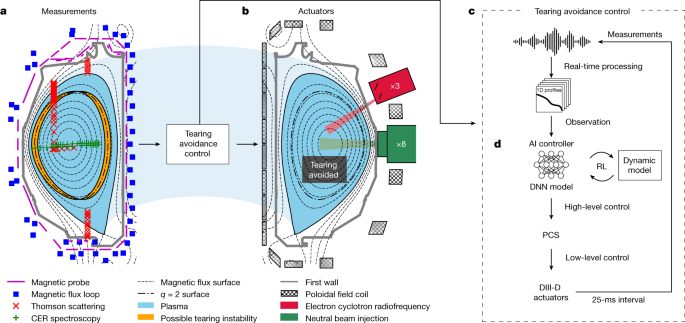
The basic idea I had was that fusion plasma containment involves containing a turbulent, dynamical system, so it might require some kind of actual intelligence learning or co-evolving with the system.
I wondered if this might be the only way to achieve over-unity fusion outside gravitational confinement (stars, black hole accretion disks, etc.). This would mean there are two fusion mechanisms in nature: gravitational confinement and cognitive confinement. The latter can only be a product of a living system.
When a living system achieves this, its biosphere "ignites" and becomes something I termed a "biostar." Biostars could be potential SETI targets -- biospheres that have harnessed fusion and so emit anomalous amounts of optical and infrared radiation on their night side. This moment of ignition would be an event in a biosphere comparable to the evolution of photosynthesis-- a fundamental change in the energetic dynamics of life.
In the far future life the that achieved fusion could settle things like rogue planets in deep space, so that would be another potential SETI target. Find objects emitting anomalous infrared in the interstellar void. The advantage would be being far from destructive events like solar storms.
Captain's Log: Since we came to orbit Venuuil III to host talks between the Klingons and the Venullians, there has been a increased incidence of unpredictable fluctuations of plasmas in the warp drive containment field. We are now devoting all available power to increasing our computer's ability to track and predict this rapidly changing phenomenon. Geordi reports that at the current growth factor we can maintain containment for 22 hours, 47 minutes, 17 seconds. To support the peace talks, we will remain here as long as possible.
Captain's Log: Intriguingly, the fluctuations are beginning to reveal an embedded temporal distortion that exhibits language like patterns. Data has begun working on an interface between the containment field and his positronic neural net.
What a series, I really need to read them again.
Control strategies in nonlinear systems are an effectively huge search space, and deep learning is just one way to find a good-ish solution faster.
Edit: to add some numbers, the "planned" DEMO power plant (the hypothetical successor of a successful ITER experiment) would produce something like 750MW, while Three Gorges Dam produces 22,500MW. Even if DEMO could be scaled up (which is hard, given that it would already be beyond the limits of today's material science), it definitely couldn't scale up 30 times.
I'm being entirely serious. Even though the visualization of the reactor was wildly off the mark, this specific concept fits what the writers had in mind with the AI mechanical limbs.
https://www.projectrho.com/public_html/rocket/torchships.php
Da fuck? The mechanism is compression. This is like calling "generating electricity via a generator", "cognitive energy".
What is ITER? Black Magic that happens to cause Fusion?
Inertial confinement has sort of achieved this but only on paper. If you tally up the total input to set up and run the system it’s still way in the red.
ITER has the potential to run just a bit over unity but it’s really just a research platform.
I mean that is a cool scifi story, but economics seems to hate cool things.
There's this "big lie" that fusion people imply that it will be cheap, clean, and limitless.
Cheap is doubtful, clean is undermined by the reality that fast neutrons from fusion degrade the reactor to radioactive isotopes, and ok the fuel is pretty much limitless
Now, if we can get scalable fusion as viable load levelling, to develop it to the point it can be used in space then that's some real scifi.
But then there’s Helion. If you can extract electrical power directly rather than through heat exchange and a turbine, it changes the equation drastically. So I think their approach can work from a theoretical point of view.
For that matter, if a space colony is equipped with a mirror for concentrating the sunlight needed to illuminate the inside as if it were Earth, and we place the limiting distance as that at which the mass of the mirror is equal to the mass of the space colony, the distance is about 1 light year.
https://www.nature.com/articles/s41598-023-49432-3
Sabine has a good review of it:
And has been rapidly emerging for 60 years...
They'll work on it even if there is no hope of commercial fusion power, simply for academic kudos. Government's will fund it simply because there isn't much other blue skies physics research to fund.
The plasma in the Safire reactor has self-containing magnetic fields and doesn't need the $20billion+ super-magnet infrastructure. A Safire reactor costs under $20-million to build, and probably much less these days.
The Safire reactor can keep the plasma lit and going for hours if not days without interruption. The Safire reactor has been around for over seven years now.
The results of the Safire type 3 reactor rendering radioactive material benign were done by a third party, which means independent, laboratory. They literally spell this out in terms that even a complete idiot can understand in the documentary you just pointed out. Hence why a very small part of their team spent some documenting what the science team did to make Safire type 3.
But I've never heard of SAFIRE. I've been on their website, and I can't find anything explaining what SAFIRE is and especially nothing about why it's so much better than a Tokamak. I can't find anything peer-reviewed.
All their marketing materials are leaving a very bad (e.g. pseudoscience) taste in my mouth
Here is what was shared, including some raw video footage, of what happened when a small tungsten rod was exposed to plasma in a Safire type 2 chamber. https://vid.puffyan.us/watch?v=7y46wMAHnsI
Just FYI. You're not effectively refuting the pseudoscience claim with this.
But since ITER was designed decades ago, we're stuck with a massive, expensive, outdated beast that's taken so long to build it will likely end up being lapped by other projects.
At least NIF has something to show for it. ITER feels like building the Vasa.
And the improvements have not made tokamaks sensible. Even higher field magnets don't rescue the tokamak concept from practical irrelevancy.
NIF is a nuclear weapons research program, as are all other (non-scam) ICF designs. Other MCF designs are either more-or-less legal scams (such as the MIT-derived startup claiming to build a working fusion power plant by the end of next or year or so), or woefully under funded.
What matters is how we build Tokamak's has changed. A huge notable difference are the magnets used for example.
Commonwealth are using cutting-edge high-temp superconductors which can generate much stronger fields:
The idea is old, the tech is new.
Helion would have to ship something that gives positive net energy first.
Sure, they have prototypes, but we don't know how well they are currently performing
We know that helion is able to recover 95% of the energy of every pulse. And they've measured the scaling laws. There doesn't seem to be anything that will prevent net positive energy in the reactor they're building right now.