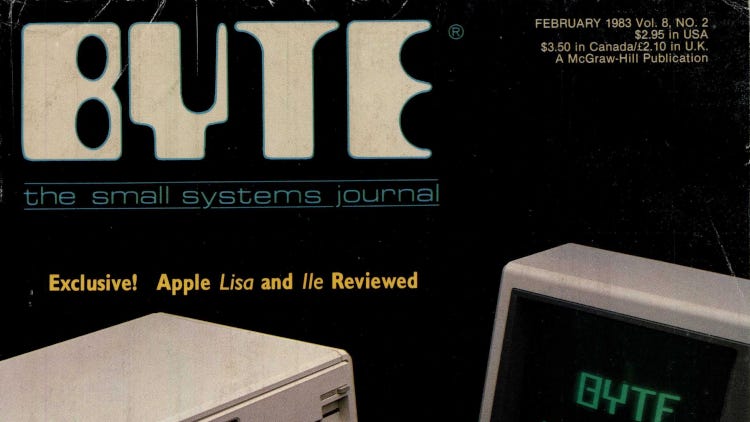
Byte Interviews the Apple Lisa Dev Team (1983)
A behind-the-scenes look at the development of Apple's Lisa.
computeradsfromthepast.substack.com
155 points · by easeout · 2y ago · 44 comments
I’d love to hear some specific examples of this. Things that we probably take totally for granted now but weren’t at all obvious during the initial design and implementation phases.
This isn’t the kind of shit you get from A/B testing.
Daniels: These people have pride. They set their own milestones and they want to meet them, so they'll put in extra work to do that.
Tesler: We decided a long time ago that since the project would obviously go on for more than a few months — a couple of years — we couldn't have this constant pressure on everybody, because people would just crack.
"This is great managerial wisdom right here.
From everything I've read, Larry Tesler really was someone great. RIP
The remarks about team-building were very interesting too.
> BYTE: Do you have a Xerox Star here that you work with?
All of the hosts are very technical.
This is so ironic because Wayne was the one who shut down WFH at Google when he took over from Urs Holzle back in 2001. That was one the things that caused me to leave.
It was widely available here in the UK and in a pre-world wide web age it was one of the most important ways of knowing what was going in the US market. Well for a young me anyway.
I loved it. I remember the issue detail the NeXT Cube particularly.
It’s crazy to think Apple Lisa devs were hired without needing to solve several Leetcode problems.
https://folklore.org/0-index.html
though I still think about what might have been when I read:
https://www.folklore.org/MacBasic.html
and wish there was something readily available and well-supported along those lines now.
I wonder if Apple would have included it in the box, or if it would have been popular, and if the Mac would have attracted more hobbyist programmers like the Apple II did?
On the other hand, a couple of years later Apple introduced HyperCard, which really was a kind of end-user programming revolution, even if it largely became an evolutionary dead end (though HyperTalk influenced AppleScript and probably other languages as well.) Perhaps if HyperCard had been networked then it might have survived longer into the web/JavaScript era.
Typing "magic" in the message box of the Hypercard player converted it into a full version of Hypercard.
It got there in the end.
But in the early days, that opened up the niche for the Atari ST, the "Jackintosh", sold with the tagline "the power without the price". Dismissed these days but hugely important and influential in its time.
And that also paved the way for the Amiga.
But in the end, they tied their systems too closely to the low-end entry-level spec, which Apple did not do with the "sealed off" Mac. Which led to the Mac Plus, and the Mac II, and hundreds of models, still on sale today.
While the ST and Amiga struggled into the 68030 era then mostly died out.
So in fact, it's not really true, is it?
It's not about the price, because...
... in the end, they got reasonably priced...
... and still sell today, 40 years later...
... there's always the 2nd hand market...
... they had cheaper rivals but those companies died, showing that keeping your prices high enough for healthy profits is in fact the long-term winning strategy.
So: no. The MacBook Air is even more "sealed down."
It has been on sale, that locked down, for 16 years, and yet it still sells ten million a year.
https://gitnux.org/macbook-air-statistics/
So... no. Argument rejected on all counts.
Lisa really was the superior platform in many ways and it really would have come down to finding a way to get prices lower through economies of scale. Another couple years and the 68k and supporting chips and RAM were way cheaper and you could make a fairly beefy machine in that class for pretty cheap (as Tramiel showed with the Atari ST.)
⸻
1. Until my cousin got me a Spectravideo 318 when I was a senior in high school to write some demo programs for the local dealer, I never had a computer of my own and to get computing time I had to either show up before school or stay after and use the school computer lab, assuming it was even an option.
https://vintageapple.org/byte/
(I have no idea if the foreign language editions and so on made it online)
https://vintageapple.org/byte/pdf/198302_Byte_Magazine_Vol_0...
http://ascii.textfiles.com/archives/5543
I recently started looking at ads in the old Byte magazines and among the things I was reminded of was how long the Z80 held on among the Byte crowd. And how much money (more apparent if you adjust for inflation) hobbyists and aspiring professionals were willing to spend on their hardware and software toys in the eighties. Having grown up in that time makes things like (a timely example) some people whinging about the cost of a Raspberry Pi 5 feel so irritating and inexplicable.
Lisa was far out of that bracket. But business S-100 systems had been selling for $2k to $20k and up since the 70s, so $10k for Lisa's advanced features would have seemed realistic.
Today most people are paying far more in student debt, health insurance, and housing costs. So although nominal income is three times higher, free disposable income hasn't kept pace.
It's true that hardware today is commoditised and much, much cheaper. But at the low end, those old II/Mac systems were still more affordable to middle class families than a straight inflation conversion suggests.