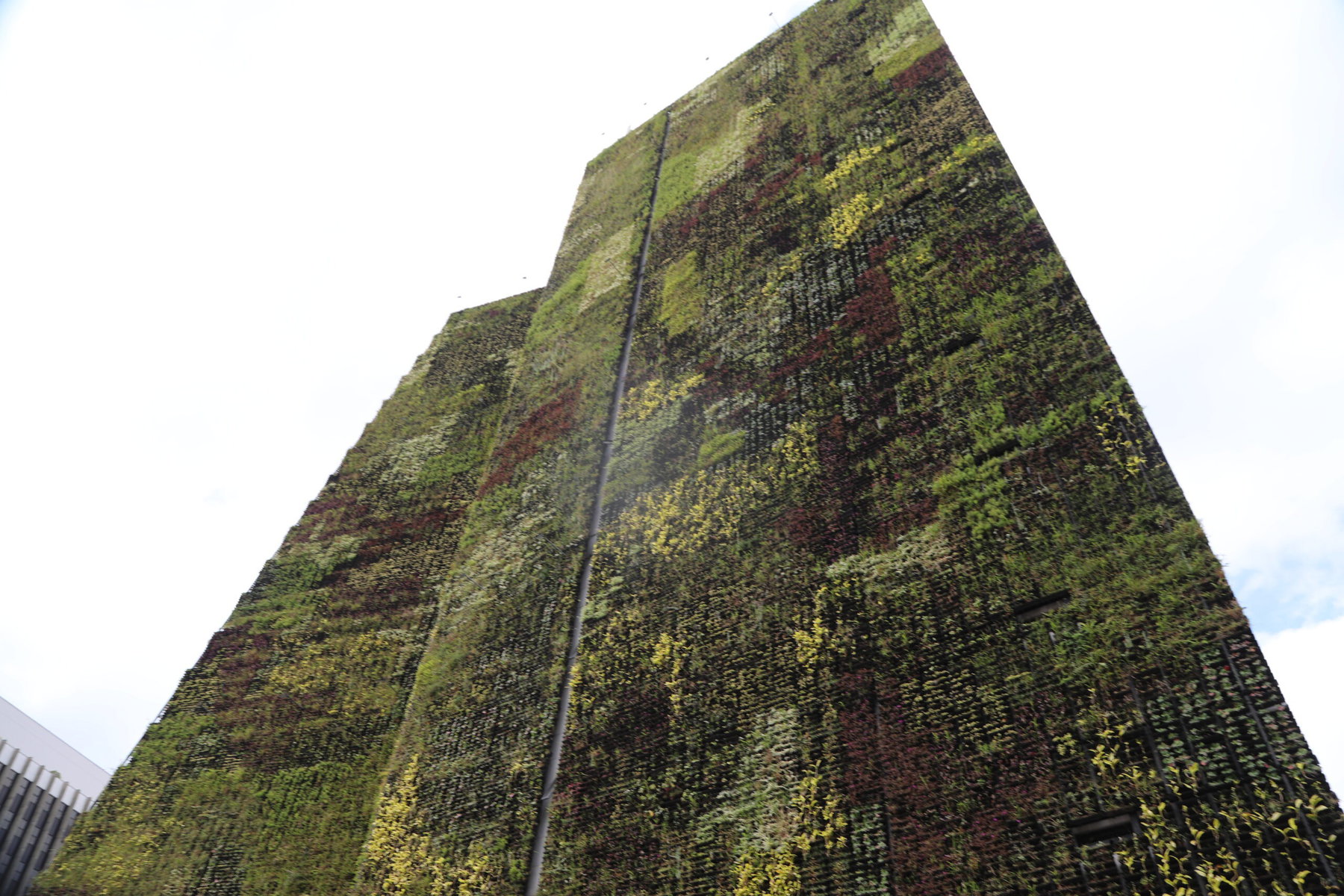
How a Colombian City Cooled Dramatically in Just Three Years
With “green corridors” that mimic the natural forest, Medellín is driving down temperatures — and could become five degrees cooler over the next few decades.
Reasons to be Cheerful
232 points · by fodmap · 2y ago · 87 comments
That seems incredibly cheap for the benefits. Colombia looks to have a GDP per capita about 1/10th of the US, so if we scale it up 10X...
I live in a relatively cold climate, and I would still be delighted to pay $2.50 a year for this kind of infrastructure development. Heck, even scaling it up 100X seems like it would be worth considering.
Maybe there's a cost I'm missing here, but for a hot city, the AC savings alone seem like they would be worth it, not to mention the 40% reduction in respiratory infections through increased air quality.
But yeah at 10x that’d be taking away from significant programs never mind 100x.
The problem for LA is that most of the drainage is there to move storm water away as quick as possible, which means that local water is hard to come by.
https://la.curbed.com/2018/8/23/17720768/los-angeles-plants-...
You can get a pretty good idea what "LA or Vegas with natural green belts" would look like just by going outside the metro areas. I'm not saying it's bad - I love southwest desert - but natural desert "greenbelts" are probably not what you're picturing if you think "why don't we do Medellín here?"
Truly they don't, but even inside Medellin the precipitation rates are not as great as the lands around...
...because of the deforestation that /already/ happened, say, 50 years ago...
Ain't no commercial high rise neighborhood (semi-common in Medellin) that can "pull in" as much precipitation as a virgin forest no way, and you can see this if you visit there and then you visit an actual virgin rain-forest...
...but of course, this is what they are trying to alleviate and if the outskirts of the city are super-green it can help...
Btw all of the outskirts aren't super green but a lot of them are...
Ah, yes, but costs for public projects like this in the US is far greater than 10x Colombia's.
In cold climate, you definitely do not want tall buildings with space between them, or straight roads. Unfortunately that's what gets built.
Particularly bad: The same St. Petersburg but now Brezhnevist and contemporary built up districts such as Murino[2] or Veteranov[3] (but any of these, actually). Even the pompious Stalinist Moscow avenue[4] would be quite uncomfortable in chilly wind and -15C. Wide streets mean faster winds and more walking. St. Petersburg is very transit oriented so most people do walk.
The newly build Vostochnyi Cosmodrome Tsiolkovsky town[5] seems super chilly as it is the same pattern of high-rises separated by a long nothing. And it's located way north. You would need a space suit just to get groceries.
1. https://yandex.ru/maps/-/CDFjZUm4
2. https://yandex.ru/maps/-/CDFjZU-0
3. https://yandex.ru/maps/-/CDFjZY7J
Higher density of vegitation is what I dearly miss in the sprawl centric cities of California and what I like about my city back in India.
We saw the city hall vertical garden - pretty neat.
An immense amount of effort has gone into revitalizing the city in recent years.
One thing that struck me though, is that the rising tide hasn't quite lifted all boats - or people to be more precise. I saw a lot more beggars, people living on the streets, and homeless encampments than in Bogotá, or Cali or other cities. It feels like a disconnection from community and family that is still present in other places - especially smaller cities and towns. I hope they can figure out ways to help the bottom 1%. (Realizing that is a common refrain worldwide.)
We see that a lot in Seattle, that people who became homeless out in Enumclaw or Goldbar or wherever slowly get drawn towards the city because the systems that support the homeless are there, whether it be infrastructure that can be used for shelter or soup kitchens or day labor or even just a good corner to beg from.
Its not the only source of the homeless by any stretch of the imagination, but it is a source.
It turns out that, in spite of what libertarians might like to tell everyone, people and societies aren't actually boats and marinas. Who would've thought?
The key benefit of the plants is cooling the city without electricity, which is an ongoing effect.
Depends how you manage them, and their detritus
If you burn it, you are correct
There are other approaches that sink the carbon and improve soils.
https://www.elcolombiano.com/antioquia/restricciones-por-mal...
...or maybe just fewer cars because of global recession...
(The nice parts are pretty nice though.)
Medellin is surrounded by mountains and the contaminated air cannot escape. There didn't used to be a lot of cars, but now there is financing so the number of cars is growing significantly.
The hills are steep and old busses spew black smoke.
Here is some more info on pollution in Medellin: https://medellinguru.com/medellin-pollution/
Saying Medellin's temp decreased by 2 degrees Celsius based on "Mejorar el microclima hasta 2°C" is a misinterpretation. I think this article is quite misleading.
I think a good first step would be ditching all the diesel vehicles that have minimal/non-existant exhaust emissions systems.
The good thing about hill cities such as Medellin (sadly not a format available for big cities say in Europe or the US) is that you can choose your altitude, and at around 2000 thousand meters (the city starts at ~1500m) the air quality is not so bad, used to be worse years ago (maybe you lived there 2 or 3 years ago), but now it's much better.
> You can talk with any locals and they say that the climate is noticeably different than it was in the past.
Yeah, the city is much warmer compared to say 10 years ago, whether this is due to the city growing into previously-forest areas or /global/ warming I don't know... but yeah, locals agree it was MUCH colder 10 years ago...
> Medellin is surrounded by mountains and the contaminated air cannot escape.
See comments above about living at 2000m altitude (up in the mountains a bit away from the high-rise buildings and such, think of Beverly Hills or something like that.).
> The hills are steep and old busses spew black smoke.
As of now, there's almost no remaining old busses spewing black smoke anymore, but there's some cargo trucks still doing it.
> Saying Medellin's temp decreased by 2 degrees Celsius based on "Mejorar el microclima hasta 2°C" is a misinterpretation. I think this article is quite misleading.
I wouldn't know, but locals do say that it was a much more colder city in the past...
E. G. They build the metro cable essentially a "ski lift" public transport system up the steep slopes of the hills surrounding the city. It's a great example how to transform communities by giving people access to transport and thus economic opportunities (the metro cable changed a 2h walk to the metro station at the base of the valley into a 15min gondola ride). It wrestled the slums from the control of the gangs and massively reduced crime in the areas.
I would love to see a city or building try this in the US
We certainly need more of this.
More importantly, this may also reduce the heat-soaking of the earth underneath the city as well as the surrounding countryside.
Caracas is reportedly green-ner than Medellin, but obviously under a dictatorship thus mostly not available to digital nomads.
You also have Buenos Aires, designed from the beginning to be green (only in certain places I think? but still very green in those places)...
That feels like a quote out of a novel or a Hollywood movie. Absolutely thrilled for Medellin to be able to enact this kind of change. It's a huge struggle in the US and extremely dispiriting.
The American Southwest and the baking suburbia is basically the opposite of how one should design for such a climate.
But I do wonder, what about insects? Are there more insects because there are more places for them to live?
However they are constantly being rezoned to residential housing through political corruption.
I do think that's like the most extreme difference you could find in any given day.