664 points · by mootpt · 2y ago · 303 comments
Plain uint8 wouldn’t allow for the same accuracy range as float8 and it’s the accuracy not the precision (which uint would win for the largest values it can represent) that counts most.
[1]: github.com/google/gemma.cpp
But rest assured there's an improvement, it's not like people would be doing it if there wasn't any benefit!
“bfloat16 data type and arithmetic instructions (AI and others)”
https://eclecticlight.co/2024/01/15/why-the-m2-is-more-advan...
E5M2 is like an IEEE 754. But to compensate the smaller exponent, "E4M3’s dynamic range is extended by not representing infinities and having only one mantissa bit-pattern for NaNs".
Some people reported E4M3 is better for the forward pass (small range, more precision) and E5M2 is better for the backward pass (bigger range, less precision). And most implementations have some sort of scaling or other math tricks to shrink the error.
[0] FP8 Formats for Deep Learning (Nvidia/ARM/Intel) https://arxiv.org/abs/2209.05433
Which gives me hope that - like the web - hardware will catch up and stuff will become more and more accessible with time
To make your own competing LLM today you need hundreds of millions of dollars, the "very expensive" of this is on a whole different level. You could afford the things you talked about on a software engineering salary, it would be a lot of money for that engineer but at least he could do it, no way anyone but a billionaire could fund a new competing LLM today.
That’s why Sam Altman makes so much noise about “safety” - OpenAI would really like a government-backed monopoly position so they can charge higher rents and capture more of that value for themselves. Fortunately, I think that llama has already left the barn.
Training AI models costs a fortune, but so far it's been just front-loading costs in hopes of a windfall. We'll see what actually happens.
Its easier to spin up a business for sure -- also easier to unwind it - there not as sticky as they used to be.
The only question is - what tactic? I don't really know, but one trick I am aware of is "specifying to the vendor." In other words, the introduction of regulatory requirements that are at every step in the process a description of the most favored vendor's product. As the favored players add more features, potentially safety features, those features are required in new regulations, using very specific descriptions that more or less mandate that you reproduce the existing technology, to use a software engineer's term, bug-for-bug. If your product is better in some ways but worse in others, you might have a chance in the market - but to no avail, if the regulations demand exactly the advantages of the established suppliers.
The dream may be barriers to entry that allow high margins (“rents” if you prefer the prejudicial), but all too often these huge capital costs bankrupt the company and lose money for investors (see: WeWork, Magic Leap). It is high risk, high return. Which seems fair.
I assure you that before Apache and Linux took over that "dot" in the .com was not cheap!
Fortunately it only really lasted maybe 1993-1997 (I think Oracle announced Linux support in 1997, and that allowed a bunch of companies to start moving off Solaris).
But it wasn't until after the 2001 crash that people started doing sharded MySQL and then NoSQL to scale databases (when you needed it back then!).
It's early. You can do LORA training now on home systems, and for $500 you can rent enough compute to do even more meaningful fine-tuning. Lets see where we are in 5 and 10 years time.
(Provided the doomers don't get LLMs banned of course!)
I don't know a lot about ML. Does anyone know if it is possible to keep training the system while it is running?
That would help a lot if you don't have the possibility to use huge training sets as a starting point.
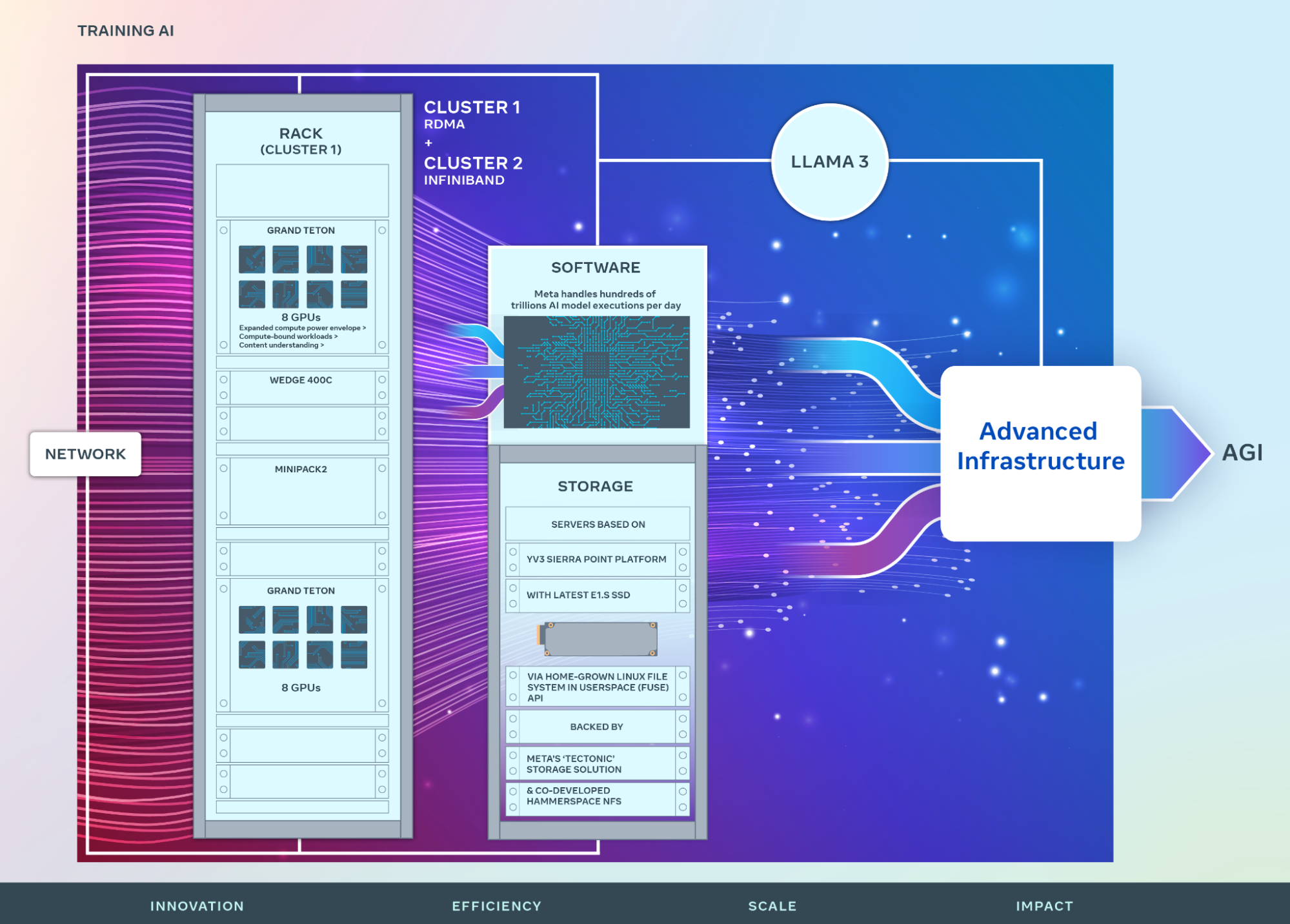
They mention custom building as much as they can. If FB magically has the option to 10x the compute power, would they need to re-engineer the whole stack? What about 100x? Is each of these re-writes just a re-write, or is it a whole order of magnitude more complex?
My technical understanding of what's under the hood of these clusters is pretty surface level- super curious if anyone with relevant experience has thoughts?
To get the job he applied for a spot I'm Software Engineer applied in Machine Learning, he went through the multiple step interview process, and then when he got the job he did a few weeks of training and interviewing teams. One of the teams in charge of optimizing ML code in Meta picked him up and now he works there.
Because of Meta's scale, optimizing code that saves a few ms or watts is a huge impact in the bottom line.
In sum:
- Get a formal education in the area - Get work experience somewhere - Apply for a big tech job in Software Engineer applied with ML - Hope they hire you and have a spot in one of the teams in charge of optimizing stuff
I have a PhD in CS, and lots of experience in optimization and some in throughput/speedups (in an amdahl sense) for planning problems. My biggest challenge is really getting something meaty with high constraints or large compute requirements. By the time I get a pipeline set up it's good enough and we move on. So it's tough to build up that skillset to get in the door where the big problems are.
Its also a group effort to provide simple to use primitives that "normal" ML people can use, even if they've never used hyper scale clusters before.
So you need a good scheduler, that understand dependencies (no, the k8s scheduler(s) are shit for this, plus it wont scale past 1k nodes without eating all of your network bandwidth), then you need a dataloader that can provide the dataset access, then you need the IPC that allows sharing/joining of GPUs together.
all of that needs to be wrapped up into a python interface that fairly simple to use.
Oh and it needs to be secure, pass an FCC audit (ie you need to prove that no user data is being used) have a high utilisation efficiency and uptime.
the model stuff is the cherry on the top
For other settings, moving to something like opencue might be better (caveats apply)
Some folks start with more familiarity in ML research and dip down as far as they need.
Other folks come from a traditional distributed systems/compilers/HPC background, and apply those skills to ML systems.
Feel free to DM me to learn more.
It is a real loophole in the economy. If you're a trillion dollar company the market will insist you set such sums on fire just to be in the race for $current-hype. If they do it drives their market cap higher still and if they don't they risk being considered un-innovative and therefore doomed to irrelevancy and the market cap will spiral downwards.
Sort of reminds me of The Producers.
Thanks! (Your number is consistent with what I hear of, but I never managed to get solid sources to back them up)
Which is a fourth of what they spent in VR/AR in a year. And Gen AI is something they could easily get more revenue as it has now become proven technology, and Meta could possibly leapfrog others because of the data moat.
I don't think anyone else has gotten that group chat with AI thing so nailed.
It's not impossible. The prediction from many(not that I believe it) is that over long run modelling tricks would become common knowledge and only thing that matters is compute and data, both of which Meta has.
Also there could be a trend of LLMs for ads or feed recommendation in the future as they has large completely unstructured dataset per user across multiple sites.
Meta certainly has an edge in engineer count, undoubtedly. But I'd say they really, really want the metaverse to succeed more to have their on walled garden (i.e. equivalent power of Apple and Google stores, etc.). There's a reason they gave a hard pass to a Google partnership.
AIUI, Google required Meta to basically cede control of a partnered OS to them:
"After years of not focusing on VR or doing anything to support our work in the space, Google has been pitching AndroidXR to partners and suggesting, incredibly, that WE are the ones threatening to fragment the ecosystem when they are the ones who plan to do exactly that.
"We would love to partner with them. They could bring their apps to Quest today! They could bring the Play store (with its current economics for 2d apps) and add value to all their developers immediately, which is exactly the kind of open app ecosystem we want to see. We would be thrilled to have them. It would be a win for their developers and all consumers and we’ll keep pushing for it.
"Instead, they want us to agree to restrictive terms that require us to give up our freedom to innovate and build better experiences for people and developers—we’ve seen this play out before and we think we can do better this time around."
-- From Mark Bosworth
Source would be appreciated, because this is opposite of obvious. Regulations against using public first party would be a big news and I haven't heard of anything like that. They use my data for recommending feed so why not for answering my question?
I’m guessing that Meta got a sweetheart deal to help take a lot of inventory for NVidia and make commitments for future purchases.
I wonder if they will use it in RSC.
I’d point the interested at the DLRM paper [1]: that was just after I left and I’m sad I missed it. FB got into disagg racks and SDN and stuff fairly early, and we already had half-U dual-socket SKUs with the SSD and (increasingly) even DRAM elsewhere in the rack in 2018, but we were doing huge NNs for recommenders and rankers even for then. I don’t know if this is considered proprietary so I’ll play it safe and just say that a click-prediction model on IG Stories in 2018 was on the order of a modest but real LLM today (at FP32!).
The crazy part is they were HOGWILD trained on Intel AVX-2, which is just wild to think about. When I was screwing around with CUDA kernels we were time sharing NVIDIA dev boxes, typically 2-4 people doing CUDA were splitting up a single card as late as maybe 2016. I was managing what was called “IGML Infra” when I left and was on a first-name basis with the next-gen hardware people and any NVIDIA deal was still so closely guarded I didn’t hear more than rumors about GPUs for training let alone inference.
350k Hopper this year, Jesus. Say what you want about Meta but don’t say they can’t pour concrete and design SKUs on a dime: best damned infrastructure folks in the game pound-for-pound to this day.
The talk by Thomas “tnb” Bredillet in particular I’d recommend: one of the finest hackers, mathematicians, and humans I’ve ever had the pleasure to know.
[1] https://arxiv.org/pdf/1906.00091.pdf
[2] https://arxiv.org/pdf/2108.09373.pdf
[3] https://engineering.fb.com/2022/10/18/open-source/ocp-summit...
OpenAI takes money from MSFT and buys Azure services
Anthropic takes Amazon money and buys AWS services (as do many robotics etc)
I am fairly sure it’s not illegal but it’s definitely low quality revenue
Here more on the deals (2003):
https://www.cnet.com/tech/services-and-software/aol-saga-ope...
Popular names included AOL, Cisco, Yahoo, etc.
Not sure if Amazon’s term sheets driving high valuation are nothing but AWS credits (Amazon’s own license to print money).
This is a myth. It simply isn't true. AWS was conceived as a greenfield business by its first CEO. Besides, S3 and SQS were the first AWS services; EC2 didn't appear till a few years later. And it wasn't built from excess Amazon server capacity; it was totally separate.
Heck I worked at Amazon and even then I couldn't tell you the total datacenter space, they don't even share it internally.
Last I updated my spreadsheet in 2019, Google had $17bn in investments across their datacenters, totaling 13,260,000 sq ft of datacenter space. Additional buildings have been built since then, but not to the scale of an additional 30mil sq ft.
Amazon operates ~80 datacenter buildings in Northern Virginia, each ~200,000 sq ft -- about 16,000,000sq ft total in that region, the other regions are much much smaller, perhaps another 4 mil sq ft. When I'm bored I'll go update all my maps and spreadsheets.
There was one manager who worked at two large Dutch companies and sold AWS to them, as in, moving their entire IT, workloads and servers over to AWS. I wouldn't be surprised if there was a deal made there somewhere.
Also how exactly they would do it, they don't have enough infra for renting, they would need to x10 what they have now.
Offering reliable IaaS is super hard and capital intensive. Its also not profitable if you are perceived as shit.
Granted, HW is much harder than SW, but I would not discount Meta's ability to displace NVIDIA entirely.
Meta is a services company, their hardware is secondary and for their own usage.
Good hardware, good software support, and market is starving for performant competitors to the H100s (and soon B100s). Would sell like hotcakes.
Google used to sell a search appliance-in-a-box and eventually lost interest because hardware is so high-touch.
Beyond that they might not be as stable or resilient outside of the closely curated confines of their own data-centers. In that case selling them would be more of an embarrassment.
Something like counting an autoplaying video that ran for 3 seconds as a 'view' IIRC
[1] https://twitter.com/adamconover/status/1183209875859333120
I see what you did there, Meta.
https://www.reuters.com/technology/inside-metas-scramble-cat...
Interesting dig on IB. RoCE is the right solution since it is open standards and more importantly, available without a 52+ week lead time.
Sharing on Hacker News ... they now their audience.
but I suspect its not that, because Twine is optimised for services rather than batch processing, and doesn't really have the concept of priorities.
Such a large number, makes sense?
Meta's commitment to Open Source is well under calculation.
OCP is a way to rally lower-tier vendors to form a semi-alliance to keep up with super-gorilla like AWS & Google.
LLaMA has already gained much more than its cost (look at the stock price, and the open source ecosystem built surrounding LLaMA, and Google's open source Gemma models which is a proof of Meta's success).
IMHO, Meta's Open Source strategy already covered at least 5 years in prospect. That's enough to finesse a 180 degree turn around if necessary (i.e., from open source to close source)
https://www.amazon.com/Tesla-NVIDIA-Learning-Compute-Graphic...
But I do wonder how they foresee monetising this.
Since people don't want to talk to algorithms, this would result in them shunning all social media, which is a huge danger to companies in the space.
In contrast, Microsoft is spending over $10b per quarter capex on cloud.
That makes Zuck look conservative after his big loss on metaverse.
https://www.datacenterdynamics.com/en/news/q3-2023-cloud-res...
> In contrast, Microsoft is spending over $10b per quarter capex on cloud.
to service other people's work load. Its a different business.
I guess people buy their vr headsets, if that counts. I'm not too familiar with what the "metaverse" entails though...