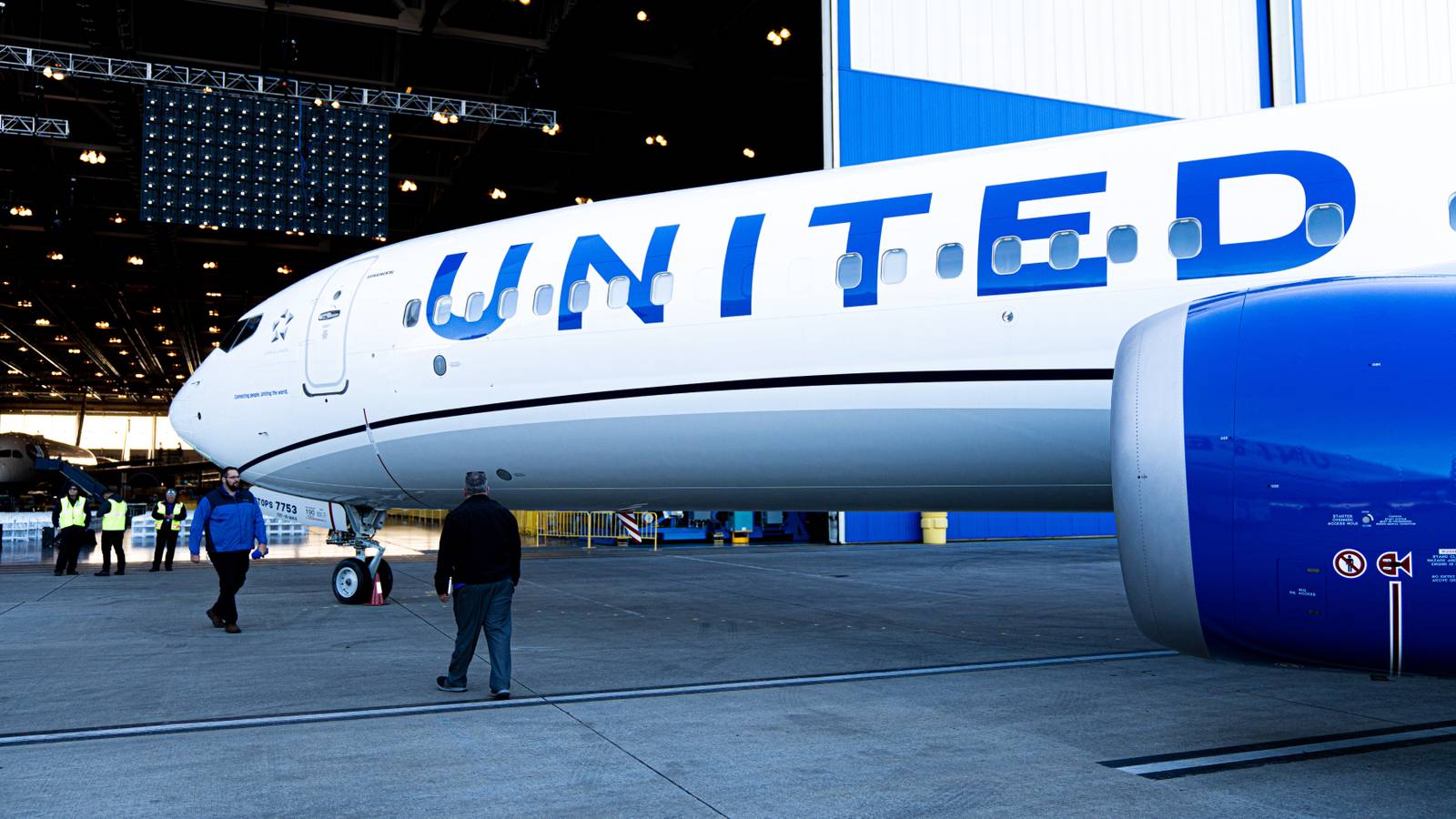
Major Blow: United Airlines Tells Boeing To Stop Building MAX 10s And To Switch To MAX 9s
The latest announcement came after United had announced it was not expecting any deliveries of the type in coming years.
Simple Flying
99 points · by bookofjoe · 2y ago · 209 comments
But they do want more companies in their team when the successor comes.
At the same time they will stretch A220, then they can hopefully move production from A320 to A321.
https://www.ycombinator.com/blog/boom-yc-w16-is-building-an-...
The exit plan for all aviation startups in the US is to sell out to Boeing or Lockheed (preferably with an acquihire), or be folded into their supply chain. Zero exceptions.
The government should go the EU way. Build the tracks but lease out the actual operations to private companies that can bid for track and station time.
For example, I suspect if Amtrak was forced to compete with private firms for track time in the NorthEast corridor you’d see an explosion of service and a dramatic drop in prices.
I suspect flights like Boston-NYC and DC-NYC would reduce dramatically.
And maybe even more importantly there would be greater lobbying efforts from private firms to upgrade the tracks and improve the routes.
Currently it’s very difficult for Amtrak to push for that because it’s quasi public nature means there is limited profit incentive and no opportunity to raise capital from the private sector.
That would change if at least a couple of private firms could get going in the NorthEast corridor.
That doesn’t rule out bankruptcy.
Edit: for example by buying overpriced military equipment, tax benefits, or ...
More likely private capital, though, or some Hyperillionaire from Seatopia.
While running through the Spreewald, my troops also enjoy oral readings of such classics as "Libertarian Aryan Rocketmen will Save the West from the Red Horde".
And death, of course. Hot fiery death.
Boeing's not going anywhere as long as the US exists. It is the state monopoly on civil aviation. However, allowing these rogue MBAs to run amok with it over the last 20 years has been an absolute disgrace. Any sane, democratic, society that had not been beaten into the dust by regulatory capture and corporate lobbying would have cleaned house on them and sent people to jail after they killed hundreds of people through pure greed. It's a pathetic state we're in now to realize that it's probably going to take another 200+ dead Americans on a domestic scheduled flight before anything even remotely material happens about it.
Is there a connection between flag carrier airlines and aircraft manufacturing? That never occurred to me, since most flag carriers fly Boeing and Airbus like everybody else.
But I guess for larger states, like Aeroflot / Air China, they probably subsidize the local manufacturers?
In any case, I'm inclined to push back against your assertion that this is the "same reasons [sic] all other countires" have them - I don't think very many flag carriers are supported because of manufacturing concerns, or that the relationship is similar to the US State's relationship to Boeing. That seems like a stretch to me.
Par for the course. I read the other day that a major automakers infotainment system will assure you your driving data will not be shared with third parties without your consent...on the screen where you agree to the off-screen legalese that includes a consent allow them to share your driving data with third parties.
https://www.nytimes.com/2024/03/11/technology/carmakers-driv...:
> General Motors is not the only automaker sharing driving behavior. Kia, Subaru and Mitsubishi also contribute to the LexisNexis “Telematics Exchange,” a “portal for sharing consumer-approved connected car data with insurers.” As of 2022, the exchange, according to a LexisNexis news release, has “real-world driving behavior” collected “from over 10 million vehicles.”
> Verisk also claims to have access to data from millions of vehicles and partnerships with major automakers, including Ford, Honda and Hyundai.
> ...
> The other automakers all have optional driver-coaching features in their apps — Kia, Mitsubishi and Hyundai have “Driving Score,” while Honda and Acura have “Driver Feedback” — that, when turned on, collect information about people’s mileage, speed, braking and acceleration that is then shared with LexisNexis or Verisk, the companies said in response to questions from The New York Times.
> But that would not be evident or obvious to drivers using these features. In fact, before a Honda owner activates Driver Feedback, a screen titled “Respect for your Privacy” assures drivers that “your data will never be shared without your consent.” But it is shared — with Verisk, a fact disclosed in a more than 2,000-word “terms and conditions” screen that a driver needs to click “accept” on. (Honda does mention Verisk in an FAQ on its website and Kia highlights its relationship with LexisNexis Risk Solutions on its website. A Kia spokesman said LexisNexis can’t share driving score data of Kia participants with insurers without additional consent.)
> Strict: Blocks tracking content (videos, ads and other content that contain tracking code) in addition to trackers blocked in the Standard setting.
For example downsizing their Washington manufacturing facilities and outsourcing critical R&D to cheaper countries didn't come from McDonnell Douglas.
That's logical, isn't it? If your claim is that the company cut the long-term philosophy and squeezed short-term benefits, the most profitable time for the company is logically going to be the time where benefits go up while long-term investments are no longer made.
I'm not saying that you're wrong, just that your rebuttal isn't going to convince someone thinking like that.
There's some kind of inertia, were bad and good decisions take some time to have their effects felt.
Likewise, due to the same inertia, unless something dramatic happens, the current administration of a company is downstream the culture of previous administrations, as the people at the helm in the present were promoted, hired mostly based on the criteria of the the last past dramatical cultural change, that was the managerial takeover by the MD bureaucrats post-merge.
Boeing's timeline of failure actually matches the trajectory of other MBAified companies.
There’s no such thing as being “MBAified.” An MBA is a generalist degree that contains the bare minimum information you need to operate a corporation.
You know how in undergraduate computer engineering you learn many different subjects like power systems, microcontroller programming, computer programming, transistors, basic processor design, digital/analog circuit design? And how nobody is going to use all those subjects in the real world? That’s exactly what an MBA is like: it’s got subjects like corporate finance, organizational behavior, information systems management, marketing, etc. Just about nobody with an MBA is going to use ever single one of those subjects on a daily basis.
Nobody else is being judged by their degree. It’s ridiculous, and kind of disgusting that people act like learning the set of knowledge contained in an MBA makes you a worse manager. Armchair engineers seem to think they could run a multi-billion dollar aircraft manufacturer using avionics engineering skills alone without understanding the concepts you learn in an MBA like inventory turnover, cash flow, global operations, or how to design the organizational structure of a company with tens of thousands of employees. In what way does an engineering degree prepare you to do that job?
Imagine if you were a nurse and you got told that you were a worse nurse because you got a nursing degree. That’s what the engineer-types who dunk on MBAs are doing.
We're all experts now.
They have, but they have left the cultural infestation behind. You'd need a complete purge of Boeing's leadership, as well as a re-integration of Spirit Aerosystems.
Pointing to Dennis as a failure of an "engineering CEO" because of the MAX incident isn't accurate.
According to the Seattle Times [0], it was in 2016 that MCAS was made more powerful and it was determined that a 10-second reaction time would be required to avoid catastrophe. In that year, in spite of the fact that they changed MCAS, they did not submit the new hazard assessment documents to the FAA. That article also seems to indicate that it was after 2016 that they scrubbed all references to MCAS from the manual.
[0] https://www.seattletimes.com/business/boeing-aerospace/inspe...
> Muilenburg held numerous management and engineering positions on various Boeing programs, including the X-32 (Boeing's entry in the Joint Strike Fighter competition); Boeing's participation in the Lockheed Martin F-22 Raptor fighter; the YAL-1 747 Airborne Laser; the High Speed Civil Transport; and the Condor unmanned reconnaissance aircraft. He was later vice president of the Boeing combat systems division and program manager for the Army Future Combat Systems program.[10] Muilenburg was president and chief executive officer of Boeing Integrated Defense Systems, later renamed Boeing Defense, Space & Security (BDS), from September 2009 to 2015.
> In December 2013, Muilenburg became the president of Boeing.
https://arstechnica.com/health/2024/01/hospitals-slash-staff...
I don't know if you're being sarcastic, but my impression is private equity makes the same kind of detrimental changes that Boeing has already been making. IIRC, they're known for cost cutting and cashing out goodwill, not making expensive culture changes to pursue engineering excellence.
"It turns out the same thing can happen in technology companies that get monopolies, like IBM or Xerox. If you were a product person at IBM or Xerox, so you make a better copier or computer. So what? When you have monopoly market share, the company's not any more successful.
So the people that can make the company more successful are sales and marketing people, and they end up running the companies. And the product people get driven out of the decision making forums, and the companies forget what it means to make great products. The product sensibility and the product genius that brought them to that monopolistic position gets rotted out by people running these companies that have no conception of a good product versus a bad product.
They have no conception of the craftsmanship that's required to take a good idea and turn it into a good product. And they really have no feeling in their hearts, usually, about wanting to really help the customers."
The examples of IBM and Xerox were truly dominant in their day.
I'm not going to get into the definition of "monopoly" here. But there's a reason for the "No one ever got fired for buying IBM" quote, and there's a reason that "Xerox" is/was basically synonymous with "photocopy". No one calls an Android device an "iPhone".
Apple captures basically 100% of the market excitement and profit, but not sales or penetration. Apple is not dominant anywhere near what IBM and Xerox were.
So, for me this fails the test of ~"sales and marketing running the company and not bringing forward great new products". Apple is still delivering.
Apple is not all things to all people -- but no one is without choice. I think Apple, and Apple customers, are happy with Apple.
But then they'd be providing value to the clients and not shareholders. We can't have that, can we.
Friendly reminder that Boeing has recently had a series (EDIT: one, also terrible) of engineers as CEOs. The MBA trope is a noughties-era Silicon Valley meme.
The current CEO is an accountant. While he went to Virginia Tech, it wasn't for engineering.
The prior CEO was an engineer.
CEO before that was an MBA with an American Studies degree. He oversaw the MAX program.
Plenty have looked for the connection. It hasn’t surfaced. The problem is short-term incentives, a lack of a principled culture and corruption. We each like to think our in group is immune from those forces, and some certainly are more than others, but none in totality.
The Mad Dog nickname came not only from its MD initials but also because it took off like a rocket and makes a hell of a lot of noise. Unlike later automated planes, the Mad Dog also needs full hands-on attention from the pilot during takeoff and landing. (i.e. doesn't kill you with MCAS)
Source: https://simpleflying.com/why-was-the-md-80-called-the-mad-do...
It says they're switching because Max 10 isn't certified (and probably won't be any time soon, considering recent events). I read that as they would happily get it but they worry the FAA won't allow it.
They're happy to order the Max 9 which had the door problem.
Make what happens in Boeing's factory a 'maintenance issue'. It wasn't a job done by Alaska Airlines was it?
As a potential passenger on these planes, why do you go along with the passing the blame game?
https://www.cnn.com/2024/03/07/business/ntsb-probing-stuck-c...
You're correct that this problem exists on all MAX variants, but those other variants are already certified (the issue was discovered post certification), and it's deemed to be not severe enough / with a good enough mitigation that they are allowing Boeing some time to come up with a fix for the already-certified design, and continue producing it. The expectation is that once Boeing has a proper fix and retrofit plan, it will be required by an AD on all aircraft. However it's unlikely the FAA will certify the new MAX10 variant with this known issue, and so far Boeing doesn't have a fix.
I'm guessing that's what's happening. Or I hope. No more self certifying and waivers.
> United specified that the removal of the MAX 10 from its delivery outlook was due to the unknown certification timeframe for the largest variant of the MAX family.
> “We are in the market for A321s, and if we get a deal where the economics work, we’ll do something. If we don’t, we won’t and will wind up with more Max 9s.”
The A321neo delivery schedule is late and incredibly backlogged too.
A321neo: 1282 delivered (since 2017!), 6169 orders, so 4887 in the queue (or about 25 yrs worth [1]).
A320neo: 1929 delivered (since 2014!), 4124 orders, so 2195 in the queue (or about 11 yrs worth).
Across all aircraft, 15,276 delivered, and 23,828 ordered, so their outstanding orders are more than half of all Airbus ever delivered (and more than 60% of all Airbus in operation).
Must be nice to work for their sales department...
[0] https://www.airbus.com/en/products-services/commercial-aircr...
[1] with the assumption that the production rate remains the same as since introduction (obviously unrealistic, just to get a rough picture).
Like this message is literally saying "we are stuck with our second choice".
As a vendor, this is a sign that you're really boned. Maybe this order will go through, but you're going to have to work your butt off after this one.
The current backlog is around 8500 aircraft, and their current production rate is around 700-800 aircraft per year. Last year they build 570 A320's - so around 48 per month. Airbus' goal is to get to 75 per month by 2026.
Aircraft factories are obviously very expensive, and super expanding to burn down the queue right now would probably harm Airbus in the long term, especially since the airliner market is uh... really cyclical. I understand that the current backlog is something of a result of the pandemic.
Large airplane orders are always significantly discounted. Airbus has an easy option here, reduce discounts (which rumor is they have already done significantly) and make a lot of money. Let the queue be the queue, they can't add extra capacity in the short term anyway.
[1] https://injuryfacts.nsc.org/home-and-community/safety-topics...
[2] https://en.wikipedia.org/wiki/Aviation_accidents_and_inciden...
Finally, killing off the 10 will likely force Boeing to actually build a new plane instead of iterating on a half century old design.
Personally I hate the 737. It needs to be put out to pasture and replaced with an aircraft design that represents modern ideas.
AA just ordered a ~100 of them. They are still making the Max10. And the problem that has caused certification issues for Max10 still needs to be fixed for Max9. Just not a big enough issue to ground existing planes.
The result will be very few, very big companies owning the whole economy.
Let's not throw out the baby with the bathwater.
So LM and MD basically competed. MD having a more established costumer base, lower prices and being first to market won against the more fancy LM jet. So really its more accurate to say that MD killed LM.
But really it fucked both companies over, widebody tri-jets just weren't a big enough category. LM engineering was mostly on point. They should have just build a twin-jet instead.
The problem is, a single project is so expensive it might take the company down. LM made a bet, lost and it almost destroyed the company. So they didn't want to bet again.
Do you have any examples of that happening to a company as big as Lockheed Martin, which has a market capitalization of over 100 billion?
Building ~ 160 F-35's a year, with special alloys and coatings is a lot different than building 200 commercial aircraft, made out of aluminum and rivets.
Like Haskell vs. Cobol.
I'm sure I'm not the only one who takes Boeing's reputation into account here.
The question is ultimately whether it changes broad consumer behavior. No doubt it does for a few, but for most I imagine it simply doesn't weigh as high as cost or convenience
Passenger comfort IMO depends on seat width, legroom, headroom, climate control.
Secondary would be ease of luggage access, lavatory size/number, ride comfort (resistance to turbulence) and aesthetics.
Does the a321neo have better legroom and seating than say, a 737?
https://www.nytimes.com/2024/03/12/business/john-barnett-boe...