479 points · by coloneltcb · 2y ago · 132 comments
What makes you say that? It's already done by so many institutions within the GLAM sector. They usually don't have the same marketing budget as Getty though. Here's[1] a glimpse into the digital heritage of the EU. That's a good starting point for some exploration.
https://www.europeana.eu/en/item/08547/Museu_ProvidedCHO_Sta...
The image is only 600x768 pixels. Way too small to be useful. You can't even read the text in the image. The original work is 30x42 cm.
Download link is a dead dropbox account. And this is the first thing I tried.
Except we do.
NDL Digital Collections: https://dl.ndl.go.jp/
NDL Image Bank: https://ndlsearch.ndl.go.jp/en/imagebank
If you view items in the image bank, they show you a preview. You'll then have to click the link that takes you to the digital collections page for that item (which shows the full uncropped image). From there you will want to scroll down to the download panel and make sure you select "high resolution". Those images are generally at least around 2k x 2k or better depending on when they were captured.
You should also be able to get the unconverted image from their api (as many of them are in varying, less common formats like JP2/JPEG2000) but I haven't been able to figure out how. If you sent someone at the library an email you could probably figure it out though.
don't dismiss the value in simply making them accessible. they're providing a platform to access these works, which is great.
Museums like to pretend that they hold copyrights on these photos. They do not.
(In the US).
[1] https://en.wikipedia.org/wiki/Bridgeman_Art_Library_v._Corel....
Read more here: https://www.copyright.gov/engage/visual-artists/
When I was there they also had an awesome special exhibit (cave temples of dunhuang if my memory and Google skills serve), which makes me think their average special exhibits are decent.
Instead of building image generators off of images scraped from people's art without their consent, we could use openly licensed images, and intentionally push the public towards licensing more of their images for open datasets by encouraging twitter and instagram/meta to add image license options to image uploads, and running some public service campaigns on these platforms to encourage use of open licenses to help build better datasets.
At the same time the smaller image sets that would be available would encourage additional research in to sample efficiency, which I regularly hear would be a generally useful area for further research.
This approach would ensure several things: Public datasets would be available to all, not just the major institutions (assuming enough people cared about open licensed models to push the major players to use them), sample efficiency would be improved, more people would get used to licensing their images for public use, and artists who did not want their style copied by these technologies would have their rights respected.
That last point would have a HUGE effect on public opinion about AI, building trust between the public and the AI research community.
Ultimately I am in favor of a world where intellectual property restrictions are sharply curtailed, but to do that ethically we would need to put in place other systems to provide for those whose livelihood depends upon their intellectual works. And if someone created a work before AI existed, and they reserved their legal rights for their work at the time of publication, I think that should be respected such that the work would be left out of machine learning datasets.
This approach would take more work, but setting this expectation would encourage the tech industry to clarify image licenses on their platforms, ultimately promoting open culture and open image licenses.
There simply aren't enough of them. Stable Diffusion is trained on 5 billion images. That kind of scale doesn't exist in public domain artwork. This dataset of 88k images is 0.0017% of that.
Also, it's worth noting that intellectual property is a weird construct. Human artists are trained from looking at copyrighted works their entire lifetime. If you asked me to draw a cartoonistic bear I cannot guarantee you that it doesn't vaguely look like Winnie the Pooh or Baloo. I've seen those things and can't un-erase them from my head. And if you prevented me from ever seeing copyrighted works for my whole life, I might not be able to draw anything.
So why are we holding AI to a different standard?
Right, which is why work on sample-efficiency would be so valuable.
> So why are we holding AI to a different standard?
Because it is an automated computer system, not a human being. It can be held to a different standard because it is an entirely different system.
Also, I feel like the main reason artists have a beef with AI right now is mostly because lots of their published works were used without permission to train models. I think if instead SD/Midjourney et al had used open datasets curated in the way TaylorAlexander described, there would be a lot less pushback, because everyone would know the models were trained with consent of the underlying artists responsible for the training data's existence.
There is still the concern of automation eliminating demand for work done by humans, but I have a hunch that in the long term, artists will embrace these tools in the same way that's been done with Photoshop and every other digital tool. It still might be very different, i.e. AI is much more powerful/enabling than Photoshop, but I'm not sure that'll change the outcome.
I think artists will too, but so will everyone else - including many who wouldn't have the skills to create the art they want without AI and who would have had to hire an artist. Photoshop did this is a small extent, but it is possible that AI will meet most people's needs in most situations. As someone with little ability to draw or paint I'm excited for that future personally, but I can't blame professional artists for being nervous. That their own artwork is being used to train their replacement is just rubbing salt into their wounds.
Right now, AI is putting out a lot of substandard work, and artists may find themselves employed just to fix the quirks of AI output, but I doubt they'll find that fulfilling. Eventually AI art may become so homogenized, derivative, and censored that it won't satisfy clients and their customers and if that happens demand for real artists will improve, but I think things could get really difficult for many professional artists in the meantime and I don't think many will be willing to offer up their art for AI the same way most people wouldn't offer to weave rope or sharpen axes for their executioner.
The AI art models are still going to be trained regardless. One artist opting out, individually doesn't stop any of that.
Allowing people to remix your stuff can lead to awesome outcomes, just not personally financially beneficial
For a different project I’m looking in into using k-means to determine the dominant colors.
For example I can't download the 11k version of this [1].
Is anyone else experiencing this?
Edit: Upon trying to get some others, the error shows up "Read error at byte 7127040" seems they probably either limiting, overloaded servers or having some more serious issues.
Also, the server (or the load balancer) doesn't support range download, so I cannot resume where it failed :(
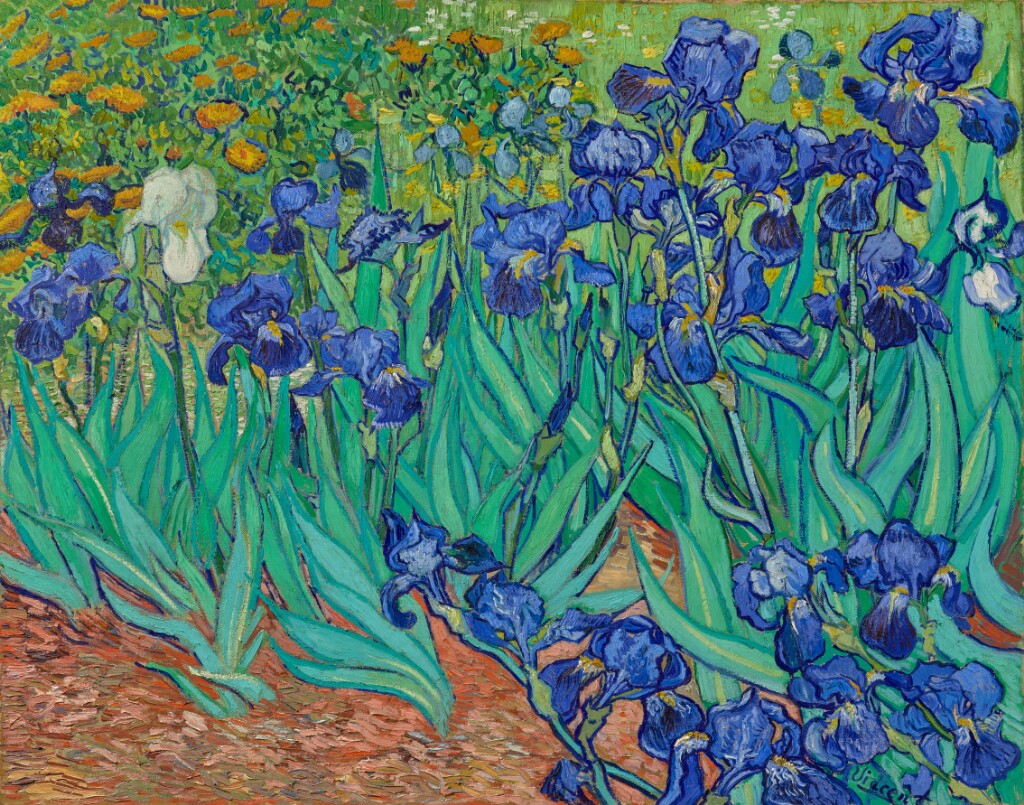
The article specifically mentions Irises by Van Gogh, but the link (https://www.getty.edu/art/collection/object/103JNH) takes you to a page where it seems like you have to ask nicely and agree to terms to use this public domain image.
Worse, they've attempted to extract licensing fees from people who use such public domain images, in one unfortunate case: Carol M. Highsmith, a photographer who had donated her works to the public domain received a letter of demand from Getty Images for using her own public domain images.
https://petapixel.com/2016/11/22/1-billion-getty-images-laws...
* While Getty Images and Getty Museum are born of the same "Getty" family, they aren't connected entities, and one does not reflect upon the other.
art.nelsonenzo.com.
It's fun to explore, but annoyingly he never finished it with the Metadata. So you can never search, or get them back in the same order, nor know what your looking at. He said he redirects reddit.com to there on his work computer and he just uses it to meditate. Annoying.
not too bothered with the resolution as mere mortals today can only afford to train on downsized images anyways.
this is a rather disrespectful way to refer to the benefactor.
https://brightside.me/articles/the-story-of-the-richest-man-...