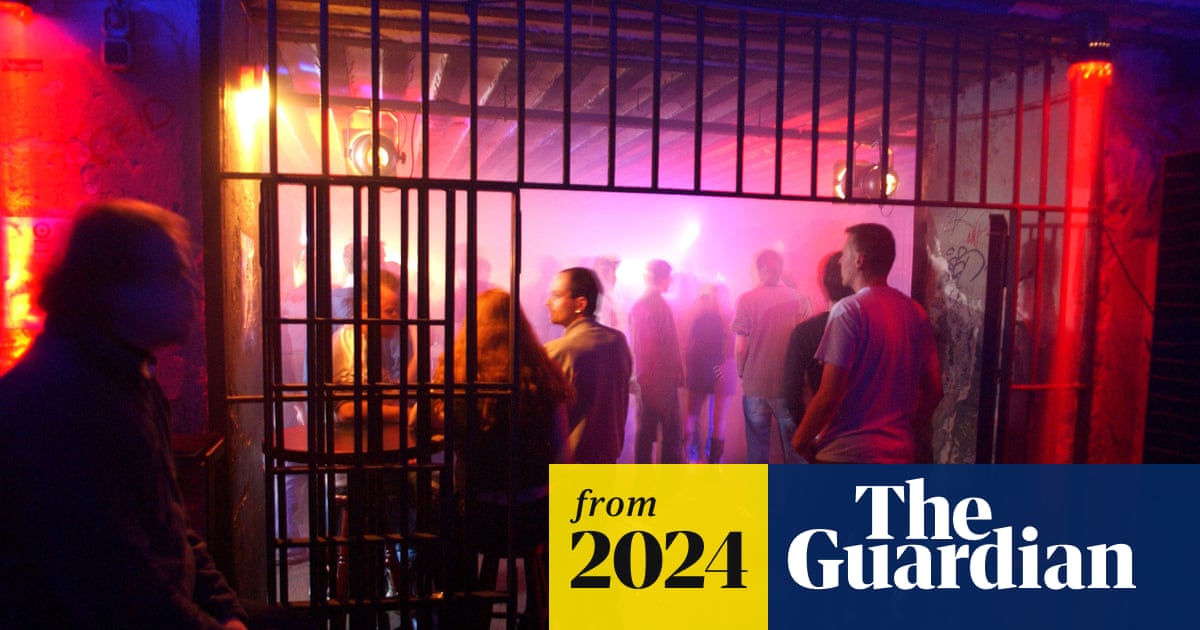
Germany adds Berlin’s techno scene to Unesco cultural heritage list
List recognises techno scene’s contribution to Berlin’s cultural identity
the Guardian
398 points · by kasperni · 2y ago · 287 comments
No city can really replicate the absurd situation Berlin was in after the second world war. The absolute oppressive atmosphere, with one day the whole city getting flipped upside down. Anyone being able to take over a building on the East side and throw a party there. When before you could end up in a cell overnight for playing a boombox too loud on the street. The original location for Tresor (club) was the literal translation of the German word: A big old safe in a bank. That you had to climb down a ladder to get to.
An unexpected connection of cities is between Berlin and Detroit: Underground Resistance (a group of Detroit born Techno producers) among many others playing gigs in Tresor going back to the early nineties.
[0]: https://www.amazon.com/Klang-Familie-Felix-Denk/dp/373860429...
The ladder was into the cellar of the Fischbüro location somewhere in Kreuzberg 36. (these guys started Tresor later)
(Eimer (Bucket) was a really bad location several years later, you wouldn't have been able to get out of the basement if ...)
36 is the cooler, poorer, more political, younger half of the borough, it really was a center for non-conformists after reunification, but it's being gentrified these days.
I think you mean the cold war.
In a more general sense the old rave cities are making way, and have been making way, to other cities. A movement spanning more than 20 years now, thanks to very active promoter teams, leads to Lyon, Prague, Zagreb, Thessaloniki and even Sofia.
I'd also argue that the most recent accelerator for the shift in culture in Berlin isn't so much the tourism, but the pandemic. People haven't really been the same since.
I think the biggest drag is actually rent prices. When I got to Berlin 20 years ago you could get a room in a shared flat for €100. That same room now would be €500. Same for music spaces: it was easy to rent unused warehouse space in the inner city 20 year ago. There are a lot of interesting things that happen to a city when rent is ridiculously low as it was in Berlin for a long time (there were more apartments than people).
There's still a lot going on in Berlin, but the character has very much changed. 20 years ago it was rare for clubs to be legal. Most of Berlin's well known clubs now started off as illegal clubs back then. But there were hundreds of other spaces that didn't survive and transition to being legal spaces. There's still some of that, but much, much less. Also back then just randomly setting up a sound system in a park in the summer was much more tolerated. "Open Airs" in Berlin were just kind of what you did in the summer.
Honestly, while I generally did not partake in such, the pandemic was the first time that I realized that came back some. Partying was illegal and the parties were moderately guarded secrets. I hadn't seen that much buzz around illegal parties in more than a decade.
Addendum: As a weird note, I don't even get the grandparent's comment about Potsdam? For the non-Berlin folks, it's a city just outside of Berlin's borders, but an hour away on the train from the more alternative bits of the city. It's neither known for its music scene, nor honestly as a place that rich people want to move. I know a couple of people that have moved there because of usual suburb reasons: they wanted a bigger place, and it's cheaper there. The other cities listed there are also weird. I've been out in all of them but Lyon and, yeah, there's some stuff, but to say the "scene" is moving there is really off. Three of the cities listed there are in the Balkans, but the best city for techno in the Balkans is undoubtedly Belgrade.
Imagine a guy comes around to your house every month and demands $1000 or else he breaks your kneecaps. You'd be quite motivated to ensure you can make that $1000 each month and you'd not be left with as much energy for doing everything else you might want to do. That's essentially the economic effect of rent. At least taxes are indexed to your income, so you can always afford to pay them; rent is not.
Sooner or later, the Berlin scene will just feel like the one in Brooklyn. Everything will be properly gentrified.
This is a super common cycle. City gets economically depressed -> rents drop a lot -> lots of young people and artists, etc. move in -> great "scene" develops -> people with a bit more money start moving in because of the scene -> rents rise -> young people and artists move elsewhere -> scene slows or stagnates.
Obviously that's an oversimplification, and just becoming cheap to live in isn't enough by itself, and just becoming more expensive isn't the death knell.
Belgrade is long way from Europe although the scene is good, but I’d say Croatia and Albania are much more preferred by promoters
I've seen the pattern in several other places as well: arts thrive in the affordable undesirable edges of society until it generates enough buzz for capitalists to notice it and move in seeking to profit off of it. The problem is that culture is not valued in capitalism because it has no landlord.
Let me get you a list for your next Prague trip: Fuchs 2, Bike Jesus, Altenburg, Bukanýr, Ankali, Roxy, Onyx, Jilská 22, Swim, Centrála, Cross, Storm, Chapeau Rouge, Planeta Za, Wildt, Mecca, Studio ... That's just the very well known ones, then you have hundreds of random small unknown places with great unknown DJs all around the city, and many great rave events in places like nuclear bunkers, castles, churches, forests.
The mainstream event halls normally used for big artist concerts are now hosting raves too.
In Europe, most EDM is happening in Amsterdam.
Music, events, and culture in general should be diverse. It would be a fucking bleak future if the world converges on the single right way to party, detach, relax, or feel.
I’ve enjoyed far more raves in LA and Detroit, and lots of harder techno clubs in Chicago that felt a lot more authentic. The Berlin crowds were kind and chill, but there definitely was this odd feeling where it all kinda felt..scripted?
I hadn’t gone to Berlin up until two years ago, so I can only imagine it was pretty incredible a decade ago before tourism swamped them.
And before anyone asks, I was rolling with native berliners and service industry folks, so I was fortunate to get in to and attend a lot of the best parties while I was there. I’d love to go back, I do just feel like it was slightly overhyped before I got there :/.
Happy for them regardless, they deserve the recognition even if I didn’t get to really experience the best of it
I just had this possibly _too_ high expectation of the Berlin techno club/party scene before I got there, and it just didn’t wow me like I had heard it would (despite having a great time and no issues).
Berlin as a city, however, exceeded my expectations..which definitely adds to my confusion on my overall sentiment towards everything
Leipzig is lovely but tiny in comparision, you won't find even remotely as many clubs and parties.
That’s exactly what someone would say, to keep the tourists away :p
“No, there are no underground raves around here, nor have there ever been, nor will there ever be. Please stay away from this town.”
Where there is affordable housing, there be musicians doing brave new things instead of worrying about rent and rapping rants about gentrification.
So I am not a techno aficionado, and I'm curious what the state of Detroit techno is now. It seems like it should be more notable (maybe it is and I'm not in the scene to know) given the history and cost of living.
I regret the US turning away from house and techno, compared to Europe.
Berlin is the biggest city in continental Europe, there's a lot of everything and there'll always be hidden little nooks.
[1] https://en.wikipedia.org/wiki/List_of_cities_in_the_European...
https://en.wikipedia.org/wiki/List_of_metropolitan_areas_in_...
There's a ring of sbahn commuter rail around the center. From east to west that's about 16km and from north to south about 10km. Anything inside that could definitely be considered as the center. Walking east to west would take about three hours or so. You'll pass through a lot of interesting neighborhoods, each with their own little centers. You'll pass lots of landmarks. The former east and west berlin "centers" are about 9 km apart. A lot of the traditional landmarks and hotspots are spread out throughout that zone. And then you have a lot of gentrified spots that are becoming hotspots in their own right.
I use the word center loosely of course because there really is no such thing in Berlin. It's all spread out over a huge area. There are probably about well over a dozen areas that can lay claim to being a center of something. And frankly, most of the interesting bits are outside of what the tourists flock to these days.
Outside the ring, the city continues in pretty much all directions for quite some distance. And some of those areas are quite nice as well. But most would not consider that the center. I've lived here for about fifteen years and there are huge parts of the city that I've simply never even been to because it would take like an hour plus to get there and there isn't much in terms of landmarks, etc. to draw me there.
Technically Berlin is actually a city state (within the federation of Germany) that includes the capital and a few suburbs. Total population is still smaller than it was before WW II (3.5M people vs 4M people then). So there's a lot of open space, huge parks, two decommissioned airports (Tempelhof, Tegel), etc. all within the city limits. Tempelhof is huge. About 2km by 2km of open space in the middle of a big city with two decomissioned runways. It was the site of the cold war air bridge. You have Kreuzberg to the north, Neuköln to the east and Alt Tempelhof just outside the ring on the south west side. And that's just one corner of the city. All in former west Berlin.
The population is growing for the last decades at a pretty decent rate (about 50K new people per year or so). But it will take some time to catch up to pre WW II era levels.
"It use to be about the music"
I remember hearing this 25 years ago.
Of course, what happens is that you get people who have been going to these things for 10 years and the novelty has worn off along with being 10 years older.
Most fun activities are better when you are 10 years younger with no expectations.
In my experience, people who like things because they are hidden and exclusive tend to be shitty, shallow, superficial people. Many, many, varied decades of life lived all over the world, and I've never witnessed a counterexample so I hesitate to make it an absolute.
Same goes for people who think they like things more than others because they liked them first.
Sounds a bit like a strawmen. No one here said, they like something, because it is hidden.
But hidden places are quite free and can cultivate a very different culture, than one that plays by all the legal rules. And where money took over everything.
The best places I have been, were not listed in lonely planet. And I could not book them online. I had to find them.
Speaking as someone who's split ~half my time between Leipzig and Berlin for the last 5 years, this is not true.
Leipzig's club scene is an extension of its university population. It's younger, straighter, whiter, and about two orders of magnitude smaller. People visit the clubs while they're going to school there, then they graduate and move elsewhere. Often to Berlin.
Why does this illusion exist? Because Leipzig is about an hour away from Berlin by train. Berliners visit for a weekend and think "wow, it's like Berlin in the 90s! Still cheap! And look at all these cool young kids at these scrappy clubs -- so that's where the underground has gone!". Then they go back to Berlin and spread the word to credulous out-of-towners, who go on to repeat this truism to people who have never visited either city.
In reality, Berlin's club scene -- both "mainstream" and "underground" -- dwarfs that of any other city. Nothing short of an asteroid hit is likely to change that.
I think, for a moment around 15 years ago, Leipzig was dirt cheap and had quite a bit of momentum, because you didn't need a business plan to try and make things happen. People, students from west Germany, payed 100€ for rent and 30€ for an atelier. Lots of raw excitement and empty buildings.
But the momentum died maybe 8 years ago. What's left is nothing like Berlin. Cheaper, but still expensive; liberal-ish, but all kartoffel. Leipzig doesn't feel exciting, but small now. And it's deep in enemy territory, very depressing region, the mere thought doesn't spark joy at all.
Berlin can have the heritage, NOW it’s not there anymore, do u get it?
Or maybe that people got too busy that they can only afford to party when it’s a proper vacation.
On the hand, Barcelona is as cramped as ever (with rents showing it too) but there is plenty of festivals in the city, especially around Port Forum (a marina) which have huge open spaces and is right before the city limits.
This has been a meme forever, and while Leipzig has its own decent scene for its size, it is not remotely close to rivaling Berlin. Pick a decent sample of either established or up and coming DJs and compare how often they play in Berlin vs there to disuade yourself of that notion.
>and even Sofia.
Yeah, no. Just because a city has some parties here and there, it doesn't mean it should even be in the conversation in this context.
Well there's the problem. What you should compare is how many unknown new guys just making good music for fun in small unknown clubs visited by locals are there.
In my city I can go to a random non-descript bar with zero marketing or entrance fee, sit down peacefully with a drink, and hear world class techno together with few dozen strangers. Every evening. Doesn't feel that way in Berlin anymore, even if I pay it's all that global commercial style that the established DJs with promoter/management teams seem to fall into and the places are totally overcrowded.
I believe this is the usual cycle of cities going through: arts scene existing because it's a cheap place to live, artists congregate in places they can afford, create a cool scene, the cool scene brings some bars/cafés and slowly it erodes to gentrification since these places are cool and attract other crowds into it (higher income, and/or tourists), eventually it makes the place expensive and artists have to find a new place where it's cheaper to live, and create their spaces.
Very similar to the geeks, MOPs, and sociopaths essay on subcultures. [0]
Add to that that Berlin has been a place for internationals for generations, whereas Leipzig is entirely German.
For the record, I love Leipzig, I think it's gorgeous.
It's funny how the (somewhat leftist) techno scene hates on foreigners destroying their tradition. Berlin and Bavaria aren't so far apart after all.
It is basically the techno scene version of gentrification (not talking about the impact or harm or whatever else being comparable between the two, just the mechanics of it), except it is happening with the techno scene instead of housing.
This is not incongruent with your observation about “somewhat leftist” techno scene people hating on outsiders destroying their tradition. It is very similar to the analogous complaints those “somewhat leftist” people would make about gentrification.
A very comparable similar example: Burning Man. Look at how it changed and what people who have been attending it since forever ago are saying. Very similar things, and it obviously has nothing to do with actual foreigners. It has everything to do with “gentrifying” the event, and it just slowly turning into a trust fund glamping larp.
The same thing is being done to hiphop in a similar way.
The whole damn point was people dancing in a room together, not whatever authenticity tests you have in mind.
That's funny, Detroit lays claim to the same thing.
This is the kind of mistake that we made in the US decades ago, and the results are plain to see today in any neighborhood bisected by a freeway.
This issue is that the controlled-access highways should have never been placed inside cities, but that precludes the automobile becoming the de facto mode of transportation.
It's important to remember that many of Robert Moses's city-splitting projects were started before WWII. I suspect that some of the worst aspects of what resulted from his legacy were based on vain attempt to use suburbia as defense mechanism to better survive a nuclear exchange.
The irony is that the existing controlled access highways could be fairly easily repurposed to rail if we wanted to, it's just that the automobile addicts that we are would collectively lose our mind if we actually converted some of redundant urban highways into railways.
https://www.theatlantic.com/business/archive/2015/11/syracus...
It's a much-needed change, the side of Philly's Chinatown to the north of the freeway is clearly suffering compared to the south side. It's such a stark difference.
https://www.thetimes.co.uk/article/cairo-flats-are-handy-for...
The museum treatment is the end for any artform, IMHO; it's petrification. Did rock'n'roll grow and move and thrive after its Hall of Fame opened? I suppose there was grunge.
It freezes the artform in a certain state (and by who and how is that state chosen?) and defines it that way for eternity. That's death - growth and change are ended; like the dearly departed it's defined by memories of it, not who it will be today or tomorrow; it's no longer doing something new that will surprise you or make you uncomfortable; it's sometimes reenacted by people who try to represent it, who miss the point of art - to express something of your own.
Demoscene is on the same list, but that doesn't mean UNESCO is forcing demoparties to run a certain way or forcing demosceners to make demos a certain way or that any of it became a museum. It just means the government shouldn't try to shut it down. Maybe it enables the government to make some official demo archive in the future or something, but what's wrong with that? A demo museum can exist at the same time as an active scene, just like museums about the past of Berlin can exist at the same time as Berlin exists, and the same in techno.
Demoscene
https://www.unesco.de/en/culture-and-nature/intangible-cultu...
From what I hear from people who are, the clubs have become basically tourist traps that are unaffordable to locals and some have even been priced out of their original locations so not sure if this decision will help much.
I remember in 2015 paying 10-15€, even Berghain would be around 15-18€ and that was expensive already.
The techno scene is still pretty good music-wise if you check the line-up and avoid the new fad of celebrity DJs from the past 8-10ish years. I'm very fond of my early techno days where you could barely see the DJ from the dancefloor, they would be spinning in the shadows and the focus was dancing (this in the early 2000s so not an OG at all to the scene from the 90s, and not in Berlin).
To me personally since the big room/celebrity techno DJs took more space in the scene it has become much harder to find dancefloors like Berghain. I'm still sad for De School closing in Amsterdam, it was a very different place than Berghain but the crowd and dancefloors were very enjoyable.
Interestingly, as an expat/immigrant I've met all my local Berlin friends clubbing, and most of my friends here are German. My colleagues who don't go clubbing seem to be in little bubbles of other expats.
As a result, these people go everywhere and do consumption and outcompete everyone who is not like them. Then everything gets adjusted to their pleasure and they consume all the resources(being housing, food, entertainment etc).
Also, the supply and demand are not able to stabilize because the money moves around the globe freely but working people can't. So when a cryptobro from Russia moves to Portugal he can consume all the Portuguese resources but he can't bring fellow Russians to work and re-supply. Why wouldn't Portuguese just work harder and make buck by increasing the supply to meet the demand? Well because the cryptobro demands luxury housing, luxury food, massages, cars and cocaine but the Portuguese in the location they moved in are maybe painters, taxi drivers, chemical engineers or doctors and they can't simply start doing this new stuff.
The folks are angry with working class immigrants but most of their troubles are actually due to a-few-millionaires who are not rich enough to do substantial long-term investment but are rich enough to consume like there's no tomorrow.
The real economy is not elastic enough to handle increase in demand instantly. It takes years to train people to do the things that are taken for granted.
Think of it like the developer salaries in the USA when the money poured in, until it stopped.
I agree that it's worth considering why Berlin has been chosen without acknowledgement to its roots (no shade to Berlin, I love that city and much of the music it has produced).
I enjoyed reading you essay. Coincidentally, U Street Music Hall was one of the venues that shaped my teenage years and served as my gateway into the electronic music scene.
One of my favourite things about Berlin is just sitting in a bar with friends till you're done for the night, no pressure to move on - often this can drag till 4 in the morning, but it doesn't feel laboured.
I agree the scene is "dying" though, simply because Berlin is very different than it was 20 or 30 years ago. Robert Henke (Monolake) talks about this: after the wall collapsed, the factories in east Berlin were abandoned, and west Berlin were happily giving permission and even some money to any student who wanted to open an "artistic space" in one of the old factories. So it was easy, you had a very industrial space, you brought some speakers and some beer along, and suddenly you had a club.
This is basically a very rare cultural moment: large amounts of unused industrial space being given away to anyone who wants to party. Berlin is, of course, nothing like this now.
When the russians hit Odessa with missiles today, only 14 people died.
Thanks UNESCO!
If I zoom out further into EDM in general, I think of Paul van Dyk, but that's literally it.
My knowledge is dated, but it does fall in the realm of "post cold war", so I'm wondering why I can't think of more if this scene was so important.
https://www.unesco.de/kultur-und-natur/immaterielles-kulture...
What are your most favourite underrated techno clubs in Berlin? I've been to the big ones already, keen to explore the fringe places.
And it's very close to the famous Mustafa's Gemuse Kebab, so you can try that afterwards.
I'd skip the tourist queue and go to any other random places you find on the way instead.
I don't think even Golden Gate nor ://about:blank would be considered truly "underground" anymore. As usual with the underground stuff you need to dig deeper to find them, as I don't live in Berlin I need to rely on my local friends to take me to these places as they are inserted within the underground culture.
I feel very privileged to have lived my 30s through that time. Public Office in West Melbourne. The Lounge! Oh my god the Lounge on Swanston. E55 at the bottom end of Elizabeth. And let’s never forget Revolver, not that it needs forgetting as it’s still going.
Everyone in that scene was there for the music. We all danced, we all enjoyed each other, we went home together, we bonded over ciggies on the balcony, we stayed up all night, we shared everything. It was epic.
I’m 47 now. I have no mid-life crisis, and I put it down to living in Melbourne through my 30s. A spectacular little bubble in human history. x
However .. I was there for https://www.youtube.com/watch?v=4yyUO93JpEw https://en.wikipedia.org/wiki/Little_Band_scene
and later made it to Berlin to being working tech crew for Wim Wenders Wings of Desire when the scene with Nick Cave and the Bad Seeds was shot https://www.youtube.com/watch?v=ZPf6SWcENWo
Two decades seems excessive, I was there for the shortest no-wave ever(?) The Immaculate Consumptive in the time of Scraping Foetus Off the Wheel.
Melbourne's always seemed to have several layers of music scene on the go at any one time, for better or worse many of the acts travel onwards and outwards, some returning to base camp.
This is wonderful.
Cybergoth Dance Party and Techno Viking are now even more important parts of our collective human heritage.
Edit: It seems Cybergoth Dance Party was shot in Dusseldorf, my life is now even more full of lies.