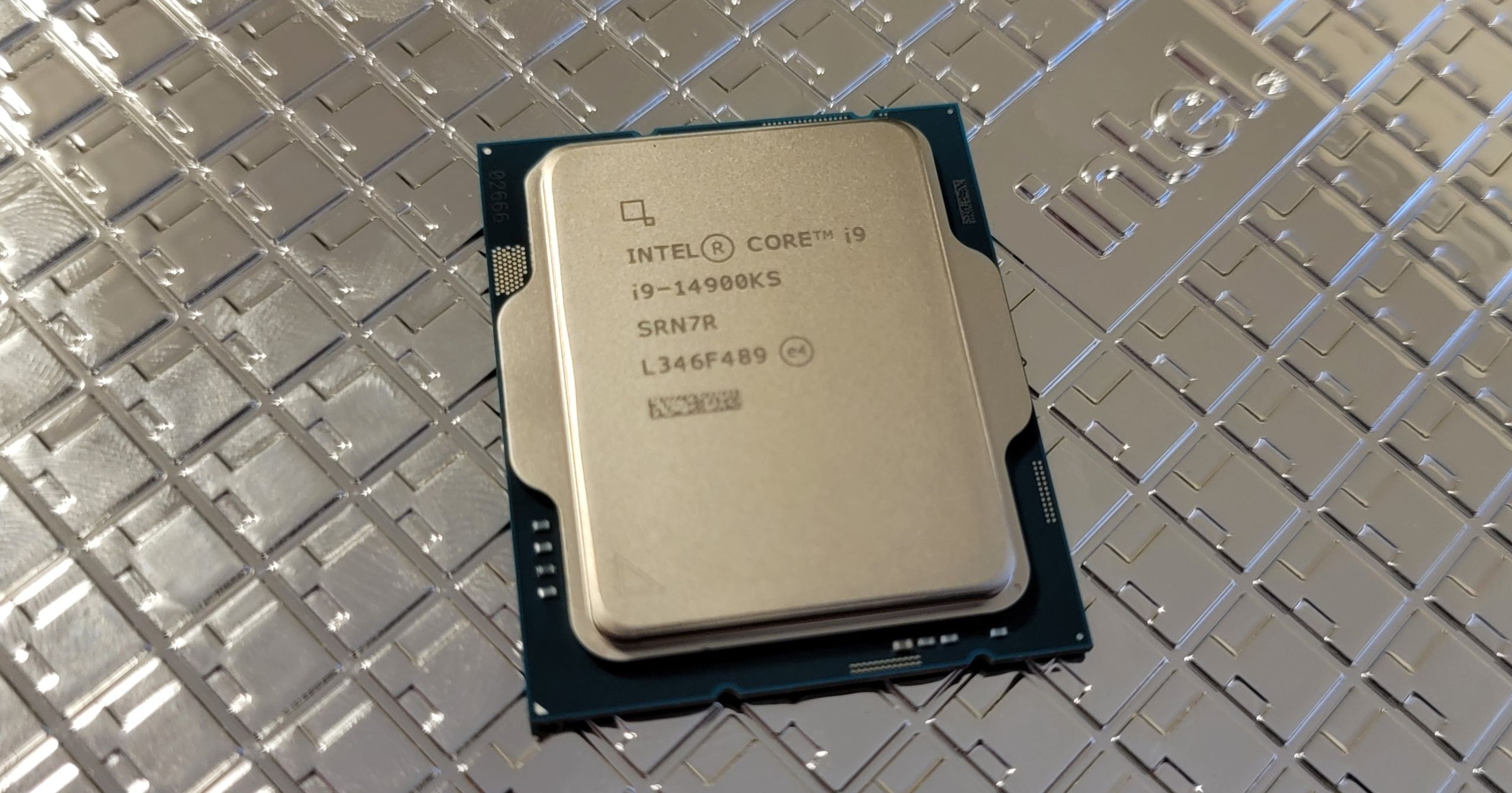
Intel Core i9-14900KS Review: The Last Core i9 Hits Record 6.2 GHz at Stock Settings
6.2 GHz and a whole lotta power draw.
Tom
149 points · by tomcam · 2y ago · 270 comments
On the other hand, Intel did get the 12700k to 5GHz in 2021. That's an actual flagship part that actual people might actually buy for an actual purpose.
When Intel ran into their 14nm woes and started actually getting pushed by AMD, Intel responded by upping their core counts (part way) to erode the AMD core count advantage, while really leaning into their single core performance advantage (which was truly a real thing in Zen1/2) by really starting to up their clock speeds.
As an example: to hit these speeds, Intel and AMD are pushing 1.4V into chips built on processes that work best at and below 1V. And the result isn't a stable, long-lasting chip: https://news.ycombinator.com/item?id=39478551
What I would want to know is what happens to these good binned chips when you lower their voltages and frequencies and run them at a more reasonable 3.5GHz or something for a long time. Is the price / power / performance ratio better than a server chip or is it worse ? Would love some data on that. But no one is buying these for it and server chips have different things going on for them like being able to replace the chip for years etc. still would be interesting to find out if these the best ‘quality’ chips out there
Intel warrants their processors for 3 years if they are operated according to spec, which includes supplying 1.3~1.4V as far as I'm aware.
From what I can tell, the linked thread and article concern CPUs that were either defective out of the box (and thus under warranty, regardless usage) or were driven out of spec by mobo overclocking by default (which would void warranty).
Officially, 10-11 years ago. (This first 5Ghz CPU wasn't that impressive, and part of the reason "chasing Mhz" started to fade into irrelevance.)
For modern AMD, it wasn't until 2022 that they ventured back across 5Ghz, but this time it's much more impressive.
https://www.theverge.com/2022/5/23/23137217/amd-ryzen-7000-c...
Okay, but unless you have cooling with liquid nitrogen you cannot maintain 6.2 GHz for long due to thermals in practice, hence after a short sprint it will fall back to a much lower frequency.
12900K: 5.2 GHz peak
13900K: 5.8 GHz peak
14900K: 6.0 GHz peak
14900KS: 6.2 GHz peak
I haven't noticed before either.
But given that my laptop pulls this off at a way lower TDP makes me wonder how competitive that Intel chip is, especially as the articles title already says it has a huge power consumption.....
(no, fx-9590 does not count)
Link for the lazy
There used to be a business in selling these ultra performant ST chips to high frequency traders, who'd overclock the absolute crap out of them. Luckily, this is no longer a business. But these kind of products used to be the "waste stream" from them, left overs.
But now, the KS-series intel chips are for slightly insane gamers and overclocking enthusiasts with more money than sense. That's okay, there's a real market segment there. At our work, we buy the 14700K for dev machines like sane people.
HF trading is no longer a business?
the bottleneck will always be the fact that software is either unable or unwilling to be paralellised
You can get performant enough parts for half and reasonable enough parts for even less than that. But some people have hobby where they just want the fastest thing.
(As mentioned another post here, for even more CPU-intensive games like Factorio, the difference is even starker.)
For general mixed workloads (assuming you need more threads), I think the 7950X3D is the way to go - 8 3D VCache cores for similar gaming, 20% cheaper than the 14900KS, generally neck and neck on development workloads but also has AVX512 support, and of course all while using significantly less power (also 120W TDP, 160W PPT - you can do even better w/ PBO+UV or Eco mode). Here's the OOTB power consumption comparison, it's a bit bonkers: https://www.techpowerup.com/review/intel-core-i9-14900ks/23....
7950x3d is limited to ddr5 6000 while 14900 can do ddr5 8000.
The benchmarks you shared are using ddr5 6000. So by upgrading the ram, the 14900 should come out on top. The memory controller is a key part of the cpu. It makes sense to test them with the best components they are able to use. I know it probably doesn’t matter, but if you’re chasing those last 5% of performance fast ram is a better value than custom water cooling.
The user-mode video driver and kernel mode driver both use other cores as well
True, the bottleneck will shrink - but according to Amdahl's law [0], it will never really go away.
Also, the more cores you have, the more the single-threaded performance increase multiplies. Imagine a million-core CPUs in the future - even a tiny increase in single-threaded performance will yield millionfold.
(Work paid for it for ML prototyping.)
I've had 12900k, 12900ks,13900k processors, I'm going to build a new one with either a 14900k or ks. I own a P5800x optane ssd to match.
Also, many more people are installing solar power residential batteries, so there’s that.
https://www.statista.com/statistics/263492/electricity-price...
If you can afford a 320W CPU in the first place, you can probably afford the batteries to power the thing for a few hours, but it does still add a considerable amount to your backup costs.
Lower power consumption means less heat, which means less noise from cooling fans and lower temperature increase in my room.
YMMV
I have a Ryzen 7950X in ECO mode 105W that's very fast in every workload I can throw at it, trivial to run whisper quiet with a basic Noctua cooler, and barely warms the room.
In general, as a home user, you should care about power consumption in desktop computers for the following reasons.
* Higher power requirements means more expense in other parts of the build. It means higher PSU requirements, and stronger cooling requirements.
* If you ever plan on running the PC on battery backup (UPS or Tesla Powerwall) or if you plan on installing solar energy then power consumption becomes a bigger expense.
Environmental impact maybe? Higher power usage = more heat = more noise?
There’s a bunch of other cases too.
All this negative shilling about power consumption of Intel and AMD desktop CPUs started after Apple ARM processors appeared on the desktop. Apple sells soldered SSD and CPUs with un-upgradeable RAM, and the proprietary SoC is no longer a true general purpose CPU as only macOS can run properly on it. Performance wise also they don't truly beat AMD (and in some cases Intel) processors. This is a huge negative factor for Apple Silicon based hardwares. Thus, the only negative marketing they can do about Intel and AMD processors is based on its higher power consumption.
That said, Intel and AMD will (and do seem) to care about power consumption for their laptop and server segments.
How many TPS can I get on my Factorio megabase.
https://www.tomshardware.com/news/ryzen-7-7800x3d-smashes-co...
https://www.reddit.com/r/factorio/comments/12ckmc3/hardwares... (this doesn't have the 14900K(S) but given that it's the same thing as the 13900K you can guess where it'll end up, and it ain't close to the X3D's)
Games need to do a crazy amount of branchy unpredictable work on an enormous dataset so they're very often limited by memory latency which is alleviated most readily by more cache and prefetching. It's why the ECS pattern is so popular as of late from a performance standpoint because it encourages more logic to be written as iterations over dense linear arrays which are just about the best case for a CPUs cache management and prefetching logic.
Factorio is probably the best example of this because it's a game where performance is entirely CPU limited where AAA games more often used in benchmarks are much more dominated by GPU time.
https://m.youtube.com/watch?v=0oALfgsyOg4
Excluding the massive power difference...
(direct link to image: https://gamersnexus.net/u/styles/large_responsive_no_waterma...)
Compared to house hold appliances, with 4000watts of power, you can run 3 microwaves (at 1200 watts), more than 5 refrigerators (at 800 watts), a reasonably sized central air conditioning unit (though 5KW models aren't that rare), etc.
These power and thermal figures make me wonder why Intel is not moving towards Apple's design philosophy behind the M1, M2, M3 series of chips.
No, that's just a way to set no upper limit. A very beefy desktop power supply is 1600W, and that's typically over-specced to handle brief surges of power.
Intel makes laptop ships too and those don't use 100W.
Why does everyone these days hate consumer choice and market diversity so much?
A lot of people got into CPU topics because Apple created their M1s and they think that ARM is some unparallelled thing that every1 must adopt and that Apple's design goals are most important (other market segments are irrelevant)
They shouldn't even be compared since they target different audiences.
Why do you need to pull in Apple so badly into this?
This bloviating is really getting tiring here - this is the most expensive, most highend chip that people put into gaming machines and their worstations. People who really want the maxiumum power no matter the cost or heat.
If you utter "laptop", "M", "ARM" in this context you're not the target market for this chip. That's OK. Not everything needs to be a medium powered laptop chip for browsing.
The provide laptop chips, desktop, high-end enthusiast desktop and server chips.
Why should they just copy apple?!
Apple had it easier with the switch to ARM - they use vague metrics like over 2 times faster without actually getting into benchmarking or technical details like the PC crowd does.
See Apple still comparing M3 to M1 instead of comparing M3 to M2.
They will tell you "It's because M1 users are the most probable to upgrade" but nothing says Apple couldn't have compared to the M2 also.
That's the amount of copium one has to inhale when stuck to the whims of a single vendor.
> That's the amount of copium one has to inhale when stuck to the whims of a single vendor.
These are such weird things to add here. Your comment was a perfectly good criticism of the way Apple markets their M1/2/3 CPUs, but then you added that extra nonsense and just came off as someone who spent way too much time in a PC gaming culture war on Reddit that the rest of us don't really care about.
It shows how wasteful these new Intel processors are compared to their direct competition.
add multiplayer into the mix for an even worse experience.
Besides, games are GPU bound, not CPU bound for the most part.
https://www.intel.com/content/www/us/en/products/sku/237504/...
For multi core you can just look at AMD Epyc CPUs which achieve great performance by using many (up to 128) relatively low power cores. An all core load pulls around 400W of power.
Like the new MacBook Air, you mean?
But why is this such a silly idea? A rebirth of the Apple x-server. They make excellent performance cores, they have half of TSMC dedicated to them, and developers love them.
Does this mean that only two cores can be simultaneously at that speed?
The CPU has 2 golden cores that can hit max boost, and the others can't (at least not consistently enough to market it)
This of course backfires once people realize it doesn't matter if you have 64 cores when most of them run like crap and cause you to have to constantly self-manage whitelisting processes to run only on performance cores.
I'd rather have fewer cores of all the same higher performance that don't cause a hassle.
That's not even close to an accurate description of Intel's E cores. They have the same performance per clock as the Skylake cores they shipped in all their desktop processors from 2015 until just three years ago, and the E cores run at similar speeds. They may be descended from Intel Atom, but they're not crap.
The general idea of the E cores is sound: for tasks that can scale to more than a handful of threads, the E cores provide better performance per mm^2 of silicon and better performance per Watt. Going beyond the current 6-8 P cores in a consumer processor makes no sense; extra silicon budget should be spent on more E cores (and maybe more cache per E core).
Intel "E" cores are about 30% as big as the normal ones.
AMD avoids the scheduling issues, but does not get the density benefits.
When I can get a CPU which is all P-cores and has significantly more cores than even the biggest P + E hybrid CPU then what's the point? But if they could give me, say, a hybrid CPU with double the number of cores compared to the biggest available P-only CPU - now we're talking! Alas, the market for such a thing is probably not big enough to be economical.
Though I don't have experiencing using these CPUs so I don't know how well management of processes is implemented (probably only going to improve from now though).
Sure, marketing might play a bit into it. Less savvy buyers might make the mistake of comparing core counts across different brands / architectures rather than checking benchmark comparisons. Makes me think of the class action that happened with the Bulldozer architecture [3]. As long as they advertise the cores as distinct P and E cores, I think it is fair enough.
[1] https://www.tomshardware.com/reviews/intel-core-i9-12900k-an...
[2] https://www.tomshardware.com/reviews/cpu-hierarchy,4312.html...
[3] https://en.wikipedia.org/wiki/Bulldozer_(microarchitecture)#...
It's a bit inconvenient that all cores are not identical, especially in real-time applications such as video games. Some schedulers may also not be able to use them well automatically. But if you care mostly about throughput, E-cores are superior to P-cores.
The case where you have many lower workload tasks or system processes, and a few high workload tasks.
This allows for maximizing throughput for the majority of users, while also optimizing for silicon usage and power draw.
Perhaps for your use cases, E cores don’t benefit you, but there’s been over a decade of proof of the use of heterogenous cores across mobile, laptops and now desktops.
E cores are meant to make a much milder tradeoff of performance and features than would be required to jam that many computing units into that area.