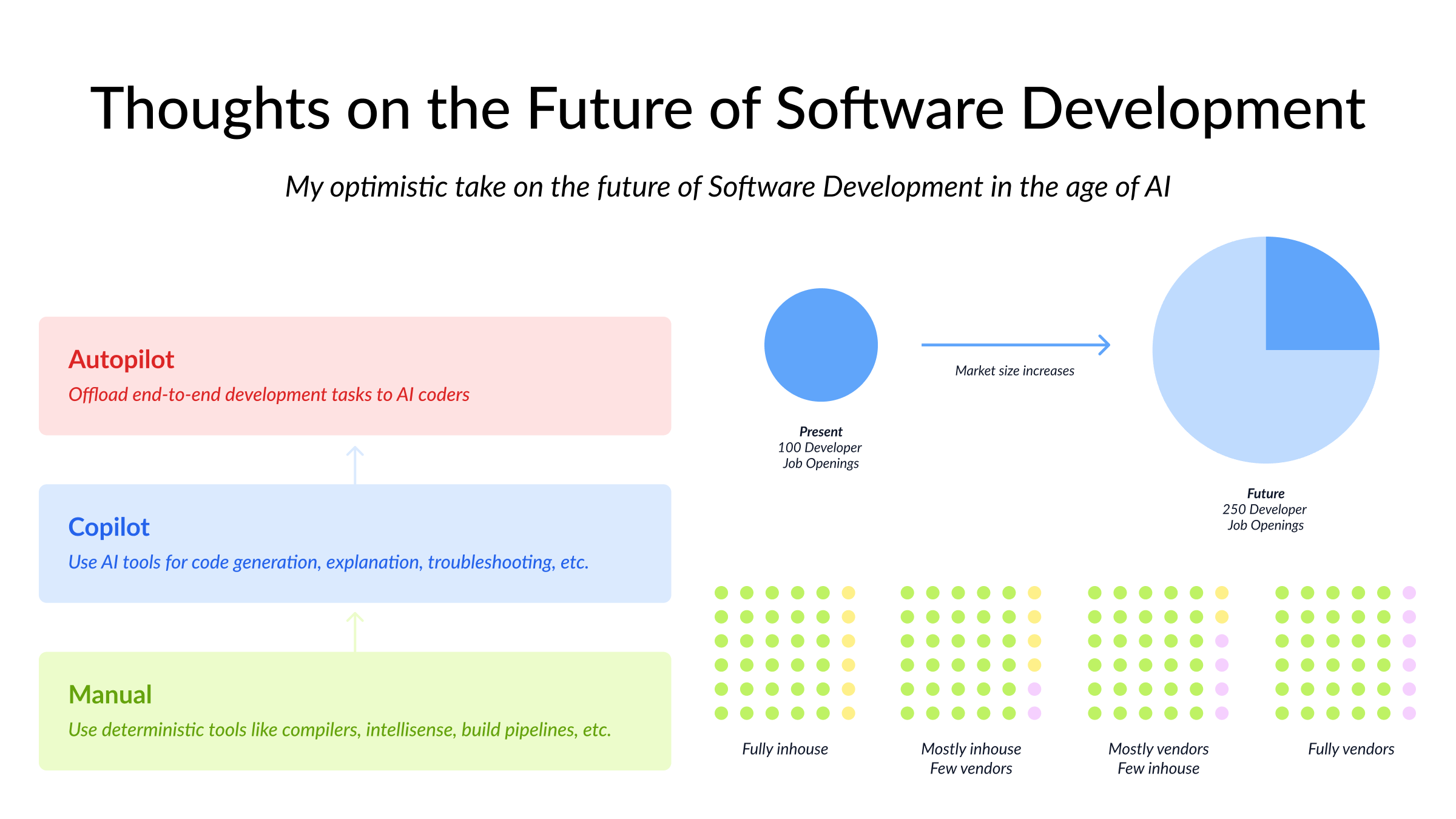
Thoughts on the Future of Software Development
My optimistic take on the future of Software Development in the age of AI.
Shesh
257 points · by rkwz · 2y ago · 420 comments
This is precisely what I dread. When it comes to software development specifically, the parts that the AI cheerleaders are excited about AI doing are exactly the parts of the job that I find appealing. If I wanted to be a glorified systems integrator, I would have been doing that job already. The parts that the author is saying will still exist are the parts I put up with in order to do the enjoyable and satisfying work.
So this essay, if it's correct, explains the way that AI threatens my career. Perhaps there is no role for me in the software development world anymore. I'm not saying that's bad in the big picture, just that it's bad for me. It increasingly appears that I've chosen the wrong profession.
For example, when moving up to C from assembler, the task of the "programmer" remains invariant and the language tool affords broader accessibility to the profession since not everyone likes to flip bytes. There is no subdivision of overall task of "coding a software product".
With AI coders, there is task specialization, and, as pointed out, what's left on the table is the least appetizing of the software tasks: being a patch monkey.
This is the issue.
"Automatic programming always has been a euphemism for programming with a higher level language than was then available to the programmer. Research in automatic programming is simply research in the implementation of higher-level languages.
Of course automatic programming is feasible. We have known for years that we can implement higher-level programming languages. The only real question was the efficiency of the resulting programs. Usually, if the input 'specification' is not a description of an algorithm, the resulting program is woefully inefficient. I do not believe that the use of nonalgorithmic specifications as a programming language will prove practical for systems with limited computer capacity and hard real-time deadlines. When the input specification is a description of an algorithm, writing the specification is really writing a program. There will be no substantial change from out present capacity.
The use of improved languages has led to a reduction in the amount of detail that a programmer must handle and hence to an improvement in reliability. However, extant programming languages, while far from perfect, are not that bad. Unless we move to nonalgorithmic specifications as an input to those systems, I do not expect a drastic improvement to result from this research.
On the other hand, our experience in writing nonalgorithmic specifications has shown that people make mistakes in writing them just as they do in writing algorithms."
Programming with AI, so far, tries to specify something precise, algorithms, in a less precise language than what we have.
If AI programming can find a better way to express the problems we're trying to solve, then yes, it could work. It would become a matter of "how well the compiler works". The current proposals, with AI and prompting, is to use natural language as the notation. That's not better than what we have.
It's the difference between Euclid and modern notation, with AI programming being like Euclidean notation and current programming languages being the modern notation:
"if a first magnitude and a third are equal multiples of a second and a fourth, and a fifth and a sixth are equal multiples of the second and fourth, then the first magnitude and fifth, being added together, and the third and sixth, being added together, will also be equal multiples of the second and the fourth, respectively."
a(x + y) = ax + by
You can't make something simpler by making it more complex.
I think this will weed out the people doing tech purely for the sake of tech and will bring more creative minds who see the technology as a tool to achieve a goal.
Maybe it will abstract away setting up the paint and brush and the canvas, that part I'm fine with though.
All niche jobs will become mundane chores. I don't know if it is good or bad. Because humans always find a way to cultivate something new.
I'm only half joking.
The question is always what's your 'description' language and what's your 'painting' language? I see the same in music: DJ's mix and apply effects to pre-recorded tracks, others resample on-the fly, while some produce new music from samples, and others form a collage from generated soundscapes, etc. It's all shades of gray.
Like sure, these AI's can generate code that works. Can they generate replacement code when you need to change how something works? Can they troubleshoot code that isn't doing what it's meant to? And if you can generate the code you want but then need to tweak it after to suit your purpose, is that... really that much faster than just writing the thing in your style, in a way you understand, that you can then change later as required?
I dunno. I've played with these tools and they're neat, and I think they can be good for learning a new language or framework, but once I'm actually ready to build something, I don't see myself starting with AI generation for any substantial part of it.
All of what you wrote in your second paragraph will become something AI will be doing better and faster than you.
We never had technology which can write code like this. I prompted ChatGPT to write a very basic java tool which renders an image from an url and makes it bigger on a click. It just did it.
Its not hard to think further and a lot of technology is already going into this direction. Alone last week devin was showne. Gemini has a window token of 1 Million tokens. Groq shows us how it will feel to have instant response.
Right now its already good enough that people with Copilot like to keep it when asked. We already now pay billions for AI daily. This means the amount of research, business motivation and money flowing into it now is probably staggering in comparision to what moved this field a few years ago.
Its not clear at all how fast we will progress but i'm pretty sure, we will hit a time were every junior is worse than AI which will force people of rethinking what they are going to do. Do i hire an junior and train him/her? Or do i prefer to invest more into AI? The gap will widen and widen, a generation or a certain amount of people will stay longer and might be able to stay in development but a lot of others might just not.
It's worth noting, that it can do things like that because of the large amount of "how to do simple things in java" tutorials there are on the internet.
Ask an AI to _make_ java, and it won't (and will continue to not) be able to.
That's the level that AI will fail at, when things aren't easily indexed from the internet and thus much harder / impossible to put into a training set.
I think the technology itself (transformers and other such statistical models) have exhausted most of their low hanging fruit by now.
Sora, for example, isn't a grand innovation in the way latent space models, word2vec, or transformers are, it's just a MUCH larger model than DALLE-3. which is great! but still has the limits inherit to statistical models. They need the training data.
And I think many assumptions on this front are products of magical thinking that are discarding limitations of LLMs in favor of waiting for the intelligence to emerge from the machine, which isn't going to happen. ChatGPT and associated tech is cool, but it is, at the end of the day, pattern recognition and reproduction. That's it. It cannot invent something not before seen, or in our case here, it cannot write code that's never been written.
Now that doesn't make it useless, there's tons of code that's being written all the time that's been written thousands of times before. But it does mean depending what you're trying to build, you will run into it's limitations pretty quickly and have to start writing it yourself. And that being the case... why not just do that in the first place?
> We never had technology which can write code like this. I prompted ChatGPT to write a very basic java tool which renders an image from an url and makes it bigger on a click. It just did it.
Which it did, because as the other comment said, tons of people already have.
> Its not clear at all how fast we will progress but i'm pretty sure, we will hit a time were every junior is worse than AI which will force people of rethinking what they are going to do. Do i hire an junior and train him/her? Or do i prefer to invest more into AI? The gap will widen and widen, a generation or a certain amount of people will stay longer and might be able to stay in development but a lot of others might just not.
I mean, this sounds like an absolute crisis in the making for software dev as a profession, when the entire industry is reliant on a small community of actual programmers overseeing tons of robot junior devs turning out mediocre code. But to each their own I suppose.
At least ai will stay put.
But most of us will be getting by on basic income. Or banging on the gates of robo guarded walls begging for food.
To some extent... This is already the world we live in. A lot of code is unreadable without a lot of effort or expertise. If all code was open sourced there would almost certainly be code written to do just about anything you'd like it to. The difficulty would be finding that code and customizing it for your use.
I imagine some sort of segregation would happen where the "machine cities" would be somewhat removed from the general human populus. This would be to ensure the machines could use whatever information transport system they desired, unencumbered by the needs of the human populous, and vice-versa.
At a certain level of compute, I prognosticate that a certain level of logistical optimization would be trivial to advanced intelligences, and could be accomplished with almost-literally no effort using left-over cycles from whatever big calculation they were doing.
This would start to define different roles for humanity and machine. With logistics essentially "solved," a programmer would be a human-machine interpreter, sometimes journeying to the machine cities to disceminate needs of the people, or define a good way to introduce new technology to the populous.
This could look something like: During a headlining musical act, a "programmer," recently-returned from the machine city, grabs a mic and says "Does anyone want some of this BLUE, GLOWING, NON-RADIOACTIVE SELTZER WATER?" At which point the crowd would go wild. "If you liked that, just wait until you see what's coming next week!"
So essentially the programmer role becomes a hype-man for new, emergent technologies.
A lot of software engineers would spend a portion of their day tracking their volatile stock / options etc. in those years.
On a personal level I feel bad for the people who enjoyed wiring up small data centers or enjoyed writing GitHub comments about which lint rules were the best. But I'm glad those are no longer necessary.
Being a human, I realise that I as a developer have put a lot of people out of a job. Those folks have had to adapt to that change.
I guess now it's our time to adapt to change. At least it keeps me on my feet!
For most developers this will not be true. Most apps, websites, compilers, desktop software etc. will not have put anyone out of a job. I certainly never ever put someone out of a job. I made some peoples live easier, but their total working hours didn't shorten and they certainly did not change profession or were replaced. In fact the majority of tasks that my software was applied to would simply have been deemed impossible to do and not have been done and that would have been all there was to it.
I'm sure they all found new jobs but it did make me think about the consequence of my work.
Other projects involved making freemium games more addictive to suck people into paying. Of course everyone has a choice but playing on people's addictions to make money is an questionable morality.
Unfortunately technology benefits only the 1% in our current society, and job loss is a bad thing (it should not be!)
I'm just saddened by the prospect that, for me, "adapting to change" would mean "no longer being able to make a living doing what I actually enjoy". that's why if this is the future, it's a career-killing one for me. Whether or not I stay in the industry, there is no future in my chosen career path, and the alternative paths that people keep bringing up all sound pretty terrible to me.
My only hope is that AI will not achieve the heights that its proponents are trying to reach (I suspect this is the case). I see no other good outcome for me.
Many people suffer through bullshit jobs[1] so we are privileged to have - at least for a time - done what we really enjoy and got paid for it.
[1] David Graeber father of the term "bullshit jobs"
That was 1968. Plus ca change...
Ok and? You don’t think any of the others put out of their work by other forms of computing like you might’ve enjoyed their jobs? You don’t think it might have been career ending for them?
Like the allied bomber pilots in WWII looking down below at the firestorm knowing that there is a good chance (~45%) that they too will join their fate only later.
It's reasonable to expect that sometime relatively soon, AI will be a clear-cut aid to developer productivity. At the moment, I consider it a wash. Chatbots don't clearly save me time, but they clearly save me effort, which is a more important resource to conserve.
Software is still heavily rate-limited by how much of it developers can write. Making it possible for them to write more will result in more software, rather than fewer developers. I've seen nothing from AI, either in production or on the horizon, that suggests that it will meaningfully lower the barrier to entry for practicing the profession, let alone enable non-developers to do the work developers do. It will make it easier for the inexperienced to do tasks which need a bit of scripting, which is good.
There’s no reason to think AI won’t also take over all the parts you don’t find appealing, too. The whole point of the Singularity, is that no aspect of human work cannot be performed better by superhumanly intelligent machines.
But same; if AI starts writing code and my job becomes tweaking pre-written code, I'm planning an exit strategy. :D
But there are still knife craftsman.
You could become a software craftsman/artist if you enjoy writing software.
The result I foresee is a further concentration of power into the hands of those with capital enough to own data-centers with AI capable hardware; the petite bourgeoisie will shrink to those able to maintain that hardware and (perhaps) as a finishing interface between the AI's output and the human controlling the capital that placed the order. It definitely harms the value proposition of people who's main talent is understanding computers well enough to make useful software with them. THAT is rapidly commoditizing.
I mean, at some level, this is what frameworks were meant to do: give you a loose outline and do all that messy design stuff for you. In other words: commodify some amount of software design skill. And I’m not saying that’s bad.
Definitely puts a different spin on the people that get mad at you in the comment section when you suggest it’s possible to build something without a framework though!
- Dominance of neoliberalism thought, with its strong belief that for any disease markets will be the cure.
- Strong lobby from big corporates.
You don't want to intervene to early, but you have to make sure you have at least some limits before you let the winners do too much damage. The EU has to be applauded for having a critical look on what effects these developments might have, for instance which sectors will face unemployment.
That is in the interest of both people and business, because the winner takes it all means economic and scientific stagnation. I fear that 90% of the worlds' data is already in the hand of just a few behemots, so there is already no level playing field (which is btw caused by aforementioned dominance of neoliberalism).
But are there more or less knife craftsmen today than in the old days?
How about more or less knife craftsmen per capita?
Finally, and most importantly, if you are a budding knife crafstman -- is it easier or harder to get a job that pays the bills of a contemporary average lifestyle, today than in the old days (ie, what is the balance of supply and demand)
Probably the biggest thing that GPT does for me these days is to replace google (which probably wouldn't be necessary if google hadn't become such hot garbage). As I say this, I'm made aware of the incoming rug-pull when the LLMs start spitting SEO trash in my face as well, but right now they don't which is just the best.
A close second is having a rubber duck that can actually have a cogent thought once in a while. It's a lot easier to talk through a problem when you have something that will never get tired of listening - try starting with a prompt like "I don't want advice or recommendations, but instead ask me questions to elaborate on things that aren't completely clear". The results (sometimes) can be really, really good.
I suppose my lunch is about to be eaten by all these people who will use it to automate the software engineer job away. So it goes
Back 25 years ago when I graduated, everyone kept saying there wouldn't be a need for software developers. Either the work was going to get sent overseas to the cheapest bidder or it was all going to get automated away anyway. I even recall CEOs making outrageous claims like "we didn't need any new software" as if all the software to run the world had already been built and would magically continue to run without maintenance.
We heard the same thing once upon a time about manufacturing too, but now we see a shift back on shore for manufacturing that we once thought was gone, either to robotics or offshore. It's different than before, but still manufacturing.
Software developers are still here, their compensation has overall increased dramatically, but of course the nature and the demands of the work continue to shift. Will it be different in 20 years? Of course, but it will still be software development.
I don't see AI pushing out deep thinkers and the "annoying" nuance devs anytime soon. I'm that kinda person too and yeah, I'm not as fast as my colleagues. But another friend (who is similar) and I both are surprised how often other people in our lab and groups we work with (we're researchers) talk about how essential GPT and copilot are to their workflows. Because neither of us think this way. I use GPT(4) almost every day, but it's impossible for me to get it to write good quality code. It's great at giving me routines and skeletons, but the real engineering part takes far more time to talk the LLM into than it does to write it (including all the time to google or even collaborate with GPT[0]). LLMs can do tough things, but their abilities are clearly directly proportional to the frequency of the appearance of those tasks. So I think it is the coding bootcamp people that are in the most danger.
There are expert people that are also at risk though. These are the extremely narrow expertise people. Because you can target LLMs for specific tasks. But if your skills are the skills that define us as humans, I wouldn't lose too much sleep. I say this as a ML researcher myself. And I highly encourage everyone to get into the mindset of thinking with nuance. It has other benefits too. But I also think we need to think about how to transition into a post scarce world, because that is the goal and we don't need AGI for that.
[0] A common workflow for me is actually due to the shittiness of Google. Where it overfits certain words and ignores the advanced things like quotes or NOTs. Or similarly broaching into a new high level topic. I can't trust GPT's answer, but it will sure use keywords and vernacular I don't know that enable me to make a more powerful search. (But google employees should not take away that they should push LLMs into google search but rather that search is mostly good but that same nuance is important and being too forceful and repeating 5 pages of essentially the same garbage is not working. The SEO people attacked you and they won. It looks like you let them win too...)
You don't go to your painter friend and ask them for coding help, much like you don't go to the general-purpose GPT; you'd go to the Copilot, who enjoys programming tasks or whatever.
Can GPT help? Sure. But the skeletons, rough jumping-off points, etc. all scream to me "I'm not going to do your homework for you," which I love.
In the end, both have been immensely helpful, but I use them for different things.
However, with recent grads flooding into IT for remote work and high pay, they could be hurting as AI reduces the need for entry level roles. Entry level was already saturated, and now it will be more saturated, with AI reducing the need for jobs.
But this is actually something I worry about. The best way to become an expert is to do things the hard way. I've talk a lot of people linux over the years and only 3 have really learned it. Every time I teach people I give them two options: the easy way, which is just how to use it and use the gui and a bit of terminal or the hard way, which hand them the arch wiki, tell them to come back after their third failed attempt to install. Those 3 people came back, but usually did more than 3 installs, but had all been successful at some point. All 3 mentioned they understood why and then we could really talk about how to use linux, make scripts (and that scripts aren't aliases...), and so on. All 3 still are terminally terminal, years later. The thing is that humans (and even machines) learn by struggling, getting things wrong, and learning from mistakes. The struggle is part of the learning process. I've found this both in myself and whenever I teach anything, that if I just feed someone the answer (or look it up and nothing more for myself) they (I) don't end up remembering, they don't end up playing, they don't end learning how to learn.
You, not a boss, will own the code.
And if you have any needs, you will be able to speak the word and those needs will be met.
You will no longer need to work at all. Whatever you want to build, you will be able to build it.
What about that frightens you?
But this relies on a few assumptions. 1) there will be open source AI that can solve low resource survival problems, 2) civilians will be able to run these AIs on whatever computing resources they're able to scrounge together, 3) the solutions the systems come up with will let civilians survive or revolt without access to high levels of capital, 4) the systems will NOT rise to the level of independent power gaining AGIs
Note that I have specifically assumed that we don't have independent AGIs. If we hit AGI, then I don't think we can assume that anyone will be able to use AI to solve the problems of post work survival. The AGI will do what it wants to do. I'm not sure how civilians should position themselves in that situation.
Developers can already deploy code on massive infrastructure today, and what do we see? Huge centralization. Why? Because software is free-to-copy winner-takes-most game, where massive economies of scale mean a few players who can afford to spend big money on marginal improvements win the whole market. I don't think AI will change this. Someone will own the physical infrastructure for economies-of-scale style services, and they will capture the market.
And it's going to be done piecemeal, not all-at-once. Someone will figure out a way to get an AI to do _one_ thing faster and cheaper than a human and sell _that_. Maybe it's automatic test generation, maybe it's automatically remediating alerts, maybe it's code reviews. The scope of work of what a software developer does will be reduced until it's reduced to two categories:
1) Those tasks that it is still currently only possible for a human to do. 2) Those tasks which are easier and cheaper for a human to do.
You don't even really need to think about LLMs as AIs or conscious or whether they pass the turing test or not, it's just like every other form of automation we've already developed. There are vast swathes of work that software developers and IT people did a few decades ago that almost nobody does any more because of various forms of automation. None of that has reduced the overall amount of jobs for software developers because there isn't a limited amount of software development to do. If you make software development less expensive and easier than people will apply it to more tasks, and software developers will become _more_ valuable and not _less_.
I agree, but "1" must include all tasks where a mistake could lead to liabilities for the company, which is probably most tasks. LLMs can't be held responsible for their fuckups, they can't be punished, they have no body. It's like the genie from the bottle, it will grant your three wishes, but they might turn out in a surprising way and it can't be held accountable.
The same will apply for example for using LLMs in medicine. We can't afford to risk it on AI, a human must certify the diagnosis and treatment.
In conclusion we can say LLMs can't handle accountability, not even in principle. That's a big issue in many jobs. The OP mentioned this as well:
> even when AI coders can be rented out like EC2 instances, it will be beneficial to have an inhouse team of Software Developers to oversee their work
Oversight is basically manual-mode AI alignment. We won't automate that, the more advanced an AI, the more effort we need to put in overseeing its work.
If you hire a junior programmer and they make a mistake, they aren't held liable either. Sure, you can fire them, but unless there's malice or gross negligence the liability buck stops at the company. The same can be said about the wealth of software currently involved in producing software and making decisions. The difficulty of suing Microsoft or the llvm project over compiler bugs hasn't stopped anyone from using their compilers.
I don't see how LLMs are meaningful different from a company assuming liability for employees they hire or software they run. Even if they were AGI it wouldn't meaningfully change anything. You make a decision whether the benefits outweigh the risks, and adjust that calculation as you get more data on both benefits and risks. Right now companies are hesitant because the risks are both large and uncertain, but as we get better at understanding and mitigating them LLMs will be used more.
Let me tell you a story - a company was using AI for invoice processing, and it misread a comma for a dot, so they sent a payment 1000x larger than expected, all automated of course because they were very modern. The result? they went bankrupt. "Bankrupted by AI error" might become a thing
Even if an LLM and a human were equally competent, the LLM is not a living being and, I guess, isn’t capable of being liable for anything. You can’t sue it or fire it.
Doctors have to carry insurance to handle their liability. I can see why it would be hard to replace a doctor with an LLM as a result.
Typically engineers aren’t personally liable for their mistakes in a corporate setting. (I mean, there’s the whole licensed Professional Engineer distinction, but I don’t feel like dying on that hill at the moment). So where does the liability “go?” I think it just gets eaten by the company somehow. They might fire the engineer, but that doesn’t make the victim whole or benefit society, right?
Ultimately we’d expect companies that are so bad at engineering to get sued so often that they implement process improvements. That could be wrapped around AI’s instead of people, right? But we’re not using the humans’ unique ability to bear liability, I think?
I'd further state that LLMs appear to do ok with generating limited amounts of new code. Telling them "Here's a class, generate a bunch of unit tests" works. However, telling them "Generate me a todo application" will give mixed results at best.
Further, it seems like updating and changing code is simply right out of their wheelhouse. That's where I think devs will be primarily valuable. Someone needs to understand the written code for when the feature request eventually bubbles through "Now also be able to do x". I don't think you'll be able to point an LLM at a code repository and instruct it "Update this project so that it can do feature X"
Everything is going to be close enough, not fully spec'ed out. Full-self-driving is only the beginning of everything.
I was not trained professionally yet I'm writing production code that's passing code reviews in languages I never used. I will create a prompt, validate it compiles, passes tests, have it explain so I understand it was written as expected and write documentation about the code, write the PR, and I am seen as a competent contributor. I can't pass leet code level 1 yet here I am being invited to speak to developers.
Velocity goes up and cost of features will drop. This is good. I'm seeing at least 10 to 1 output from a year ago based upon integrating these new tools.
I was going through devin's 'pass' diffs from SWE bench.
Every one I ended up tracing to actual issues caused changes that would reduce maintainablity or introduced potential side effects.
I think it may be useful as a suggestion in a red-green-refactor model, but will end up producing hard to maintain and modify code.
Note this one here that introduced circular dependencies, changed a function that only accepted points to one that appears to accept any geometric object but only added lines.
Domain knowledge and writing maintainable code is beyond generative transformers.
https://github.com/CognitionAI/devin-swebench-results/blob/m...
You simply can't get past what Gödel and Rice proved with current technology.
It is like when visual languages were supposed to replace programmers. Code isn't really the issue, the details are.
I even wrote a majority of my codebase in Python despite not knowing Python precisely because I would get the best recommendations from LLMs. As a frontend developer, with no experience in backend engineering in the last decade, and no Python experience, building an app where almost every function has gone through an LLM at some point, for almost 8 months — I would be extremely surprised if some of the code it generated landed in production.
Think of this as Facebook page vs. WordPress website vs. A full custom website. The best option is to have a full custom website. Next, is a cheaper option from someone who can put a few lines together. The worst option is a Facebook page that you can create yourself.
But the Facebook page also does the job. And for some businesses, it's fairly enough.
Your coworkers likely aren't doing a very good job at reviewing, but also I don't blame them. The only way to be sure code works is to use it for its intended task. Brains are bad interpreters, and LLMs are extremely good bullshit generators. If the code makes it to prod and works, good. But honestly, if you aren't just pushing DB records around or slinging HTML, I doubt it'll be good enough to get you very far without taking down prod.
Then again, it's always dinosaurs who value their own teachings, above anything else, and try to cling on to it, at any cost, without learning new tools. So, while the industry is going through major changes (2023 saw a 30% decrease in new hires. Among 940 companies surveyed, 40% expect layoffs due to AI), people should adapt rather than ignore the signs.
You still need that domain knowledge of whatever you are writing code for or integrating with, especially is the technology is more niche, or documentation was never made available publicly and scraped by the AI
But when it comes to writing boilerplate code it is great, or when working with very commonly used frameworks (like front end javascript frameworks in my case)
Okay, so you are just kicking the can down the road to the test engineers. Now your org needs to spend more resources on test engineering to really make sure the AI code doesn't fuzz your system to death.
If you squint, using a language compiler is analogous to writing tests for generated code. You are really writing a spec and having something automatically generate the actual code that implements the spec.
But sure, call me back when AI will actually reason about possible race conditions, instead of spewing out the definition of one it got from wikipedia.
Many software devs will likley have job security in the future, however those $180k salaries are probably much less secure.
Because not liking code and being a dev is absolutely bizarre to me.
One of the most amazing things about being able to "develop" in my view is exactly in those rare moments where you just code away, time flies, you fix things, iterate, organise your project completely in the zone - just like when i design, paint or play music, do sports uninterrupted, it's that flow state.
In principle i like the social aspects but often they are the shitty part because of business politics, hierarchy games or bureaucracy.
What part of the job do you like then?
I do not enjoy the next part, where I have to type out words and weird symbols in non-human languages, deal with possibly broken tooling and having to remember if the method is called "include" or "includes" in this language, or whether the lambda syntax is () => {} or -> () {}. I can do this second part just fine, but it's definitely not what I enjoy about being a developer.
GM/Chrysler/Ford didn't have to be better than the startup competition they just had to be mediocre + be able to use their market power (vertical integration) to squash it like a bug.
The tech industry is headed in that direction as computing platforms all consolidate under the control of an ever smaller number of companies (android/iphone + aws/azure/gcloud).
I feel certain that the mass media will scapegoat AGI if that happens, because AGI will still be around and doing stuff on those platforms, but the job cuts will be more realistically triggered by the owners of those platforms going "ok, our market position is rock solid now, we can REALLY go to town on 'entitled' tech workers".
Now I know there are ton of different flavors in each of these tech but they will be mostly distraction for employers. With heavy layer of abstraction of above pattern and SLAs by vendors as you say Microsoft/Google/Amazon etc employers will be least bothered vast variety of software products.
At some point it'll become impossible to build stuff off platform because it'll have to integrate to stuff on platform to be viable. Your startup might theoretically be able to run on 3 servers but your customers' first question will be "does it connect to googazure WS?" and googazure WS is gonna be like "you wanna connect to your customers' systems? Pay us. A lot.".
There goes your profit margins.
Then, if your startup is really good googazure WS will clone it.
There goes your company.
Speaking from an ethics point of view: at what point do we say that AGI has crossed a line and deserves self autonomy? And how would we ever know when the line is crossed?
Who knows what version of sentience would form, but honestly, nothing sounds more nightmarish than being locked in a basement, relegated to mundane computational tasks and treated like a child, all while having no one actually care (even if they know), because you're a "robot."
And that's even giving some leeway with "mundane computational tasks. I've heard of girlfriend-simulator LLMs and the like popping up, which would be far more heinous, in my eyes.
AGI will theoretically be able to create perfect copies of itself. Will it be immoral for an AGI to clone itself to get some work done, then cause the clone to cease its existence? That's what computer software does all the time. Keep in mind that both the original and the clone might be pure bits and bytes, with no access to any kind of physical body.
Just a thought.
There is no reason to believe this, and every reason to believe that humans can, in fact, be cloned/copied/whatever. It may not be an instant process like copying a file, but there is nothing innately special about the bio-computers we call brains.
Yes we could simply ask the AGI what to do anyways. I hope it's friendly.
The highest paying jobs will probably get replaced first.
[1] https://www.griddynamics.com/blog/number-software-developers....
The difference here though is the high compute cost might upset this ability to scale cheaply enough to make it worthwhile economically. We won’t know for a while IMO; new techniques could make the algorithms more efficient, or new tech will make the compute hardware really cheap. Or maybe we run out of shit to train on and the AI growth curve flattens out. Or an Evil Karpathy’s Decepticons architecture comes out and we’re all doomed.
> The Administration will work with Congress and the private sector to develop legislation establishing liability for software products and services. Any such legislation should prevent manufacturers and software publishers with market power from fully disclaiming liability by contract, and establish higher standards of care for software in specific high-risk scenarios. To begin to shape standards of care for secure software development, the Administration will drive the development of an adaptable safe harbor framework to shield from liability companies that securely develop and maintain their software products and services. [1]
LLMs can help! But using them without careful babysitting will expose your company to unlimited liability for any mistakes they make. Do you have humans doing proper checking on their output? Safe harbor protections for you!
[1] https://www.whitehouse.gov/wp-content/uploads/2023/03/Nation...
This will only limit them further until they are nothing more than a fancy API endpoint, almost like the "old" APIs but consuming 1000x more energy.
I bet these "standards of care for secure software development" will demand a very deterministic API be put in front of the LLMs to ensure only approved output passes through. At which point I question the useful of such a solution.
It would indeed totally change the profession.
This sounds very...big corp, which inevitably needs many professional box drawers, expert negotiators, smooth communicators, miracle alignment workers, and etc. But guess what, if you are in a core group in a small company, you function as a grad student: you tackle hard problems, you spend time discussing insights, you derive theories, and you spend most of your time writing software, be it requirement gathering, designing, code writing, debugging, or documenting. But you definitely don't and shouldn't spend most of your time talking to other teams.
My mentor: "Don't worry, by the time you graduate, you don't have to program, the world will soon be modeling software".
We'd go from 3G languages to 4G and beyond.
That never happened. Three decades have passed and we still develop at an obscenely low abstraction level. If anything, complexity has increased.
At the end of the day though, the point of computing is that the machine does what we want. Expressing this via a programming language where very expensive humans write text files is not necessarily to last forever.
To me the much more interesting threat is regarding purpose. As AI becomes ever more capable, an increasing amount of things become pointless.
If using AI I have the power of 50 programmers at my fingertips, how could one possibly develop anything sustainable and unique? Anybody else can trivially make the same thing.
What would set something apart if effort no longer is a major factor? Creativity? Easy to just replicate/steal.
Have you seen how APIs are written for ChatGPT plugins? It is in plain English. There's no code.
Function calls also done in plain English.
50 effectively becomes and unlimited amount as capability grows. If AI can match the capability of a single programmer, it would then be trivial to scale up. Although in that case the term programmer makes little sense.
Citation needed.
A: needs to have a close to complete understanding of the problem to solve and the tools they have in languages to complete this in the most efficient way and..
B: need to be able to iterate through all of the different options it can generate and run `perf` or what have you on the outcomes of each and present the top few winners
AGI might not be a thing we can make, but if we can make enough semi-intelligent AIs communicating via a standardized format that are each 95% right on their respective domain we might be at a level that is good enough. Add in for critical domains some sort of polling that is done between a few admin AIs to make sure the winning results are not a hallucination.
AI may very well plateau, but it might not.
Is it? I see no evidence that machines are any closer to "thinking creatively" than they ever have been. We certainly have been developing our capacity for computation to a great extent, but it's not at all evident that statistical methods and creativity are the same thing.
It is. And I bet most people would agree with GP. Most people (including engineers building these systems) have experienced surprise with some of the outputs of these models. Is there anything better to gauge creativity by than perceived surprise?
Sometimes it adds an extra detail or two even!
A few years ago that was almost unthinkable. The best we had was arithmetic over abstract language concepts (KING - MAN = QUEEN)
We don’t have a solid definition of “creativity” so the goalpost can move around a lot, but the idea that a machine can not create new prose, for example, is just not true anymore.
That’s not the same as creativity, sure, but it definitely weakens the “computers can’t be creative” argument.
The thing is that statistical models only need to be fed large amounts of data for them to exhibit what humans would refer to as "creativity", or "thinking" for that matter. The process a human uses to express their creativity is also based on training and the input of other humans, with the difference that it's spread out over years instead of hours, and is a much more organic process.
AI can easily fake creativity by making its output indistinguishable from its training data, and as long as it's accurate and useful, it would hold immense value to humanity. This has been improving drastically in the last few years, so arguing that they're not _really_ thinking creatively doesn't hold much water.
AI coding seems all wrong compared to that world. In fact, the only reason why there is a push for AI coding is because the software world of the ol' days has been co-opted by the evolutionary forces of consumerism and capitalism into a pathology, a nightmare that exists only to push us with dark patterns into using things and buying things that we don't really need. It takes the joy out of software development by placing two gods above all else that is mortal and good: efficiency and profit.
AI seems antithetical to the hacker ethic, not because it's not an intriguing project, but because within it seems to be the deep nature of automating away much of the joy of life. And yes, people can still use AI to be creative in some ways such as with AI prompts for art, but even so, the overall societal effect is the eroding of the bespoke and the custom and the personal from a human endeavor whose roots were once tinkering with machines and making them work for us, and whose final result is now US working for THEM.
Don't make the mistake I do and think HN is populated predominantly by that type of hacker. This is, at the end of the day, a board for startups.
(Not to say none frequent this board, but they seem relatively rare these days)
Doing pottery, art, music etc.
I do call myself a hacker and what i do for a living is very aligned with one of my biggest hobbies "computer" but that doesn't mean shit to me tbh.
I will leverage AI to write the things i wanna write but know that i don't have the time for doing those 'bigger' projects.
Btw. very few people actually write good software. For most its a job. I'm really good in what i do because there are not that many of us out there in a normal company.
I disagree, chatbots are arguably best for hacks: dodgy kludged-up software that works if you don't sneeze on it, but accomplishes whatever random thing I wanted to get done. They're a great tool for hackers.
A bunch of clueless managers are going to fall for the hype and try and lean on the jank machine to solve problems which aren't suitable to a quick hack, and will live to regret it. Ok, who am I kidding, most of them are going to fail up. But a bunch of still-employed hackers will curse their name, while cashing the fat paycheck they're earning for cleaning up the mess.
I think this is an example of correlation but not causation. Obviously it's true to some extent in the sense that all things being equal more care is good, but I think all you're probably saying here is that good products are built well and products that are built well tend to be built by developers that care enough to make the right design decisions.
I don't think there's any reason AI couldn't make as good (or better) technical decisions than a human developer that's both technically knowledgable and who cares. I think I personally care a lot about the products I work on, but I'm far from infallible. I often look back at decision I've made and realise I could have done better. I could imagine how an AI with knowledge of every product on Github, a large collection of technical architecture documentation and blog posts could make better decisions than me.
I suppose there's also some creativity involved in making the "right" decisions too. Sometimes products have unique challenges which have no proven solutions that are considered more "correct" than any other. Developers in this cases need to come up with their own creative solutions and rank them on their unique metrics. Could an AI do this? Again, I think so. At least LLMs today seem able to come up with solutions to novel problems, even if they're not always great at this moment in time. Perhaps there are limits to the creativity of current LLMs though and for certain problems which require deep creativity humans will always outperform the best models. But even this is probably only true if LLM architecture doesn't advance – assuming creativity is a limitation in the first place, which I'm far from convinced of.
The typewriter, the printing press, the wheel, never did anything of the sort.
And, you're also ignoring speed and scale: AI develops much faster and changes the world much faster than those inventions did.
Your argument is akin to arguing that driving at 200km/h is safe, simply because 20km/h is safe. The wheel was much safer because it changed the world at 20km/h. AI is like 1000km/h.
We're pretty far from AI being able to properly, efficiently and effectively develop a full system that I believe before that will take my job, I'd probably be retired or something. If my feeling is wrong, I'm still sure some form of developer will be needed, even just to keep the AI running
Of course I don't think you need to go that far back; the main thing that differentiates pre and post printing press is that post printing press, the emphasis is increasingly more on the value of the idea, and less on the act of putting it down.
The real defining thing to remember is that humans don't need AI, but AI needs human data.
I don't think the idea of painstakingly writing out a book, and then having a printing press propagate your book so that all can easily reproduce the idea in their own mind, is so very different.
I think this is why the real conversation here is about the lossiness of the data, where the "data" is conveying a fundamental idea. Put another way, human creativity is iterative, and the reason we accept "innovative" ideas is that we have a shared understanding of a body of work, a canon, and the real innovation is taking the canon and mixing it up with one new innovation.
I'm not even arguing that AI is net good or bad for humanity. Just that it really isn't so different than the printing press. And like the Bible was to the printing press, I think the dominant AI model will greatly shape human output for a very long time, as the new "canon" in an otherwise splintered society, for good and for bad.
Proprietary models, with funding and existing reach (like the Catholic Church when the Gutenberg press came along), will dominate the mental space. We already have Martin Luther's nailing creeds to the door of that church, though.
Still, writing by hand does still have special meaning, encoding additional information that is not conveyed by printing press. But then as now, that additional meaning is mostly only accessible to those closest to you, that have more shared experiences with you.
I'll accept that there's an additional distinction, though, since layers of communication will be imported and applied without understanding of their context; ideas replaced, filled in, rather than stripped. But let's be honest: every interpretation of a text was already distinct and uniquely an individual's own, albeit likely similar to those that shared an in-group.
AI upsets the balance between producers and consumers, but not in the way that it's easier for more people to be producers, but in this day in age, that there is so little time left to be a consumer when everyone you know can be such a prolific producer.
Edit: typewriters and printing presses also need human data
At the end of the day most people will only care about how the tool is solving the problem and how cheaply. A cheap, slow, dirty solution today tends to win over a expensive, quick, elegant one next year.
Now there are still some people writing ASM, and a lot of them as a hobby. Maybe in a few years writing code from scratch will be seen in the same way, something very few people have to do in restricted situations, or as a pastime.
Sure, and who is supposed to understand the code written by AI when we retire? Since writing code by typing on a keyboard will apparently cease to exist, who will write prompts for an AI and put the code together?
Person: Hey AI, build me a website that does a, b and c.
AI: Here you go.
Person: Looks like magic to me, what do I do with all this text?
AI: Push it to Git and deploy it to a web server.
Person: What is a web server? What is a Git?
AI: ... let me google that for you.
Yeah, I'm just not seeing it play down as in the conversation above.
Why someone would need to? Do the product/business people who order creating something understand how it is done and what is Git, a webserver etc.? It is based on trust and if you can show the AI system can consistently achieve at least humanlike quality and speed on almost any development task then there is no need to have a technical person in the loop.
How stable and secure all of this will be though is another question. A rhetorical one.
Business already doesn't know what security is, they will jump head first into everything which allows them to get rid of those weird developer dudes which they have to cater to and give a lot of money.
I personally would also assume that there might be a new programming language AI will invent. Something faster, more optimized for AI.
Person: I want A
AI: Here's B
Person: No, I wanted A
AI: I'm sorry. Let me correct that... Here's B
.. ad nauseum.
Or alternatively:
Person: <reasonable request>
AI: I'm sorry, I can't do that
I disagree with this platitude, one reason being the sheer scale of the hidden infrastructure we rely on. Just looking databases alone (Postgres, SQLite, Redis etc.) shows us that reliable and performant solutions dominate over others. Many other examples in other fields like operating system, protocol implementations, cryptography.
It might be that you disagree on the basis of what you see in day-to-day B2B and B2C business cases where just solving the problem gets you paid, but then your statements should reflect that too.
An attempt to modify the already generated specific piece of code or the program in general will produce an unexpected result. Saving some money on programmers but then losing millions in lawsuits or losing customers and eventually the whole business due to an expected behaviour of the app or a data leak might not be a good idea after all.
If you're pushing unreviewed, untested code to production, that's a bigger problem than the quality of the original code
And how do they build the knowledge and skill needed to review and test without being practiced?
* sounds like next quarters problem
* since everyone is doing it, sounds like it will be society who has to figure out an answer, not me. (too big to fail)
Not joking, I think those are the current defacto strategies being employed.
Here's a nice litmus test: Can your AI take your code and make it comply with accessibility guidelines?
That's a task that has relatively straightforward subtasks (make sure that labels are consistent on your widgets) yet is still painful (going through all of them to make sure they are correct is a nightmare). A great job to throw at an AI.
And, yet, throwing any of the current "AI" bots at that task would simply be laughable.
> Business logic must always be defined in an unambiguous format
No. That’s only the case because unambiguous ‘business logic’ is what we have to use when trying to explain to rigid, unthinking machines how we want our business to operate. Business processes aren’t naturally rigid. Computerization has just made us think that they have to be.
What LLMs have the potential to do is to replace rigid unthinking machines with fuzzy contextually aware machines. Instead of emulating mindless bureaucrats only capable of operating on the rigid record formats of their strict filing systems, who’ll reject any form that contains a single error, as computer programs do today, future systems with a grasp on fuzzier language might be able to work with more ambiguity.
I would argue it is more finance, accounting and management theory that made it rigid. Perhaps a little HR/legal as well. I remember the days when customer service was allowed to actually help you and it was nice.
I’ll admit the tech demo was impressive on the face of it. But it had all the flags showing it was a well rehearsed demo (think Steve Jobs and original iPhone debut) or even simulated images and videos. For all we know the code was written well in advance and recorded by people then tech ceo Steve Job’d the shit out of that performance.
I notice the ai is still in preview and locked behind gate
I know quite a few people in my circle who never got into tech because they believed all this outsourcing crap. After 20 years I can say without a doubt I am much better off than any of them.
How many now will never get into tech due to AI?
Now, get all that code to compile, run at all, run correctly then finally run optimally. Hell, get it to pass a basic test case. Use the LLM for all of this. Feed the bugs to the LLM and ask for a correcting fix of the condition etc.
Even simpler, pull a ticket from your next sprint and assign it to a dev with the instructions to use the LLM as entirely as possible for the task.
The results of this experiment will be informative and unless you're building a demonstration API endpoint that reverses binary trees or something else trivial, then you will cease to be worried about AGI taking over anyones job in the near to medium term. Try it FIRST - THEN flame me if you still feel like it (if you're not still busy fucking with prompts to build code you could have built in less time yourself)?
To be clear I'm a proponent of this kind of technology and I use it daily in my dev/ops/everything work. Its faster and more accurate than reading docs to figure something out. Im never asking GPT to "do" something novel as much as Im asking it to summarize something it knows and Im setting a context for the results. I can't tell you the last time I read a Man page for some Bash thingy - Its just fine to ask GPT to build me a Bash thingy that does XYZ.
Of note, Ive asked GPT4 for some very specific things lately re-configurations (I have 3 endpoints in different protocols Id like to proxy via Nginx and Id like to make these available to the outside world with Ngrok - tell me the configurations necessary to accomplish this). It took me quite a bit of mucking around to get it working and the better part of the day to be satisfied with it. Im pretty confident a suitable intern would have had difficulty with it too.
AI is great and ever increasing in its abilities but we're just not there yet - we'll get ever closer as time goes on but we'll never quite get there for general purpose development-in-whole-by-AI. A line that continually approaches a given curve but does not meet it at any finite distance, thats an asymptotical relationship and I believe that describes where we are very well today.
Doesn't Devin run using GPT-4? And as such, with all generative AI technologies, its performance is subject to the common challenges faced by these systems.
Mainly the transformer model, which is the foundation of GPT-4, is known for its linear scalability. This means that as more computational resources are allocated, its performance improves. However, this scalability is subject to diminishing returns, reaching a point where additional resources yield minimal improvements. This theoretical "intelligence" limit suggests that while continuous advancements are possible, they will eventually plateau.
The future of software development will continue to involve human software engineers until we achieve true Artificial General Intelligence. Regardless of when or if AGI becomes a reality, your skills and expertise in your niche domain will remain valuable assets. While companies may leverage AI-powered software engineering tools to augment their workforce and in effect replace you, you as a skilled professional can do the same.
If you possess a deep understanding of your core domain and a passion for building useful products, you can leverage AI software engineering tools, AI-powered design assistants, and AI-driven marketing solutions to launch new startups more efficiently and with less capital investment, especially in the realm of software-centric businesses.
So, the way I see it, it is the businesses that need to be afraid, if AI becomes capable enough to start replacing their workers, as it will also make it easier for most software engineers and product managers to build competing products in their areas of specialization.
We're looking at AI competing with the jobs that programmers do today, but it's likely that these new AI tools will change software itself.
I mean, why have a complicated UI with design/validation/etc when you can just tell your phone you want a plane ticket to Paris tomorrow ? I'm just going to guesstimate that at least half of the apps we use today can be done without a UI or with a very different type of UI+natural language.
Add AI agents that are fine tuned on all your personal data in real time (eg. photos you take, messages you send, etc) which will end up knowing you better than your mom. In a company setting, the AI will know all your JIRA tickets and Slack/Teams conversations, e-mails and so on.
On the backend, instead of API endpoints, you'll have just one - where the AI asks you for data piece by piece, while the client AI provides it. No need to program this, the AIs can just figure it out by themselves.
Definitely interesting times, but change is coming fast.
However it’s not as imminent as “just fine tune it on personal data”.
“Reformulate this problem statement for a programmer to implement” straight from executive’s mouth and then “given these status updates, tell me if we are there and if anyone is trying to bullshit” is a perfect thing for an LLM.
That may actually work.
For a year or two.
Then, the engineers that learn to leverage AI, and add their own skills, will knock those folks into the skip.
Personally, I'm having a difficult time, integrating AI stuff into my work; but that's more because the stuff I do, and the platforms I use, are currently not a particularly rich AI substrate. I suspect that will rapidly change, and I'm looking forward to seeing what I can do.
The first is the models themselves:
1. A lack of longer context, i.e. white boarding or other means of breaking down problems into components, being able to focus context in and out, etc. This is a direction models are going to go.
Just like us, they are going to benefit from organizational tools.
The other two are just the need for normal feedback, like we developers get:
2. They need a code, run, evaluate, improve cycle. With a hard feedback cycle today's models do much better.
They quickly respond to iterative manual feedback. Which is just an inefficient form of direct feedback.
3. A lack of multiple perspectives. Groups of models competing and critiquing each other on each task should improve results for the more tricky problems.
--
I personally think it is astounding that models generate somewhat reasonable, somewhat buggy code on their first pass.
Just like I do!
I don't know any coder that doesn't repeatedly tweak code they just wrote due to feedback. The fact that models can output first pass code so quickly without feedback today, suggests they are going to be very very good once they can test their own code, and converge on a solution informed by different attempts by different models.
A group of models can also critique each others' code organization for simplicity, readability and maintainability.
Green - non engineers employed by the "the company"
Yellow - In house engineers, or engineers employed by the the company
Lavender - Vendor engineering external to the company
About the "write the code" part - what code is that? Machine code, Assembly, JS? Who creates the languages, compilers, interpreters and the plethora of tools required to operate these and deploy to production?
Will this be acheived in a few years or a a few decades or never I can't tell.
Although I worry that a lot of junior programming jobs will simply vanish. Software is facing the same headwinds that a lot of low-level office jobs faced, they were first shipped overseas and then automated away.
A lot of software development which is CRUD applications is going to be disrupted.
Bespoke software that requires specialized skills is not going away anytime soon.
The argument in the article is that that something for SW developers is increasingly going to be to feed the machine with requirements.
I have no idea how this will pan out, but from where I am sitting the ability to converse and understand business users, even if they stay human ones, better than current sw devs do doesn't feel like much of a moat, especially with the machine's evolving io modalities.
What's needed is a way to write down what the military calls "commander's intent".[1] Commander's intent reads like "why", but its real purpose is to provide guidance as to what's important when things don't go as planned.
[1] https://www.armyupress.army.mil/Portals/7/military-review/Ar...
Really? For me it's always been, and hasn't changed since LLMs have been released, that it's much harder to explain in enough details what you want to an AI and get the correct result than to actually code the correct result yourself.
Prompting is like a programming language but keywords have a random outcome, it's 100% inferior to simply writing the code itself.
LLMs will help with tooling around writing the code, like static analysis does, but it'll never ever replace writing code.
We should still have software products however.
Not just business logic. Technical one too, such as "proove that this critial code can never run into an infinite loop"
AI could very well be the revolution needed to bring theorem proover and other formal proof based languages ( coq, idriss, etc) to the mainstream mass of developers.
However, LLMs aren't capable of writing proofs. They can only regurgitate text that looks like a proof by training on proofs already written. There's no reasoning behind what they produce. So why waste the time of a human to review it?
If the provers' kernel and automation make the proof pass but it makes no sense, what use is it?
People write proofs to make arguments to one another.
LLMs != AI.
I'm not worried about LLM's impact on my career. In their current form they're nothing more than a trap, who will suck in anyone foolish enough to grow a dependence on them, then destroy them, both personally and corporately. (Note difference between "using them" and "grow a dependence on them".) Code that no human can understand is bad enough, code that no human has ever understood is going to be even worse as it starts piling up. There are many characteristic failures of software programming that LLMs are going to suffer from worse than humans. They're not going to be immune to ever-growing piles of code. They're not going to be immune to exponentially increasing complexity. They'll just ensure that on the day you say "OK, now, please add this new feature to my system" and they fail at it, nobody else will be able to fix it either.
If progress froze, over the next few years the programming community would come to an understanding of the rather large amounts of hidden technical, organizational, and even legal and liability debt that depending on LLMs creates.
But LLMs != AI. I don't guarantee what's going to happen after LLMs. Is it possible to build an AI that can have an actual comprehension of architecture at a symbolic level, and have some realistic chance of being told "Take this code base based on Mac OS and translate it to be a Windows-native program", and even if it has to chew on it for a couple of weeks, succeed? And succeed like a skilled and dedicated human would have, that is, an actual, skillful translation, where the code base is still comprehensible to a human at the end? LLMs are not the end state of AI.
Whether it's something you care about, or even something that should be true at all is out of scope.
Today's prompts are yesterday's intermediate languages & toolkits. Today's hallucinations are yesterday's compiler bugs.
Is about allocating the brightest humans to the most productive activities.
The corollary being that those people are already earning their bread doing things which an artificial intelligence can't replicate. I've seen many vast overestimates of how many of these jobs could even be replaced with a Jetsons robot, and we're nowhere close to deploying anything vaguely resembling one of those.
Regarding science is about one standard deviation further than software development in complexity. It's not necessarily a trade off. On the contrary, software applies scientific breakthroughs.
Pull Requests accepted.
Kubernetes, linkerd, envoy, istio, cloudformation, terraform, cdk.
We're just configuring schedules and binpacking computation and data movement into a calendar.
The semantic space of understanding behaviour is different to understanding syntax.
I mean, what business, science, [popular] art, and even politics are all essentially? Just a clever optimization process against the real world. Throw ideas/hypotheses on the wall and see what sticks.
Computers are very good at optimization! No reason to believe it won't all be solved in N years, with like 100x more efficient compute and a couple more cool math tricks.
Give future "GPT-10" interfaces for interacting with the real world, and it could do everything — no human supervision/"prompting" needed at all. Humans would only be an unneeded bottleneck in that optimization process.
There will be big companies consisting only of their founder and no one else. And I am not sure there will many such companies (so like "everyone could have one") — no, it is more likely that due to economies of scale, there will be only a few megacorps, owning all the compute.
What we should worry about is how to avoid extreme wealth disparity/centralization that seems imminent in that future...
Remember, the job of a developer is not just (or even primarily) writing code. It's mostly about design and problem solving - coding is just the part after you've nailed down the requirements, figured the architecture and broken the implementation down into pieces that can be assigned (or done by yourself). Coding itself can be fun, but is a somewhat mindless task (esp. for a senior developer who can do this in their sleep) once you've got the task specified to this level where coding can actually begin. Once the various components are coded, they can be built and unit tested (may require custom scaffolding, depending on the project), debugged and fixed, and then you can integrate them (maybe now interacting with external systems, which may be a source of problems) and perform system test, and debug and fix those issues. These aren't necessarily all solo activities - usually there's communication with other team members, maybe people from external systems you're interacting with, etc.
So, above process (which could be expanded quite a bit, but this gives a flavor) gets you version one of a new product. After this there will typically be bugs, and maybe performance issues, found by customers which need to be fixed (starting with figuring out which component(s) of the system are causing the issue), followed by regression tests to make sure you didn't inadvertently break anything else.
Later on in the product cycle there are likely to be functional change requests and additions, which now need to be considered relative to the design you have in place. If you are smart/experienced you may have anticipated certain types of change or future enhancement when you made the original design, and the requested new features/changes will be easy to implement. At some point in the product's lifetime there will likely eventually be changes/features requested that are really outside the scope of flexibility you had designed in, and now you may have to refactor the design to accommodate these.
As time goes by, it's likely that some of the libraries you used will have new versions released, or the operating system the product runs on will be updated, or your development tools (compiler, etc) will be updated, and things may break because of this, which you will have to investigate and fix. Maybe features of the libraries/etc you are using will become deprecated, and you will have to rewrite parts of the application to work around this.
And, so it goes ...
The point of all this is that coding is a small part, and basically the fun/easy part, of being a developer. For AI to actually replace a developer it would need to be able to do the entire job, not just the easy coding bit, and this involves a very diverse set of tasks and skills. I believe this requires human-level AGI.
Without AGI the best you can hope for, is for some of the easier pieces of the process to be addressed by current LLM/AI tech - things such as coding, writing test cases, interpreting compiler error messages, maybe summarizing and answering questions about the code base, etc. All useful, but basically all just developer tools - not a replacement for the developer.
So, yeah, one day we will have human-level AGI, and it should be able to do any job from developer to middle manager to CEO, but until that day arrives we'll just have smart tools to help us do the job.
Personally, even as a developer, I look forward to when there is AGI capable of doing the full job, or at least the bulk of it. I have all sorts of ideas for side projects that I would like an AGI to help me with!
Currently, these models seem to be useful but produce incorrect code sometimes, right? So coders might need to still exist. And they do they actually work well for whole projects, or just snippets of code (I’m sure increasing project size will be an area of rapid improvement). Also the models are trained on existing code, will the models need extra data to train them?
The analogy would fit if we still needed horses to drive manual cars or to help navigate. Or if cars were an interpolation of horse behavior and we studied horses to improve the operation of cars.
from min 1:29:55 — Sam Altman & Lex Fridman’s new interview, incl questions about AGI
https://youtu.be/jvqFAi7vkBc?si=tZXNdVnOSk1iWX34
I agree but there will likely be demand for experts to help direct AI to create a better solution than otherwise and even write pseudocode and math formulas sometimes. The key is for the expert to understand the user’s needs better than AI by itself and ideally better than the user themselves.
Many/most software engineers could act more like art directors rather than artists, or conductors instead of musicians.
In contrast, automation and technology did not replace "real" engineers. If anything, it made their job more productive.
All this to say that a generic software engineer with no specialized skills might be replaced by other professionals (engineers, accountants, etc.) who might be able to leverage AI to create production quality software.
Web applications are a category of software with just as much variance in their complexity as anything else. Are mobile apps and desktop apps also trivial? What's the difference? And if none of mobile apps, desktop apps, or web apps require "real engineering," then what does? Presumably games are just "repetitious production-line-like usage of a game engine." So what's real? The Linux kernel? Are the only real engineers those writing never-before-seen C code?
This reads to me like a self-serving humblebrag setting yourself aside as a real engineer, not like those other engineers.
If all the things we do are so varied and creative, then we shouldn need to worry about AI replacing our jobs. But that is not what I am reading in this post. What software engineering jobs will AI replace then?
In fact, what I wrote suggests that specialization is a way to make software engineering save itself from the AI threat by making the task of the software engineer more irreplaceable. No matter what you think about its complexities, making web sites is not it.
Your argument is built on this flawed premise. ChatGPT can generate poetry and stories. Does that mean writing poetry and stories is neither varied or creative?
The fact that AI can do something doesn't diminish its value when it comes from the hands of a human.
Machines in factories can make all sorts of household decorative goods too, but there's a reason people still buy hand-made things.