Indonesia’s e-bike shops are building their own batteries
Battery-pack builders chase maximum range, despite safety risks.
Rest of World
226 points · by donohoe · 2y ago · 190 comments
I got a battery welder a few years ago to repair an ebike pack and also to repair a EGO power tool battery pack, but thus far haven't used it. The ebike pack was a bunch of "packets" rather than 18650 cells, and the EGO was slightly smaller than 18650, so I need to wait for another pack to fail so I can scavenge cells from one to repair the other.
Be careful if it smells like birthday cake when you're working with lion cells, that can preclude them bursting into flames. Have a metal container nearby to drop them into for transport outdoors.
Before doing that, try watching some experiments with fireproof containers specifically designed for these fires, to have an idea how quick and violent this can be, and how bad most of these containers are at preventing it from going from 0 to inferno or to a toxic cloud suffocating you in seconds. This might or might not help you plan for the worst case, or better yet forget about doing DIY battery pack repairs at all.
I'm skeptical of the idea that some repairs are meant to be performed only by "experts" and that nobody should ever try to learn how to make them. It fuels an industry of people charging hundreds or thousands of dollars per repair to install cheap parts, and it's part of the reason our society throws so much stuff away.
Sure lithium ion packs are dangerous, but there is a manufacturing process that: welds cells together to make banks, and that sometimes produces a runaway reaction inside the cells. Given that that's the case, it should be entirely possible to do that safely in a controlled environment inside of a garage.
This is the same attitude that informs our decision not to repair garage door springs. Or more relevantly the same attitude that tells us to just use whatever async library du jour exists but never to learn about the internals of that library. "Don't worry about what's under the hood, that's dangerous stuff" says the dealer's mechanic.
Ventilation. Compartmentalization. Controlled processes with early warnings. Proper tools. Quality control. Active fire suppression. Not doing that at home with your wife, kids, and your dog.
Sure, if you know what you're doing, can deal with thermal runaway, and can trust your work afterwards, nobody stops you from doing it. I've done it myself (never tried anything larger than a e-bike battery though). Just keep in mind that you're working with a firebomb that deceptively looks like an electronic device.
That is a very dangerous point of view. Many things really are too dangerous and require too much expertise for you to do. That's how and why expertise exists - it's required to accomplish certain tasks. Not everything - not nearly everything - can be done by amatuers.
It's dangerous to you and also to people around you. The flaming lithium ion cell can kill lots of other people, or leave them in horrible pain and permanently disfigured with burns, or destroy lifetimes of memory and property.
What will you tell them? 'I thought I could do it'? Why did you try when everyone told you it was too dangerous? '...'
> there is a manufacturing process that: welds cells together to make banks, and that sometimes produces a runaway reaction inside the cells. Given that that's the case, it should be entirely possible to do that safely in a controlled environment inside of a garage.
Not unless you have millions of dollars invested in design (by experts trained and experienced in designing such facilities), equipment, and construction for your garage. And it's not near any neighbors - they don't put those factories in residential neighborhoods.
If you're skeptical of this very banal notion than you are likely not qualified to be doing whatever work you're doing. Yes, tons of technology is needlessly complicated and the salesmen and their compatriots in the "no user serviceable parts inside" sticker division have spent a lot of time and effort to convince people that the inside of electronic devices is sacrosanct; however that has led to an IMHO dangerous notion that every instance of someone saying "hey, you really shouldn't take this apart on your home bench" is regarded with suspicion, or some notion of "they just want you to buy a new one!" and not that, sometimes things break and if they're designed well, they may well have a failure mode that prevents a much worse failure mode.
And it might be expertise that's the dividing line, but it could just as easily be a matter of the material itself: that sometimes, what's in there is pretty fucking dangerous actually and shouldn't be messed with by just any old guy, even a technical guy, who has a YouTube tutorial. It might be that the parts inside failed for a reason and replacing them, while it makes whatever thing work again, might not actually be a great idea depending on why the original ones failed and that if you don't know the answer to that question, blindly putting them back might be setting you up for something disastrous.
I'm 100% a believer in the right to repair, but I do not mean for that always to be myself. On the rare occasion I take something apart with lithium cells inside (which I avoid at all costs!), I handle them like live grenades and either re-connect them to whatever managing circuitry or, if whatever it is is beyond fixing, disposing of them safely. I don't do this because I don't understand them: I know intimately how they work. I do this because I understand them and respect the danger they pose, not unlike firearms or the parts of my car that I know I don't know enough and am not qualified to fix.
Being intelligent is, IMO, oftentimes more about knowing what you don't know and respecting that than knowing what you know.
And, as an aside just because it's related to this point I've articulated: do not take apart lithium batteries in an apartment. I don't give a shit what your qualifications are or how good your risk assessment might be, you do not have the right to take into your hands the safety of yourself and at the same time, every other person currently occupying the structure you inhabit. That is just not your risk to accept, full stop. You are not an island and all the high minded libertarian nonsense you can muster cannot get around the fact that if you make a mistake, no matter how benign in the moment, you could damn well set other people's homes on fire with zero warning for them.
The point is to never put Lithium-ion batteries inside buildings, especially not put them inside heavy (metal) boxes bolted to the building.
Missing word?
Because I have dozens of 'em inside this building right now...
No EVs in garages or multi-storey car parks?
Yah, some things it's best to not learn the hard way.
But if you're intent on doing it, to it outside on a concrete slab.
I watched a bunch of those videos on YouTube when I was in the market for one and ended up not buying any. The ones that were fully sealed just exploded and the ones that were vented shot 3 foot tall flames and showers of sparks out of the vents igniting everything on the ground around the container. Better to just charge the bike outside on pavement or concrete away from anything flammable.
This is hilariously specific. I wasn't sure how to describe that sweet smell of li-ion packs immolating. Birthday cake seems to fit it perfectly.
In some languages, these are the same word (this is the case at least for my native Portuguese), so this could just be a translation issue.
Soldering does not melt the parts to be joined, it just melts the solder, at a much lower temperature.
Brazing is the midpoint of these: joining with dissimilar metal, without melting the parts to be joined, but at a relatively high temperature.
Something about it using a directed microwave pulse to make the weld spot, so it doesn't dump a bunch of heat into the batteries and potentially cause a fire.
The theory of it sounded ok to my layman ears. Hopefully he gets it up and working in the near future. :)
Source: Tried to solder batteries.
Buying battery cells and spot welding them together is a thing that many companies do, even in the "western world", i know of at least three in my small eu country.
Before lithium, they did the same with NiMh and NiCd batteries.
You can also make them yourself at home, although it can get relatively dangerous if you don't know what you're doing... same as with replacing an outlet at home, but more of a fire damage instead of a shock risk, so definitely not for everyone, but with some basic precautions, can be done safely.
The bigger problem in the current times is, that device manufacturers fight hard against any kind of repair or DIY stuff, so sometimes just disconnecting the cells from the BMS (battery management system) makes it "reset" and fail the "authenticatioN" between the device and the BMS (which exists only to prevent repair). Companies know how to avoid that (via using a power supply to keep the board powered up), but attempting to DIY fix it (without knowing about the issue) makes you destroy the BMS.
I'd be a bit frightened if I knew someone in my apartment building was assembling their own batteries -- poor quality ones can burn down the building.
It's an increasing problem here in San Francisco. I know at least one friend who had to move due to smoke damage caused by a neighbor collecting these batteries. https://sfstandard.com/2024/01/09/san-francisco-e-scooter-bi...
Doing anything with mains power, water pipes and gas pipes is still done by many people themselves, and the risk is minimal.
Also most of the battery fires happened with factory installed batteries, be it in vapes, galaxy notes, or other devices.
The rate of proliferation of gadgets with such batteries is crazy. So much of society already has so many of these little flashpoints in phones, tablets, toothbrushes, kids toys (electric scooter anyone?) - statistically your concerns are already valid without anyone being an electronics hobbyist.
So can galaxy notes, hoverboards, vapes, etc. So can poor electical installations, bridged fuses, cooking oil fires, etc.
These packs (18650 based) are a lot safer than "baggied" packs found in many fpv drones and RC cars, and those packs are factory assembled.
Firewise, i'm more afraid of an alcoholic with a cigarette, than of batteries.
Safety equipment, in a safe environment, not exposing others to fire risk?
Using a BMS is another indication they are not professional or even had an engineer design them.
Sadly I know of only a very few small professional battery pack manufacturers, certainly none of the EV or bike makers.
My Bosch e-bike has 4 cells in parallel and put 10 of those in series. This so called 10S4P is a very typical setup for e-bikes. Each individual cell does definitely not have their own current/temp sensor. The BMS will check voltage for each of the 4 cell blocks.
Note that Tesla famously used a 6-series/74-parallel configuration in the Model S's battery pack: https://circuitdigest.com/article/tesla-model-s-battery-syst...
Each pack only had a single BMS connection for every clump of 74 cells! Presumably they only got away with doing this by doing extensive binning/characterization of the cells before building them into packs.
What is the proper alternative? Do any ebike packs conform to the standard you expect?
Thermal design to make sure the pack doesnt overheat under normal conditions. There's the mechanical side to make sure that the pack can survive shock and vibe.
Getting packs certified to UN38.3 or IEC62133 are no small feats. Unsurprisingly, the certification process is not cheap. For 62133, we had to provide a ton of samples.
Not a good comparison at all. The battery can burn down the entire building and kill everyone in it - or just burn them alive and leave them breathing. Don't forget all their property.
Your wall outlet will just knock you on your butt, afaik.
Did that for my semi-diy bike. Got an older Sparta with stupid DRM in it, removed all the sparta parts, made a custom PCB for the motor/hall sensors and had the NiMH battery replaced it with a custom 7s9p pack (in frame so was limited in options) resulting in a nice 650Wh battery instead of the 200Wh it used to have. Using recycled cells from a crashed scooter resulted in a (relatively) cheap, reused ebike.
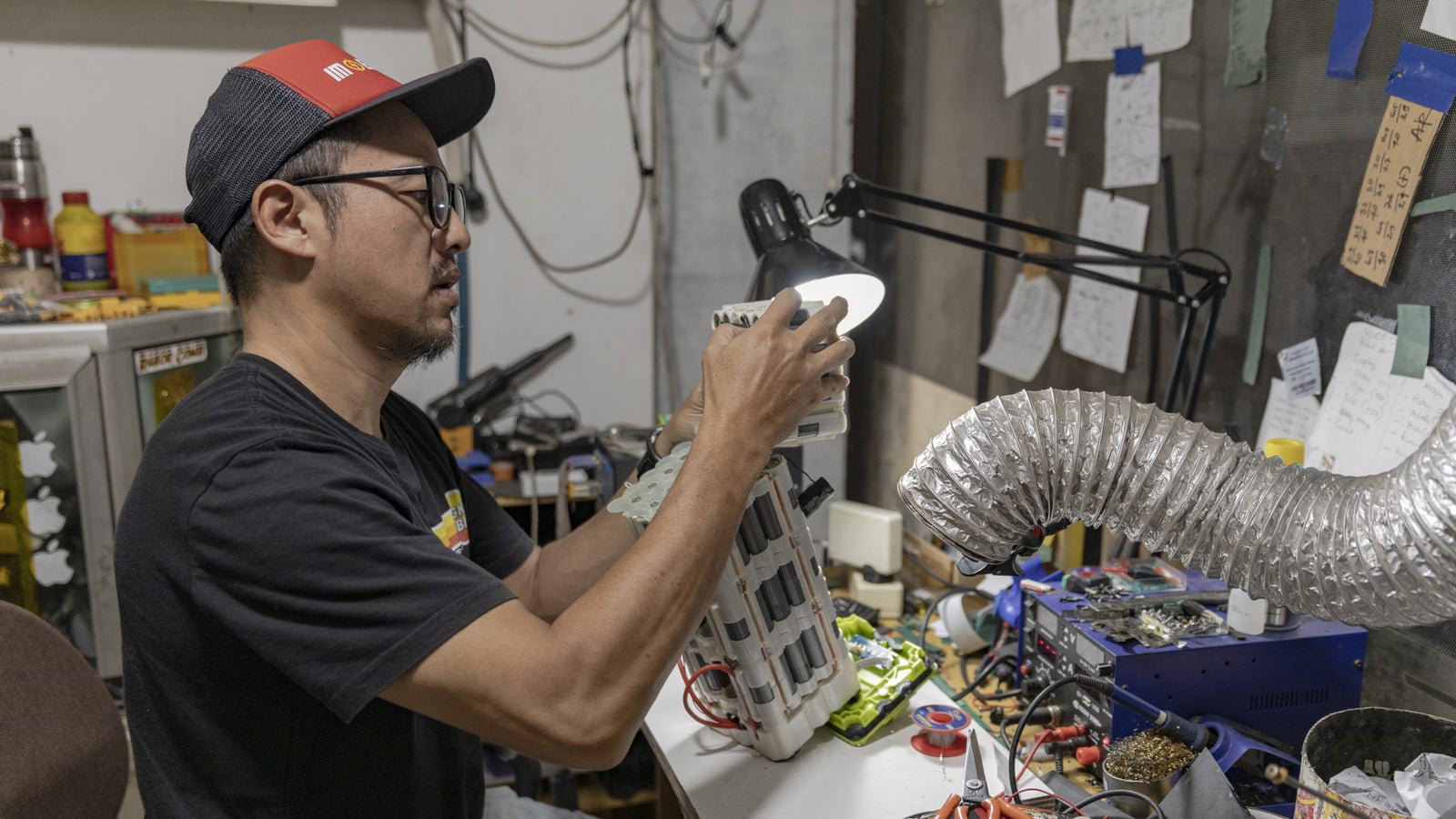
It's hard to tell what those grey cells are being used in the pack, which is probably most important factor, but the construction of it appears solid. It's also evident from photo that he is disassembling a damaged pack. See the missing row of cells at the top, and corrosion on the bottom in this photo: https://149346090.v2.pressablecdn.com/wp-content/uploads/202...
EVE cells are also used in newer Ryobi power tools, it's worth pointing out: https://www.reddit.com/r/ryobi/comments/oxn53g/psa_ryobi_is_...
But you will find articles and sources online referring to them as 1865 cells, like Wikipedia.
"An 18650 battery[1] or 1865 cell[2] is a cylindrical lithium-ion battery common in electronic devices"
https://en.m.wikipedia.org/wiki/18650_battery
I imagine Tesla calling their new battery a 4680 (opposed to a 46800) also leads to this usage.
It seems quite risky even for those that are careful. I recall one of the bigger channels ending up eating humble pie when they had a fire.
Not something I’d ever want to do unless I could house in in an outdoor shed quite far away from everything else
How 'programmable' is the BMS typically? is it arduino programming hard? Can you e.g. shape the charge profile. set the stop point, route around damaged cells? is the BMS field upgradable?
I'm guessing its a commodotized un-upgradable closed solution and you set the params on purchase (alibaba) and its how it works forever.
Yes, it's programmable. Even has eight GPIO pins. It would be "field programmable" in the sense that if you scraped the conformal coating off the pogo pin pads you could reflash it... which you probably don't want to do.
Despite what the article says, a BMS doesn't actually do many of the things you mention. It balances cells, monitors temps, and sets fault flags if something's wrong. A BMS chip does not charge the battery, it doesn't determine max voltage, (the charger does that) and it can't isolate a bad cell. (Because they're all welded together! Pack current doesn't actually pass through the BMS-- it only has thin balancing wires to each cell which can't handle much current.)
Something roughly a liter, liter and a half in size. A standard, perhaps twist connector on the bottom. Various bike configs could incorporate a handful of these in locations that make sense for their bikes — the number of packs reflecting the range or torque requirements.
With a standard you could swap packs, get the cost benefits of scale...
Standardized packs for low-end ebikes would be wonderful.
Not the only ones!
CYC motor kits can take up to 72v, and they don't care about talking to the BMS of the battery, so you can pretty much run any battery.
The final reduction is external, so they sell different chainring sizes. With higher voltage, you get more motor speed, so you can do a bigger reduction for the same power, which means lower motor required torque for the same wheel torque, which gives you efficiency.
I have the 52v setup from them on a full suspension mountain bike, with the 416wh battery, and I have done 30 miles on it with pedal assist and knobby mountain bike tires and basically got the battery down about halfway (im fairly fit and have a higher FTP so I don't require much assist).
If I was to build a setup like in your post, with a big 72v battery taking up the entire front triangle of the bike, and use faster rolling tires, I could either have an ebike that can probably keep up with cars on a highway under throttle, or in the pedal assist mode, do over 100 miles.
However - I bought a ~7,000 e-bike and I love/hate it:
I have an Orbea Rise H30 - and its ~36 lbs. The problem is that the magnets in the motor are always engaged - meaning that even when the bike is 'off' I am fighting against the magnets - and it governs me and when off, no matter how hard I pedal - I cant get about 11 miles an hour.
It is a type 2 - so it is not supposed to boost you passed 20 miles an hour - but instead it effectively governs you to 20 mph. Its very hard to get it much faster - the fastest I have gotten to is 24.5 mph. Downhill.
However - when the battery is powered - its great, except you have to only keep it on BOOST which is the highest of three settings (eco, trail, boost)
I'd not buy this bike again. It range is really around ~30 miles - and they have a range booster battery pack for $600 - and I should have bought that when I had the money to throw at it... but yeah the bike sucks when the battery dies.
It's astonishing how anti-modular various industries are. Even batteries, which for all their "oh no gonna blow" are really quite simple components. But why are cars not modular? How about HVAC? Housing is pretty modular.
In any case, the fault is almost certainly either physical abuse (which has nothing to do with accessibility/modularity) or simply bad chargers (which better access would actually mitigate).
This is very common for DIY ebikes.
I'm not saying it's wrong nowadays to say an 18650 is a battery.
https://en.wikipedia.org/wiki/Artillery_battery
We owe the term to Benjamin Franklin, who used it to describe what you're referring to as a pack (although Leyden jars are considered capacitors rather than batteries in modern terms).
Lithium Ion (and especially LiPo) are not to be trifled with, small things might matter (such as whether the battery is under mechanical stress, dented or bent). I would never want a large battery from a non-reputable supplier around my home.
Slapping together some LiPo? It's just a matter of when, not if.
Recently published very relevant talk by Grin: https://youtu.be/j92Gt4VviSQ?si=0TV_HqZBEBuVDqdx
Otherwise I think these things are super cool, but in the case of lithium ebike batteries, they look so innocent and easy to build, and are so dangerous. I'm speaking from being humbled myself after building two NMC packs with cell-fuses, a spot welder, being careful... I'm dead scared of my packs.
Not really.
LiPo are very dangerous and even NMC which are stabler
LiPo refers to lithium polymer, which doesn't mean a different chemistry. It means "polymer electrolyte instead of a liquid electrolyte".
https://en.wikipedia.org/wiki/Lithium_polymer_battery
are very error prone when assembled in an ebike pack
There are billions of 18650 battery packs out there now in general.
the cells need to be high quality (LG, Panasonic)
No, the cells need have their specs correct and the packs need to be built according to cells' specs.
the BMS needs to be quality (or it'll overheat and cause a fire).
The BMS is there to limit things like discharge voltage, charge voltage, discharge amps, etc. It makes things safer.
Basically in a "tough" environment like ebikes, I think the aging of the pack is much accelerated, which leads to lower mean-time between incidents. Combine that with the profile of the average buyer (wants the cheapest, longest range battery they can get) and it's an even higher probability.
Don't get me wrong, I absolutely love custom DIY packs. It's just way more dangerous than meets the eye, especially in dirty and high vibration environments.
LFP:s are less popular for DYI because you need a much smarter BMS to deal with the flat voltage curve when charging. A cheap, easily available open source LFP BMS should solve that.
The dead giveaway the author has been in the battery industry for a long time is this: > Packers often use 18650 lithium-ion cells — essentially a larger, rechargeable version of a standard flashlight battery.
Then calling a group of people "packers" shows the author wants to label and dehumanize then.
As more battery packs begin to fail this will become the norm.
Off the top of my head Tenergy is one that operates in the states, but there's tons of them out there.
This is just assembling cells, not building a battery from scratch.
their approach does not seem too different from the norm, but it is interesting to see it happen at commercial level. from an economic standpoint, the countries producing commodity cells can stand to benefit a lot from cottage industries like this to increase electric mobility.
Some guy DIY-ing batteries in his shop is pretty much the epitome of "no brand name and QC" though. Seriously, look at some of the pictures in the article. Those botched together mains wires alone look like a fire risk.
Quite apart from the circumstances of their creation, the homemade battery packs themselves can also be quite unsafe as some/most shops use any secondhand cells they can get their hands without regards for discharge ratings etc. That sort of imbalance can easily lead to fires during use, which is obviously not great when the driver is in busy traffic at the time.
I am only pointing out that I would be concerned regardless of the source, chinese or local but suspect the local guy has a greater incentive to maintain his brand than the imported brand from china.
I'm guessing you haven't been to Indonesia. This style of wiring is common in businesses and homes in Indonesia, Thailand and lot of poorer asian countries. The regulations are weak or unenforced. Often unlicensed people build houses, run power, water etc.
It's (probably unintentionally) dishonest to judge this by a first world standard.
There is nothing inherently unsafe with bolting power strip onto the wall.
> Quite apart from the circumstances of their creation, the homemade battery packs themselves can also be quite unsafe as some/most shops use any secondhand cells they can get their hands without regards for discharge ratings etc. That sort of imbalance can easily lead to fires during use, which is obviously not great when the driver is in busy traffic at the time.
Not reading the article before yapping your mouth eh ?
> Ady Siswanto, owner of e-bike workshop Dyvolt in Jakarta, told Rest of World he takes care to match the internal resistance and capacity of the cells.
Most of the "serial DIYes" know that just fine, as it is blindingly obvious in performance of batteries and if you're making it a business you'd not have many returning customers... except ones returning for a return.
And let's not pretend name-brand packs don't have "accidents"
You do realise that China makes some of the worlds best batteries right?
There is a reason why BYD, EVE and CATL are in the news all the time and it's not because they suck.
Quality wise Chinese/Korean/Japanese batteries are all pretty much the same on NCA/NCM chemistries. China has a big advantage in LFP but LFP is shitty for an e-bike because the reduced density penalty is much more meaningful than in a car.
Those companies make cells of course but there is also plenty of high quality BMS available and fully assembled batteries out of China too obviously.
So yes, Chinese ebike batteries are on a whole of low quality.
No. There is just a handful of companies producing cells at reasonable scale and cost. Pretty much every cell you can buy from Alibaba (which is almost certainly where these e-bike pack makers are buying from) come from just 7 companies: CATL, BYD, EVE, CALB, Gotion, Sunwoda and Farasis.
All of these companies make high quality cells and these are definitely the only ones with a good enough price/performance to shove in a hand-made e-bike pack and make a profit.
This notion that Chinese batteries are somehow bad is ludicrous and the lengths people go to state as fact something they clearly have no experience with is intellectual dishonesty at best.