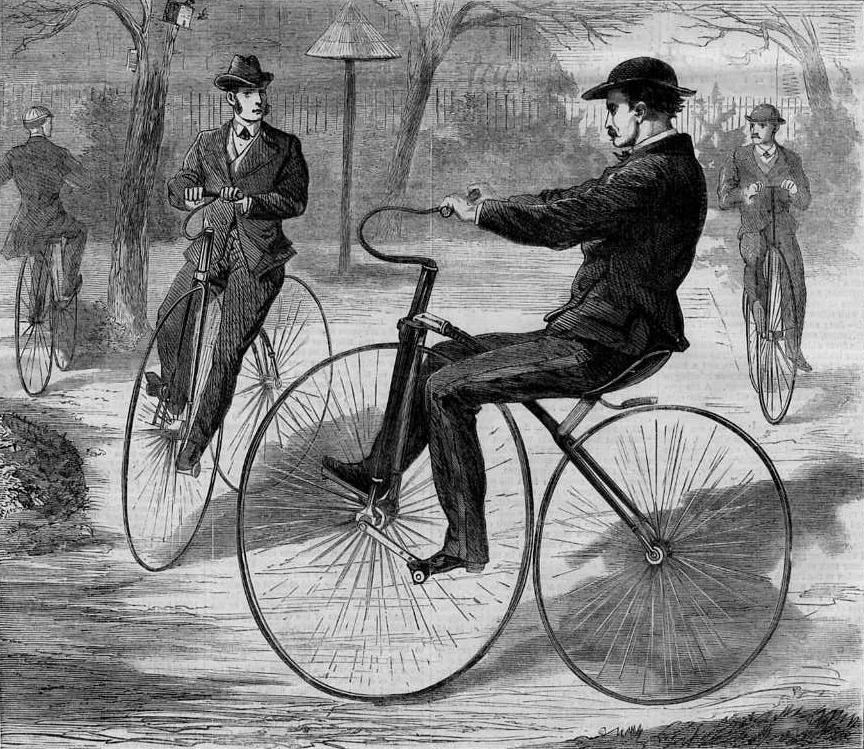
Why did we wait so long for the bicycle?
The bicycle, as we know it today, was not invented until the late 1800s. Here are some theories about why
The Roots of Progress
204 points · by onychomys · 2y ago · 237 comments
The primary means of transportation was not horse, but feet. You could walk to a destination on the other side of an average city of those times in 15 minutes, so a bike wouldn't bring big gains in time.
Only in 2nd half of 19th century, cities began growing, and transportation became a problem.
See perhaps:
> Marchetti's constant is the average time spent by a person for commuting each day. Its value is approximately one hour, or half an hour for a one-way trip. It is named after Italian physicist Cesare Marchetti, though Marchetti himself attributed the "one hour" finding to transportation analyst and engineer Yacov Zahavi.[1]
* https://en.wikipedia.org/wiki/Marchetti%27s_constant
* https://archive.is/edypl / https://www.bloomberg.com/news/features/2019-08-29/the-commu...
I felt a fairly strong _compulsion_ to do that. Marchetti might be onto something...
In the US it is 28 minutes:
* https://www.census.gov/newsroom/press-releases/2021/one-way-...
* https://www.titlemax.com/discovery-center/money-finance__tra...
I know there are reasons they didn't have bicycles, but I don't think "going by feet is equally good" is one of those reasons.
"Regularly" may have been once a week (e.g., Lord's Day / Sunday). Otherwise people lived either in villages themselves, or in hamlets (collective security at night) and 'commuted' to their fields. Or on-site of the land owner if they were workers (earlier: serfs).
Living on a farmstead wasn't really a thing until relatively recently in history.
Also villages, churches, manors, inns, markets, blacksmiths, and all the other necessary infrastructure was rarely more than 1 hour on foot away.
In my country there's 1 church per 30 km2, that's on average 6km between churches which is roughly 1 hour on foot.
Serfdom declined over time in western Europe and had largely disappeared by the end of the middle ages. So it does not explain why western Europeans not invent the bicycle in that period that was at least a few centuries, sometimes longer - 800 years in some places!
* The Industrial Revolution increased the number of people with disposable income. The potential market for a new thing was seen as much larger post Industrial Revolution.
* Inventing was seen as a much more profitable venture with the possibility of manufacturing behind it. There was a wave of entrepreneurs on the latest hype cycle.
* Urbanization helped spread ideas faster. The trains helped connect distant people. Part of the marketing of bicycles is seeing people ride them on the street. Busier streets with more visitors only help spread the word.
* Previous levels of material sciences limited the quality of the bike
A good book on increasing precision in history, The Perfectionists: How Precision Engineers Created the Modern World:
> The rise of manufacturing could not have happened without an attention to precision. At the dawn of the Industrial Revolution in eighteenth-century England, standards of measurement were established, giving way to the development of machine tools—machines that make machines. Eventually, the application of precision tools and methods resulted in the creation and mass production of items from guns and glass to mirrors, lenses, and cameras—and eventually gave way to further breakthroughs, including gene splicing, microchips, and the Hadron Collider.
> Simon Winchester takes us back to origins of the Industrial Age, to England where he introduces the scientific minds that helped usher in modern production: John Wilkinson, Henry Maudslay, Joseph Bramah, Jesse Ramsden, and Joseph Whitworth. It was Thomas Jefferson who later exported their discoveries to the fledgling United States, setting the nation on its course to become a manufacturing titan. Winchester moves forward through time, to today’s cutting-edge developments occurring around the world, from America to Western Europe to Asia.
> As he introduces the minds and methods that have changed the modern world, Winchester explores fundamental questions. Why is precision important? What are the different tools we use to measure it? Who has invented and perfected it? Has the pursuit of the ultra-precise in so many facets of human life blinded us to other things of equal value, such as an appreciation for the age-old traditions of craftsmanship, art, and high culture? Are we missing something that reflects the world as it is, rather than the world as we think we would wish it to be? And can the precise and the natural co-exist in society
Now if you’re trying to save every last ounce and someone else is paying for the bike, sure go carbon, but the vast majority of people are not even at the fitness level to really “need” a carbon bike.
just want to point out that a high fitness level allows you to get more out of heavy bicycles. Any couch potato prefers carbon.
Steel framed bicycles are good enough for the vast majority. I fear bike manufacturers are switching to less repairable materials and proprietary parts to increase profits.
Is the frame really an issue though? I don't aluminum frames break that often, I'd bet that's probably one of the least common problem for modern bikes (gears, brakes, suspension etc. are way more fragile). Most bikes are likely to be discarded way before the frame would need to be repaired. It seems totally like a red herring to me..
> Steel framed bicycles are good enough for the vast majority
Well most people don't seem to agree. There are still plenty of steel bikes available, even relatively high-end ones, they are just not that popular.
Alloy, titanium and carbon fiber are lighter and that's what most consumers want, having watched Tour de France and bicycle industry marketing materials. Big brands facing increased competition from Asia started to put carbon frames of questionable quality on the market, so if you want an okay bike you are best served by alloy, because they're mass produced and the process is quite optimized and well understood. Titanium is basically unrepairable without special tooling and know how and it feels basically the same as alloy. It's stronger and more corrosion resistant.
The bike industry also puts a lot of new or proprietary standards on the market, especially when it comes to bottom backets. Other new standards include different fork spacing, head tube diameters, rear suspension couplers, proprietary frame integrated suspension and more recently integrated e-bike batteries. The worst offensers are Cannondale, Specialized, Trek and Cervelo.
If you want a bike with sensible standards you want a BSA threaded bottom bracket if it's a metal frame or BB86/92 press fit if it's a carbon frame, a fork with a 1 1/8" steerer or tappered from 1 1/8" to 1 1/2" steerer if it's a mountain bike or a high end road bike, a 34 mm or a 44 mm head tube, 135 mm O.L.D. rear and 100 mm front fork spacing for quick release skewers or 148 mm/110 mm boost spacing if it's a newer mountain bike or 142 mm/100 mm spacing if it's a newer road bike with thru axles, a seat post diameter of 27.2 if it's a road bike or 31.6 mm if it's a newer mountian bike. For brake mounts I prefer IS brake mounts because they're robust, don't have threads to cross thread and misalignment issues are not common, but modern road bikes come with the flat mount (FM) standard and newer alloy MTBs come with post mount (PM). What you probably don't want is a mountain bike with flat mount brakes, funny axle standards, direct derailleur mounts, integrated seat posts, integrated cockpits, full internal routing, lefty forks, integrated frame suspension and so on.
>> I fear bike manufacturers are switching to less repairable materials and proprietary parts to increase profits.
So I kinda disagree, there is greater interoperability in bikes now than there ever was(imho). Many SRAM parts can be used with Shimano parts and vice versa, nearly everything is still easily disassemblable and repairable by someone with a work stand and a set of tools.
The biggest "threat" to bike repairability is unfortunately electrification - motors and batteries are essentially black boxes that while repairable(nearly all ebike motors are right now) the skill level to do so is significantly higher. And batteries are of course disposable, no one repairs them as far as I know. Which is a shame because buying an ebike has been completely transformative for me with MTB as a hobby - it removed some mental barriers for going out on my bike out of fear I'll get too tired to continue, with an ebike I go much more often and ride for longer and further. But while I can do 90% of the maintenance on it myself(and I think anyone can with a bit of spare time), if the motor goes I'll have to rely on a third party to fix it.
It's neither more durable or lighter than frames made of aluminium, titanium or carbon fibre.
For example, a typical frame made of steel will generally be about 1kg heavier than one made of carbon. The forks will 500g heavier. If you scratch or chip the paint steel will corrode.
The claims that steel (or titanium) "feels" better than aluminium or carbon fibre have been thoroughly debunked.
The Young's Modulus of steel tubes used in bike frames ends up almost exactly the same as aluminium or titanium and steel has no "magic" vibration absorbing qualities.
Carbon fibre is the only frame material with any real vibration damping and even that is massively over-hyped compared to an actual shock absorber or even bigger tyres.
If you want to choose a steel frame then it should be because you like the look, it's easy to weld, uses less energy to make or it's cheaper.
I don't think it's obvious that putting a human on a long, two-wheeled vehicle will make it more stable than that vehicle is on its own. I think it's also not obvious that most humans can quite easily and quickly learn how to balance a bicycle.
(This is actually true of bicycles, for a similar reason: like a single wheel, they steer in the direction of a fall, and that counteracts the fall, because if you steer left, you fall right and vice versa.)
The possibility that a two-wheeled vehicle could be stable when moving should have manifested itself to some of the brightest minds in European science as far back as at least the Renaissance.
we like to think how amazing the wheel is, but ... what's amazing is a road network. and what's ridiculous is that some empires spent their might on making flat slabs and putting them in a big pile, while others used some of theirs to make roads, but it took so many years to combine the two :)
and that's why railroads appeared before bicycles basically.
oh, and see also one of the earliest known built road things: https://en.wikipedia.org/wiki/Sweet_Track#/media/File:Sweet_... it's about 5800 years old!
Bicycles and bicyclists came first, then the better roads.
https://www.theguardian.com/environment/bike-blog/2011/aug/1...
> The hard, flat road surfaces we take for granted are relatively new. Asphalt surfaces weren't widespread until the 1930s. So, are motorists to thank for this smoothness?
> No. The improvement of roads was first lobbied for – and paid for – by cycling organisations.
Good roads are important to cycling, obviously, and to cycling becoming popular, but lack of smooth roads didn't impede the development of the bicycle. Rather, lack of bicycles impeded the development of smooth roads!
What people did try to make work was a four-wheeled cart, which I think is in line with a tricycle. I also agree there were other factors - I think there is no single answer to this question, but rather a constellation of factors. My claim is that I believe it reasonable to include people's lack of imagination that two-wheels could work in that list of factors.
Found one picture https://www.google.com/search?q=1860+tricycles&oq=1860+tricy...
I bet a bicycle using 1700s tech would be horribly expensive considering the GDP per capita too. Not having rubber tires would make them dangerous as heck too. Traction is a huge factor in vehicles that aren't animal drawn. A horse/ox/human provides a ton of traction and stability to a vehicle when they pull it.
83% of horseback riders are injured while riding. It's literally an extreme sport more dangerous than skiing or motorcycle racing. It boggles my mind to see riders without helmets or other protective gear.
None of the early designs seemed to have any brakes, making them quite impractical.
Without modern steel and machined parts, a bicycle of wood and iron would simply be too heavy.
None of them were freehub designs, so you could always backpedal to slow down. It's definitely more work than a real brake, but it's not nothing.
The penny-farthing was a direct drive on the front wheel - no chain. It had you positioned on top of the wheel to get as much traction as possible.
A primitive recumbent trike would tend towards the same design, like a child's trike, with no chain and a direct drive on the front wheel.
And because you'd get terrible traction, with so little weight, you'd be dead in the water until the machining was available to engineer a chain system to connect pedals in front of the cyclist with wheels underneath. I don't think there's any penny-and-two-farthings intermediate to make the recumbent trike work before that.
I’d go so far as to say no cyclist understands. AFAIK there’s no simple physical explanation.
As you can see from the simulation, this is a multibody dynamics problem. The bicycle and human have lots of moving parts, and as they move there are forces in 3D [2] amongst them. So there can't really be a simplified, short and mostly complete English explanation (like for why planets go around the sun). That doesn't mean we can't predict.
[1] https://www.comsol.com/blogs/simulating-the-motion-of-a-self...
[2] i.e. you can't find a 2D plane in which all forces act.
> Their study shows that there isn’t one simple reason for this phenomenon. A combination of factors, including gyroscopic and caster effects, bicycle geometry, speed, and mass distribution come into play to keep an uncontrolled bicycle upright.
I think we’re saying the same thing. There is no simple physical explanation that humans can intuitively understand, because the interaction of forces is so complex. I’m not claiming that it’s a mystery causing fundamental problems for physics.
There is no mention of air resistance at all. Does it play a role in (de)stabilizing the vehicle in higher speeds? Would a bicycle work as well in, say, lunar vacuum (I imagine that it would be hard to pedal in spacesuit, but let's assume a spherical cow and a lunar bicyclist in normal clothes). Would a lunar bicycle be more stable at lower speeds because of the lower gravity on the Moon?
When I started riding motorcycles, I bought a well-known motorcycling book. It had a whole chapter on countersteering because there are even today many seasoned motorcyclists who don't believe or understand that you turn using countersteering.
The actual question is "Why, when you give a bicycle a good shove, does it stay upright on its own, continually changing its direction to balance itself?"
Back when I used to do my commute with e-scooters, indicating my direction was a real pita and, most of the time, totally impossible. In fact I used to use the sidewalk and pedestrian crossings if I needed to go left through the traffic.
Understanding the physics is not a requirement to operate the vehicle.
The rider turns the bike by moving the handle bars slightly in the opposite direction he wants to turn. Then the bike falls in the direction he wants to turn, and the handle bars are then rotated in that direction. To straighten out, the handle bars turn a little tighter, and the centrifugal force of the turn pushes the bike back upright.
Definitive explanation? Yes - to a significant degree of definitive. As with all science/engineering-understanding there are always further details but this we've got pretty well down at the macro level humans operate at.
A site beloved by HN to explain this: https://ciechanow.ski/bicycle/
A beautiful site, check out the archives for other explanations and animations of things too.
There's more to it than just Newtonian mechanics.
Also, horses are the original self-driving transportation, and anyone with the means to buy some newfangled technology like the early bicycle. It's been a hundred years and we're still not better in that regard than the finest of equine hybrid technology, so can you imagine the landed gentry giving that up to... Exert themselves to travel to town?
(Queue 'bicycle as feminist icon' comments below)
Landed gentry often love showing off their wealth in ecentric ways, so yes i could imagine that.
It’s cool that the bike movement had a role in building roads. And that a political movement can drive technological change.
Romans had roads thousands of years before trains were invented. They had "things on wheels" too: horse-pulled (or human pulled) carriage.
https://en.wikipedia.org/wiki/Roman_roads
FWIW there are many places in Europe where pedestrian, bicycles, cars and whatnots are still using these very same roads, made of pavement, the exact same way romans were building it. I use these in the old city center nearly daily.
In the US some roads were built in the early days, but canals and later the railroad had enough advantages over road transport (both can haul far more bulk) that for most roads were not worth building and the dirt track was fine. Towns would build roads in town because mud was annoying enough, but farmers (the majority of the population) didn't travel often enough that the cost (labor) to build a road was worth it - they just stayed on the farm when it rained.
The Roman made some decent roads, but only in some parts of the world and only a comparatively few.
When bicycles were young, train travel was the norm.
Without an appropriate surface, such as a road, wheels are a pretty bad mean of locomotion.
You never rode on dirt roads before? Sure, it's not as efficient as on pavement and you can't use road tires, but it's still much more efficient than walking.
The wikipedia article states that they date back to only the 1970s, but there does not appear to be any technology reason why they couldn't long pre-date that, and they apparently work well on dirt roads that have probably been around for a long time.
One article [2] claims they have been used "for centuries" but a quick Google did not find any evidence to back that up, but it does seem plausible.
[1] https://en.wikipedia.org/wiki/Chukudu#:~:text=5%20External%2....
[2] https://oneminutexplore.com/the-chukudu-a-timeless-marvel-ma...
(The medieval wheel was powered by extreme amounts of lubrication.)
Theoretically, a two-wheeled transportation contraption could have been made, but having to carry the grease with you would make it pointless.
https://onlinebicyclemuseum.co.uk/wp-content/uploads/2014/05...
The idea of moving a burden or a person around using a wheel and human power (no animals) was around for centuries.
The Wright Bros invented the directed research and development program, where:
1. the problems were identified
2. each problem was solved as a separate effort
3. the solutions were combined into a final working project
This has been followed ever since. The race to the moon program is probably the finest example of its implementation.
In an agricultural area? How would that work?
Before that, most farms were run by a family group and the farmhouses were typically within a couple miles of a community center which provided access to a church, school, store/market, inn/tavern, etc. (There were self-sufficient estates and plantations but they seem to be more the exception than the rule.)
For example, the town I live in now was founded more than 250 years ago when the families (mostly farmers) who lived at the outer fringe of their town got tired of having to walk 2+ miles to church and school. So they petitioned the government to split off and then built their own church and school.
https://onlinebicyclemuseum.co.uk/wp-content/uploads/2014/05...
Only by the 1860s the fast iteration of bicycles (together with substantial innovations in machine production) started and then went hand in hand with cars and motorcycles.
Some huge innovations after the safety bicycle were the derailleurs which continued to be iterated upon well after WW2, when the bicycle as we know it was finished.
The bicycle is not simple or obvious at all.
The uniform, smaller size of safety bike wheels also enabled adoption of pneumatic tires.
Why did we wait so long for the bicycle? (2019) - https://news.ycombinator.com/item?id=25331858 - Dec 2020 (83 comments)
Why did we wait so long for the bicycle? - https://news.ycombinator.com/item?id=20443822 - July 2019 (492 comments)
When you are moving, it adds in the gyroscopic balancing effect.
Gyroscopic motion means that the force applied acts about 90 degrees later, so when you turn the handlebars which are on a (roughly) vertical axis (call it the "z" axis), the force of that turn is actually applied about the axis that runs from front to back (call it the "y" axis). Gyroscopes "translate" the force.
If you're stationary, and there is no gyroscopic motion, then the only thing that turning the wheel really does is allow you to move the front of the bike to the left or right in order to change your centre of gravity.
It may play a part in the effect, but does not explain it entirely.
Just by having a lot of people on bicycles instead in closed cars, it creates a whole different society then if everyone would be in cars and I love it.
Q: "Why didn't they just use solar cells to power their cars instead of using gasoline?"
A: "They had almost unlimited access to an energy-dense fuel called petroleum they mined from the earth."
My point is we can imagine many technologies that would serve our needs with much less energy use.
https://rootsofprogress.org/why-did-we-wait-so-long-for-the-....
One rule of thumb seems to be that a new technology needs to be not merely better but ten times better than the alternative(s) for it to go viral. For instance, James Dyson built a washing machine with twin contrarotating drums. It was significantly better than conventional machines, but not ten times better when all costs were accounted for, e.g. the increased price and its unconventional larger size.
Dyson's gadgets which really were significantly better than the contemporary competition tended to succeed, despite a cost premium. Notably the vacuum cleaners, of course.
Look up Henry Leland and the progress made in metrology, and look at the time period he worked in.
How much variance can you have in a bike chain and still have a bike worth using?
I think that would make a VERY good interactive museum experience.
Bicycles are murder on bad roads. You could invent them earlier but probably not convince anybody to ride them?
[0] https://en.wikipedia.org/wiki/Roads_Improvement_Association
I mean this is true with a modern bike, but a primitive bike with wooden wheels, no spokes, no gears, no suspension and questionable brakes would be pretty awful on a trail.
And people tend to forget rain and hence mud when it comes to the state of pre-modern roads, there's no way one could have ridden a bicycle through a lot of mud and rain puddles. Being high up there in a horse-driven coach meant that you were also avoiding all that mud hassle.
Even dropper seat posts are a useful recent innovation IMHO.
Droppers are overrated (for me). Disk brakes are awesome. Bike weight (for mountain bikes) has probably gone up in the last 30 years. One by shifting is nice and the new front chainrings that keep chains on are cool.
- foldables: they're a real game changer regarding where bikes fit and where they can go. Designs also tremendously improved and the cycling performance is really good nowadays.
- electric assist: it's not just adding a motor, a lot of work has happened to make the better of the it, and cargo bikes have become widespread mostly because of this.
Not sure why the article starts off with an incorrect hypothesis. There is evidence of bicycles in the sculptures in at least one Indian / Hindu temple Southern India. The temple dedicated to "Panchavarna Swamy" - 5 colored god, was built at least 1500 years old. (dated to the early 7th century by historians)
Photo of the bicycle in the temple: https://imgur.com/a/M1ZAUFf
https://www.snopes.com/fact-check/bicycle-2000-year-old-temp...