Sega Saturn Architecture | A Practical Analysis
An in-depth analysis that explains how this console works internally
The Copetti site
327 points · by StefanBatory · 2y ago · 231 comments
You end up with a 2D console with parts and bits of an unfinished 3D console inside it. It makes no sense.
For a tech enthousiast and someone who loves reading dev postmortem, it's glorious. For someone who likes a clean design, it's irksome to no ends. For mass gamers of that era, where the big thing was "arcade in your living room" it's a disapointement, and SEGA not knowing which side to focus on didn't help at all.
The wikipedia article has a lot more details [1]
The actual result of Sega's infighting was far more stupid IMO. Sega of America wanted a more conservative design than the Saturn using a Motorola 68020 (successor to the 68000 in the Genesis) which would have lower performance, but developers would be more familiar with the hardware. After they lost this fight, they deemed the Saturn impossible to sell in the US due to its high price. SOA then designed the 32X, a $200 add-on to the Genesis that used the same SH2 processors as the Saturn but drew graphics entirely in software and overlayed them on top of the Genesis graphics. The initial plan was that the Saturn would remain exclusively in Japan for 2-3 years while the 32X would sell overseas. Sega of America spent a ton of money trying to build interest for the 32X and focused their internal development exclusively on the 32X. However, both developers and the media were completely uninterested in it compared to the Saturn. After it became evident that the 32X wouldn't hold the market, Sega of America rushed the Saturn to market to draw attention away from the 32X, but had to rely exclusively on Japanese titles (many of which didn't fit the American market) because they'd spent the past year developing 32X titles (the 32X had more cancelled games than released ones). All of this ended up confusing and pissing off developers and consumers.
> I think his biggest mistake was that he underestimated how quickly the industry would switch to mainly focusing on 3D.
I think his mistake was a bit more subtle than that. Because he didn't have any experience in 3D or anyone to ask for help, he didn't know which features were important and which features could be ignored. And he ended up missing roughly two important features that would have bought the Saturn upto the standard of "workable 3D".
The quads weren't even that big of a problem. Even if the industry did standardise on triangles for 3D hardware, a lot of the artist pipelines sick with quads as much as possible.
The first missing feature is texture mapping. Basically the ability to pass in uv coordinates for each vertex (or even just a single uv offset and some slopes for the whole quad). The lack of texture mapping made it very hard to export or convert 3D models from other consoles. Instead, artists had to create new models where each quad always maps to an 8x8 texel quad of pixels.
The second missing feature is alpha blending, or semitransparent quads. The Saturn did support half-transparency, but it only worked for non-distorted sprites, and you really want more options than just 50% or 100%.
With those two features, I think the Saturn would have been a workable 3D console. Still not as good as the playstation, but probably good enough for Sega to stand its ground until the Dreamcast launched.
> The first missing feature is texture mapping. Basically the ability to pass in uv coordinates for each vertex.
These two situations are fundamentally related. Most 3D rasterizers including the Playstation use inverse texture mapping, iterating over framebuffer pixels to find texels to sample. The Saturn uses forward texture mapping, iterating over the texels and drawing them to their corresponding framebuffer pixels.
The choice to use forward mapping has some key design consequences. It isn't practical to implement UV mapping using forward mapping, and quads are also become a more natural primitive to use.
> The second missing feature is alpha blending, or semitransparent quads. The Saturn did support half-transparency, but it only worked for non-distorted sprites, and you really want more options than just 50% or 100%.
I don't consider this to be a significant problem. The checkerboard mesh feature provides a workable pseudo-half-transparent effect, especially with the blurry analog video signals used at the time.
Side note but forward mapping is also the reason why half-transparency does not work for distorted sprites. Forward mapping means that the same pixel may be overdrawn. If a half-transparent pixel is blended twice, the result is a corrupt pixel.
VDP2 can also provide half-transparent effects in various circumstances - this video provides a comprehensive look at various methods which were used to deliver this effect.
AFAIK the problems lie in things like clipping/collision detection. Now that you have four points instead of three, there is no guarantee that the polygon is a flat surface.
People beat Sega up back then, and also now, but I do not think their hardware was that bad. The pricing was a huge issue.
If I were them, I would have NOT released the 32X as a standalone, NOT released the Saturn, and instead focus on a fusion of the two into a standalone cartridge based system. For everything people criticized the Saturn for, the cartridges made it work. The N64 showed off the advantage of using a cartridge over a CD based system.
If I were going to release a non-portable gaming system today, I'd build one around cartridges that are PCIE 5.0 x4 based and design it so that a) you can quickly shut off the system and replace the game rather than digging through ads/clunky ui/launcher. b) access and latency times are fast c) the hardware is potentially extendable in many different ways.
However, I actually liked the 32x and it's games. Maybe that is because I got the 32x on clearance at walmart for $10 and the games for $1-$2 each, or maybe it was because many of the games were fun and were a genuine upgrade over my 16 bit systems.
I don't think the Saturn was bad, but it was overpriced for the time and definitely rushed.
I DO think this rush to make consoles require an internet connection has left a sizable hole in the market, a hole that nintendo is only half filling. Offline gaming is a thing, and just because a console CAN be connected to the internet, doesn't mean it should be. I've been fantasizing about making one in the future. Something that is kind of like the old Steam Machine, but with the aspects I have mentioned. Maybe one day I will. For me it won't be about success, but rather about building something cool.
Anyways, I'm rambling. Have a great night.
sega was a dysfunctional business reacting to fickle changes in the market (32x was a response to the Atari Jaguar lol).
probably as they didn't have the strong cash reserves of a nintendo, sony or microsoft.
but ultimately i think they were an arcade business and the transition from arcade to home killed them. the same as snk/neo geo.
I was on team N and I was always confused by the weird accessories of the Genesis, and the 32X’s timing always was one of the most confusing bits, but I’d never actually looked into it.
Unfortunately the combination of the 32X mistake plus the rushed Saturn launch just annoyed all partners, retail and development. It’s likely a big reason the Dreamcast did so poorly.
It was a nice system but Sega was already on their back foot, not many people trusted them, and piracy was way too easy. Their partner in MS wasn’t helpful. And then the PS2 was coming…
Namely, lean in hard on 32X for about a year or two to try and slow demand for Ps1 with cheaper hardware. Release the Neptune (Genesis with inbuilt 32x). They then take up Panasonics deal and use the M2 platform to be the Saturn. Release that in 1997 with specs far beyond Ps1/N64.
Neat idea but this is all just fantasy stuff at this point.
It's hard to really nail down without knowing about chip prices in the day, but my thinking was to wait on the Sega CD until 92 or 93, include a DSP or two for basic 3D operations (like the Sega Virtua Processor in Virtua Racing) and market the CD as allowing for cheaper, bigger games instead of FMV garbage.
Then release the Saturn in 95 as an upgraded version of the same architecture akin to the SMD/Gen being based on the SMS. Add a newer CPU (SH-3 or PowerPC 603), use an upgraded SMD's graphics chip for 2D (like VDP2 on the Saturn), the 68K for audio, and whatever 3D silicon Sega had developed (probably still quads)
If this was financially / technically possible, it would have staved off Sega's fear about the SMD/Gen falling behind the SNES in 92-95, allowed backwards compatibility, and been less jank to develop for.
I think consumers were def skeptical of the 32X despite the marketing, and that was the main thing, in addition to an unimpressive library. Magazine coverage was decent but Gamepro in particular was very negative toward it. Like, Chaotix sucks but the music is amazing, and Gamepro not only trashed the game but gave even the music low marks because "no 32X audio is apparent" lol.
The fact that the Saturn was harder to develop for, had a smaller market share and Sony were paying studios to release on the PlayStation, it’s no wonder Sony won the console wars that generation.
interesting. i always thought this was an order from SOJ.
It's commonly cited that VDP2 was added later to give it 3D support. But VDP2 doesn't do 3D at all, it's responsible for the SNES "mode 7" style background layers. If you remove VDP2 (and ignore the fact that VDP is responsible for video scanout) then the resulting console can still do both 3D just fine (Many 3D games leave VDP2 almost completely unused). 2D game would take a bit of a quality hit as they would have to render the background with hundreds of sprites.
If you instead removed VDP1, then all you have left are VDP2's 2D background layers. You don't have 3D and you can't put any sprites on the screen so it's basically useless at 2D games too.
As far as I can tell, the Saturn was always meant to have both VDP1 and VDP2. They were designed together to work in tandem. And I think the intention (from SEGA JP) was always for the design be a 2D powerhouse with some limited 3D capabilities, as we saw on the final design.
I'm not saying there wasn't arguments between SEGA JP and SEGA US. There seems to be plenty of evidence of that. But I don't think they munged the JP and US designs together at the last moment. And the PSX can't have had any influence on the argument, as the Saturn beat the PSX to market in Japan by 12 days.
And if you read the interview that ndiddy linked above (https://mdshock.com/2020/06/16/hideki-sato-discussing-the-se...), it might be accurate to say the Saturn design is what you get when an engineer with no background in 3D graphics (and unable to steal sufficient 3D graphics experience from the Sega Arcade division) attempts to create a cost-optimised Model 2.
I suspect the first pass was just a cost-optimised textured quad renderer, then Sato went back to his 2D graphics experience and extended it into a powerful 2D design.
While this is true, I still think that the PlayStation had the most interesting and forwarding looking design of its generation, especially considering the constraints. The design is significantly cheaper than both Saturn and Nintendo 64, it was fully 3D (compared to Saturn for example), using CD as media was spot-on and also having the MJPEG decoder (that allowed PlayStation to have not only significantly higher video quality than its rivals, but also allowed video to be used for backgrounds for much better quality graphics, see for example Resident Evil or Final Fantasy series).
I really wanted to see a design inspired in the first PlayStation with more memory (since the low memory compared to its rivals was an issue it seemed, especially in e.g.: 2D fighting games where the amount of animations had to be cut a lot compared to Saturn) and maybe some more hardware accelators to help fix some of the issues that plagued the platform.
The N64 is really far beyond the other two in terms of being "fully 3D", with it's fully perspective correct z buffering and texture mapping, let alone mipmapping with bilinear blending and subpixel correct rasterization.
    This should have been no struggle for Sega. They basically
    invented the modern 3D game and dominated in the arcade with
    very advanced 3D games at the time
The Model 2 arcade hardware cost over $15,000 when new in 1993. Look at those Model 1 and Model 2, that's some serious silicon. Multiple layers of PCB stacked with chips. The texture mapping chips were from partnerships with Lockheed Martin and GE. There was no home market for 3D accelerators yet; the only companies doing it were folks creating graphics chips for military training use and high end CAD work.
https://sega.fandom.com/wiki/Sega_Model_2
https://segaretro.org/Sega_Model_1
Contrast that with the Saturn. Instead of a $15,000 price target they had to design something that they could sell for $399 and wouldn't consume a kilowatt of power.
Although, in the end, I think the main hurdle was a failure to predict the 3D revolution that Playstation ushered in.
Nintendo managed largely not-janky graphics with the N64, but it did come out 2-3 years after the Saturn and Playstation.
By the way, I'm always open to criticism ! (https://github.com/flipacholas/Architecture-of-consoles/issu...)
The RDP could rasterize hundreds of thousands of triangles a second but as soon as you put any texture or shading on them, the memory accesses slowed you right down. UMA plus high latency memory was the wrong move.
In fact, in many situations you can "de-optimize" the rendering to draw and redraw more, as long as it uses less memory bandwidth, and end up with a higher FPS in your game.
I think you can play Rogue Squadron with and without if you want to compare.
Or do youe mean some lower cache level?
One exception to this is the shmup genre. The Saturn was inundated with Japanese Shmups and many are perfect (or near perfect) arcade ports.
Edit (answered): "Why is PlayStation called PSX? Wishing to distance the project from the failed enterprise with Nintendo, Sony initially branded the PlayStation the "PlayStation X" (PSX)."
[0] https://en.wikipedia.org/wiki/PSX_(digital_video_recorder)
Many people said that ultimately it was hard for companies to justify the investment in learning it all to make games that fully utilize the hardware. Somehow this reminds me of Sid Meier's saying that the player must have fun, not the game developer - and in this case, perhaps the hardware designers were having too much fun!
Then the generation after everyone had a Playstation, and I knew of only one kid who ended up with the Saturn. It's so strange considering that the Saturn was released several months ahead of the Playstation here.
I dont't know if it was due to the Saturn being seen as the inferior option at the time, pricing, availability or some other factor, but the Playstation absolutely killed it. After that Sega was gone.
Sega has always floundered with its home consoles — they released 3 competitors to the NES after all. Genesis ended up being more of a one-trick pony than any indication of longterm success.
Ironically, it went the opposite way for the Saturn. It was pretty successful in Japan (slightly ahead of the N64) but a complete failure elsewhere.
A lot of diehards (like me) felt really burned by those failures.
NES, Genesis, PSX/N64, PS2/XBOX, PS3/XBOX360, XboxOne.
I was fanatic about Genesis because of the big title games like Mortal Kombat, Sonic, etc.
I VORACIOUSLY read gaming mags and the hype around the PSX was massive. It utterly dwarfed Sega. And seeing the first image of Cloud starting up at the Shinra tower captivated me. The games they were touting were just incredible looking.
I was just a kid and marketing won me over.
As always bad console sales resulted in a vicious cycle of fewer attention from 3rd-party devs resulting in even fewer console sales.
IIRC it was not that, the Saturn was the most expensive to manufacture of the big three, and the need to price match the PS made it a financial disaster for Sega.
This gave the 3D Sega Saturn games a more boxy look than PS1 counterparts. Comparing Resident Evil on Saturn and PS1 is a good side by side to see the difference. The overall result is that Sega Saturn games have a unique aesthetic in 90s 3D gaming.
It's also worth highlighting that the Sega Saturn's emulation is far behind other platforms. Perhaps it's the lack of success in the west, paired with the complex architecture.
https://mednafen.github.io/documentation/ss.html#Section_int...
>Mednafen's Sega Saturn emulation is extremely CPU intensive. The minimum recommended CPU is a quad-core Intel Haswell-microarchitecture CPU with a base frequency of >= 3.3GHz and a turbo frequency of >= 3.7GHz(e.g. Xeon E3-1226 v3), but note that this recommendation does not apply to any unofficial ports or forks, which may have higher CPU requirements.
Those minimum specs are about the same as what's required to emulate a Wii via Dolphin, two generations ahead of the Saturn!
Its such a hassle to take out the CD from its plastic casing with rubber gloves to preserve value and put it back in each time but you don't want to trade original game experience with emulation
End result is you have every single game released on that console playing on the physical hardware.
The next crazy step here would be mods you can do to connect online and play your retro games online somehow (maybe some crazy real time 2d/3d video game segmentation and AI enhancement to generate multiplayer hacked ROMs).
So many games yet so little friends to play with...
edit: oh, and of course Saturn Bomberman
Saturn and following on, the Dreamcast were quite good and deserved more success.
From what I understand, emulating the platform is still tricky to this day, although there have been some significant advances in the last 10 years.
Technically Tomb Raider was out on Saturn in Europe a few weeks before PlayStation and PC, but that's really being silly.
Edit: Forgot I'd already mentioned Panzer Dragoon for PC elsewhere, but there was Sonic R for PC as well, as with Panzer Dragoon, later ports of Sonic R are based on the PC version AFAIK.
Re ports from Saturn to other systems: I think Grandia and Lunar Silver Star Story were initially developed for the Saturn and later ported to the Playstation.
https://en.wikipedia.org/wiki/Grandia_(video_game)
https://en.wikipedia.org/wiki/Lunar:_Silver_Star_Story_Compl...
Plus, the Saturn just wasn't that successful. Games like Panzer Dragoon Saga are legendary but only within niche circles.
Some of the same OEMs and publishers made it through until today.
I’d like to see an infographic and may be so motivated that I make one.
Games: what games set the world on fire on PSX, really? Resident Evil in '96 and FFVII in' 97? And the Saturn had killer games esp in '96. So it's def not the library IMO.
Hard to code for: devs had no problem dealing with the Playstation 2 a gen later, and the DC was easy to utilize but everyone dropped it when SEGA discontinued it, even tho the user base was good (in the USA at least, not sure about EUR).
Consumer good will toward SEGA: yeah, but look at reliability issues with Sony and MS systems. They were pretty bad, esp with the 360, but these didn't hurt their console long-term health at all.
The SEGA CD was not a flop in the States at least. It was always a high-end, kind-of-unnecessary cool product with some great games, but no killer app. It was successful for SEGA. (The 32x WAS a huge eff up tho for everyone involved. But I don't think on a mass-consumer level it's brief existence single-handedly crippled the Saturn).
People will buy anything that's marketed well in the States (can't speak for EUR). The Saturn was marketed like CRAP in the US. SEGA had its head up its ass and threw out all that made the Gen more successful than the SNES.
We can talk tech and minor details about what worked and didn't work for the consoles, but it's really just marketing and no good Sonic at launch (or ever) that doomed it.
Since it was essentially 2 consoles working in tandem, it was another situation where you had 2 CPUs working together to pump out a video image. He tried to wire up his own video cables and found you could cut out the video signal from one machine and only get the output rendered from the other. The 32X itself would pump out 3D rendering while the Genesis would supply 2D graphics for e.g. menus, HUD, sprites, etc.
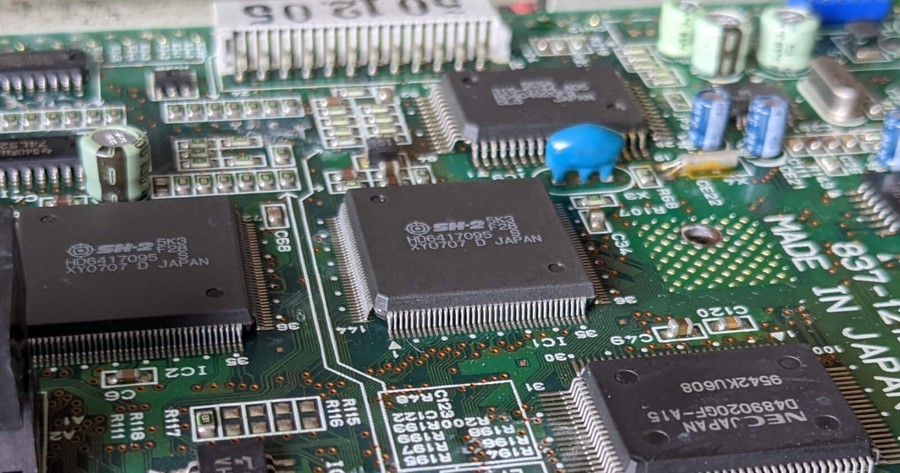
The thing had two custom RISC chips which could be used as CPU (one with additional GPU capabilities and the other with DSP) plus a 68000 devs were not supposed to use.
You know what's also funny? I've never heard anybody complaining about the Saturn being buggy.
It's legendarily hard to code for, but seems like it was at least pretty solid.
Even the Genesis was sort of "buggy." I think there was one particular design choice that crippled digital sound playback. Also the shadow/highlight functionality is kind of weird, not sure if "buggy" is the right word, but weird.