240 points · by gascoigne · 2y ago · 291 comments
They're a great warning for designers/architects/engineers to not get too enamored with the elegance of a system if parts of it are not yet completely solved. It's so easy when designing to try to shove aside some complex problem and say you'll solve it later, or play some shell game where every time you hit some hard to solve problem you wind up shuffling it around to someplace else [1], but that kind of instinct ultimately leads to unworkable things in practice.
[1]: 'we'll solve the seals problem later.. maybe materials has an answer' or 'just add oil in the mix to protect the seals there, we'll solve emissions later'
I read a comment on HN a while back that you can look like a genius in software by going back about 10 years and finding something forgotten. The whole web development shift from server-side to client-side and now drifting back to server-side as if it’s something new seem to validate this. Though in this case it just seems like the extension of the decades long back and forth of going from mainframe with super minimal client, to PC only, to networked, to client/server, to server-side web, etc, etc.
Your total guess is orders of magnitude off.
Most software today is in the ballpark of 10,000x slower than it should be.
This especially applies to React core devs. Remember XHP?
Kelly Johnson of Skunkworks had a keen mind for differentiating between them.
https://cornponepapers.blogspot.com/2006/04/short-life-and-u...
Just a little bit to early but when they came back to the idea they ended up with a technology that they use on all their new (big) commercial engines.
For anyone that doesn't know the name Kelly Johnson I recommend "Kelly: More Than My Share of It All". A rare person who combined technical genius with an ability to get large scale things done.
The rotor is pretty much unable to be cooled too.
That said, the article doesn't describe any benefit to using the rotary engine here either.
I wonder if we're missing something?
https://carbuzz.com/news/mazdas-new-rotary-engine-variable-v...
Which, now that I think of it again, is a bit silly because most EV mass is battery, not motor.
Increasing the unsprung weight by 10% causes a 100% deterioration in handling and ride quality.
You're suggesting increasing the unsprung weight by about 400%.
No offense, but this right here is peak HN.
The article mostly makes it sound like Mazda just loves the wankle and wants to find any possibly way to bring it back - even though it has “high” emissions… so coupling it with a hybrid electric motor makes it happen..
That can’t be the whole story?
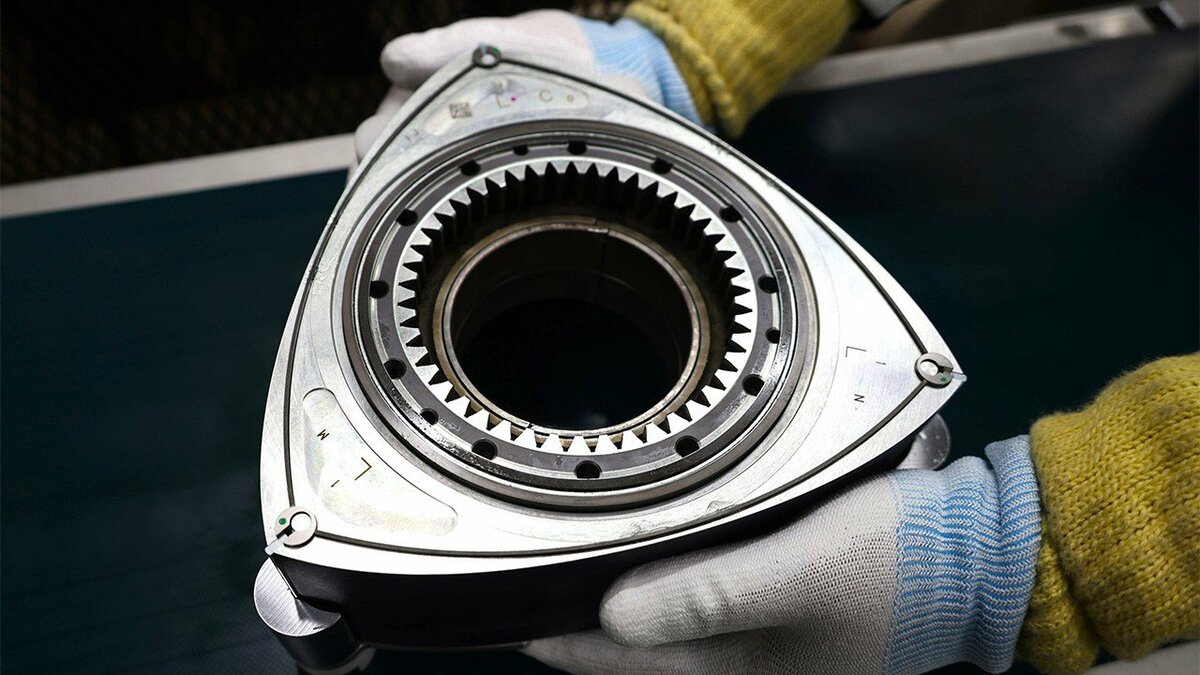
Wankels have tremendous power-to-weight and power-to-size ratios. Their main problem is reliability. The generally accepted solution to improve rotary engine reliability (oil injection) results in poor emissions. The wide, flat-ish combustion chamber doesn't help the emissions problem, either.
The Wankel is at its most efficient and its most reliable when operating at a constant RPM. Conveniently, the EV generator application demands a pretty flat RPM band. As a result, the engine doesn't need to lean as hard into those emissions-increasing compromises.
Thus, EVs allow the Wankel's benefits over a reciprocating-piston engine to be reaped without the same costs as before. In theory, at least. It remains to be seen if the benefits will outweigh the drawbacks. I'm glad they're at least going to give it a try.
I've seen many very reliable 3 or 4 rotary wankel swaps in RX7 FD3S that output far beyond anything imaginable any V8/V12 could produce. 2000hp is not a joke here, when being run on pure ethanol as fuel input. Apart from fuel injectors, clutch and gearbox, these engines run very stable and reliable.
There was an RX-8 Blue model being sold in Japan which was burning hydrogen directly, effectively producing water as output, which, in the prototype was being converted back to hydrogen via a fuel cell. And this was in 2004.
I wish there were more Wankel engines being used as "pocket generators", because they can reliably run on synthesized alcohol and hydrogen and be a potential generator replacement for all that Diesel based crap that's being used in rural areas.
Imagine a solar roof on your house that produces hydrogen with some fuel cells (which also produce heat for your home). This could be the optimum cycle for use in a decentralized home, as chemical energy storage has no loss compared to li-ion batteries that have a limited lifetime. The multiple use of hydrogen (e.g. a stove just needs to burn the gas) also makes it very low tech, and possibly much more reliable than a circuit based system where transformers might fail over time.
But of course, can't sell decentralized approaches via gas stations, so it will never take off...
There's an extremely good reason "rural" applications are reliant on diesels. It's not uncommon for a diesel engine to hit 300k+ miles and still operate reliably. And not to mention simply. They are relatively easier to maintain than a standard gasoline engine.
Diesels also greatly benefit from being on a fixed power band. It's why they work so dang well on large ships.
Where as rotary engines(rx-7's at least) need a rebuild every 80-100k miles. So I think without really knowing what you're doing mechanically or having access to a mechanic that can repair those kinds of engines you aren't going to be super reliable with a rotary.
Green hydrogen approaches via rotary engines does seem quite interesting. I think if the reliability of the rotary could be improved that could have some serious merit. Or at least making small enough generators that you can easily ship them out to be replaced/repaired could have serious merit.
Oh, no. You don't want to be cooking over a flame capasble of melting platinum. You will utterly destroy your pots and pans temper. I do jewelry work, hydrogen gas is one of the hardest gases to properly work with. I'd rather let a newbie play with oxy-acetylene than a hydrogen torch.
Built Nissan VR38DETT V6 produces 2000hp. A full billet block will produce 3000hp+. Nissan GT-R guys(T1, ETS,AMS) Let's not even get into the big block V8's because these things will run all day at that hp and be a whole lot more reliable than anything mentioned here.
I don't think there's a good reason to keep pushing down deadend reliability paths. We should be responding to our hard earned decades of learning and be pressing advantages. Not every novel and viable solution ends up being an enhancement.
That's a strange take.. It took decades to get reciprocating engines to be reliable, even deployed at scale. It also took decades to get jet engines reliable enough to comply with ETOPS requirements, to the point that it was long considered a pipe dream.
If it hadn't been for continuous investments over long periods of time and incremental adoptions of improved technologies, we wouldn't be enjoying any of their benefits today.
Are you proposing that Mazda should put two engines in their cars? Or am I misreading this?
>hard earned decades of learning and be pressing advantages. Not every novel and viable solution ends up being an enhancement.
That's precisely what Mazda is doing. They poured decades of R&D into the rotary engine, and are leveraging that research to their advantage. Their engine's diminutive size means they can provide more interior space in a compact vehicle, which is one of the key benefits of an EV that you can't get with a conventional hybrid. There are innate material advantages to the rotary in this application, it's not just hand-waving.
There's nothing overly novel about series hybrids, either. Chevy proved they can deliver EV driving dynamics and efficiency with ICE convenience, even at a larger scale than Mazda appears to be targeting.
This entire comment perplexes me. I can't tell if you like what Mazda's doing, or if you dislike it.
If I understand the article correctly, the "series" hybrid configuration means precisely that it cannot operate at the ideal rpm when charging the battery, because it is always driving the wheels directly as well.
No hybrid ever runs its battery all the way to zero, and series hybrids are no exception. The Chevy Volt (the other notable series hybrid in Western markets) keeps its engine at a near-constant RPM by using the battery to supply torque, even when the battery is "dead." I would expect the MX-30 to do the same.
IME in several thousand miles driving/riding in a Volt, it hums away within a very narrow RPM band unless you hoon it on a dead battery in cold weather. Even then, it's not nearly as wide of a rev band as a conventional hybrid.
You've got it backwards.
The Prius's Atkinson engine makes low-end torque *worse*, and then relies upon the EV Motor to drive the car at low speeds (0mph to 10mph) before the ICE kicks back in.
If ICE is operating, its at higher RPMs where the generator can still be useful (low RPMs like 500 are too low for the Atkinson engine to be effective in any way, the computer instead increases the RPM to maybe 2000, and uses all the power to drive a generator instead)
------------
So you see, the name of the game is efficiency at all costs, with EV-motors assisting whatever compromise you built into the motor. In the case of Toyota, its absolutely undrivable crap for low-end torque ICE, but a powerful enough 60hp to 100hp electric-motor that can handle the low-speeds and stop-and-go traffic, smoothing out any problems.
------
IE: The engineers build a highly compromised ICE engine (the Atkinson engine) that has a far narrower band of usable RPMs than a normal vehicle. Then they smooth out those problems with electric motors.
It sounds like Mazda is doing the same trick here with their Rotary engine, but the Rotary engine doesn't have the crazy-good efficiency curves that the Toyota Atkinson engine has. Efficiency isn't the "only" name of the game however, but Mazda now needs to find out a good way to market this engine / highlight its strengths.
Yes: https://en.wikipedia.org/wiki/Atkinson_cycle
However, these modern Miller cycle engines are being called Atkinson or Atkinson-Miller cycle for some reason.
So you have compact size, good power to weight ratio, and power limitations that don't really matter for range extender purposes. Lots of potential.
I can't find the article right now, but I'd swear I remember discussion here a handful of months ago about a startup marketing a similar EV range extender engine design.
Possibly https://liquidpiston.com
Prior discussions: https://hn.algolia.com/?dateRange=all&page=0&prefix=true&que...
Also for those who don't know, it's pronounced /ˈvaŋkl̩/ or /ˈvaŋkəl̩/ in the International Phonetic Alphabet (IPA). In German, "W" is pronounced as "V" in English, and the "e" in the syllable "kel" is reduced to a schwa ([ə]) sound, common in many German pronunciations of unstressed vowels.
They can simulate lots of it but to get real answers, they have to build the engine and see how it holds up.
Also Mazda is a small-ish manufacturer at the Japanese scale. Since Wankels are part of their identity they could decide to build a car with it even though the downsides wouldn't make sense for a "rational" brand like Toyota. It can give them that creative freedom that help make desirable cars and keep Mazda relevant.
https://www.youtube.com/watch?v=Hdjj52FUsEo
>These are some of the earliest ads I wrote and directed. Many of these ads cost our client just a couple of hundred dollars. When you look at this early attempt ant animation, it's not surprising that it didn't cost much more as a decent lunch these day!
>It's hard to believe now how absolutely 'revolutionary' the rotary engine appeared to be in those days. Many of us expected that they would eventually take over from reciprocating engines completely.
>This ad was produced just before the moon landing.
>The Agency was Hayes Advertising, Sydney. My producer (and dear friend) was Max Cleary and the Account Director was Vic Violet.
Mazda RX-3 Commercial:
https://www.youtube.com/watch?v=oHzeGEHWMjo
>Piston engine goes boing, boing, boing, boing.
>Mazda engine goes Hmmmmmmmmmmmmmmmmmmmmmmmmmm.
Felix Wankel:
https://en.wikipedia.org/wiki/Felix_Wankel
>Wankel and the Nazi Party
>During the early 1920s Wankel was a member of various radical anti-Semitic organizations. In 1921 he joined the Heidelberg branch of the Deutschvölkischer Schutz- und Trutzbund and in 1922 he became a member of the NSDAP, the National Socialist German Workers Party (or "Nazi Party"), which was banned soon afterwards. Wankel founded and led youth groups associated with a cover-up organization of the NSDAP. With them he conducted paramilitary training, scouting games and night walks.[3] When his high esteem for technical innovations was not widely shared among the German Youth Movement, he was offered instead the opportunity to talk about the issue of technology and education to Adolf Hitler and other leading National Socialists in 1928.[4]
>In the meantime Wankel's mother, Gerty had helped founding the local chapter of the NSDAP in his hometown of Lahr. Here Wankel not only rejoined the party in 1926, but also met the local Gauleiter, i.e. regional head of the NSDAP party, Robert Heinrich Wagner. In 1931 Wagner entrusted Wankel with the leadership of the Hitler Youth in Baden. But they soon fell out with each other, because Wankel tried to put a stronger emphasis on military training, whereas Wagner wished for the Hitler Youth to be a primarily political organization. In a particularly bitter and ugly controversy Wankel publicly accused Wagner of corruption. Wagner retaliated by stripping Wankel of his office by early 1932 and managed to have him expelled from the party in October 1932.
>Wankel, who sympathized with the social-revolutionary wing of the NSDAP with Gregor Strasser, then founded his own National Socialist splinter group in Lahr and continued his attacks on Wagner. Since the Nazis' seizure of power on 30 January 1933 had strengthened his position, Wagner had Wankel arrested and imprisoned in the Lahr jail in March 1933. Only by intervention of Hitler's economic adviser Wilhelm Keppler and Hitler himself, was Wankel set free in September 1933.[5] A fellow native of Baden and member of Reichstag from 1933 to 1945, Keppler had been a friend of Wankel and an ardent supporter of his technological endeavors since 1927. He now helped Wankel to get state contracts and his own Wankels Versuchs Werkstätten experimental workshop in Lindau.
>Wankel tried to rejoin the NSDAP in 1937, but was turned down.[6] With the help of Keppler, however, he was admitted to the SS in 1940 in the rank of Obersturmbannführer.[7] Two years later his membership was revoked for unknown reasons.[6]
A true electric successor to the RX-7 would capture so much attention.
First, like most of the Japanese manufacturers, Mazda bet against electric vehicles. They focused R&D on improving engine efficiency and getting their engines to run on hydrogen. If Mazda wants to make electric vehicles now, they have to play catch-up, or license key technologies from other manufacturers.
Second, batteries are heavy. For sedans and mid-size crossovers, this isn't much of a problem. EVs of that class are about the same weight as combustion vehicles. But for a lightweight sports car with decent range, batteries would be a big chunk of the total weight. Tesla's 85kWh battery weighs around 1,200lbs. If your desired weight is 2,500lbs, that only leaves 1,300lbs for the actual car. Yes you can save some weight by making the battery part of the structure, and you don't need an exhaust system, engine block, alternator, intake, etc, but it's still a tough set of constraints to work within.
Why do customers want sports cars to be light? Well all else equal, a lighter vehicle will have better performance. But even when all else isn't equal, vehicle weight can drastically affect driving enjoyment. I have a 4,048lb Model 3 Performance and a 2,182lb Mazda Miata. In terms of specs, the Model 3 is better in every way. It can accelerate, brake, and turn better than the Miata. It even has more range than the Miata. But the Model 3 feels like it's using brute force to beat inertia into submission. (Don't get me wrong, that can be fun.) The Miata is the opposite. Its light weight means that there's very little inertia to overcome, and something about that is extremely satisfying. It's almost like having a street legal go-kart. Until battery technology improves, an electric version just won't have the same appeal.
I’m not sure I want to drive around with a capacitor in the boot, but a huge battery isn’t ideal either.
https://www.motortrend.com/news/2026-mazda-mx-5-miata-electr...
Not entirely sure that would be the case even with a Red Sun label on it.
That's not what the TV commercials from the 70s told me:
"Piston engine goes 'boing, boing, boing, boing'"
"But the Mazda goes 'hmmmmmmm'"
(Oh, of course there's a YouTube video: https://www.youtube.com/watch?v=oHzeGEHWMjo)
Engineering organizations fall in love with superficial attributes of solutions that worked especially well for them in the past. When RIM/BlackBerry realized the iPhone was a serious threat, they built a touchscreen phone where the entire display produces a physical clicking effect because they were so convinced that what people really want from a smartphone is the click of a keyboard.
Mazda is BlackBerry, and the rotary engine is their clicky keyboard.
No, they're not. Go test drive a Miata. They make the most fun cars to come out of Japan. And also have one of the better design languages.
Unfortunately, Wankels have extremely huge mechanical problems - complex geometry (classic ICU are very close to just cylinders), need of better materials, depend on much better oil.
And also big problem is production scale, as I talked with people, they considered Wankels as toy, you will just utilize when it run out guarantee term.
For example, for standard ICU, considered big repair, sleeves, so they will continue working, sure, less heavy duty than new.
What does low end torque have to do with electrical generation?
You do want efficient horsepower to drive a generator. More low end torque means the HP comes at lower RPM, which should mean less fuel consumption.
Sibling says the achilles heel of the Wankel rotary is low end torque, but you don't take the direct output from the engine, it goes through gear reduction for final drive output. The real achilles heel is the awful emissions. It's more or less a 2 cycle engine from that POV.
When driven at variable speeds it's hard to wrangle.
The reason it's well suited for electrical generation is its mechanical simplicity, compactness, low weight, low NVH, and not least important, "rotary" brand value. I suppose that when run at constant RPM and constant or smoothly changing load, the emissions is easier to deal with.
It's been awhile since I gave a damn about wankels (or ICEs in general), but ISTR there being a relatively low limit to achievable static compression ratio due to the fundamental geometry of the swept volume. Modern ICE engines are largely exploiting the combination of direct injection and the high compression ratios it enables to improve their thermal efficiency. Between the relatively low compression ratio and sub-optimal combustion chamber shape and the fact that it migrates around the housing with the power stroke, the wankel is pretty much doomed in a world that cares about efficiency.
disclaimer: I've worked hard to discard all my gearhead knowledge, but went fairly deep down the rx-7 rabbithole in my 20s-30s. Take the above with a big grain of "I may be senile and overconfident in stale once-deep knowledge" salt.
There are better designs than Wankel for "series hybrid" application.
https://newatlas.com/automotive/innengine-one-stroke-engine-...
One (potential?) advantage not mentioned in the article is lighter weight relative to a similar traditional engine.
It does prefer a narrow RPM band, which is fine.
Reliability is the biggest concern TBH, but maybe that's not a huge bummer if its more of a backup/assistant engine.
Having said that, I'd have been much more excited about this 10-15 years ago.
As others have pointed out, the article doesn’t do a great job of explaining how the rotary helps.
But even if it was, that was the most powerful stock configuration made and it topped out at ~184 lb/ft. :)
Torque was never the strength of this motor.
Nowadays, I have a cheaper car with a lot more range, almost 4 times more in real life conditions, and plenty of fast chargers everywhere. I don’t see why I would bother with an ICE. It makes no sense for me.
It’s because I live around Oslo in Norway, a place where it’s the age of electric cars.
I think ICE for cars has a very limited future in the age of electric cars. I see it reserved for specific applications where the energy density is a must, and some car enthusiasts activities.
Hybrids are some kind of temporary solutions for places where the EV infrastructure aren’t good enough yet. Once the infrastructure is good enough, some people will still buy ICE for a little while as they are unsure, but most switch to full electric eventually. At least that what happened around Oslo and happens now in the country side of Norway.
Two reasons:
First, in relation to your point
> Once the infrastructure is good enough
I live in the UK and I think this is gonna take a long, long time here. Not only will we need to build an enormous amount of fast chargers, but there will need to a significantly greater number of them than petrol stations, to offset the fact that even the fastest chargers take 5-10x as long as filling up with petrol (2-3 mins vs 20-30).
Of course, the ideal scenario with EVs is that most charging is done at home, with fast chargers used only on long journeys. Problem is, by some estimates 2/3 of UK households do not have off-street parking. We would need to roll out en-masse solutions for on-street charging and, to my knowledge, we have not even began to think about this outside limited trials.
Second is cost. Almost all cars have got crazy expensive over the last few years (I’m unsure if the rise of the PCP is a cause or effect of this), but over here full EVs are still not affordable for a huge number of people—myself included.
I really wanted to go electric, and was looking at the MG4; widely considered to be the best value in EVs in the UK right now. But for the model with a range that would suit us, and the cost of installing a charger, you’re looking at close to £30,000. I just don’t have that sort of money, and a finance deal would be half my mortgage again. And for context, I make nearly double the median UK salary.
Installing electric power plugs everywhere isn’t that challenging. I’m sure UK can manage it if the local government decides to do it seriously.
By the way, 35k€ for a brand new car that is cheap to run isn’t a bad deal. New cars are expensive. Maybe you can wait a decade or two before switching with a cheap used EV that has enough range.
I just drove to the airport in a bit of a rush. Drove straight up to pump, tapped credit card, authorized for $100 and opened cap at same time. Stuffed the pump in and held it at max flow. 45l of gas later (small car), cap back on, pump away and moving again.
I don’t think it would be possible to be faster.
Total time stopped: 7 minutes.
This was clearly a wonderful idea but it was hamstrung by a silly California rule requiring the gas range to be less than the electric range to qualify for rebates. With a 6 gallon tank, the car would have been able to do ~300 miles instead of 170 and would have been parked in everyone’s driveway.
An added benefit was that the car could use existing gas station infrastructure when you needed to travel long distances.
The problem is that BMW wanted to get the same amount of credits as a pure-BEV. California anticipated that a car with 300 miles of gas range might spend much of it's life being driven on gas if there was no penalty for doing so... and in fact that is exactly what happened with many European plug-in hybrids sold as company cars.
California never gave BMW the credits, but BMW decided to keep the dinky gas tank anyway, so that's on them.
The counter force to that is that lease car drivers have to meet certain fuel efficiency goals, so, adopt an efficient driving style and plug in the plug-in hybrid instead of ragging it around; I'm not sure what the consequences were though, probably more taxes. Either way, enough of a push for my colleagues with plug-in / hybrids to do the thing.
Thankfully it’s trivial to change.
I think the goofy styling was probably as much of an issue as the tank size.
I thought so too, but my research suggested that the efficiency is pretty much the same if not worse and power delivery is worse. Do you have some links? I‘d like to be wrong on this one.
0: https://minkara.carview.co.jp/car/nissan/note_e_power/nenpi/
1: https://minkara.carview.co.jp/car/toyota/prius/nenpi/
2: The latest one has a worse fuel economy figure than the 1st gen, by the way
See Prius's "Powersplit Device".
I'd describe the Powersplit device to be a combination of generator/alternator, starter/electric motor, reversed-differential (2x power inputs -> 1x driveshaft), and effective gear-ratio. All in one planetary gearset.
EV motor2 determines the speed of the car.
The ICE motor can spin at any speed that the computer determines to be useful. If EV Motor2 is 0-rpm, then the ICE is 100% in generator mode (2000rpm but the car isn't moving: all the energy goes to charging the battery). If the EV motor is at 10mph but ICE is off (0-rpm), then its 100% electric drive mode. And any combination in-between is possible.
EV Motor1 (a smaller, weaker motor) controls the 3rd set of gears (I think the planet gears?? I forget), which determines how ICE relates to EV (changes the effective gear-ratio)
---------
So yeah, the PSD allows the ICE to always function at the appropriate speed (which is either 0rpm or ~2500rpm for efficiency). While the combination of EV-motor1 (changes effective gear ratio of ICE) and EV-motor2 (hard-wired to the final speed) handle the different speeds the user wants in practice.
All in like, 15 gears or so.
https://www.youtube.com/watch?v=jofycaXByTc
---------
I do think that the Prius (and Prius Prime) have surpassed the Volt's design, and the proof is in the pudding. Prius Prime has 52mpg, a figure far more efficient than the Volt ever had.
Prius Prime also has 220 horses today for a 0-to-60 time of 6.6 seconds. So today's Prius Prime is a lot faster than the Volt too.
Volt was good when it came out, but technology has gotten better since then. Toyota has seemingly perfected this "power split device", and its beginning to lead into exceptional acceleration and good driving feel (as opposed to being 100% economy focused like before). Volt had better feel than the 2010-era Prius, but 2024-Prius is a totally different car.
I think all Volt fans are in "but what if GM didn't kill the Volt and kept investing in the technology?". And... yeah... that's a fun what-if. But... GM killed the Volt. It sucks, because it seemed like great tech. Apparently GM has kept the drivetrain technology ("Ultium") and has continued to provide R&D, but Toyota's recent advancements are jawdroppingly good.
This is partly because the Prius is optimized as a hybrid-first design, while the Volt is optimized as a BEV-first design. The difference is in the gear ratios of the planetary CVTs: Prius is optimized to minimize the amount of energy transmitted electrically, which maximizes overall efficiency.
However, that design is sub-optimal for a car that you want to act like an EV. As your link shows, the Prius must have the ICE spinning at speeds greater than 42 mph. Not a problem for a hybrid, but that doesn't work for a "range-extender EV" like the Volt. Additionally, (before the current model year) Toyota's plug-in hybrids can't provide full acceleration in EV mode--they always kick in the ICE when you floor it. That's again a consequence of how the transmission is optimized for hybrid operation.
By making compromises to the gasoline efficiency, GM was able to create a car which acts like a real EV most of the time: A 1st gen Volt will go at least 80 mph in EV mode, and won't turn on the ICE (come hell or high water) until the battery is below 5%. And, it will do that for an honest 35 miles of freeway driving.
The second generation Volt uses GM's "2 mode" hybrid transmission, which closes some of the MPG gap by adding one fixed ratio (100% mechanical transmission) as well as high and low speed eCVT ratios (to minimize electrical power in those two speed ranges).
https://www.gm-volt.com/threads/gen-2-volt-transmission-oper...
In the first version. In later versions they added a second separate gear set. Then even later they merged the two gear sets back into one but with two separate planetary arrangements.
I'm not a particular fan of EVs in general, but I do very much like the Prius and the careful engineering that went into this drive train. This video[0] does a great job of explaining the overall system in the context of an operating vehicle.
I wish they had offered that same powertrain design in something other than a Cruze.
Here are the differences explained in more detail:
Nissan has the E-power hybrid that is the pure series hybrid that you describe. AFAIK it is not as efficient as a regular, parallel hybrid. The advantage is in cost as running the gas engine as a generator uses fewer components than running it in a parallel hybrid system.
https://www.nissan-global.com/EN/INNOVATION/TECHNOLOGY/ARCHI....
At low speeds (< 45 mph) it's either off the battery the whole time, or the motor runs and directs power to the traction motor or the battery. One wrinkle is that the motor assembly has a clutch that can engage the engine direct to the wheels, but like in city driving, the engine isn't going to be connected to the wheels. But I def would say that at least Honda's hybrid doesn't feel as simple as e-power.
Now this probably isn't really accurate, but architecturally I think I like it because the only thing keeping it from being a BEV is the battery size (only a couple kWh); the electric motor is strong enough to be usable on its own.
I think Toyota has increased the power on the normal prius, and definitely on the prime, but it used to be as part of the power split system, the electric drive motor wasn't sized to be enough on its own.
GM setup the Volt to alway have full power in EV mode and the vehicle would never automatically switch to gas unless the battery was discharged.
The original concept for the volt was that the engine would only generated electricity, but in production models, the engine was connected to the drivetrain.
Everyone bemoaning the death of the Volt can now just buy a Prius Prime (the PHEV variant). It's the same thing just newer/better. It even looks sporty-ish now.
I don’t think that’s correct. It may be true for highly variable/low loads where the pumping losses in the pistons dominates. However the majority of fuel consumption in a car happens at traveling speed (highway miles). That is the area that needs to be optimized for.
My 2015 Honda Accord Hybrid takes this approach. At below-freeway speeds the gas motor runs in series to drive an electric motor. At highway speeds, it engages a clutch and directly connects the engine to a low-loss 1-speed transmission.
Unless of course you drive primarily in stop-and-go traffic, e.g. delivery drivers, taxis, commuter cars, etc. Quite often you won't exceed 50 kph. For whatever reason, I've never seen (or have and forgotten) a car marketed towards this market—probably for exactly the reason that plug-in hybrids perform better in this scenario.
> I don’t think that’s correct.
You're right, it's not.
In fact, GM wrote an SAE paper about their "2-mode hybrid" transmission (which was used in their 2008-2013 light-duty trucks and SUVs, and then in later modified form in the 2nd gen Volt), where this is plainly explained.
In the paper they describe exactly the tradeoffs made to optimize fuel efficiency in an eCVT... it turns out that you want to set up the planetary gears to minimize the energy transmitted from input to output via electricity and maximize the amount transmitted mechanically because that is most efficient. You especially want to avoid a round trip through the battery in most cases (except when that allows installing a smaller, more efficient ICE).
That has implications for the CVT's mechanical ratio: GM's "2 mode" which has what basically amounts to an auxiliary overdrive integrated in the eCVT so that it can use smaller motor-generators over a wider range of speeds. Smaller motor-generators means more energy is transmitted mechanically, which means higher efficiency.
This is also basically the same reason the 1st gen Volt gets significantly worse highway MPG in range-extender mode than the (contemporary) Prius Hybrid (~35MPG vs ~50MPG): The 1st gen Volt eCVT was envisioned as an EV with a range extender (where energy usually comes from a battery), while the Prius's eCVT was optimized for driving primarily on the ICE, with the battery only supplementing acceleration.
https://www.cnbc.com/2023/11/07/new-ram-pickup-ev-has-gas-po...
EDIT: this is a big secret that none of the marketing materials (want to) make clear.
I'm uncertain the output of the wankel, but maybe with its power-to-weight it might get closer to being able to drive on gasoline in a self-sufficient way.
For too many freeways, for too much of the day, I can ride a bicycle at speeds greater than the surrounding traffic.
And in those conditions hybrids, and electric cars are perfect.
For comparison, rotaries get about 100psi of compression, a modern gas car can more than double that. More compression, more efficient burn.
Crazy to me that Chevy has abandoned their PHEV platform considering others, like Toyota, are in such high demand. Speaking of which I spent a week with a Rav4 Prime and found that equally as impressive range-wise as a volt.
It barely addresses the elephant in the room however: The Toyota Prius and its Atkinson engine.
The Atkinson engine is 99% the same as a regular engine (aka: Otto cycle), except the timing is different. Instead of closing the valves when the piston+cylinder is full of gasoline+air mix... the Atkinson engine waits a bit and "leaks" some gasoline+air back out before closing the intake valve, effectively burning only 70% of the fuel, but getting maybe 85%+ of the power of a regular Otto-cycle engine. Its a simple and cheap tweak to a traditional engine that grossly improves efficiency (but at huge costs to low-end torque).
Basically, any regular ol' carmaker who is mass producing Otto cycle / regular ICE engines can easily tune their piston timing to be an Atkinson engine instead. I believe Toyota even has computerized controls today that switches between efficient Atkinson (lower-power but higher efficiency) modes and powerful Otto cycle (higher power but lower efficiency) modes, though this control isn't really used too often in practice.
---------
This article makes a good point that Mazda has a culture of this... rotary engine. It does compare it (somewhat unfairly) to the Atkinson engine though (inside the Prius and RAV4), I don't think anyone expects any traditional engine (Otto or Rotary) to keep up with Atkinson Engine efficiency.
Its a good try however. But it does raise the question of what benefits can this rotary engine give over other engine types.
The Miller-cycle is much closer to what the Prius uses than anything Atkinson made; it was a traditional 4-stroke with LIVC, but required a super-charger to generate power at low RPMs.
The Prius has a CVT and electric motor, overcoming any issues at low RPMs. Also now that VVT is more common, many engines run with LIVC under certain conditions.
I have read that modern Toyota engines use both port and direct injection, but am not sure what the Prius does.
My uncle had an RX-7 back in the 80s when I was a kid. I remember when it was idling I could see the exhaust puffing, in pulses. It only had a single combustion chamber after all.
The third generation never got cheap enough for me to consider one, but oh, I wanted one badly. The RX-8 never really caught me. Plus they had some early issues. That Iconic concept definitely has my attention, though.
Just to be clear: At had two combustion chambers. Both the 12A and 13B engines had two rotors (1.2 and 1.3L "displacement" respectively), each one has a combustion chamber. I had an '84 GSL-SE (13B), I don't remember it particularly "puffing", not saying it didn't just don't remember it.
The engine in this article they say is an "8C", which I assume means 0.8L displacement.
Not quite true. Suzuki also made and sold a rotary engined vehicle--specifically the RE5 motorcycle.
Like in a public transport bus that needs to be on the go all day. In fact I'm pretty sure that's what the hydrogen buses in my city do, they're way too noisy to be fuel cell electric.
Besides, if you can run on electric you can bypass the whole hydrogen step altogether.
The problem is more finding a less lossy way to create it out of water with electricity.
Also I don't advocate hydrogen as a 'solution'. To me the solution is less cars and nmuch better public transport. I could see it work for buses though.
It's got as much longevity as other cars from the era if you pay attention to oil/omp and (over)boost (if you have a turbo). Everyone puts in at least a downpipe and then neglects all of the other mods (wastegate mod, better fuel bump, bigger injectors, wideband o2 sensor and new fuel map, better intercooler, etc) that you'll be forced to do along the way or suffer from boost creep and an eventual grenaded engine.
It's all of the other things under the hood that I've had to replace from all that heat though. Three alternators. A wiring harness that caught fire...
But the RX-8 just wasn't.
A cool engine still needs to be wrapped in a car that people want to drive.
The MX-30 doesn't quite fit the bill... just seems so mundane to look at.
That's because the engine serves an entirely different purpose. The Prius plug-in hybrid is a 13.6kWh battery mated to a regular engine. The MX-30 R-EV is a 17.8 kWh battery mated to a tiny ultralight emergency range extender.
As to similar designed cars, um, hello, the BMW I3 Hybrid? Exactly the same design.
The failing of the MX-30 R-EV is that its battery size is pathetically small for what amounts to an EV with a range extender. It is an embarrassment.