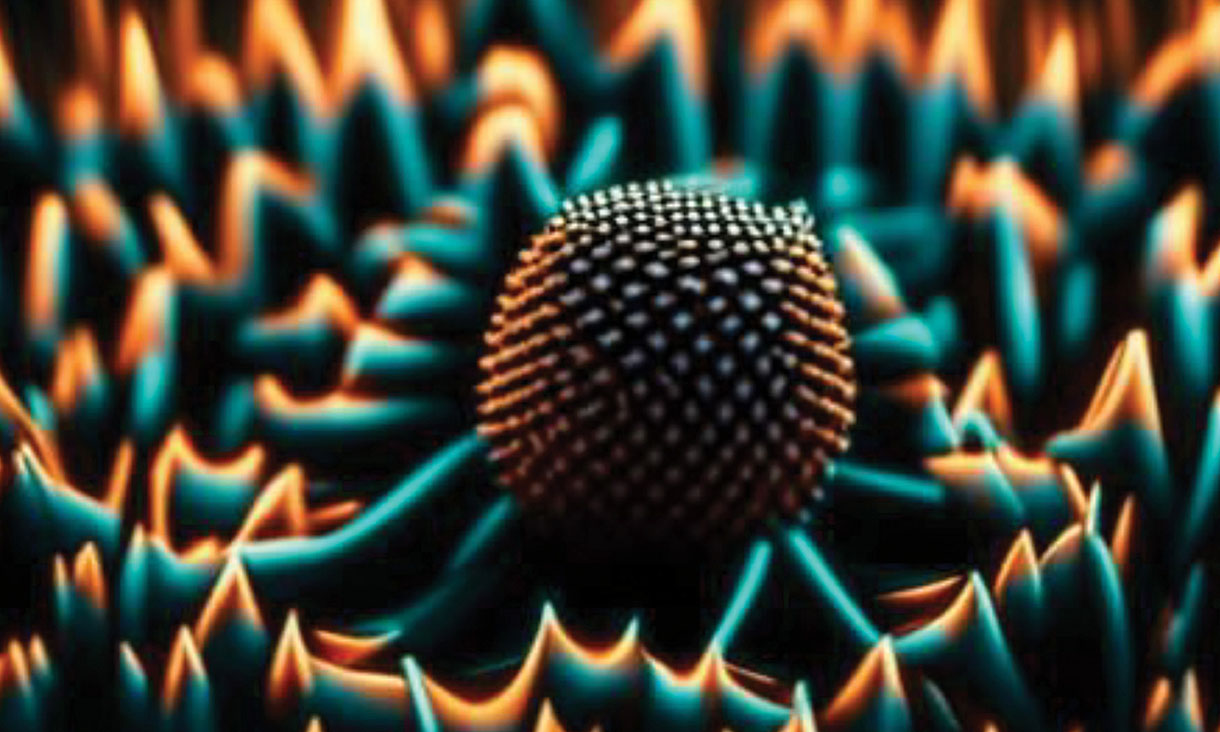
Silicon spikes take out 96% of virus particles
An international research team led by RMIT University has designed and manufactured a virus-killing surface that could help control disease spread.
rmit.edu.au
85 points · by geox · 2y ago · 66 comments
Furthermore i know the high level development of the integrated circuit industry inspires other industries to try to make things from silicon wafers, one should keep in mind that silicon wafers are still quite expensive and probably too expensive for human scale objects. The reason they work for chips is that the silicon part of chips (without the plastic and copper packaging) tends to be very small.
These researchers should take a cue from the oled display industry and try to make their spikes in annealed amorphous silicon. That may be affordable enough to make stuff from.
https://en.wikipedia.org/wiki/Epidermis
It's quite clever if you think about it. A virus can easily attack living cells but they aren't don't anything to a layer of dead cells. Similarly it doesn't need to be warm and moist to keep cells alive etc.
The durable materials, if any, can be only extracellular, like in bone tissues or cartilage tissues, where they fill spaces between and around the cells.
As another poster has said, the durable, protective part of the skin is made by dead cells, which are shed and renewed. Being already dead, they would not be affected by scratches.
On the other hand, eating some particles covered with such a surface with silicon spikes might be a bad idea, though the damaged cells from intestinal walls should also be eventually replaced, like those of the external skin.
So yes it might feel smooth, but IMO it could also feel gritty from structures larger than a single spike breaking off. It really depending on how exactly it’s made/ what it’s applied to not just the initial shape.
Or maybe lung cells too, if you systematically inhale spikes that have broken off.
And animal cells are an order of magnitude larger than bacterial cells, so I wouldn't worry about the spikes on my skin
Otherwise, the thickness of the cellular membranes is small in comparison with virus sizes and spike sizes, so these spikes should rip them apart too.
A mosquito is many orders of magnitude smaller than you, but you should still worry when it comes in contact with your skin, because it is not your size that matters, but only the thickness of your skin.
That is wrong. The expensive part in silicon chip production is the process. It's just that hard to make working circuitry close to the molecular scale and a lot of sophisticated technology had to be developed for it (i.e. a lot of R&D invested money), hence the high cost of production nowadays. Here however, it's about close to no fabrication process (by comparison) and the purity of the raw material involved will not matter that much either.
They probably don't want to immediately clog it with their oily fat human sausages.
late edit: I think it might (?) be functionally similar to fine silica dust, because (says the linked paper) the spiky surface is passivated with SiO2. ("...confirmed the presence of a thin SiO2 surface passivation layer on both planar and nanostructured Si surfaces...")
So they kill viruses if they land on it in a droplet
Right note I'm just dreading that we're going to flood our environment with another forever material.
If it were made out of copper, or iron it wouldn't last very long - who cares.
But Si structures will last forever, its oxide an excellent (the best?) passivating layer ensuring no chemical or biological systems ever degrade it.
Si's stability is why silicosis is so pernicious. Carbon deposits can, theoretically, be cleaned by the lungs (specifically by peroxides), but Si? Nothing.
Let's add that, like in communication theory, In bio I'n not impressed by 90%. How does that compare, say, with a bare surface of brass?
Steel and even copper degrade much quicker.
SiO2, which is exactly what these Si fibers will become as soon as it is in contact with air. A material that can puncture cell membranes and is almost certainly a catalyst.
But it's amazing because it is forever chemical.
> Copper and its alloys (brasses, bronzes, cupronickel, copper-nickel-zinc, and others) are natural antimicrobial materials.
> After incubation for one hour on copper, active influenza A virus particles were reduced by 75%. After six hours, the particles were reduced on copper by 99.999%. Influenza A virus was found to survive in large numbers on stainless steel.
> In a recent study, 75% of adenovirus particles were inactivated on copper (C11000) within one hour. Within six hours, 99.999% of the adenovirus particles were inactivated. Within six hours, 50% of the infectious adenovirus particles survived on stainless steel.
https://en.wikipedia.org/wiki/Antimicrobial_properties_of_co...
Though I guess it's probably faster if it physically punctures the virus, and two hours is still a significant amount of time for infection to occur with a regularly shared surface.
Salt has a similarly fast effect on viruses:
> Whitlock found that salt killed off the bug 20 to 30 times faster than the copper did, reducing MRSA levels by 85 percent after 20 seconds, and by 94 percent after a minute.
https://www.theatlantic.com/health/archive/2017/03/salt-vs-s...
Other than osmosis dessicating the virus, when the moisture dissolves the salt and then dries in a minute or two, the salt crystals physically puncture the virus's envelope, IIRC.
https://www.ualberta.ca/folio/2020/10/u-of-a-researcher-work...
Though having a water-soluble and electrolytic desiccant covering everything obviously raises its own problems, and having tried this at the very start of the pandemic, I can say you really don't want to be breathing in salt dust all day.
Ooh. That's right around the correct range for structural colouration. You could draw designs with this, or utilitarian colour-coding.
Red (700nm) means danger— The spikes will get bacteria, but are too big for viruses.
It’s always great to see more methods of microorganism control - but the challenge here is that the same mechanism likely kills many other microorganisms. Testing it to see that it is ‘safe’ in other settings is expensive and time consuming.
How about:
Two-dimensional silicon latices found affective at neutralizing virus particles
So the next problem is: how do you make virus particles come into contact with this surface? If you wait for them to fall onto it, you could be waiting a very long time.
Also, the virus has to be sitting on the spikes for several hours.
This is very interesting work, but there's a lot to be done before there are practical applications, no?
That's not a problem. An object can't harbor viruses that haven't touched it.