Replacing Wires Could Double How Much Electricity The US Grid Can Handle - CleanTechnica
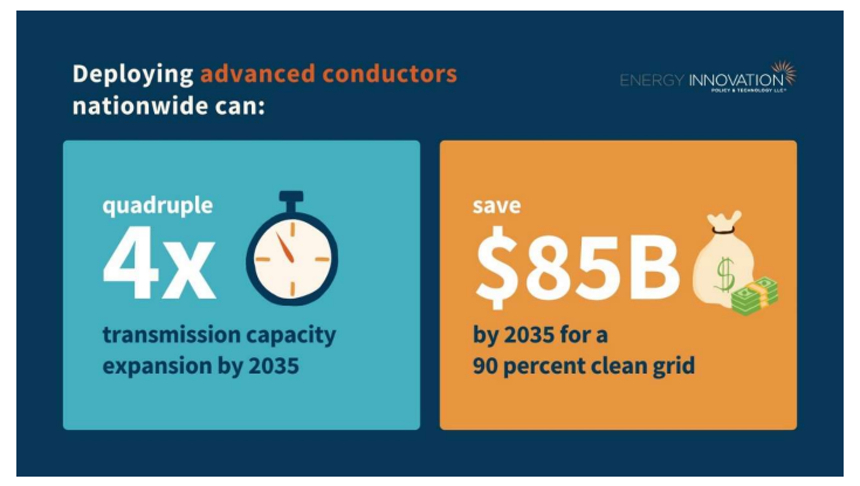
Reconductoring is one way to make the electrical grid more efficient so it can handle more input from wind and solar resources.
CleanTechnica
99 points · by thelastgallon · 2y ago · 68 comments
But an interpretation would be volume which seems intuitive, double the length or area of a cylinder and you double its volume.
  # %%
  %pip install -q pint ipytest pytest-cov
  import ipytest
  ipytest.autoconfig()

  # %%
  %%ipytest -v  # --help
  def test_pint_units_for_watt_meters():
      import pint
      ureg = pint.UnitRegistry()
      unit1 = ureg.kilogram*(ureg.meter**2)*(ureg.seconds**-3)
      unit2 = unit1 * ureg.meter
      assert 1*unit1 == 1*ureg.watt
assert 1*unit2 == 1*ureg.watt*ureg.metersIn the extreme case, you can get solar power in the middle of local night and winter by way of building a perfectly reasonable (one ohm resistance) global power grid for a reasonable material cost (260 or so billion USD at current aluminium prices, more for actually putting it wherever).
You'd still want storage for e.g. electric cars, and we aren't that coordinated globally, so I doubt we'd actually build a global grid; but I can easily believe we will see a unified north american continental grid once Texas gets out of its own way, or a unified EU+friends grid, and even at that scale you get several hours variation in sunrise and sunset, climate, and how long winter nights are.
Big deal as in expensive? Grid as a whole, not the wire itself, that's the point.
I'm seeing headlines about the USA needing to spend ten times that to modernise their grid. It isn't unreasonable to suspect the USA's grid modernisation could, for a very small increase in material cost, turn it into part of something much grander.
Big deal as in a political PitA at every level? Yup.
Storing fresh water is a good idea anyway. You don’t want to run out of that stuff :)
"Let's just use solar" comments are tiresome. It's not a panacea.
People think you slap some solar panels on your roof and it's "problem solved". Apparently they have no idea how the world consumes energy, or the scale:
https://www.penguinrandomhouse.com/books/666342/how-the-worl...
Am I missing something?
Adding more conductive material helps with the resistive losses, but also makes the cable heavier. Using an advanced cable that has better tensile strength for the same or better conductivity accounts for those second order effects better than just adding more aluminum.
Are wires that heavy that the structure that holds them is always maxed out?
On the same "holder", no, just due to how the wire is fastened to the poll. On the same poll, maybe, depends on how much poll real estate is available. Usually though there is not extra space available. High voltage conductors use the air gap as part of its insulation so to prevent arcing the conductors need to be spaced out so far apart.
Long story short, when you start to enter the kV range, your traditional rules of thumb go out the window. I have first hand experience with trying to keep a particle accelerator from arcing, and that was a nightmare ... I can't imagine mixing in high current as well.
Why build a tower that can hold like 2 tonnes of wire when it will only ever carry 1 ton for it's entire life?
But that's only useful, if you now need less of a safety margin than you thought you needed earlier.
Which is sometimes the case: when things are less well understood, properly conservative engineers add more of a safety margin. Compare how old manufactured things are often much heavier than newer designs.
See also eg how over time we managed to pack broadcast channels closer together in frequency space, because we got better at dealing with interference.
The 'magic ball' from the article is a good example of how more sensors (and better models) can help you be less conservative in your margin of error without sacrificing safety.
I'd guess there are probably some areas where the towers are overbuilt by a useful margin. How good are the records and field measurements to get that evaluated would have to be considered.
The only entities that can make such long term investments are governments, via taxes, and not all governments at that. And such investment is usually reserved for either basic research or incentivizing production by mobilizing human capital (i.e the IRA in the US), not building excess capacity of questionable utility.
You've summarily lost your mind if you think any sane utility CFO would greenlight deploying capex to the tune of billions in gross excess of requirements for the speculative option of expansion capacity at marginal cost several decades into the future. Also, good luck convincing rate payers that increased costs realized today is to speculatively reduce the utility company's cost of doing business long after they're dead.
Or maybe all of their strength is used to hold themselves up and the load they carry is an inconsequential part.
From the ground they do appear that way, but I don't really know how much load the cables put on them.
Weirdly, how utilities were financed blocks retrofits.
Public utilities make money by building new stuff. Increasing efficiency actually loses them revenue. Eventually, we have to reboot their businesses models. Meanwhile, we need legislation (and subsidies) to compel retrofits.
Maybe with fiber transceivers, sure. But twisted pair is fine... Some of the 10G equipment doesn't go all the way down to 10M anymore, but just put your old 10M equipment on the 10/100/1G ports, and the 10G equipment on 10G ports. It can be on the same subnet, no big deal, as long as you're not running jumbo packets or at least only using jumbo with MTU discovery. (You can usually even run 10G on cat5e, as long as it's not too long, and not in dense conduit)
The problem is that the marginal utility gets smaller and smaller as the rollout continues. Most places in the US have some form of communication wire available, so you're not going from "nothing to fiber" but from "something slow to fiber" which is significantly different.
We used to do things like that, sure. Unfortunately, Government "Works" projects aren't like they were in the 30s-50s. Outside of rebuilding a few crappy bridges, almost nothing useful is being created.
At this point, don’t think we can trust the government with more money regardless of what they promise to do with it.
The vast majority of new Federal Gov jobs are build-nothing, do-nothing, buerocratic paper pushing roles that create nothing of lasting or even temporary value. The net effect of the massive Federal budget increases over the past ~4 years has been a sharp decrease in our overall workforce efficiency which has been the main driver of inflation.