92 points · by tosh · 2y ago · 65 comments
For LLMs/large models the huge cost is memory ops to load each layer weights during the forward pass. This is why doing inference at batch size 1 is extremely wasteful: you pay all the mem ops cost and don’t use enough compute FLOPs to justify.
You want a high enough batch size so that compute:mem ops is close to the ratio for that GPU. This is usually done by batching together multiple user requests.
At times of low usage there is excess capacity because batch size is below this “optimal” ratio. So they can slot in these “relaxed SLA” requests for little marginal increase resource usage on their end.
Basically have a queue of these requests that you use to “top off” your batch size when you can.
Edit: also you may not be able to get optimal batch size depending on when the requests arrive, eg you don’t want to wait forever to fill up a batch. So again having a queue of outstanding/delayed requests to serve allows for smoothing things out and increasing compute utilization
I think that beyond optimizing batch size, massive training clusters tend to benefit from scheduled maintenance periods where everything gets fixed vs rolling fixes (as you either need everything to be working or you need to restart the training window). If OpenAI could interleave batch inference with training specific HW downtime like interconnect maintenance it would be another basically free source of GPU FLOPS.
Hardware demand is so high, having GPUs idling is a massive waste, but you also want to have separation between dev, test and prod environments, so not obvious what to do.
The advantage of that approach would be that latency could be minimized or tiered. Instead of a single "one batch with maybe up to 24hr latency" the offer could be a series of tiered queues with different SLAs and costs, and you can pick which you submit your work to depending on how important it is.
I wonder why they went for this custom JSON/HTTP approach instead. Maybe they feel that they can't expect developers to understand anything other than POSTing JSON.
https://dropbox.tech/developers/low-latency-notification-of-...
This open connection IS the overhead. Some approaches have more overhead, some less. Long-polling these days is not needed and can be replaced by SSE [1] (if you are OK with unidirectional communication), websockets (bidirectional), or callback URIs in the request. The latter is a per-request webhook, essentially, and would have the lowest overhead at the cost of ceremony (the client now needs to have a running web server).
By the way, long polling was popularized by Comet [2] around 2006.
It's not really easier to implement or scale, in my view. It may seem that way if you've never worked on large scale stateful connection serving. If you want users to get the answer as soon as it's ready, and you do or at least your users do, then you need users to hold open connections and at that point it's really a question of how much your protocols and libraries do for you. If you use HTTP the answer is "not much" because it was designed to download hypertext. The actual task of managing lots of connections server side isn't especially hard. There are MQ engines that support sharding and can have a regular TCP LB like a NetScaler stuck in front of them, or of course, you can just implement client-side LB as well.
An HTTP polling API may be less efficient but I know how to use that from all of the programming languages I work with already.
For example, someone below asks "how do I see my submitted jobs". MQ protocols solve that for you out of the box. You can browse the queues that you own. It's all already standardized and implemented. Because they rolled their own protocol, OpenAI lacks this function and will have to develop it themselves. Then because it's all oriented around batches (when the underlying problem does not actually need batching), the users will have to run a local DB to keep track of what prompts map to what batches or they'll find themselves redownloading the whole batch to find out what's in it.
As for firewalls, you open the port. The only issue there is if you're behind a firewall you don't have any control over and where the people who do don't want you using AI, but that's not an issue in the datacenter deployments that are presumably generating inferencing batch workloads, and such firewalls or proxies can break HTTP APIs too anyway.
The fact that you know that you can only expect an answer after 24h also avoids the need for busywork polling.
> Instead of a single "one batch with maybe up to 24hr latency" the offer could be a series of tiered queues with different SLAs and costs, and you can pick which you submit your work to depending on how important it is.
But that is what they have. They have one "ASAP" API and one "within 24h" one. These are two big distinct use cases. You use the fast one when there is a user waiting for an answer realtime, and you use the slow one when nobody is waiting for it realtime.
These are two distinct use cases from the user's perspective.
You are correct in identifying that there could be an API which offers 2h returns, or one which offer 14day returns, but why would you complicate the offering with that? It adds a lot of complication to the documentation, a lot of complication on the scheduling side and a lot of complication on the pricing side, and for what upside?
There are use cases for multiple latency tiers
1. At the lower end you have realtime-ish responses for when the chat is via SMS/WhatsApp/tickets/email, i.e. the social convention is that responses may be delayed by a few minutes or even 10-20 minutes and that's reasonable, but not by 24 hours.
2. At the high end you have a database with 200 million documents, a prompt that works, and you just want to submit all of them in one go as quickly as your client can work, then get the results as they get processed. There is no latency requirement whatsoever, but you'd prefer not to have to chunk things up and track batch IDs and such yourself. What you DO really want though is to have exactly-once submission, so you don't accidentally lose your connection half way through a batch upload and then end up paying for the same batch twice.
These are all basic problems of the type that occur all the time in the IT industry. The solutions are well known and mature. Your bank runs on message queues of various kinds. The tech really isn't that fancy.
Its simpler for them to build and operate since it fits their existing API (and user validation, quota tracking, etc.) infrastructure, its simpler for them to update their SDK to handle another HTTP endpoint than to build an AMQP or STOMP client into the SDK for this feature, its easier for most consumers who aren't using the SDK, and a message queue interface for this one bit of functionality would offer minimal benefits. Easy choice.
(If you are consuming from an environment where you are alreayd using AMQP or STOMP, sure, build a quick adapter for the HTTP interface. But I don't see any good reason OpenAI should have done one of those instead of HTTP.)
The API includes a `completion_window` parameter ("The time frame within which the batch should be processed. Currently only 24h is supported.").
At any rate, that's only the case if every request actually sits in the queue for 24 hours. The 24 hour period is clearly chosen to let them absorb free capacity overnight (all such services have diurnal cycles), but unless their implementation is really shoddy at any given moment their workers will be popping work off an internal queue anyway to take advantage of moment-sized lulls in traffic. Done properly you can saturate your hardware 100% all the time... there's certainly enough inferencing demand out there.
So at that point the question is just one of external API.
Webhooks is the best solution IMO.
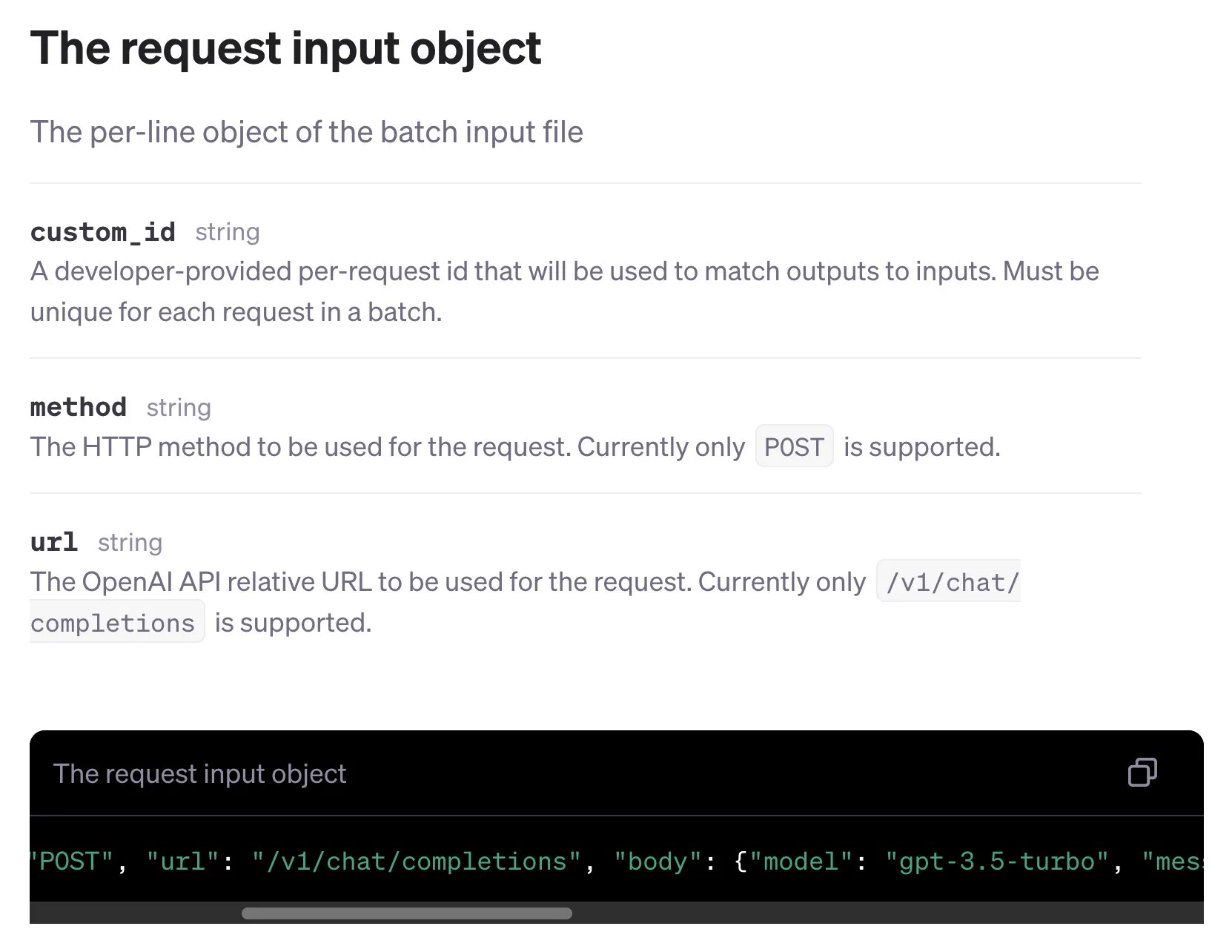
API Link: https://platform.openai.com/docs/api-reference/batch
Just hypothesizing.
Or maybe they’ve found a way to batch process many requests together in a way that’s more efficient.
If they're running their own DC (or their own hardware in a colo) then I believe the only scaling down can by shutting down the systems at night, which, while non-trivial amount in electricity savings, is not really much when compared to the total hardware CapEx or even the total OpEx.
And, even then, you have to consider the cost of shutting down and bringing them up and the complexity it brings.
Now, if they're using a cloud provider they can theoretically terminate the instances. But, even in that case, to do that, they'll have to use on-demand instances rather than use reserved instances which will probably wipe out all the savings.
It never went away.
I did some consulting years ago for a large telco. They had an overnight billing batch process that was obviously critical to the company.
It took about 22 hours to run. They were terrified it was going to start taking longer, if it ever reached 24 hours that would be the death of the company.
1) Upload your batch file
curl https://api.openai.com/v1/files -H "Authorization: Bearer $OPENAI_API_KEY" -F purpose="batch" -F file="@batch_example.jsonl"
2) Create the batch job
curl --request POST --url https://api.openai.com/v1/batches --header "Authorization: Bearer $OPENAI_API_KEY" --header 'Content-Type: application/json' --data '{ "input_file_id": "file-DYJImtYAQ2y3j25b5F27Eefp", "endpoint": "/v1/chat/completions", "completion_window": "24h" }'
3) Check the status of your job
curl https://api.openai.com/v1/batches/batch_f5Hh3MXaM0NNuTGOmutl... -H "Authorization: Bearer $OPENAI_API_KEY"
4) Download the completed file!
curl https://api.openai.com/v1/files/file-Og2t4LcJOCqOFq6rmp22Uzk... -H "Authorization: Bearer $OPENAI_API_KEY" > batch_output.jsonl
Would love an option to look up all my open jobs. I imagine doing this in a ci/cd pipeline or GitHub action. But I don't want to have to store state.
curl --request GET --url https://api.openai.com/v1/batches
but that doesn't seem to exist yet: https://platform.openai.com/docs/api-reference/batch
i need to batch anaylze 100K whisper transcriptions. 8-)