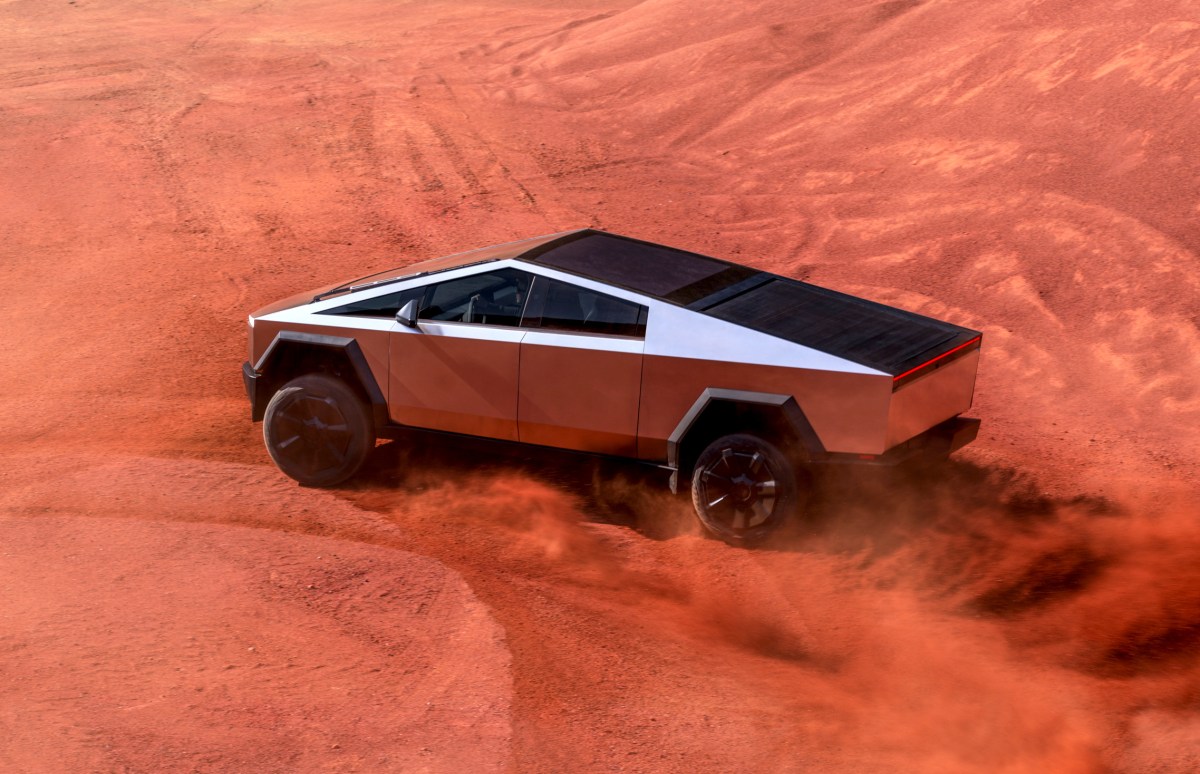
Tesla recalls the Cybertruck for faulty accelerator pedals that can get stuck | TechCrunch
It's technically the Cybertruck's second recall, but it is the most serious to date, and it caps a tumultuous week for Tesla.
TechCrunch
451 points · by sarimkx · 2y ago · 593 comments
How do you have so little quality control and insight into your manufacturing process that someone on your own production line can introduce a new step to your truck manufacturing process that no one noticed?
I guess when analysts said the incumbent auto manufacturers would have a large advantage over Tesla in manufacturing, this is what they meant?
Because this looks like a very unprofessional error to have made for a company that has done well up until now.
What they missed was the after action surveillance and analysis. In a different organization such a change would go in, and at the same time kick off an engineering investigation to verify that it doesn't make anything worse. If that analysis comes up clean, there is no change. If it finds a problem though, then the change is reverted/changed to something else. In regular car companies you see things like "We're recalling all cars between VINxxxx and VINyyyy" which basically delineate that time between when the change was made and the time the analysis suggesting it wasn't a good thing. If its a minor thing there won't be a recall, just a bit of extra "warranty work" at the next service opportunity which the dealer does.
[1] https://techcrunch.com/2024/04/19/tesla-cybertruck-throttle-...
There are numerous car companies with those sorts of sales numbers on a particular model and they don't have these issues, mostly because they aren't stupid enough to make their own stuff. Rolls Royce doesn't make their own gas pedal; they go to a company that makes them.
Nearly every problem Tesla has can be attributed to Musk's insistence that he knows better than an industry that is extremely cutthroat and has learned lessons from a century of being in business. He has been propped up by customers and VCs who think that means the auto industry is "stodgy", when really they didn't understand all the reasons things are done the way they are.
It's like the fresh college grad who comes onto the SW eng team having made some clever app while he was a sophomore...and says "oh you're doing it all wrong" to senior engineers.
One major mistake Musk made is confusing "big five" (GM, Ford, Stellantis, Toyota, VAG) ambivalence toward electric cars with incompetence. In Ford's case that is fairly accurate - the Mach E is an engineering embarrassment, the Lightning less so, probably because there is enormous organizational pressure to not fuck up in the product line that is their bread and butter.
VAG has demonstrated great competency at EVs (Porsche and Audi mostly) at the high end of the market...and once GM really gets its Ultium platform going, Tesla is well and truly fucked if they intend to keep making cars instead of just shifting to being an 'electric gas station' company...but they're on their heels there too, having slept while CCS surpassed their charging standard years ago.
What? It says nothing about Cybertruck sales and everything about how slow they've been to ramp up production.
Tesla has a well-known history of being slow to put a new model into production. I find it odd that you would assume less than 4,000 Cybertrucks have been sold because of lack of interest.
Isn’t that literally an unprofessional error? The big three already have this as standard operating procedure. Tesla still seems to be treating building cars like devops: move fast and break things, but don’t worry about the break things part until it’s bad enough that end users start complaining in a public forum.
So you agree with the parent, you just don’t think Tesla was “unprofessional”. You can split hairs all you want over what specific process or check or diagnostic or paperwork did or didn’t get done. It doesn’t change the outcome — shipping 4K super expensive cars to long suffering customers to only almost immediately have a serious safety recall? That’s unprofessional.
Tesla should have been going over these with a fine-tooth comb! This is the first iteration of an entirely new vehicle platform for the company, its first time working with steel for body panels, its first time* implementing steer by wire tech, etc etc. why isn’t every single one of these first few thousand heavily scrutinized? Insane.
To deconstruct your argument a bit, as I understand it to be this:
"This car costs a lot of money and has been delayed several times, thus during that time a 'professional' car making company would have found, and fixed, the accelerator pedal defect."
If that accurately reflects your claim, then would that be true of any car company that allowed a manufacturing or design defect to "escape" in one of their very expensive cars? Because this has happened to many (most?) of them[1].
To me, that either puts Tesla in very good company or says the entire auto industry is shite.
If you read through the linked article (it isn't that long) you may notice that a lot of the defects that resulted in recalls seem "obvious" or things that QA would catch. That is the "x-ray vision of hindsight" as my grandfather used to call it, which is that once you can see something it seems really easy to see.
Building a car from the frame up is a very complex engineering task, and there thousands and thousands of hours invested in catching things before the product is sold, but the reality is that it is really really difficult to catch a problem you don't know about before it leaves the factory. In the software world we used to have these really long customer test cycles called "alpha" and then "beta" for we got to "release candidate", the whole point of that was to put customer hours on the very complex software to help identify the problems we couldn't see as developers. That process sort of went away when it became possible to instantly download a new copy of the program, so you could send it to everyone and fix bugs that would propagate through online updates. Games loved it, you'd get a 650MB CD that you'd put into your computer to install and it would start by downloading an entirely re-written game because so much had changed between the making of the CD and the actual product. Before this you had to send new release media tapes or a CD, and the customer would uninstall and reinstall the software. It was painful.
You can't do that with hard goods of course, you can just drive into the dealership every week and swap out your current Cybertruck for the model currently coming off the assembly line. So defects like this are rather inevitable.
In my opinion, that defects both exist and make it into the field isn't "unprofessional". And when I wrote the first comment I didn't realize they had sold less than 4000 cars, so clearly they were paying some attention and they seem to have done the right thing by recalling them. To me, and this is just my take on things of course, that feels more professional than unprofessional.
[1] https://www.lambocars.com/known-supercar-recalls-in-automoti...
I think you missed "unapproved".
Three pins on the back of that appearance plate that push into starlock style fasteners in the pedal are cheaper than the appropriate glue, faster to install than glue, more reliable, trivially verified, impossible to misalign, and that's why it's a common solution that auto manufacturers use in this exact application. This was a confoundingly stupid place to rely on glue.
IDK anything about manufacturing so I wonder if this was due to incompetence, to save costs, ignorance or something else?
I remember reading about the original iPhone's manufacturing operations in China - how the Apple engineers spent a ton of time making sure that the right way is also the easy way for the factory workers.
I have no knowledge of Tesla but here would be my guess:
Assembly worker found pad hard to put on pedal in sub-assembly area and used a spray bottle with soapy water on the pad to slip it on.
Story time: Called out to final assembly, machine starts and runs but not moving. Troubleshoot and find brakes not releasing. further troubleshoot and find it is due to pressure not getting to brakes(configuration is such that brakes come on if there is loss of hydraulic pressure). Replace hydraulic line, machine is working. Remove contaminate from line, no one know what it is. Assembly pointing fingers and saying sabotage. I walk around the assembly area, I find that paint decided to use packing peanuts to mask holes that the hydraulic fitting go in instead of masking tape as directed. The packing peanut tore while being removed and the assembly working inserting the fittings did not notice.
TBH, something like this might even get approved by a foreman. "Thanks for coming up with a clever way to save a few seconds on assembly!"
Even as a dev, I resist doing it because of how unpleasant it can be. If I can come up with a workaround without having to report the issue, that's what I'll tend to do. And if I have to talk to tech support rather than the devs? That's simply not going to happen unless I'm trapped into using the product.
We still haven't cracked this problem as an industry.
* There's probably a small chance it actually would get fixed, and therefore a decent probability that reporting it would be a waste of their time.
* They needed a solution sooner than reporting it and waiting for fix to maybe eventually appear. Once the workaround was in place there was no need for a fix.
* Sometimes the people running projects you use can be hostile, which makes reporting stuff very unappealing and even stressful. Much better to avoid interacting with them if at all possible.
* They didn't know who to report it to, or how to report it.
* They simply didn't have time to report it.
We had a big kerfluffle around our OTA update system at one point because they did a big round of updates and "none of them worked." And then I dug into the system logs for each of those components and 95% of what they claimed didn't work actually did. But meanwhile you've got product managers and other people wading into the conversation to try to tell you to fix something that isn't actually the problem.
We're never truly going to get away from this until we stop excluding people from the conversation about product problems. I'm just sitting here hoping we adopt a quality management system of some sort before the company's product implodes.
Because in the real world messengers get shot.
By analogy to software engineering, do your bosses or clients give you water-tight, formal specs for the software you need to build? If they could do that, they wouldn't be needing you in the first place.
We zero in on situations like that and pretend that it's the worker's fault for making the wrong call, but we ignore that if they didn't make the right calls a thousand times before, nothing would ever get done.
In this case, if pedal cover is a friction fit and can slide off and get jammed in between panels, this doesn't sound like an assembly mistake but a pretty major design error, right? Your designs should be resilient. What if the owner sprays WD-40 on a squeaky pedal and the cover slides off?
"I sleep on the floor" .. "You're fired for not proactively fixing a problem I just thought of a solution to". Is my speculation off-base?
I've always suspected it was apocryphal. But just think, if the workers had installed that fan beforehand, we might be reading a story about how important workers are at solving little production problems.
Everyone thinks this mentality of having workers fix problems is great, until they use soap to put glued parts on.
You just solve problems all the time, every day, and it's really up to the technician to know when something requires notifying Engineering or not. Notify too much and they'll get rid of you for being annoying... notify too little and shit like this can happen, but in the very large majority of cases, it doesn't.
I can't tell if this is a serious comment, because in the past there have been many weird problems, like wood trim in Model Ys:
https://www.thedrive.com/tech/36274/tesla-model-y-owners-fin...
(and yes, I know it's not exactly the same, but it's certainly still very bad to be using home renovation materials in the face of part shortages)
Incumbent manufacturers have most of this stuff figured out; Tesla seems to want to "be different" on the most minute and boring of things. They keep stubbing their toe along the way.
The rest of the industry all use a standard sensor that works well.
Only a moron of the scope of Musk would own an EV company, and then become a literal Nazi online alienating the left leaning people, you know, the kind of people interested in climate change, technology and EVs, and cater non-stop to right wingers, the kind of people who think climate change is a hoax, "EVs are for pussies", and love coal rolling.
Also, the glue used in wood trim has a fairly low combustion temperature...
[1] "In conducting their report, NASA engineers evaluated the electronic circuitry in Toyota vehicles and analyzed more than 280,000 lines of software code for any potential flaws that could initiate an unintended acceleration incident. "
"NASA engineers found no electronic flaws in Toyota vehicles capable of producing the large throttle openings required to create dangerous high-speed unintended acceleration incidents."
"The two mechanical safety defects identified by NHTSA more than a year ago – “sticking” accelerator pedals and a design flaw that enabled accelerator pedals to become trapped by floor mats – remain the only known causes for these kinds of unsafe unintended acceleration incidents."
https://www.transportation.gov/briefing-room/us-department-t...
[2] https://www.licarco.com/news/how-many-tesla-cars-have-been-s...
The mat was a design flaw from the beginning that missed QA, that happens in any large scale manufacturing as you can't just get everything right from the start.
If the article is telling the truth, this was a change made on the build line that wasnt' approved, that's a huge f$ck up if true and an incredible show of incompetence if someone can just start making design changes without approval on the build line.
Never encountered the issue.
They replaced my floor mats and installed a new pedal assembly and updated to the ECU with "brake override" ability - meaning if I pressed the brake pedal it would ignore input from the throttle.
[1] https://en.wikipedia.org/wiki/Takata_Corporation#Defective_a...
This is just the f'n rubber pad on the accelerator can come off which isn't great, but harms nothing.
What is wrong with the people here?
You can void your warranty by driving them through car washes. What exactly is the point of a bulletproof truck that can't get wet?
That's actually not unusual at all.
It's perfectly common for an engineer to order that a hole be made in a given location on a given part without specifying that coolant should be used, or the spindle speed of the drill, or how the part should be held in the machine, or that the hole should be deburred.
Manufacturing is skilled work.
That's legal covering the company.
I'd bet this was just a general design flaw.
Er, how does it cover the company? Company is responsible regardless.
I want to take his words with a grain of salt, but…I kinda believe it. Obviously hearsay means nothing, though.
Our classic mini from Australia has other production anomalies, you kinda just chock it up to the workers being a little drunk during its construction.
https://uk.news.yahoo.com/faa-found-staff-boeings-supplier-0...
Soap is a common method for getting rubber pads onto metal pedals in the aftermarket world. Dish soap dries out and becomes less slippery, unlike lithium grease or other options. It is possible it was carried over from an appropriate and approved installation method for top hinged pedals, where pressing down will push the rubber pad’s grove deeper into the metal shoe and not cause removal. For bottom hinged pedals, preferred for performance cars, I wouldn’t recommend that at all.
One off possibility is that this is NUMI knowledge making its way to Tesla ownership.
I don’t disagree with the takeaway though. If they were trying to Toyota Method/Six Sigma this assembly line properly, they’d have reviewed and approved the change as part of a periodic process and it wouldn’t have been “unapproved” and probably would not be the process they used.
Adding to my “it could have happened to any manufacturer” my EV Porsche comes with a NEMA 14-50 plug/pigtale that was previously only approved for use in 16 Amp EVSEs. The wire says 16A only (10 or 12ga wire is in use). However, they kept using these on 40 amp capable EVSEs. Over the years many 14-50 outlets and these plugs have melted. Through that time Porsche blamed low quality outlets and recommended an industrial model, but the plugs then melted instead of the outlet. Only this year did they issue a recall. This is extremely similar to an issue that happened with Tesla’s EVSE plug adapters. Porsche managed to make the same exact mistake years later despite that being an easy situation to reference.
Good point. While this was in Texas instead of there, it likely still applies. Given that this is early production, they were likely using some of their most experienced workers, possibly even as transfers from the other plant.
It is easy to imagine them transferring an approach like this ("it was approved before") without realizing that the consequences might be different.
Even a mature operation like Toyota and Ford can blunder.
At one end of the accelerator linkage is the "user interface" (gas pedal) and at the other end it's the entire V8 engine. Where the linkage connects directly to the throttle using optimized leverage and failure-mitigating springs that can overcome a number of foreseeable failure scenarios. Which had gradually been improved since the Model T and through the entire Space Age.
Runaway acceleration wasn't a problem with the pedal.
Engine was running properly too. And the linkage was perfect.
Well the engine is heavy and is not bolted directly to the frame of the car, instead it uses motor mounts, which consist of a metal plate which bolts to the motor, and an opposite plate that bolts to the frame, separated by a thick hard rubber shock absorbing pad.
Motor mounts are doing some of their isolation duty when you see an idling engine under the hood shimmying a little while the fenders and hood are nicely stationary.
Anyway it took years to figure out because it happened so seldom, and the cause & effect were so widely separated in time, but one day while navigating a jeep trail the engine had bottomed out, and that must have been the time one of the motor mounts separated, while the engine was momentarily forced an inch or more away from its normal position.
Nothing ever seemed any different, but every once in while when I would accelerate from a stop, the pedal would drop almost to the floor and it would really take off until I got my foot under the pedal and pulled it back.
Turns out the torque was occasionally capable of twisting the engine in the direction away from the broken mount, enough to be pulling on the linkage, opening the throttle further, and resulting in more torque. Might have had something to do with the octane of the gasoline in use.
I guess at either end of the linkage you want the rubber to be bonded to the metal a lot better than you might think at first.
But at this point, this just feels like piling on. "OMG, how can their processes be so immature that something like this happened?!?!" Nearly all new models have significant recalls, and I'm not surprised for a vehicle as soup-to-nuts different as the Cybertruck. These are incredibly complicated engineering processes, so it's always easy to point out one thing (out of potentially millions) and yell "How could this happen?!"
I'm certainly not excusing Tesla for their overall QA issues, but at the same time this pearl clutching and what seems like undue attention every time there is a Tesla recall just seems over the top at this point.
Haven’t there been widespread complaints about manufacturing defects (poorly-fit panels, unexpected braking, wheels falling off, suspensions collapsing, axles breaking). They tend to rank at or near the bottom in quality surveys. Alfa Romeo comes out ahead of them. Even before Elon Musk’s antics turned me off the idea of buying a Tesla, I held off the possibility of buying one because the price/quality proposition was not great.
Does it?
Which auto manufacturer's have had recalls due to unapproved changes made on the assembly line?
I've seen design flaws force a recall but i'm not certain that unapproved change s on the assembly line is something that routinely happens.
For example, what happened with Toyota's wheels falling off a couple a years ago.
bro their QA has been garbage since day 1. they've gotten better but this isn't really a surprise.
Ford - 67
Volkswagen - 46
Daimler Trucks North America - 42
Chrysler - 38
Mercedes Benz - 34
GM - 32
Kia - 24
Hyundai - 22
Tesla - 20
BMW - 20
Pretty wild, because these rarely if ever make the news.
[1] - https://www.carpro.com/blog/automakers-with-the-most-recalls...
[1] https://www.theglobeandmail.com/business/article-toyota-cana...
[2] https://www.theglobeandmail.com/business/international-busin...
[3] https://www.theglobeandmail.com/business/article-toyota-cana...
[4] https://www.theglobeandmail.com/canada/article-ford-recalls-...
The oil lobbyists and Tesla haters absolutely don't want the phrase 'software' in any of the media headlines or HN titles relating to Tesla software recalls and vehemently argued against it. The media grants their wishes.
It's hardly surprising that Tesla fans are not demanding that the word recall not be used for this car hardware issue, even they're more rational and less delusional about car recall phrasing than Tesla haters who seem to be agenda driven to create negative perception about Tesla, and the media happily accommodates them all the time.
(more seriously, software updates trigger a required mailed notification, even if the work has already been done. physical recalls do not trigger the same requirement)
Looks like "a lot of Tesla fans" are right then. Now add the fact that headlines and HN post titles about Tesla software recalls omitting that it's a software update and just stating that millions of Tesla cars are being recalled. A neutral observer would agree but not Tesla haters.
How many different models do the other manufacturers have, how many has Tesla?
And don't forget that Musk acts like Tesla is special and doesn't have the same problems as the old lame boring companies.
I’d be blown away if a full recall of the cybertruck wasn’t top headline news.
And an accelerator pedal stuck in full acceleration state, on a vehicle that can go from 0-100 in 3 seconds, allegedly because of an unapproved, amateuristic change on the production line, is an excellent case-in-point of how detached from reality that valuation is.
Mistakes happen, but when such a life-threatening mistake happens, yet again, because of corner cutting and because the basics of quality control of car production are not mastered, it deserves all the bad press it gets.
Like yeah, there are both rewards and hazards to placing yourself in the spotlight 24/7/365. As there should be.
The most serious recall I had was for an electric harness that could catch fire (or cause a fire?), one of the least serious was a light (not a headlight or taillight, a light in the door that illuminated the ground and lower part of the vehicle when you opened it) would just stop working.
The former may have made the news, I don't know, the latter had no reason to. I've even had a couple (specifics forgotten) that were entirely aesthetic (interior, not exterior like issues with paint peeling, that was on a car from the 90s).
My favorite recall was the letter I got last year for 23V048000.
The instructions for how to engage the defroster in my car manual were suboptimal. You actually _don't_ want it to be on full-blast.
Please report to your nearest Nissan dealer to get a piece of paper to put in your car manual.
But, you're right, most of these recalls are not "instant death machine you can't stop". While a fire can be dangerous, you will have time to react to that one.
https://static.nhtsa.gov/odi/rcl/2019/RIONL-19V615-0655.pdf
> If the build-up happens, it may be possible to remove the key from the ignition switch without the shift lever being in the “P” park position because the system is unable to recognize that the vehicle is not in “P” park
That's obviously not a good thing and I'm glad it was caught, but it's not quite as dangerous to the public as a 7000lb truck's accelerator getting stuck or a car catching on fire when it gets rear-ended.
That's not to say those other automakers haven't had recent recalls just as bad as the Cybertruck's -- I have no idea.
Many other manufacturers would have classified them as separate models sharing a platform, but that decision shouldn't influence the recall performance.
The other component to this is that many of those other recalls are probably software/calibration recalls, with no parts touched, and Tesla has been doing OTA updates for years longer than the other OEMs. In some ways that's good, since they can fix things without the need to issue a full recall and get the fix out to customers much faster. In some ways that's really really really bad because they push fixes to a range of hardware with limited customer ability to opt out, and I have zero reason to believe that they're managing the complexity/testing problem on that orders of magnitude better than the rest of the OEMs, since I sat through a lot of meetings trying to come up with a way to really thoroughly handle it to no avail. I distrust that kind of operation immensely and it's probably the primary reason I won't own a Tesla and have little interest in anything being produced today. Maybe a Mazda, maybe.
That said, I spent 5 years at Ford and I can't say I'm at all surprised that they lead this list...
If a large-volume vehicle gets recalled, it should be a bigger news story than a niche car.
But in the case of Tesla, I would still want to know normalized since those niche cars are being trumpeted as mroe revolutionary and better than everyone else.
As the other commenter said, I also think number of SKUs is important as each one represents a different design and BOM.
This is the wrong metric to compare.
Some recalls have been software updates. There have been plenty (like rear camera harnesses failing, the media CPU overheating, rear seatbelts being incorrectly attached, faulty MMC modules, and the incident being talked about here) that have required hardware fixes.
It seems like that most of them are software, regardless of the metric chosen (number of units recalled or number of recalls).
So were most OTA updates or not? That is either objectively true or objectively false, not "pulling a lot of undeserved weight".
The article has a chart that sources NHTSA data.
It was due to the Kuga 1.4 Ecoboost 4 cylinder - there were a design defect that caused cracks that caused fuel to leak onto a hot cylinder head and then your car broke into flames.
Thanks to social media pressure think Ford bought back all models or offered generous trade in values - the resale value of the 1.4 Ecoboost tanked in our markets.
Ford discontinued the 1.4 Ecoboost completely.
Tesla bills itself not as an automaker, but a tech company. So, it makes sense they'd have a larger media footprint, which covers not just the automotive industry, but the tech industry media as well. This isn't unfair, considering they get the benefit of a tech-based market cap to go with it [1].
They also put themselves in headlines more often than other car companies with outlandish claims such as Musk saying, "At this point, I think I know more about manufacturing than anyone currently alive on earth." [2] When Musk and the company put themselves in headlines so often, it makes sense that the media would cover them more. This is likely a direct result of their advertising strategy, to create buzz [3], so I think media coverage of failures is a direct result.
You could argue that's Musk, not the company, but they made the strategic decision that Musk is their PR function when they became the only car company to dissolve their PR department in 2020 [4].
One last thing I noticed was that the source of the recall data comes from the NHTSA [5], and they don't seem to distinguish recalls between different brands owned by the same company (for example, Ford's recalls seem like they would include both Ford and Lincoln, GM includes Chevrolet, GMC, etc.) Tesla's 20 recalls in 2022 cover I believe the four models they made in 2022, while Ford's 67 recalls are across the 39 models under the Ford brand and five models under Lincoln (I counted these by looking at the drop-down selectors on KBB's value estimator [6]).
In short, Tesla exploits the hype machine; is it surprising that their recalls are hyped as well?
[1] https://www.reuters.com/business/autos-transportation/tesla-...
[2] https://www.thestreet.com/markets/elon-musk-ted-talk
[3] https://fourweekmba.com/tesla-marketing-strategy/
[4] https://electrek.co/2020/10/06/tesla-dissolves-pr-department...
[5] https://datahub.transportation.gov/Automobiles/NHTSA-Recalls...
You need to normalize by total sales over the past ten years.
Tesla also has a monopoly on the service of their cars, so they can hide recalls. Most Tesla recalls only started to occur during the Biden administration, as regulatory bodies became less impotent.
I couldn't figure out why I was speeding up even when breaking hard. But somehow I managed to maintain control and put the gear into neutral - and then sat at the edge of the roundabout with the engine screaming at full throttle before I figured out what was wrong and turned off the ignition. Wouldn't want to be in a Cybertruck with that happening.
I've had two cars that had a stuck throttle in the past, both where the accelerator cable connects to the throttle body on the top of the engine. In both cases, lubing it up solved the problem and it never reoccurred. It is a bit of a shocking thing to happen, but with a manual it's instinctive to just jam the clutch down.
What worries me about modern cars, in particular electrics, is the lack of any kind of kill-switch. Motorbikes have them, cars used to just have an ignition switch, but now everything from the ignition to the accelerator pedals is electric. Wouldn't it be a good idea to have a switch that kills the car if all else fails?
I’m guessing most CTs have sold to big Tesla fans who already had Teslas. I’m going to assume those kind of fans also like one-pedal driving (many people do).
So if you’ve been using one-pedal for years you’re used to releasing the accelerator stopping you.
Could the driver who hit a pole have stopped themselves with the brake? Yes. If they were used to one-pedal for years, would they have thought of that? In a split-second panic scenario perhaps not.
I know millions of people love one-pedal and many (most?) electric cars have done version of it. But I wonder if stuff like this has been studied. How well to people used to it handle using the brake in a panic if they don’t often drive two pedal mode/cars?
I’d love to know the results of such a study.
In reality, there might be a 3-5x reduction to brake pedal usage. That still means on any given trip, every 5th stop sign/red light will require break pedal usage.
If anything the single pedal driving causes me to let off of the accelerator earlier than I normally would in an ICE car, and therefore I have more time to react with the break pedal if needed.
I doubt I'm unique in these things.
This is challenging if the engine is stuck in a wide open throttle (WOT) state, because the driver must overcome the cars weight in addition to the engine.
For a small car like a Toyota Corolla, this requires a few hundred pounds of downforce on the pedal. For a large 300hp SUV, this could require a thousand pounds of downforce.
As you said, the brakes can bring the car to a stop, but the car will start reaccelerating if the engine isn’t shut off.
(Sorry for mixing physical units.)
ICE engines have active heat rejection and conventional brakes don't. So ultimately in any prolonged fight between an engine and brakes the engine will win.
Hot brakes have a lower coefficient of friction. This is the brake "fade" experienced on long downhill runs or heavy use, such as while towing heavy loads. In extreme cases brake pad outgassing, brake pad glazing and boiling brake fluid, all a consequence of heat, will degrade brake power.
Traditionally vacuum assist is used to amplify brake force in passenger cars. The vacuum reserve is, however, finite and little vacuum is available from an engine with a stuck open throttle. When the throttle is even partially open and the engine RPM is kept low (such as when fighting it with the brakes) the vacuum drops severely. When boost runs out brake force is greatly reduced. This all changes in heavier vehicles where more robust systems are employed, such as compressed air brakes with large pressure reserves.
Some vehicles have enough power to overcome the brakes on driven wheels. Some vehicles have "low range" gearing that can also easily overcome the brakes.
The situation described by helsinkiandrew was probably a combination of brake fade that emerged while fighting the engine and lack of brake boost due to low vacuum because the throttle was somehow stuck. But there isn't enough information to say for certain.
Where are you going to be after half a second of maximum acceleration in a 6600lb cybertruck?
But importantly, it looks like this is more of a ratchet effect… so if your pedal is stuck at 100%, it’s because you pressed it that far (even if intending it to be momentary). That’s not something you’d normally do in a parking lot full of nuns, you’re probably on a highway with some time to react and press the brake. My guess is that’s why we haven’t seen a tragic accident out of this.
I'd bet there isn't a current truck on the market that doesn't cut the throttle when you hit the brake. Basically all cars now.
In this case you're relying on mechanics to be bug free as opposed to software. To imply that any car is designed and built in such a way that it can only fail if physics itself fails is rather arrogant. There are comments here in the thread pointing to the long lists of bugs with non-drive-by-wire cars.
Mechanics may well be easier to design correctly and test, sure. But get out with "physics".
Last I checked they were basically bespoke at this point.
[1] https://twitter.com/StonkKing4/status/1780306557538050532
There was never a claim made of a denied warranty.
[1] https://twitter.com/StonkKing4/status/1780303955811278884
Slick when initially sprayed, tacky when dry. Also the solvent in more hairspray can be used to subsequently remove them.
But the balance of all three attributes often makes them the best choice within their segment.
CT is an exception at the moment. It'd be really hard to pick it over the Silverado EV.
In fact the Toyota hybrids are quite similar to regular cars. Ground-up rewrites are great resume filler but there are other ways to innovate
https://www.cnn.com/2022/06/24/cars/toyota-bz4x-tundra-recal...
What is their reputation on reliability on here? How many decades have they been making cars compared and how mature is their manufacturing process?
You just don't hear about other carmakers' recalls on here, so everyone makes those assumptions you just did, that Tesla is disproportionately bad with quality issues..
Whether this product line will be sustainable (or exist) 1 year from now is unlikely.
Lackluster sales. Poor public perception. Truck would likely need another overhaul (more money burned) and another 1-2 year loss leader phase to test the market, and get their build processes updated to scale.
Tesla's mission was "to accelerate the world's transition to sustainable energy" which they were doing by making solid and affordable EVs and electric storage solutions.
One of the biggest reasons of the success of Model S was because it had a modern but conventional design unlike the other toy-like EV cars on the market at the time. Model S proved that it is possible to build a modern conventional EV car that people can buy.
It feels like Cybertruck is coming from a completely different mission statement. Actually most of the decisions they have been taking for the last 2-3 years feel like it.
I saw a Ford F-150 Lightning the other day, looks practically the same as an ICE F-150.
Since far before Tesla, selling cars at high profit margins has ultimately been about selling power/attention/sex-appeal, not to advance an objective like "accelerate the world's transition to sustainable energy. That's a nice side effect, but it's not ultimately what sells them. Otherwise, all of the original fan base of Tesla would have bought Nissan Leafs (which preceded Tesla).
Trendsetting companies need hero products that capture (or even set) the zeitgeist.
Teslas older models once played that role, but no longer, since they are so common at this point in their primary target markets.
To recapture customer imagination, the Cybertruck is promoting the "faux survivalism" hero narrative. It's the same narrative that is selling Rivians and F150, but taken to the aesthetic extreme.
If the customer buys it, they switch to an EV platform, thereby accelerating Tesla's mission of "transition[ing] to sustainable energy".
Leading with "it's an EV" is the primary reason why "legacy auto" has been scaling back their EV manufacturing, because people generally don't care about "EV". They do care about something "cool" though.
I often think this, but then I think about how it would have actually happened. Right now, Tesla doesn't have enough domestically produced 2170s to supply both 3 and Y production. The 4680 ramp has been so slow that it is barely ahead of CT production anyway.
I think some of their failures on the battery supply chain side are bleeding over into product failures at this point.
The thinking being, of course, that if/when they get it nailed, they've potentially got an advantage to leverage over other manufacturers for future cars such as the Model 2.
Only time will tell whether this is the case, and whether it worked.
I don't see moms picking up their kids with these trucks. I don't see people using them for camping. The unnamed companion ATV seems to have been recalled for not being roadsafe and doesn't seem to be coming back any time soon.
It's possible there will be a revised Cybertruck eventually but this thing has so many design flaws and underdelivers on so many promises (e.g. "you could use it as a boat" when taking it to the carwash voids your warranty) that it's not mass market compatible. Heck, it's not even possible to make it street legal in Europe without massive changes.
As far as Musk's ventures go, the Cybertruck is up there with the Hyperloop in terms of what it is and what was promised. Remember the unprovoked throwaway claim that it'll let you use it as a source for compressed air to drive pneumatic tools? Or the talk about selling a version of it to the military as an APC?
Is it just me or many people don't seem to understand fixed costs vs. variable costs that I learnt about in high school while growing up in the third world?
Don't people have to take Econ 101 in the USA or whatever the equivalent is in their countries? Or is it optional.
Not even going to bring up "advanced" concepts like COGS that I know about while being a CS major and never taking an economics course.
What you said doesn't many sense, because, say they sell 100 million trucks, according to your logic they would end up with a huge loss. But in reality they would make a big profit.
Sometimes that's a supermarket selling 'loss leaders' to get people into the store where they'll hopefully buy other things - or a games console manufacturer planning to make up the loss because they get paid for every game sold.
Other times a manufacturer wants to hit a promised launch date, and hopes to get manufacturing costs down later. Maybe they haven't had time to set up certain cost-saving automation, or a planned lower-cost component wasn't ready in time for launch. Maybe their widget supplier has promised a lower cost when they're ordering 10,000 a month but right now they're only ordering 500 a month.
Of course, without access to insider information we can only guess if this is really occurring...
Extremely poor design. With something as simple as a peddle, its almost unfathomable.
https://twitter.com/elaifresh/status/1779600432085819708?s=4...
These forums are all moderated by Tesla, or is it Elon fanboys who refuse to accept any criticism?
Here is a message they use to spam regularly on the main r/teslamotors subreddit:
> To the critics, we ask you to remember that many people in this sub not only believe in what Tesla is doing, but have voted with their money.
https://old.reddit.com/r/teslamotors/wiki/automoderator-sche...
In the real world runaway acceleration cases are extremely rare and always involve a degree of operator error, but they make for exciting headlines so people get the wrong idea about how common they are.
In an older car, yes. Current cars in the US are all fly-by-wire throttle, and programmed to close the throttle if you apply the brake. And when the throttle is closed, vacuum is restored, and you will have full brake power. All major automakers started doing this did this after the 2009 Toyota "sudden acceleration" debacle.
That hasn't been true for a number of years. Almost all ICE cars on sale today will cut the throttle if you hit the brake.
Incident report: https://www.flightradar24.com/blog/wp-content/uploads/2019/1...
Also Mentour Pilot did a pretty good video explaining all causes, including the software issues: https://www.youtube.com/watch?v=04M63B1sv_Y
BTW: What happens if you fully press both the acceleration and brake pedals? I would hope for the brakes to be more powerful and stop the car, is that the case?
The brakes do not have to be stronger, it’s handled in software.
If the accelerator is pinned down, letting up on the brake will cause the car to start accelerating again. So you have to keep on the brake and then put the car in park. Pressing the accelerator while in park does nothing.
Much to the frustration of those of us who occasionally engage in some left-foot braking. (Though TBH in my experience it's usually more effective in FWD cars.)
There is a video floating around of this issue, and based on that I'd call it an issue in all shipped trucks. While only a couple had it loose from the factory, the fact the two plates are only press fitted and when it slides up there is a perfect nook for it to get stuck in is a huge problem.
If I was a Cybertruck owner I'd inspect it at least every week and schedule the recall work ASAP.
You get a “both pedals pressed” alert and the accelerator is ignored, so the brakes don’t even need to overcome the engines. The behaviour is logical at least since tesla added blended braking (though I’d assume it also did that before then).
However as soon as you release the brakes the car starts accelerating as whatever the throttle is at again.
Meanwhile I’m not so sure the same leniency applies to Chevy or Toyota or whatever.
I don’t deny that iteration is a crucial process. Also I’m not advocating for a hall pass for big auto. I just think this is a really big oversight and mistake. When you’re dealing with software that doesn’t directly impact lives, go ahead: break stuff. But when we’re talking about big ass trucks on roads, there should be a harsh response to a recall like this.
At the risk of sounding trite, it's incredibly difficult to form a balanced opinion on any situation because the little lizard brain inside always wants to steer you one way or another.
There does seem to be a borderline cult of personality around the guy, composed of people that more or less seem motivated to come up with a reason to excuse anything. But that isn't that big a group of people, they are just loud.
There's also plenty of people that are loud because they don't like his politics/attitude.
Honda's shipped a whole generation of Accord with a bad transmission. Civic clear coat failures were horrible for a while. Nissan has had huge issues with CVTs.
Chevy or Ford would be treated much worse for similar situations. There are patterns, and real disconnects between the reputational damage that is done and underlying vehicle reliability.
https://www.powernationtv.com/post/auto-brands-with-the-most...
But man, when accelerating at max power due to a glitch, you need to look at the touchscreen to find the right place to slide your finger to switch to neutral... I thougt having touch controls for climate was bad.
That is totally wrong. Most/all cars won't even go into neutral if the throttle is pinned. Your best option, always, is to mash the brake pedal as hard as you possibly can. It will win every time, even if the car doesn't have throttle cutoff.
In fact this is a somewhat little advertised boon to three point turns, in that you can go from reverse to drive without depressing the release button on floor mounted shifters or pulling the stalk in on steering wheel mounted units. You can just slap the car into D from R.
It doesn't really move the needle either way.
https://en.wikipedia.org/wiki/Sudden_unintended_acceleration...
To repeat what I wrote on that post, this is all 100% explainable by Tesla's sacred five-step algorithm for manufacturing[a]:
1. Make the requirements less dumb: "All designs are wrong, it’s just a matter of how wrong." - Musk
2. Try and delete parts (that seem unnecessary): "If parts are not being added back into the design at least 10% of the time, not enough parts are being deleted." - Musk
3. Simplify or optimize: "The most common error of a smart engineer is to optimize something that should not exist." - Musk
4. Accelerate cycle time: "You're moving too slowly, go faster! But don’t go faster until you’ve worked on the other three things first." - Musk
5. Finally, as a last step, automate. "I've made the mistake of going backwards on all five steps." - Musk
Evidently the accelerator pedal issue was caused by step #2: At some point, the Cybertruck team at Tesla questioned the requirement to securely tighten the metal plate covering the accelerator pedal, and somehow concluded it seemed unnecessary. Now they have to add it back!
---
[a] https://evannex.com/blogs/news/elon-musk-reveals-his-5-step-...
Other manufacturers have made the news for smaller recalls, so this is pretty normal. Toyota, for example, when they recalled the bz4x.
https://www.theguardian.com/uk-news/2023/feb/01/royal-navy-o...
Move fast and break things, ketamine-fueled edition!
not this time
So one of the smallest recalls in recent history? I understand that this company, its CEO, and this vehicle in question are all controversial, however the levels of attention coming from media are getting to be a bit too much. If you look at NHTSA's data and take a data-driven approach (just sort by potentially affected), you will find this to be quite normal.
https://datahub.transportation.gov/Automobiles/NHTSA-Recalls...
Also, not like other automakers don't have recalls like this. You just don't hear about it here because... reasons. The legendary name for quality, Toyota had its wheels literally falling off.
As stated elsewhere the point is that you cannot pay for car quality with stock options that are worth zero if the stock doesn't double and car sale increases don't meet really high metrics
Unlike the other car companies that pay CEOs directly, like Toyota could've used their CEO's pay to instead maybe stop their wheels from falling off recently.
> it's silly to imply that a public company isn't going to act differently after it's stuck a significant fraction of its revenue on the wrong side of its balance sheet
What? The $2.5B isn't coming from revenue.
> Tesla noted that since 2018, Musk hasn't drawn any compensation, including salary or cash bonuses
His stock compensation was performance based/
> Shareholders approved Musk’s pay package back in 2018. However, according to an Axios report, very few investors at the time believed that they would have to pay out on it. That’s because the compensation plan was tied to extreme performance goals that seemed improbable Therefore, at the time, the expected value of the Tesla pay package was “closer to zero than it was to $56 billion”
You cannot pay for auto parts quality with stock options that pay out only when 'extreme peformance goals' are hit. So Musk's salary had pretty much zero impact on this recall, unlike, say, other company car recalls which they could have presumably used the company CEO's salary to prevent the recalls, going by the assumption that the OP was making.
People forget that if the stock price didn’t at least double and Tesla meet some manufacturing and sales quotas, Elon’s pay package would be 0. The only reason he’s getting paid 44B or whatever number is because the stock price has gone through the roof and the Model Y has become the best selling car in the US. On top of that, he is required to hold the stock for at least 5 years, so even if the judge didn’t invalidate his pay, he wouldn’t see any liquidity for at least 5 years.
You don’t need to like Elon to see that his pay package was completely fine. I doubt many CEO’s would accept a pay package where they don’t get paid a dime unless the stock price at least doubles, a very large number of CEO’s would also be paid 0 under such a pay package.
That was a recall from 2022 (https://www.cnn.com/2022/10/06/business/toyota-bz4x-wheel-fi...) for 260 vehicles (their model BZ4X electric SUV).
The Cybertruck recall affects 3,878 vehicles (https://www.caranddriver.com/news/a60538687/2024-tesla-cyber...).
> Only 260 BZ4Xs had been delivered to customers before the recall was announced
If they had sold 4000 like the truck, they would have recalled 4000. Both recalls affected all the cars sold for the model.