CAISO Live Dashboard and Price Map | Grid Status
Real-time grid conditions and LMP price map for CAISO on Grid Status
gridstatus.io
107 points · by hackerlight · 2y ago · 98 comments
Also, as a bonus, if you click this link[2] while logged in it will enable a preview of our nodal price map app which people tend to enjoy playing around with.
[0] https://blog.gridstatus.io/balancing-act/ [1] https://www.gridstatus.io/records/caiso [2] https://www.gridstatus.io/map?nodalMapPreview
IMHO, not enough attention has been paid to how important better insulation + workplace EV charging are to the energy transition. If homes were insulated like they are in Northern Europe (where you can go a week without heat and your home will still be tolerable when you get home) rather than Northern California (where your furnace cycles on after an hour despite it being 55F out), you could run basically all residential HVAC during daylight hours, when solar is producing abundantly, and turn the housing stock into a giant thermal battery. And similarly, if everybody charged at work rather than at night, you power transportation on solar rather than on natural gas.
While the daytime rates are less expensive than the evening peak rates, both are very expensive compared to just about anywhere else.
Workers might start demanding WFH or that their leisure hours be during the day and we can't have that.
Disclaimer: I work for Octopus Energy Group.
For example, placing solar downstream of a transformer nearly at capacity could allow for deferral of capital upgrades that would only be needed for a few hours a day.
I remember people being upset about potential time of use meters around 2000. Of course then we wanted to move consumption away from daytime when peak loads were higher than supply. Now we want to move consumption towards daytime when peak supply is higher than demand.
Similar responses happened then, including night storage heaters, variable tariffs and pumped hydro storage.
I have solar, a powerwall battery, a high efficiency heat pump, and... a poorly insulated 70-year old home in Silicon Valley.
It can be wildly expensive to properly mitigate poor insulation: you need good air sealing, insulation around the entire building envelope, double or triple paned windows, and a different HVAC setup with dedicated fresh air ventilation. In other words, it requires a major remodel in some cases. Homes need to be built with energy efficiency as a top concern, and I wonder sometimes if that is going to require re-training and incentivizing the entire construction industry. Fewer than 1 in 10 contractors I talked to even knew what I was talking about when I asked for how they would do my project. "What's an ERV?" is a common question I heard. Many still think that gaps are good because "a house needs to breathe."
Perfect is the enemy of good enough. You are not going to eliminate all gaps.
https://www.energy.gov/eere/solar/federal-solar-tax-credits-...
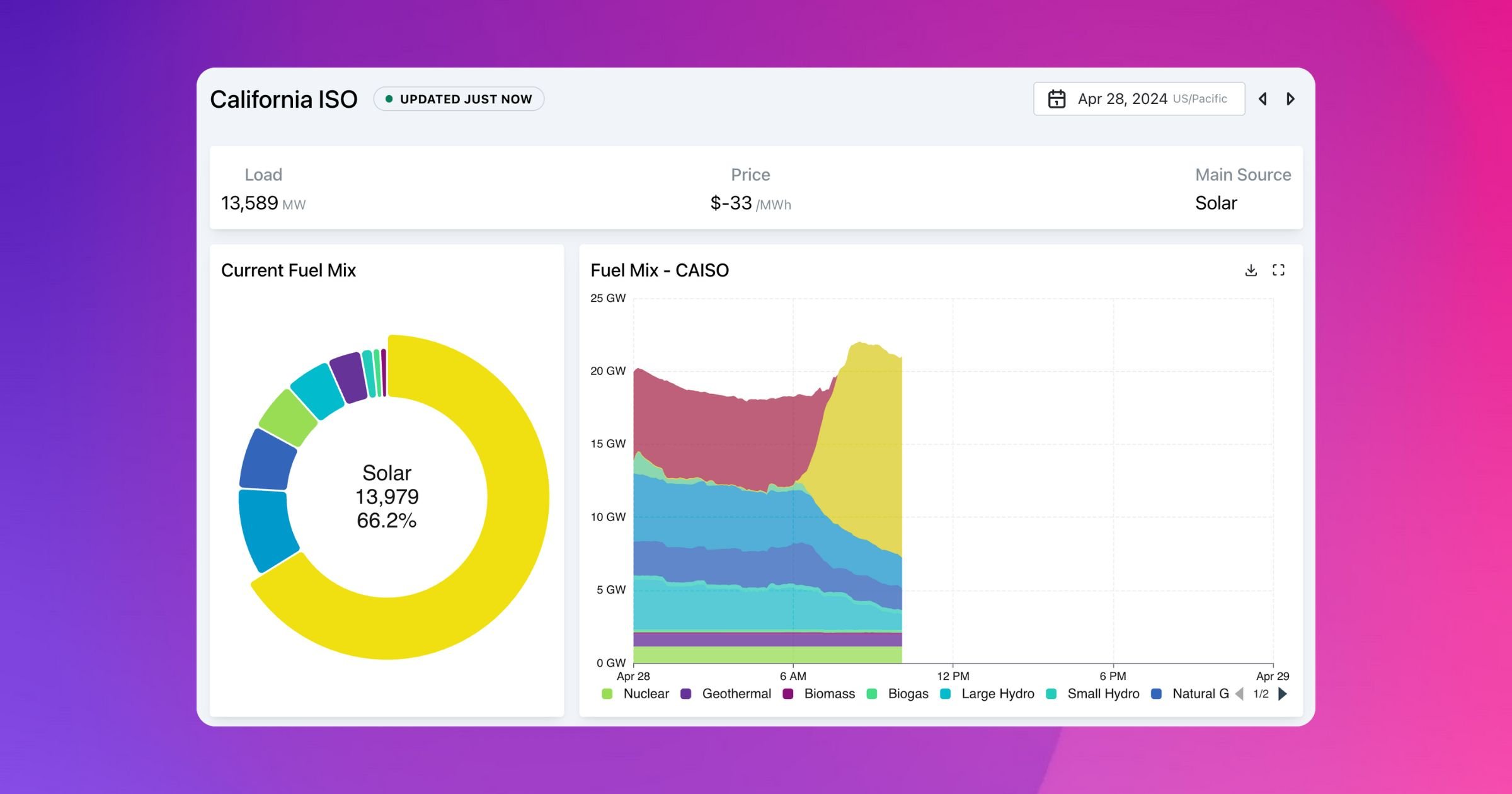
Gas plants can respond quickly to changes in load, but they need to be up and running to do that. In the future this will be done with batteries but we don’t have enough of those yet. California does have about 20x more batteries than it did a few years ago, check out the Record Tracker link. There was a new record for battery discharging 5 days ago.
I don't think that what I'm seeing suggests a bug with labeling.
On one hand it might create a new market, hopefully H2 electrolysis that replaces coal or gas in industrial processes rather than Bitcoin farms. On the other it also signals that any additional Solar is going to evict about as much capacity into such curtailments.
Anyway, California is the record-breaking market and all eyes are on it to helps us guide the global energy future.
So once there’s enough of this excess energy you’ll start to see industry soaking up as much of it as they can get.
If you “only” need ~200°C there’s some very powerful heat pumps entering the market that can give you more than 100% efficiency.
Yes I have solar, and it does not seem to help.
Meanwhile in Texas with the AC running 24/7 never had a bill over 300.
Another way to spin it: renewable electricity (except hydro) is literally worthless. You get it when you don't need it, but you don't have any guarantee it'll be available when you do.
There is zero solar power at night, you know, the time when you need the lights on.
Source: https://www.worldnuclearreport.org/The-World-Nuclear-Industr...
https://www.reuters.com/world/us/us-finalizes-11-billion-cre...
But, it's neat the way that flaw has been rebranded as "baseload". The extra energy you need when people wake up and go to work? That's someone else's problem.
But the other part is you can absolutely adjust the output of a nuclear reactor, we just don’t because the availability is there. Look up the largest power stations in the us/globally, and sort by capacity factor.
https://en.m.wikipedia.org/wiki/List_of_largest_power_statio...
I probably don't need to give my usual lecture on why pie charts suck to the HN crowd.
Can anyone comment on what is the greater impact: transmission bottlenecks or lack of sufficient demand? FYI, my back of the envelope calculation for daily curtailment is 11.4 gigawatt-hours. I'm assuming that would be bigger but for the presence of battery storage on the grid.
2. Peak curtailment is mid-April through June: peak hydro and solar production, plenty of wind, and little HVAC load: http://www.caiso.com/informed/Pages/ManagingOversupply.aspx
3. Yes, you can see that batteries are charging from solar on CAISO Today's Outlook.
4. There is an enormous amount of home solar which shows up as a drop in "Demand": http://www.caiso.com/TodaysOutlook/Pages/index.html#section-... . Set the date widget to April 8, and notice "demand" rise to 20GW at the 11:15 partial eclipse peak and drop almost 6GW over the next couple hours. Figure > 10 GW of peak output from home solar
5. Grid and home solar together (> 25GW) are roughly comparable to total load (~26GW on this cool spring day).
6. Neither the transmission nor the distribution networks can efficiently send supply to load; both have bottlenecks.
7. This waste is an opportunity for more batteries, grid-scale electrolysis, etc.
8. A GWh is worth roughly $50,000. In the context of California's (~$4T/year ÷ 365=)$10B of daily economic activity, wasting $500k is not that big a deal. Particular matter from the state's natural gas plants kills many people a day.
(Newer reactors use a big pool of molten salt as a battery and can time shift production. I wonder if the same trick could be used instead of grid-scale battery storage. I also wonder if it’s possible to play games with heat pumps to convert from electricity back to stored heat. That might be easier to ramp than new nuclear.)
[1] https://www.caiso.com/TodaysOutlook/Pages/supply.aspx#sectio...
Looks like cali needs to incentivise more dual side vertical solar panels to catch morning and evening sun to spread the curtailment