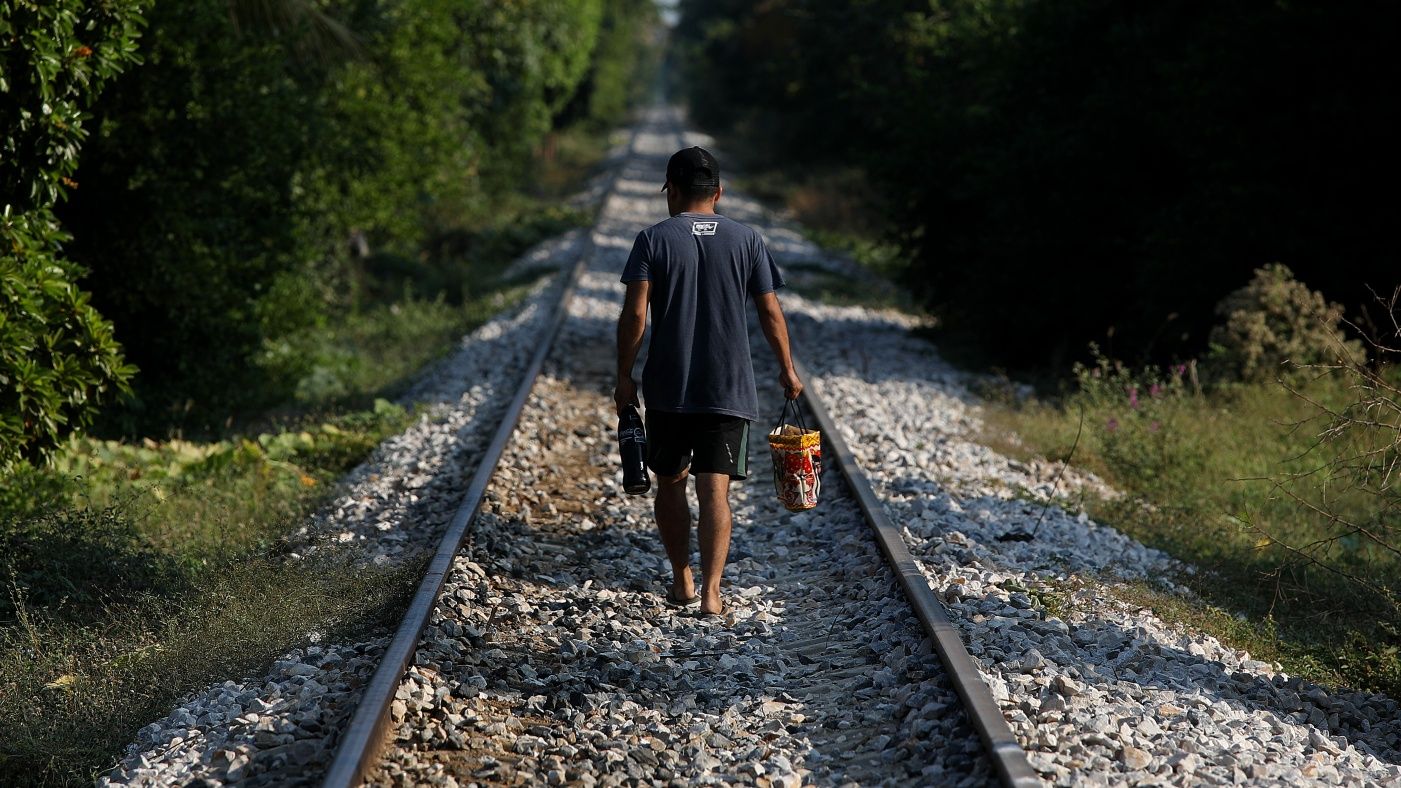
The 100-year-old railway Mexico hopes will rival the Panama Canal
The route will run across Mexico
The Week US
75 points · by mooreds · 2y ago · 119 comments
I doubt that. Isn't the Canal already operating at maximum capacity? The railroad would simply enable more traffic. It's not zero sum.
I'm assuming being able to punt and offload and swap cargo would be a welcome alternative for operators. Maybe you spend a day to offload and load new cargo but that would beat waiting two days for a slot to open up at the panama canal.
Being a specialized load (read, unusual cargo, not containerized, on a barge) I doubt transloading to rail and back onto a ship on the other side would have been practical in our case but for other cargoes? It might be an attractive alternative.
So why isn't this rail line already taking the traffic Mexico hopes for?
This is going to sound snarky, but I genuinely look forward to how this operates with the current state of the Mexico government, lawlessness, cartels, and in that particular area, insurgents.
Bad actors are not going to simply ignore the value, there.
I would really love to see Mexico become a rich country with a functional and less-corrupt government/military/law enforcement. That seems insurmountable within a generation, though.
Amen to that. That will never happen as long as we continue The War on Drugs™ -- and that appears to be an impossible habit to kick.
Decriminalizing hard drugs has been a failed experiment in Oregon, where hard drug use shot up drastically.
I think discussions on criminalizing or decriminalizing or The War on Drugs is a waste of time if the goal is to reduce drug usage because they only affect the symptoms of the drug problem. We should still discuss them, but for other reasons.
Is the problem the increased usage, or is it the secondary effects (more homelessness, etc)?
https://en.wikipedia.org/wiki/Fourth_Transformation#Infrastr...
The US needs to get its drug war policy in line, but so much is on the line that I think the cartels are going to become a point of "special emphasis" in the coming decade. Mexico is going to become the center of manufacturing for the US in all likelihood.
The cartel/drug civil war will come to an end as part of a broad sweep of investment and interest by the United States. I just don't see the cartels maintaining their political/corruption power when the stakes become so much higher.
The cartels either need to legitimize, or they'll probably get a healthy dose of US military forces attention and be ground to dust.
Sheinbaum is the current governor of Mexico city, and candidate and frontrunner for the upcoming presidential elections.
Note: Mexico doesn't do presidential reelections - even temporary holders of the post can never run for or hold it again. They had a number of civil wars and related fights around this so it's taken very seriously.
Also, if a certain skim percentage becomes acceptable loss to all parties, the cartels will want more.
Mexico’s government is bullish about prospects for the rail crossing, which will offer proximity to the US and a transit time of 6.5 hours excluding loading time — less than the eight to 10 hours it takes on the 80km canal.
Much more than transit time, I'm interested in throughput. How long does it take to move a full container ship's contents from one end to the other? How long does it take just to unload and load?
Also, regarding loading/unloading: When I think of a train, I imagine it being loaded/unloaded in semi-serial - first the front cars, then the next set of cars, as the train moves segment-by-segment past the ship. Essentially you are transforming a massive pile of containers onto a long string of containers. Is that correct? Is there any solution to speed it up? I suppose they could lay several train tracks in parallel alongside the ship and use extra train engines to pull up groups of rail cars, and then reconnect them into one long train as the train pulls out. How long is a train carrying a full container ship's capacity?
Cost seems the other essential question: Sea transport costs a fraction of rail transport, generally, but I expect that canal transport is far more expensive than open sea transport.
[0] https://www.ft.com/content/bbe8e851-e9f2-4ed1-a4a7-051a670b4...
So this rail isn't going to be tremendously useful unless they connect it directly to the USA.
As for loading the trains, they already do it in parallel; look at an arial photo of a stockyard. For this specific use, you could parallelize it even more I suspect.
Why does connecting directly to the US help? If you're in one ocean and just want to access the US, can't you just steam direct to a US port?
The whole thing comes into its own if Panama is overloaded and the other option is taking around the South America).
According to Wikipedia[1], "Container ship capacity is measured in twenty-foot equivalent units (TEU)."
And container ship size categories are (conveniently!) based on what can fit through the Panama Canal. Neopanamax ships are the category that can fit through in the canal's new (upgraded) configuration, and those can hold 10,000 to 14,500 TEU.
For round numbers I'll use 10,000 TEU. That means if you laid all the containers end to end, they would stretch out 200,000 feet, which is about 38 miles or 61 km.
Trains can stack containers two high[2], so divide that by two, and a train has to be at least 19 miles or 30 km. But really somewhat longer since one train car's containers don't butt up directly against the next car's containers.
So presumably they would need multiple trains for one ship's cargo.
---
[1] https://en.wikipedia.org/wiki/Container_ship
[2] https://en.wikipedia.org/wiki/Double-stack_rail_transport
If it is more than 8-10 hours, you start getting overlapped I/O.
As to parallelization, I wonder how much of the route is a single track. Parallel tracks could allow coming and going without interference. (then there are siding and crossover tracks, etc)
I also wonder - do you have to unload EVERYTHING? maybe just the express cargo, while the rest of the ship waits.
Or you could combine ship cargo and one ship could make the long trip, while others return back across the pacific.
Other articles:
The upgraded Coatzacoalcos - Salina Cruz line, as well the ports in both cities, are managed by the state-owned Isthmus of Tehuantepec Railway, part of the Mexican Navy.
https://www.railjournal.com/passenger/main-line/passenger-op...
By 2028, the Isthmus of Tehuantepec Interoceanic Corridor (CIIT) should see 300,000 cargo containers transit every year, with 1.4 million — about 33 million tons — by 2033. The 80-km Panama Canal moved about 63.2 million tons in 2022.
https://www.japantimes.co.jp/business/2023/11/16/mexico-rail...
bonus if they can connect to rail heading to the middle of the us (think El Paso to Denever)
I think this might be where their big advantage would be. The ports of Los Angeles and Long Beach are at capacity (and considered inefficient), and the Mexican container port of Manzanillo further down the coast is only medium-sized (1.4 million TEUs). If Mexico were to build dedicated freight corridors like India has, they could move an amazing amount of cargo into the central US.
As in, every union member gets an immediate pension and $1M cash as part of the legalization.
And the train-to-ship part would double as ship-to-ship redistribution, fanning out to different ports in both Asia and on the east coast. Basically a role similar to the one served by Atlanta in the United network.
Mexico building rail rival as water shortages drain Panama Canal
Mexico building rail rival as water shortages drain Panama Canal - https://news.ycombinator.com/item?id=38991317 - Jan 2024 (107 comments)
Plus the time to unload and load all those containers (3-4days). I don't see rail competing with the canal.
Edit: On average there are 7.5 container ships transiting the Panama canal per day. And it takes 8-10 hours to transit ocean-to-ocean.
If you can get dozens of trains from coast to coast in the time it takes to get one caego ship through the canal, that could end up being significantly more economical - and maybe even faster - in the long run.
Not really, no.
It takes 3 to 4 days to unload 1 ship, and we can assume it takes about the same time to reload them on the other side. Let's be generous, and assume that we can put the entire load on one train, that has an average speed of 40 km/h. That will be an other 8 hours gone to get from harbor A to harbor B. So, for one ship, you went from a 10 hour crossing, to 8+ days of loading-train-travel-unloading.
Now for the logistics part. If one ship holds 15,000 containers, and a train carries 400 containers, you need 38 trains to transfer 1 ship worth of containers.
In 2022, 19 ships a day passed through the Panama canal, per direction. So you would need 722 trains to process the same capacity.
You have 1440 minutes in a day, so to absorb the the incoming freight, you will need a train every 2 minutes on a single track, 24 hours a day. Which, is completely unrealistic. You can double the track, and now you have a 4 minute slot in between trains, per track. Still completely unrealistic. If you would have 5 tracks per direction, you can get to a 10 minute slot in between trains, 24 hours a day, which is still not realistic.
So, in conclusion, we can say that the rail solution does not scale better.
10 min slot is starting to be realistic. But the unloading/reloading is still not realistic. At least, not with current trains and loading cranes. If you could make special purpose rail and cars which hold 4 containers per car (2 side by side, stacked 2 high), you get 4x capacity, now only 2 tracks per direction is enough. Special cranes which could sit above whole ship and unload several containers at once would speed unloading.
Such engineering challenge would probably cost as much as original canal, but would not require so much water (water is main bottleneck currently).
It sounds impractical, but so does marshaling all the trucks and trains to get the very same containers from the original shippers to the ports of origin and from the ports of destination to the final recipients.
Sure, you could scale it and build 10 train tracks side-by-side (whoa!) which would support 5 trains in each direction, and then you'd only need to get 8 trains faster in total.
And that's disregarding the 3-4 days needed on either end to unload/load the ships.
It’s a big operation, putting together a new container-oriented freight railroad, and I hope it goes well!
Already the "drought" is causing issues with the Panama canal, and not only is that drought never-ending, it's going to get worse over time (climate change).
Is there an engineering solution to recycling more of the water and flushing less of it to sea?
I am seeing numbers that it costs anywhere between $100k-400k per trip to go through the canal, with some tens of ships per day.
So of course, this highly profitable venture would dedicate basically nothing to improving the infrastructure until it became a tire fire.
I guess in principle something like this could also be retrofitted to the existing locks.
But using less water in the first place, I'm curious what approaches might exist.
https://www.ft.com/content/bbe8e851-e9f2-4ed1-a4a7-051a670b4...
According to Wikipedia, it’s an old line that has speed limitations in some areas of 20 kph. Addressing these limitations is a substantial part of the rehabilitation project, aiming to get the speed from 20 kph up to 70 kph.
https://en.m.wikipedia.org/wiki/Interoceanic_Corridor_of_the...
“the rehabilitation is reportedly expected to result in a speed increase for trains using the railway, from 20 kilometres per hour (12 mph) to 70 km/h (43 mph) for cargo trains, and of up to 80 km/h (50 mph) for passenger trains”
The rehabilitation increased the speed from 12mph to 43mph. They are planning passenger train that can reach 50mph. So that is probably limit to the railroad.