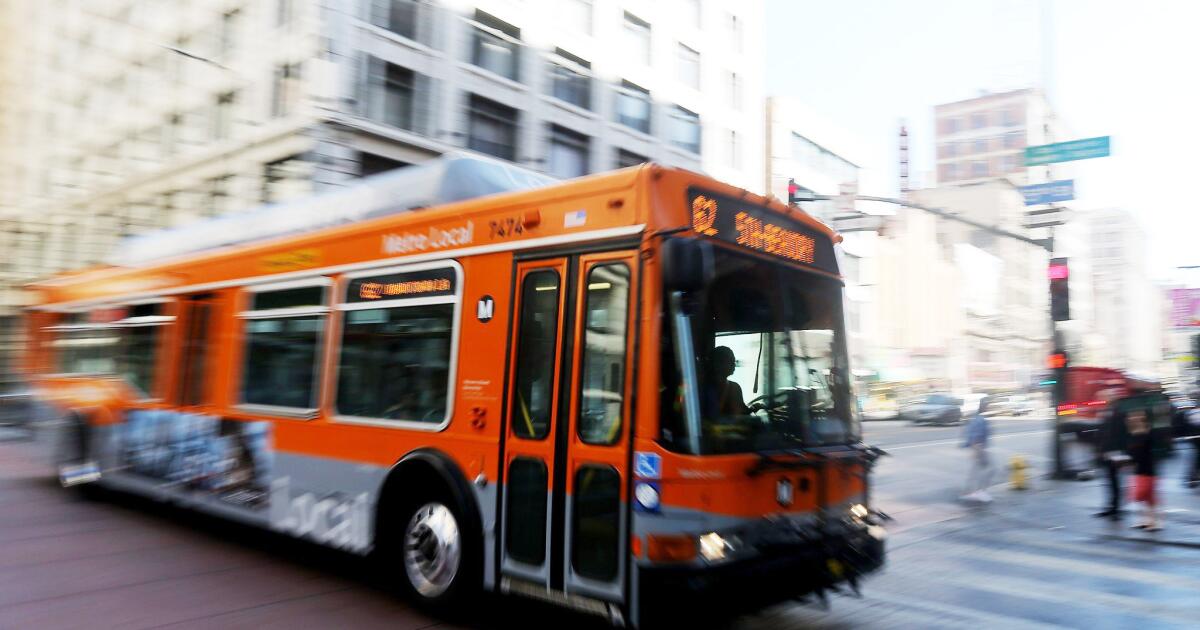
AI-powered cameras installed on Metro buses to ticket illegally parked cars
The technology from Hayden AI will help the ticketing process of vehicles parked in Metro bus lanes and at bus stops.
Los Angeles Times
93 points · by hentrep · 2y ago · 145 comments
These technologies are probabilistic with some nonzero chances of error which can't always be easily detected. These are implemented by people with some knowledge of the tech used (and hopefully the understanding of error), but are to be used by people who expect the output to be 100% true. I do not know how they would deal with tech errors which do not look like errors, but feel like there should be more cognizance about this and expectations should be set accordingly. Same goes for any facial recognition tech deployed by authorities.
[1]: https://en.wikipedia.org/wiki/British_Post_Office_scandal
Certainly a lot better than the big tech "we banned you but won't tell you why or allow you to talk to a human about it".
My only problem with more camera-based law enforcement for traffic violations is the fact that they can't tell who was driving. SO the fine goes to the registered owner of the vehicle, so folks won't want to lend vehicles. Of course, one argument is that you shouldn't loan your vehicle to some one who is going to be breaking the law... but is that really the world we want to live in, where we can't loan anything to anyone for fear of them misusing it and the owner being held responsible? I don't have a good answer there.
If you are talking about a car, then yes, that's the world I want to live in. Would they even be insured anyway?
You just declare who was driving when you receive the fine, if it's not you. It already works this way in many countries.
Only if it is that easy to contest it.
For most of the cases, won’t need a human in the loop.
I wonder if there's a phrase for that.
But what we should expect (and demand) is that the process have no higher an error rate than human reporting, and that the errors should be no harder to correct/appeal.
The only thing you can argue is that it shouldnt require a court case to dispute unless it fails a human review.
There should be a phone number, a QR code, and a printed link on the ticket that all provide a one-step process to contest a ticket. As soon as a ticket is contested it should be put on hold with no payment due until a follow-up ticket is issued by a human.
If we don't do this then we've just automated the creation of false positives without giving the victims of those false positives any equivalent advantage.
Imagine if the system was flawed and assigned all tickets with an unrecognized license plate to NULL or 000000. THe owner of that specific plate would have to spend their entire life contesting tickets.
A less extreme case of this would be a badly-trained model that always detects certain kinds of cars as occupying bus lanes, even if they're parked legally. If you're in the tiny minority that has one of those, you can't park anywhere without getting a ticket which you must contest.
If those cars end up statistically more likely to be owned by the poor / black / homeless, now the local government has a scandal on their hands.
And in Western countries with weak privacy laws, this class of technology also raises the specter of private "social credit" behavioral tracking to discriminates against and quantize people by grading their online and offline behaviors in totally opaque manners.
This is possible but we have decades of camera enforcement experience suggesting that courts are aware that these systems are not as reliable as the manufacturers claim. People have been challenging photo tickets since the previous century and there’s a well-established process for challenging them.
A typical example would be breath analysers. If humans were to judge who is drunk, there is a high error rate. With tech, the error rate is low, but if there is a bug in one of the equipments, many wrong and unnecessary arrests might be made.
I find this an interesting comment with your choice of examples as there is an extensive legal history about false positives (medical conditions, mouthwash, etc.) and the need to show maintenance and calibration records.
I was on a jury back in the 2000s where the San Diego police had to have someone from the crime lab testify about their process for managing their breathalyzers, and we ended up unanimously finding the guy not guilty on that charge because they’d messed up the process and had been a year late on calibration testing despite everyone agreeing he was drunk (based on his own testimony, receipts, and the bar staff, he’d had 3 double vodkas in the hour before getting behind the wheel, so we found him guilty on the other prong of California’s DUI statute - which is exactly what his attorney told us afterwards had been his prediction).
Technology can help with consistent enforcement. Stop light cameras, in my experience, are more impartial and objective than police officers.
Where I live in the U.S., crime is prevalent. Many laws are flouted by criminals and rarely enforced by the police or district attorneys. The system has become a farce. It's better to enforce the laws consistently, or if they're not needed, to eliminate them.
But I'm not suggesting that every law is good. If a law is not enforceable or not a net positive for the community, change it or get rid of it. But don't enforce it inconsistently, and don't apply it to certain people and not others depending on the whims of the police and the district attorneys and their personal predilections and politics.
The police should crack down hard on: license plate covers, fake license plates, fake temporary plates, etc. I suggest seizing the vehicles as contraband. Then I might support more automated enforcement. Until then, I don’t.
Cameras actively help that process, too, because they collect data showing how widespread the problem is and individual fake plates will collect tickets showing how dangerous those particular drivers are.
You can’t (currently) ticket people for crimes like speeding, but you can use it to ticket for other non-criminal violations like other parking violations, i.e., replacing meter maids.
People should not be allowed to drive unsupervised. I am anti surveillance and anti cop. There is no safe world with unsupervised driving. And so we as a society traded some of our rights, acknowledging this new dangerous tool but choosing its convenience even though this led to whole new police departments, policies, etc.
Pedestrians, bicyclists, motorcyclists, and even drivers know that the way people drive is a serious problem.
I don’t want the cameras either, but to get rid of those you have to get rid of cars.
If someone miscalculates and ends up blocking the box, they'll get honked at, but they still get to their destination faster.
If they hit someone who had a green or walk signal, I don't know what happens to them, but it doesn't seem to be enough of a deterrent.
I'd love any evidence of that and I'd wager that that statement is wrong. Blocking the box only accomplishes slowing down the cross traffic with no benefit to the person doing the blocking.
If the exit moves shortly after you blocked, you may have saved the time between when you got to move and when the light you should have stopped for turns green. If it's a long cycle, this could be meaningful, although it may depend on bottlenecks elsewhere in your path.
If the exit remains blocked until after your light cycles, you still saved the time it takes to cross over half the intersection. This probably isn't meaningful.
Of course, if your blocking of boxes actually blocks a traffic move that would unblock your exit, that's not good. And if blocking becomes common, it causes confusion and delay for everyone.
Just 5 cameras driving about the city all day ought to catch enough violators that anyone habitually parked in a bus lane will be caught and will stop doing it.
I could understand 1 camera per route maybe if the busses physically always stay on the same route.
In most areas, local residents allowed for and voted for controlled parking zones primarily to prevent commuters or tourists parking all day/week and to reduce things like car storage by dealerships. Basically, to ensure that parking was actually available for residents, to make the best of a scarce resource.
I don't believe that the intent was ever to penalise someone parking for 15-30 minutes to have a coffee or to shop, to drop off parcels, to make tradesmen have to pay to park when working, etc. Perfect enforcement is punitive, and reduces the utility of the road network overall.
My personal opinion is that these surveillance schemes are radicalising a lot of people and turning them against their elected officials. Discretion fosters trust in power.
Seems like a good deal for the city if they fine someone at least twice a day per device.
How much would you pay to clear parked cars from bus stops and bus lanes? That's going to improve route times... Although how much of a difference it makes, and how much of a difference is worth $11M, I don't know.
I’m seeing too many comments jumping to conclusions before reading this paragraph. A human will check the footage and make a final call
While this is true, the big optical character recognition breakthrough was Yann LeCun's use of Convolutional Neural Networks in the 1990s, which I think most people put in the definitions for "ML" and "AI." But of course, as John McCarthy said: "as soon as it works, no one calls it ai anymore"
If you think about, AI are just linear regressions on steroids. So we could start selling graphing calculators as having AI even.
In any case, neither the camera company nor the bus company have any authority to issue tickets, all they can do is submit complaints+evidence to the appropriate institution.
If a car is blocking a bus stop, the harm is done even if the car leaves before some official arrives to write a ticket, and it seems reasonable that the bus operator should be able to request that the law gets enforced without having to stay on the spot and point out the violation to someone - we do want a deterrent effect towards any would-be violators, that they should fear a ticket even if there are no officials onsite, and perhaps not do the prohibited thing.
What's good for one is good for all.
https://www.nbclosangeles.com/news/local/speed-cameras-comin...
The system this builds though on a multi-decade scale is total insanity.
I don't see how it is possible that there is anything resembling what we would call a free and open society in 50 years.
That assumes that the "law" in general is fair and not favouring the current hegemonic societal consensus, which is definitely not the case. What people fail to see, or fail to want to see, is that the hoi polloi, the "poors", the "plebs", in many cases had to resort to actually breaking the law here and there in order to make their world a little bit more equal. These types of laws and the way that they are now applied will actively prohibit that in the future, in effect making this a less fair/less equal world (yes, I'm saying that in many instances actually breaking the existing law makes the world fairer for a big chunk of the population).
I'm saying that more probably there was a bigger percentage of Tesla owners paying their parking tickets compared to clunker owners doing the same, so that this law (written and most especially applied in the spirit of the world inhabited by those Tesla owners) will in effect disproportionately affect the "poors"/"plebs" a lot more.
You should note that the Ingsoc party opposition to private car ownership also applies to top-hats (part of the "uniform of the capitalists"):
> Big Brother figured as the leader and guardian of the Revolution since its very earliest days. His exploits had been gradually pushed backwards in time until already they extended into the fabulous world of the Forties and the Thirties, when the capitalists in their strange cylindrical hats still rode through the streets of London in great gleaming motor cars ...
So going on that interpretation, you can tell we live in a dystopia because almost no one wears top-hats now.
Presumption of guilt by default, requiring you to pay the fine before you’re allowed to contest the alleged infraction.
Absolute rules usually means less natural justice, there are times when pursuing minor violations are not in the public interest.
Where I live, every ticket arrives with a link to view the video. This has lead to really telling moments where people have ranted about the “trap” and some even share the videos, which reliably show them rolling through stop signs or red lights.