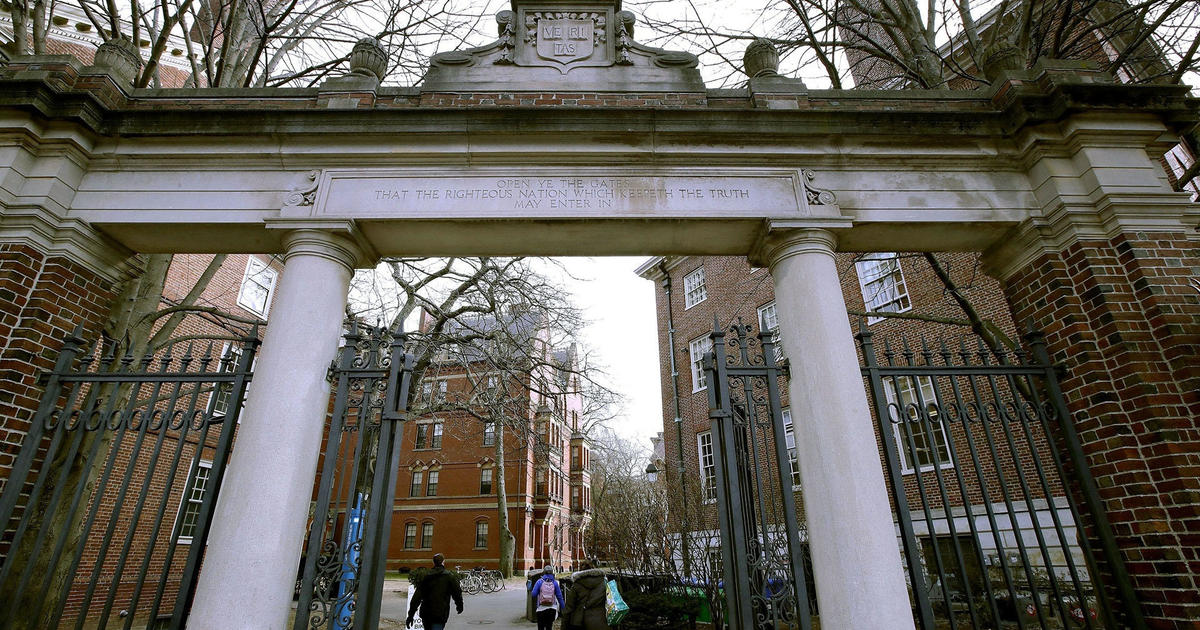
Harvard applications drop 5% after year of turmoil on the Ivy League campus
Other Ivy League universities reported an increase in applications this year, including Yale and Columbia.
CBS News
91 points · by donsupreme · 2y ago · 163 comments
[0] https://www.thecrimson.com/article/2024/4/11/harvard-busines... [1] https://forbetterscience.com/2024/01/02/dana-farberications-... [2] https://www.thecrimson.com/article/2024/1/3/plagiarism-alleg...
Plagiarism is bad, but academia as a whole suffers from it. Stanford's last president stepped down when his old lab was found to have fraudulently submitted some research.
At the same time, advancements in human understanding take place in the messy real world alongside such problems. If those are continuing or even growing, then I don't really care whether powerful donors like or don't like what Harvard's talking heads do or don't do politically
What is the base level of variance in college applications? How often do applicant counts decrease y/y? Was last year’s especially high, and thus a drop is just a return to mean?
What were the demographics of the applicant pool this year compared with prior years? Is it related to the Supreme Court decision? The school’s response to Hamas attacks?
If the latter is true we should expect similar drops at MIT and UPenn which gave similarly unpopular answers to Congress.
The decision would have two potential effects, which go in opposite directions. On the one hand, some students might decide they don't have a shot at getting in without official race-based admissions policies, and choose not to apply this year.
On the other hand, there would be some students — particularly Asian students — who didn't think they had a good shot under the old system, but who might stand a chance in the wake of this case.
Importantly, Harvard immediately made clear their dedication to diversity following the SCOTUS decision, signaling to applicants that Harvard would not simply do away with overtly racial criteria and leave the rest of the process the same. This would tend to mitigate both effects, until we see how things shake out. Either way, I doubt that the 5% drop could be based on the net effect of these two opposing forces.
If you're a poor white male student in America, you're kinda screwed from both sides. America is divided by class, but responds by addressing race. The end result is that poor white kids get held to the higher standard as if they had the advantages of their rich white peers, magnifying the discrepancy between merit and privilege even further.
If even a tiny percent of the discouraged and disenfranchised white students in flyover country believed they had a fair chance at admissions and scholarships to elite schools, that could be a huge increase in applications.
That said, I am somewhat hesitant to ascribe much impact to the poor-white-kid effect. I doubt that most of these kids would even be aware of the recent changes. Maybe in a couple years word will get out (if in fact selective colleges do implement more class-based affirmative action, which is still an open question).
That said, the SCOTUS decision alone doesn’t explain why Harvard would be affected differently than Yale. Whatever the affect is, Yale has to follow the same laws. Perhaps I should’ve left that hypothesis out.
Yes, none of the other questions or speculations even matter until this is sorted out. The article even mentions Columbia's applications increased 10% in the same season.
That an entire news article can be written about a simple percent change without including a confidence interval is poor reflection of our collective data literacy.
The usual response was: "I can't join a protest, because I'd miss Physics class!" and the organizers failed.
It made perfect sense to me, because missing even a single physics lecture was a very, very bad idea. I was hanging on by my fingernails.
RIP Prof Goodstein, my physics prof, who recently passed away. You were an awesome professor. He was also the prime mover behind "The Mechanical Universe"
https://www.youtube.com/watch?v=XtMmeAjQTXc&list=PL8_xPU5epJ...
1. When NBC cancelled Star Trek in the late '60s a group of Caltech students went and protested with signs and chanting outside the NBC offices in Burbank.
2. In 1973 people from Dabney House hung a big "Impeach Nixon" sign on Millikan library. There's a picture of that here [1], along with a copy of the letter that the President of National Oil Company then sent to the students of Dabney informing them that he was cancelling a $1 million dollar donation because of that sign. (That would be about $7 million today).
There was an on-campus sit-in about Gaza a couple of days ago [2].
[1] https://campuspubs.library.caltech.edu/3325/1/TheCaliforniaT...
https://www.latimes.com/archives/la-xpm-2010-dec-26-la-sp-cr...
That one was their second Rose Bowl prank. Here's the first [1].
Unlike high school where an A meant nothing at all. My dad (Air Force) called such things "PX ribbons", meaning you could buy them at the base exchange. The only one he ever valued was his DFC.
For $750K, that had better be all-inclusive -- don't come back to me and say you need more money for random staff bribes.
That's fine for billionaires, but the rest of us scraping by will have to do it the hard way, by paying a consultant $750K to get the right unmarked bills to the right people, with plausible deniability.
I guess it feels too tenuous a connection because I never thought about university politics when applying but maybe the marginal student is thinking about different things. I decided not to apply to some schools because the essay requirements were too long, or I didn’t they’d give me enough financial aid.
Or it could be a blip for some reason.
I wonder what the over-acceptance ratio is for ivy leagues. Just because you got in doesn’t mean you can afford to go.
It's hard to accept the right number of applicants when yield isn't exactly linear year to year
Intuitively, the turmoil likely causes the decrease.
Let's say we have 3 groups:
1. Support Palestine 2. No strong opinion 3. Support Israel.
Before the Hamas massacre, the 3 groups already apply to Harvard.
Now that Harvard showed to support Palestine borderline Hamas. It alienates Number 3 and partly Number 2.
Number 1 already applies to Harvard therefore doesn't increase in size.
The administration's response to protests has a chilling effect and discourages students who care about their right to protest.
I think your first sentence is completely accurate and as a result I'm going to pay less attention to my intuition.
I doubt this is true. Harvard suppressed protests many times in the past. That didn't seem to discourage students in the past. This is not new.
> I think your first sentence is completely accurate and as a result I'm going to pay less attention to my intuition.
Because it merely goes against your intuition. That's all. Let's not act like you would require definite proof for everything.
Could you share some history with us? How was it the same and how different than what happened recently.
Also, the suppression of the president of Harvard by outside forces seems new?
https://www.thecrimson.com/article/2024/4/11/harvard-sat-act...
Harvard stopped requiring the SATs, and then started again.
> The Cambridge, Massachusetts-based school received 54,008 applications for the class of 2028, according to the Harvard Crimson, the campus newspaper. The undergraduate college at Harvard University accepted 1,245 of those applicants, giving the incoming freshman class an acceptance rate of 3.59% — the highest admission rate in four years, the publication noted.
There are schools like UF, FSU, Purdue, Auburn, etc that offer great educations with good name recognition. Obviously not the same recognition as a Harvard or similar but kids are not assaulted and brain washed into getting kicked out or arrested
I went to a decidedly unfancy university (WGU), I think it was fine, and then I went to a slightly fancier University for graduate school (University of York, UK), but I still didn't get callbacks for the Wall Street jobs that I applied for [1]. Obviously there are thousands of factors that could lead to me not getting a callback, but eventually one recruiter outright told me that I shouldn't waste my time applying because I didn't go to a "top 20 school", and to "try working for a bank instead".
Keep in mind, I'm hardly a "fresh graduate", I have like 13 years of software engineering experience and have worked at a FAANG and other very large corporations and have spoken at multiple technical conferences. For most companies that's more than good enough (I actually worked at Apple when I was still a dropout), but the Wall Street world seems to care a lot more about yuppie credentials.
What I'm getting at is there are some careers where the quality of the education itself is secondary. They want to see some fancy names on the resume and it really doesn't matter if you're "qualified". It's not fair, it's arguably classist, but they didn't ask me when making these policies.
[1] Though some people tell me that I might have dodged a bullet with that one.
What is that based on? (Also, why those particular schools?)
Here's one way to look at it:
To learn something, some people want to learn from the best in the world and to study with the best in the world. They want to change the world and want to maximize their potential; they want professors and fellow students who can challenge them as much as possible, who can take them as far as possible.
Some people are more oriented toward a less maximizing path, which is fine - maybe more about learning what is in the textbook from a decent professor. Possibly they indeed wouldn't benefit from Harvard. I suspect when people say things like 'Auburn's education is the same quality as Harvard's', they mean that the kind of education they got at Auburn wouldn't be better at Harvard. Maybe that's true, but Harvard offers something far greater, not available at Auburn. It's a chance to work with (and build relationships with) the very best minds in the world, some of the best in human history.
Think of that kid in your high school who just blew away every class, even the hardest ones; who found other things outside school or at nearby colleges to challenge them. That kid wants to be around other kids like them, who challenge them, and around professors who can make the most out of their potential and passions.
I don't have any hard data, but I've worked with a ton of people who have been to a bunch of different schools, including Ivy League and they weren't appreciably better engineers than the people who went to decent state schools.
I mentioned those particular schools because the parent comment mentioned them.
> It's a chance to work with (and build relationships with) the very best minds in the world, some of the best in human history. > Think of that kid in your high school who just blew away every class, even the hardest ones; who found other things outside school or at nearby colleges to challenge them. That kid wants to be around other kids like them, who challenge them, and around professors who can make the most out of their potential and passions.
Ok, no, I call bullshit, that's a common thing I hear about expensive yuppie schools but I don't buy it. The really hard decent students can easily be priced out because they don't want $300,000 of student loan debt. Not everyone can get scholarships.
And "best minds in the world"? "best in human history"? Really? Think of nearly any politician that you think is a moron (I won't name names), and they probably went to an Ivy League school. I think it's utterly ridiculous to assume that only rich yuppies with rich yuppie parents are the "best minds in the world".
This is elitist horseshit, and frankly I think it's harmful. It's an absurdly reductive and honestly naive view of the world, that really only exists to have some feeling of smug superiority about how smart you are because you went to a school that was paid for by your multimillionaire parents or you got into $300,000 of debt to learn the same shit you could learn at a decent state school.
ETA:
Sorry, I was wrong, people that are going to college aren't "yuppies" because they're not professional yet. Their parents might be yuppies, or just rich.
I agree it's primarily finance and law, but I don't think they have a monopoly on elitist snobbery.
The protests are docile. There are almost no reports of violence. I've seen more than one 'encampment' at various schools; it's just people hanging around tents. Most of the chaos and violence were introduced by law enforcement. How could the protestors be any less disruptive and still be protesting? Picket lines are more disruptive.
Protests with chaos and violence include large crowds destroying and looting. The reactionaries are so anxious to assume the protestors are awful that they just seem to assume or say there is 'chaos and violence' and people repeat it, despite overwhelming evidence to the contrary.
For how much longer do you expect them to remain docile?
FWIW, your assumptions about the protestors seem to match the preconceived notions (conveniently serving anti-progressive politics) of the neoreactionaries - before the protestors even begin, they are terrorists, etc.
Judge them by what they do, not all that nonsense: they have been peaceful everywhere.
Because there's no better signal to potential employers for recent college graduates?
The media ignores them, but there's tons of protests at state schools as well. Guess you could send your kids to some religious university I suppose.
There were also protests in TX state schools, same result essentially.
Some schools don't allow other students to take over the campus and prevent other paying students from access or attending class. They also don't permit violence. Obviously each of those schools has their own political agenda controlled by their govenors but kids can go to class.
People hanging out on lawns don't prevent anyone from attending class. The encampments have been, to the best of my knowledge, entirely peaceful. Certainly the one at Columbia has been.
You can disagree with the protestors. You can think they're trespassing or that they're being too disruptive. But you don't get to lie on my watch.
Where did those things happen, specifically? At Columbia, the university administration shut down campus; it was functioning fine otherwise (except for one building on the last day).
You get wonderful things and 'good trouble'.
One of the most noteworthy instances of student activism in the history of the university I went to was recruiting people to fight for the enemy in WW1. Those people then formed the core of the army that won the subsequent civil war. Things were bad for a while, but the country turned out to be mostly fine 15-20 years later.
Some students will look at what's happening on these campuses and be disgusted by the protestors. Some of them will be proud of them. Some of them will be frightened of the crackdown from administration. Some of them will take it as a challenge.
The pro-Palestine protestors on campus have been, as far as I can tell, almost entirely peaceful everywhere in the country.
Can you provide a credible source for that?
> The pro-Palestine protestors on campus have been, as far as I can tell, almost entirely peaceful everywhere in the country.
Yes, agreed.
1: Examples of "counter protest attack"
https://twitter.com/TeresaWatanabe/status/178557561046900747...
https://twitter.com/caitiedelaney/status/1785562553025765774
In Europe universities have always been hotbeds for protest and debate. It's why they exist. They have a role beyond being a fucking diploma mill.
Although if I had to get myself into 100k student debt I might think differently...
Do you have a source? I don't think this is true.
I suspect Harvard, Yale, etc. will always carry some cachet. But the days of the elite, universally recognized golden ticket are probably gone forever.
Harvard has long been the beneficiary of a reputation of “if you get in, you’re very likely to go, as it’s probably also your top choice or very close.” This maintained an upward pressure force in Harvard to keep it a top school, because short term a strong reputation drives top-ranking students that want to study with other top students, and long term those high quality students are likely to accomplish more and further reinforce the reputation.
The flywheel starts to break if when you’re choosing between Harvard and somewhere else, you pick somewhere else. These kinds of small shifts are the rumblings you’d expect to see if the edifice was beginning to crack.