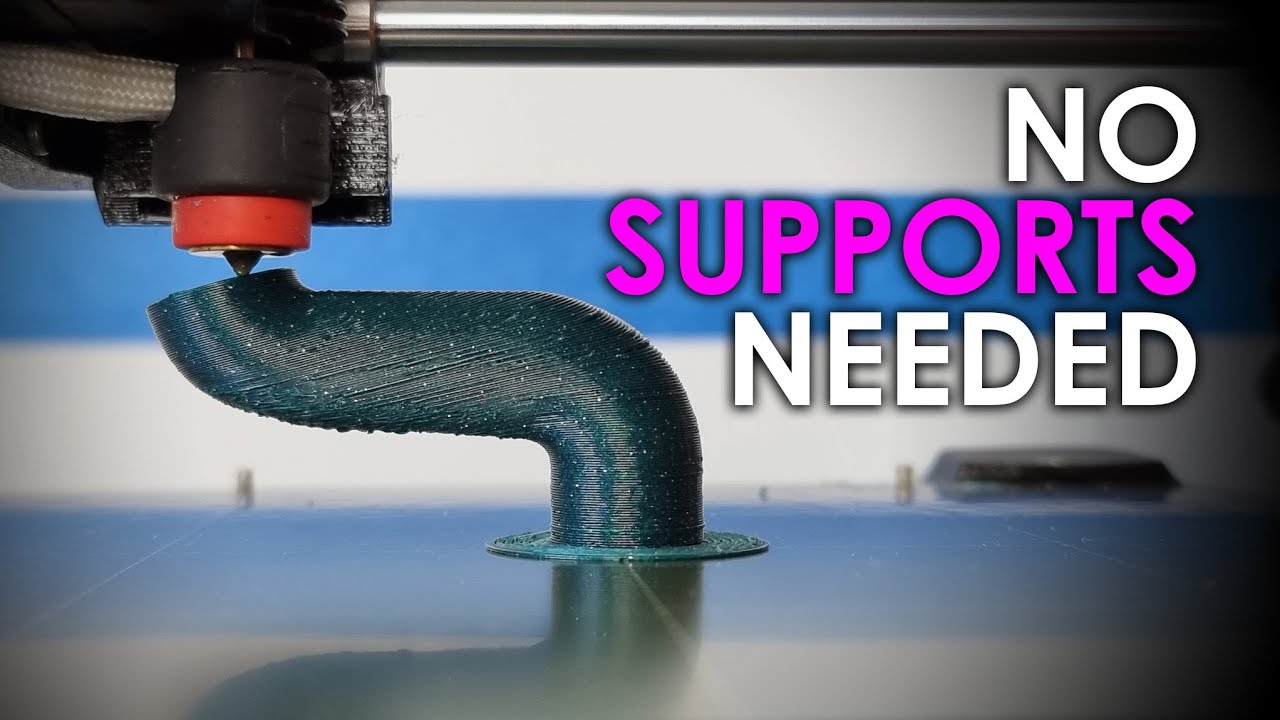
Conical Slicing: A different angle of 3D printing | CNC Kitchen
Conical slicing tilts the layers into cones instead of stacking flat planes, which lets you print steep overhangs without support. The catch is your printhead.
CNC Kitchen
120 points · by fanf2 · 2y ago · 54 comments
There's a whole frontier here, to build 3D printing systems that have more intelligent path planning than just slicing.
https://en.wikipedia.org/wiki/Crinkle_crankle_wall
There'll be a limit (some point before the head hits the previous layer), but it would still help to mitigate the weakness of planar printing.
crinkle crankle walls are that way to make them strong in flexure, so they don't just fall over when the wind hits them (failing in tension in the mortar joints between the bricks at the base on the windward side). that particular failure mode isn't relevant here because the other layers of the print already protect against that
And doing it only 2 or 3 layers in height shouldn't be out of reach for most FDM printers while adding significant strength I'd imagine.
But "I'd imagine" and "real world execution" are very different things!
He saw some strength gains, though not huge gains.
The core idea is basically the same as that of the Nubian vault, so the core idea is very ancient. One can do this with snow too, to build somewhat surprising structures without having to use supports.
I'll admit that lower complexity might be better.
When prototyping maybe it's better to tweak parts a bit for better 3d printing. And rely on simpler slicing tech.
More software might not make it more reliable, which is probably a bigger problem.
Current limits are annoying, but my 3d printer can still do a LOT I couldn't do before.
The firmware supports them last I checked, it's the slicers that don't output proper arcs.
https://www.reddit.com/r/BambuLab/comments/w15mg6/improvemen...
Can you elaborate on this? How was the process more unpredictable?
Edit: Actually, come to think of it, it's common for the front to remain open, for easily viewing the nozzle during printing. So non-planar prints should be possible on pretty much any printer in the y axis at least.
It's originally designed for belt printers but the extra clearance works here too.
One nit though about the website: I found it very distracting that the images kept cycling between slides, and by the time I was halfway down the article, I realized that they were cycling even when off-screen.
The big issue that I have is that the orientation of the layers determines the strength of the part. Any vertical tension pulls the layers apart, so sometimes I wish I could somehow print a part in two orientations to make it stronger...
The doors are about 4'h x 5'w. The hinges broke on the left door a few years ago and I printed some more in PLA from a Thingieverse design (1). They have put up with quite a lot of weather (UK, South West). One did fail but not by layer separation - the hinges sheared diagonally across the layers, ie the "threads" snapped instead of separating. I printed another and a huge lump of plastic carries on being useful instead of land fill.
I generally use a gyroid infill but that is as far as I go off piste from the defaults. Prusa MK3S - self assembled, stock everything. Filament "Sunlu" ie Amazon random and it seems to work well.
If layer printing is an issue for you then you might want a different process or look into inter layer adhesion. I'm no expert on that but I did study Civ Eng at college so I have an idea about shear and moments n that. I generally print small parts where strength isn't an issue. If you need a reasonable challenge to test your gear, try printing a small tank and turret (2) pick one with a long barrel and print it with the barrel vertical.
(1) https://www.thingiverse.com/thing:2187167 (2) https://www.thingiverse.com/thing:3553160
In the case of the hinges you linked to, if you were to set yourself the challenge of printing them standing upright on one thin edge, with the hinge barrel running horizontally, the layers would run parallel to the barrel and ultimately run vertically when attached to a standard door. This would make it likely that the hinges would break much more easily once the weight of a door was applied. Happily, this orientation would be crazy, and the obvious orientation (with the large flat areas flat on the print bed) is a strong one.
https://hackaday.com/2020/09/23/reforming-3d-prints-with-sal...