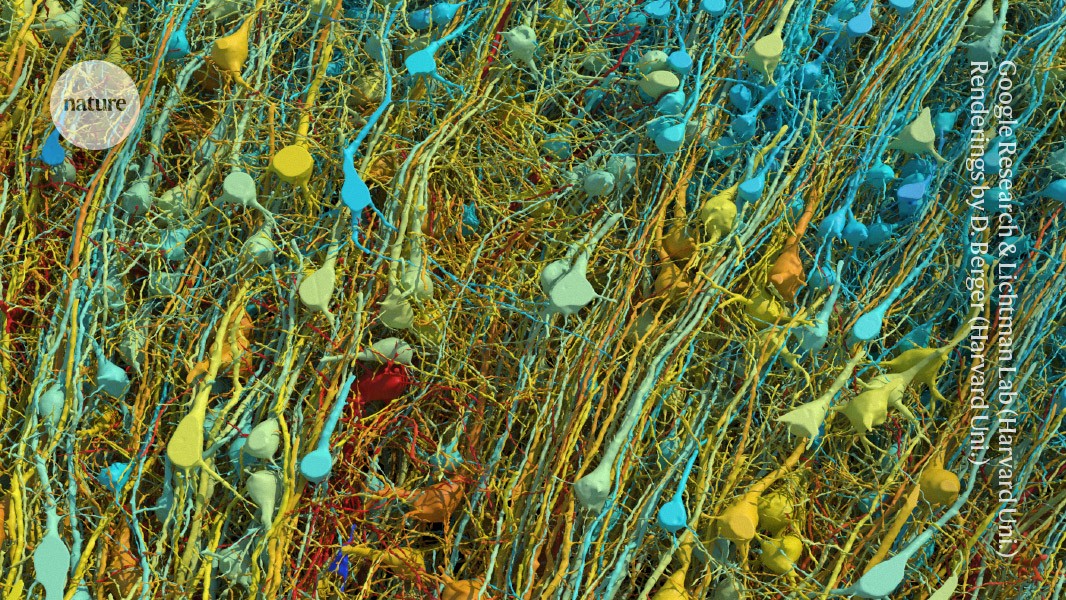
Cubic millimetre of brain mapped in spectacular detail
Google scientists have modelled a fragment of the human brain at nanoscale resolution, revealing cells with previously undiscovered features.
nature.com
520 points · by geox · 2y ago · 201 comments
https://h01-release.storage.googleapis.com/gallery.html
I count seven.
I'm particularly fond of the "Egg shaped object with no associated processes". :)
What if it's a "wireless" device?
As a complete outsider who doesn't know what to look for, the dendrite inside soma (dendrite from one cell tunnelling through the soma of another) was the biggest surprise.
http://h01-dot-neuroglancer-demo.appspot.com/#!gs://h01-rele...
To think that’s one single millimeter of our brain and look at all those connections.
Now I understand why crows can be so smart walnut sized brain be damned.
What an amazing thing brains are.
Possibly the most complex things in the universe.
Is it complex enough to understand itself though? Is that logically even possible?
If someone did this experiment with a crow brain I imagine it would look “twice as complex” (whatever that might mean). 250 million years of evolution separates mammals from birds.
So one would just need to pick that little cube out of our cerebellum, to have that 'twice as complexity'.
We have more detail than this about the C. elegans nematode brain, yet we still no clue how nematode intelligence actually works.
LLMs that work at a very crude level of string tokens and emit probabilities.
the sheer number of things that work in co-ordination to make biology work!
In-f*king-credible !
This is great and provides a hard data point for some napkin math on how big a neural network model would have to be to emulate the human brain. 150 million synapses / 57,000 neurons is an average of 2,632 synapses per neuron. The adult human brain has 100 (+- 20) billion or 1e11 neurons so assuming the average rate of synapse/neuron holds, that's 2.6e14 total synapses.
Assuming 1 parameter per synapse, that'd make the minimum viable model several hundred times larger than state of the art GPT4 (according to the rumored 1.8e12 parameters). I don't think that's granular enough and we'd need to assume 10-100 ion channels per synapse and I think at least 10 parameters per ion channel, putting the number closer to 2.6e16+ parameters, or 4+ orders of magnitude bigger than GPT4.
There are other problems of course like implementing neuroplasticity, but it's a fun ball park calculation. Computing power should get there around 2048: https://news.ycombinator.com/item?id=38919548
Quote:
"Large language models are made from massive neural networks with vast numbers of connections. But they are tiny compared with the brain. “Our brains have 100 trillion connections,” says Hinton. “Large language models have up to half a trillion, a trillion at most. Yet GPT-4 knows hundreds of times more than any one person does. So maybe it’s actually got a much better learning algorithm than us.”
GPT-4's connections at the density of this brain sample would occupy a volume of 5 cubic centimeters; that is, 1% of a human cortex. And yet GPT-4 is able to speak more or less fluently about 80 languages, translate, write code, imitate the writing styles of hundreds, maybe thousands of authors, converse about stuff ranging from philosophy to cooking, to science, to the law.
The human brain does what it does using about 20W. LLM power usage is somewhat unfavourable compared to that.
Humans know a lot of things that are not revealed by inputs and outputs of written text (or imagery), and GPT-4 doesn't have any indication of this physical, performance-revealed knowledge, so even if we view what GPT-4 talks convincingly about as “knowledge”, trying to compare its knowledge in the domains it operates in with any human’s knowledge which is far more multimodal is... well, there's no good metric for it.
Ironically, I suppose part of the apparent "intelligence" of LLMs comes from reflecting the intelligence of human users back at us. As a human, the prompts you provide an LLM likely "make sense" on some level, so the statistically generated continuations of your prompts are likelier to "make sense" as well. But if you don't provide an ongoing anchor to reality within your own prompts, then the outputs make it more apparent that the LLM is simply regurgitating words which it does not/cannot understand.
On your point of human knowledge being far more multimodal than LLM interfaces, I'll add that humans also have special neurological structures to handle self-awareness, sensory inputs, social awareness, memory, persistent intention, motor control, neuroplasticity/learning– Any number of such traits, which are easy to take for granted, but indisputably fundamental parts of human intelligence. These abilities aren't just emergent properties of the total number of neurons; they live in special hardware like mirror neurons, special brain regions, and spindle neurons. A brain cell in your cerebellum is not generally interchangeable with a cell in your visual or frontal cortices.
So when a human "converse[s] about stuff ranging from philosophy to cooking" in an honest way, we (ideally) do that as an expression of our entire internal state. But GPT-4 structurally does not have those parts, despite being able to output words as if it might, so as you say, it "generates" convincing text only because it's optimized for producing convincing text.
I think LLMs may well be some kind of an adversarial attack on our own language faculties. We use words to express ourselves, and we take for granted that our words usually reflect an intelligent internal state, so we instinctively assume that anything else which is able to assemble words must also be "intelligent". But that's not necessarily the case. You can have extremely complex external behaviors that appear intelligent or intentioned without actually internally being so.
Exactly this.
Anyone that has spent significant time golfing can think of an enormous amount of detail related to the swing and body dynamics and the million different ways the swing can go wrong.
I wonder how big the model would need to be to duplicate an average golfers score if playing X times per year and the ability to adapt to all of the different environmental conditions encountered.
This doesn't mean that an entire human brain doesn't surpass llms in many different ways, only that artificial neural networks appear to be able to absorb and process more information per neuron than we do.
An LLM cannot possibly have any concept of even what a proof is, much less whether it is true or not, even if we're not talking about math. The lower training data amount and the fact that math uses tokens that are largely field-specific, as well as the fact that a single-token error is fatal to truth in math means even output that resembles training data is unlikely to be close to factual.
And yet somehow it's also infinitely less useful than a normal person is.
Pdf: “Protein molecules as computational elements in living cells - Dennis Bray” https://www.cs.jhu.edu/~basu/Papers/Bray-Protein%20Computing...
The calculation is intentionally underestimating the neurons, and even with that the brain ends up having more parameters than the current largest models by orders of magnitude.
Yes the estimation is intentionally modelling the neurons simpler than they are likely to be. No, it is not “missing” anything.
From the sibling comment:
> Individual proteins are capable of basic computation which are then integrated into regulatory circuits, epigenetics, and cellular behavior.
If this is true, then there may be many orders of magnitude unaccounted for.
Imagine if our intelligent thought actually depends irreducibly on the complex interactions of proteins bumping into each other in solution. It would mean computers would never be able to play the same game.
I remember an interview with one neurologist who stated humanity has for centuries compared the functioning of the brain to the most complex technology devised yet. First it was compared to mechanical devices, then pipes and steam, then electrical circuits, then electronics and now finally computers. But he pointed out, the brain works like none of these things so we have to be aware of the limitations of our models.
Based on the stuff I've read, it's almost for sure too simple a model.
One example is that single dendrites detect patterns of synaptic activity (sequences over time) which results in calcium signaling within the neuron and altered spiking.
So we might need significantly less brain matter for general intelligence.
Rather than "humbling" I think the result is very encouraging: It points at major imaging / modeling progress, and it gives hard numbers on a very efficient (power-wise, size overall) and inefficient (at cable management and probably redundancy and permanence, etc) intelligence implementation. The numbers are large but might be pretty solid.
Don't know about upload though...
We may not get there. Doing some more back of the envelope calculations, let's see how much further we can take silicon.
Currently, TSMC has a 3nm chip. Let's halve it until we get to the atomic radius of silicon of 0.132 nm. That's not a good value because we're not considering crystal latice distances, Heisenberg uncertainty, etc., but it sets a lower bound. 3nm -> 1.5nm -> 0.75 nm -> 0.375nm -> 0.1875nm. There is no way we can get past 3 more generations using Silicon. There's a max of 4.5 years of Moore's law we're going to be able to squeeze out. That means we will not make it past 2030 with these kind of improvements.
I'd love to be shown how wrong I am about this, but I think we're entering the horizontal portion of the sigmoidal curve of exponential computational growth.
The car's engine, transmission and wheels, require no muscles or nerves
On the second point, the failure of Openworm to model the very well-mapped-out C. elegans (~0.3k neurons) says a lot.
It’s fascinating, but we aren’t going to understand intelligence this way. Emergent phenomenon are part of complexity theory, and we don’t have any maths for it. Our ignorance in this space is large.
When I was young, I remember a common refrain being “will a brain ever be able to understand itself?”. Perhaps not, but the drive towards understanding is still a worthy goal in my opinion. We need to make some breakthroughs in the study of complexity theory.
Yes we figured out how to build aircraft.
But it can not be compared to a bird flying. Neither in terms of efficiency or elegance.
The same argument holds for "AI" too. We don't understand a damn thing about neural networks.
There's more - we don't care to understand them as long as it's irrelevant to exploiting them.
Yes, which is why the current explosion in practical application isn’t very interesting.
> we don't care to understand them as long as it's irrelevant to exploiting them.
For some definition of “we”, I’m sure that’s true. We don’t need to understand things to make practical use of them. Giant Cathedrals were built without science and mathematics. Still, once we do have the science and mathematics, generally exponential advancement results.
Try experimenting with immersing your brain in preservatives and staining with heavy metals to see how would you be able to write the comment similar to the above.
No wonder that monkey methods continue to unveil monkey cognition.
I think we all do every day
Note the part where the biologists tell him to make an electron microscope that's 1000X more powerful. Then note what technology was used to scan these images.
We have made some progress it seems. Googling I see "up to 0.05 nm" for transmission electron microscopes and "less than 0.1 nanometers" for scanning. https://www.kentfaith.co.uk/blog/article_which-electron-micr...
For comparison the distance between hydrogen nuclei in H2 is 0.074 nm I think.
You can see the shape of molecules but it's still a bit fuzzy to see individual atoms https://cosmosmagazine.com/science/chemistry/molecular-model...
That said I do get this eerie void feeling from the image. My first thought was to marvel how this is what I am as a conscious being in terms of my "implementation", and it is a mess of fibers locked away in the complete darkness of my skull.
There is also the morose feeling from knowing that any image of human brain tissue was once a person with a life and experiences. It is your living brain looking at a dead brain.
It's definitely along these lines. Like so much (everything?) that is us happens amongst this tiny little mesh of connections. It's just eerie, isn't it?
Sorry for the mundane, slightly off-topic question. This is far outside my areas of knowledge, but I thought I'd ask anyhow. :)
If the wires make consciousness then there is consciousness. The substrate is irrelevant and has no bearing on the awesomeness of the phenomena of knowing, experiencing and living.
I'd be much more horrified to see our consciousness simplified to anything smaller than that, which is why any hype for AGI because we invented chatbots is absolutely laughable to me. We just invented the wheel and now hope to drive straight to the Moon.
Anyway, you are seeing a fake three dimensional simplification of a four+ dimensional quantum system. There is at least one unseen physical dimension in which to encode your "soul"
More project details: https://www.ll.mit.edu/sites/default/files/other/doc/2023-02...
Does anyone have any insight into how this is done without damaging the sample?
It's also the tome as in book, more properly one volume of a multi-volume (or multi-part) set, though it now generally simply means any large book.
Paper: https://www.biorxiv.org/content/10.1101/2021.05.29.446289v4 See Figure 1.
The ATUM is described in more detail here https://www.eden-instruments.com/en/ex-situ-equipments/rmc-e...
and there's a bunch of nice photos and explanations here https://www.wormatlas.org/EMmethods/ATUM.htm
TL;DR this project is reaping all the benefits of the 21st century.
[AI] "The installed base of global data storage capacity [is] expected to increase to around 16 zettabytes in 2025".
Thus, even the largest supercomputer on Earth cannot store more than 4 percent of state of a single human brain. Even all the servers on the entire Internet could store state of only 9 human brains.
Astonishing.
Obviously I'm not advocating for this, but I'll just link to the Mad TV skit about how the drunk president cured cancer.
In any case, it seems likely that we're on track to have both the computational ability and the actual neurological data needed to create an "uploaded intelligences" sometime over the next decade. Lena [0] tells of the first successfully uploaded scan taking place in 2031, and I'm concerned that reality won't be far off.
They don't even know how a single neuron works yet. There is complexity and computation at many scales and distributed throughout the neuron and other types of cells (e.g. astrocytes) and they are discovering more relentlessly.
They just recently (last few years) found that dendrites have local spiking and non-linear computation prior to forwarding the signal to the soma. They couldn't tell that was happening previously because the equipment couldn't detected the activity.
They discovered that astrocytes don't just have local calcium wave signaling (local=within the extensions of the cell), they also forward calcium waves to the soma which integrates that information just like a neuron soma does with electricity.
Single dendrites can detect patterns of synaptic activity and respond with calcium and electrical signaling (i.e. when synapse fires in a particular timing sequence, the a signal is forwarded to the soma).
It's really amazing how much computationally relevant complexity there is, and how much they keep adding to their knowledge each year. (I have a file of notes with about 2,000 lines of these types of interesting factoids I've been accumulating as I read).
Unless one's understanding of algorithmic inner workings of a particular black box system is actually very good, it is likely not possible not only to discard any of its state, but even implement any kind of meaningful error detection if you do discard.
Given the sheer size and complexity of a human brain, I feel it is actually very unlikely that we will be able to understand its inner workings to such a significant degree anytime soon. I'm not optimistic, because so far we have no idea how even laughingly simple, in comparison, AI models work[0].
[0] "God Help Us, Let's Try To Understand AI Monosemanticity", https://www.astralcodexten.com/p/god-help-us-lets-try-to-und...
Wonder how they figured out which fragment to cut out.
I worry this might make the sample biased in some way.
How do they know if their AI did it correctly or not?
I wonder if this plays into the mechanism of epilepsy. Self-arousal...?
Anybody qualified to comment on?
If all of the layers were guaranteed to be orthographic with no twisting, shearing, scaling, squishing, with a consistent origin... Then yeah, there's a huge number of ways to just render that data.
But if you physically slice layers first, and scan them second, there are all manner of physical processes that can make normal image stacking fail miserably.
[1] https://www.biorxiv.org/content/10.1101/2021.05.29.446289v4.... [2] https://www.ilastik.org/
Growing actual bio brains is just way easier. Its never going to happen in silicon.
Every machine will just have a cubic centimeter block of neuro meat embedded in it somewhere.
I strongly believe that there is a TON of potential for synthetic biology-- but not in computation.
People just forget how superior current silicon is for running algorithms; if you consider e.g. a 17 by 17 digit multiplication (double precision), then a current CPU can do that in the time it takes for light to reach your eye from the screen in front of you (!!!). During all the completely unavoidable latency (the time any visual stimulus takes to propagate and reach your consciousness), the CPU does millions more of those operations.
Any biocomputer would be limited to low-bandwidth, ultra high latency operations purely by design.
If you solely consider AGI as application, where abysmal latency and low input bandwidth might be acceptable, then it still appears to be extremely unlikely that we are going to reach that goal via synthetic biology; our current capabilities are just disappointing and not looking like they are gonna improve quickly.
Building artificial neural networks on silicon, on the other hand, capitalises on the almost exponential gains we made during the last decades, and already produces results that compare to say, a schoolchild, quite favorably; I'd argue that current LLM based approaches already eclipse the intellectual capabilities of ANY animal, for example. Artificial bio brains, on the other hand, are basically competing with worms right now...
Also consider that even though our brains might look daunting from a pure "upper bound on required complexity/number of connections" point of view, these limits are very unlikely to be applicable, because they confound implementation details, redundancy and irrelevant details. And we have precise bound on other parameters, that our technology already matches easily:
1) Artificial intelligence architecture can be bootstrapped from a CD-ROM worth of data (~700MiB for the whole human genome-- even that is mostly redundant)
2) Bandwidth for training is quite low, even when compressing the ~20year training time for an actual human into a more manageable timeframe
3) Operating power does not require more than ~20W.
4) No understanding was necessary to create human intelligence-- its purely a result of an iterative process (evolution).
Also consider human flight as an analogy: we did not achieve that by copying beating wings, powered by dozens of muscle groups and complex control algorithms-- those are just implementation details of existing biological systems. All we needed was the wing-concept itself and a bunch of trial-and-error.
Are you counting epigenetic factors in that? They're heritable.