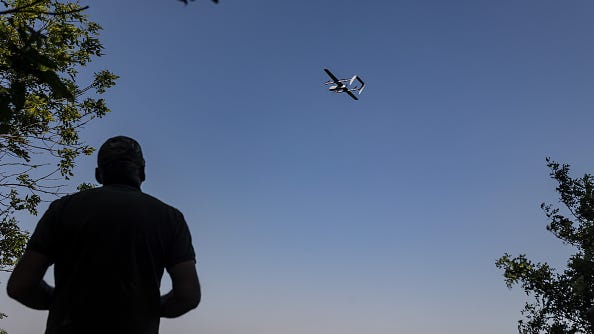
The Ukraine war is driving rapid innovation in drone technology
Ukraine is attacking Russian vehicles with drones that cost as little as $450.
understandingai.org
57 points · by jseliger · 2y ago · 115 comments
NATO armed forces have comparatively small amounts of armoured ground vehicles and artillery.
They need to and want to learn from the current war, but still keep in mind that their circumstances are different.
In fact a study came out in 2022 that made the Pentagon panic because it's estimated in a war with China, the US will deplete its entire anti-ship missile stockpile in only a week.
Western attack helicopters are just one prong in the meat grinder that would grind up enemy infantry formations and entrenchments far quicker than they can be replenished.
NATO vs Russia in a conventional war is basically the West hitting the delete button. Nuclear blackmail is about the only thing sparing Russian forces from that fate.
A war with China is more of a defensive situation. If large-scale infantry combat even had the opportunity to take place I'd be surprised.
That said it's always prudent to plan for the worst contingencies however remote.
At least, if somebody doesn't take Putin out.
Vks has superiority at least along the front line since this spring maybe winter. What they dont have is supremacy
A superior air force and air superiority are different concepts. The latter refers to a conflict-time status in a particular theatre.
But it doesn't really matter: collective defense is the whole point of the North Atlantic Treaty Organization.
The drones are too small, cheap and numerous to use a modern fighter jet's weapons against.
As far as drone defense, we already have KuRFS/Ku-720(mobile version)[0,1] radar to track drones/etc that works with a phalanx, 50-caliber guns, 30mm cannon, and coyote drones. We're also deploying a 50kw palletized laser (w/ KuRFS) with the DE MSHORAD program[2].
All of these programs predate the 2022 Ukraine invasion. The Coyote (designed at the start to take out small drones) first took flight in 2007[3].
0. https://www.rtx.com/raytheon/what-we-do/integrated-air-and-m...
1. https://www.rtx.com/raytheon/news/2021/10/11/rmd-proves-coun...
2. https://www.rtx.com/raytheon/what-we-do/integrated-air-and-m...
I don't think it's necessary true that the war devolves into a lot of loss of life and trench warfare. That's mostly the result of a stalemate. The Russians expected Ukraine to be a pushover. That didn't happen.
It is the other way around. Ukraine has a GDP per capita that is (prewar) 3 times that of Russia's.
Russia's oil does a lot. Using oil/gas fuels supports Russia's war economy by creating demand and raising their prices in the commodities markets, in addition to contributing to the climate disaster.
A snip from the post
The Analyst....
By this stage the Russians had lost most of their APC’s and tanks were standing well back acting more as artillery. The Russians then started the widespread use of what looks like golf carts and ATV’s to reinforce their infantry. Later they started using motorbikes.
With their armor gone the infantry were sent in meatwaves. *This lead the Ukrainians to mount their Octocopter heavy lift drones (which the Russians are generally very afraid of), with light machine guns to bring down the infantry attacks. While experimental these drones proved very effective, their only problem being recoil issues firing the gun. It’s planned to solve the recoil quite quickly, but using machine learning and thermal optical sights shows huge promise. This makes the drones less susceptible to having their control link severed - even if they do they can operate alone and return themselves to base. The day of the gun armed autonomous AI drone it seems, is here.*
The Russians continue infantry attacks but they have now stopped supporting them with any armor and have turned north instead, trying to find a weaker spot.
An outstanding and imaginative Ukrainian defense with limited resources yet again, blunts the relentless hammer blows of meatwave attacks backed by dwindling armor.
I remember I mentioned that this the future of drones few years ago and everyone in the seminar laughed about it, but it’s a reality now. The next one is AI deciding what to target, which I believe is already in place as Israel is using it already, and apparently failing miserably with all the civilians casualties.
I don't think we have the data to reliably determine the impact of Israel's AI usage on civilian casualties. Sam Harris this week had an expert for urban and subterranean warfare from West Point on. He explained that it's impossible to get accurate numbers this quickly. In Mosul we apparently didn't have any numbers till a year after the battle ended. The ones we eventually got had huge error margins. This is before we even talk about ability to trust the source of the numbers. He further makes the point that the reported numbers we have right now are astonishingly low given we are talking about a war in a dense urban area, especially once we consider that Hamas has dug a huge tunnel system under civilian infrastructure to which civilians don't get access for shelter.
The expert's explanations on the show are worth every minute of it.
Sauce: https://www.samharris.org/podcasts/making-sense-episodes/366...
The article makes an assumption that Ukraine has out-innovated Russia in terms of drones. That used to be true (in 2022-2023), with Ukraine's adapting low cost high availability commercial drones as weapons. However since the war has entered the long term Russia's industrial sector has outsupplied Ukraine in terms of quantity of drones, and has reached parity in terms of quality. The realities of the battlefield has seen the cheap and available commercial drones ineffective against mitigations (electronic warfare, surveillance and counter-battery, out-ranging and out-timing). Therefore the contest around drones has moved from quantity of commercial drones to cost-effective quality of drones in the face of countermeasures. This has even pushed some areas of the front to stop using FPV drones (on both sides) in favor of more traditional military drones.
The point of this is actually one of cost. Drones are effective weapons in large part due to their cost-effectiveness. As frequency-hopping modems, larger processors, and multi-frequency antennas are added to cheap drones they start getting expensive - to the point the cost-effectiveness suffers and their drawbacks start becoming more serious.
The article lists drone missions: mine clearing, evacuation, aerial drones, land drones, demining drones, ... . These are mainly overstretches. In terms of how drones have actually been employed in the war, there are naval drones which have been effective at holding Russia's Black Sea Fleet at risk, there are FPV drones which have been used primarily to stall the frontline defensively, and there are long range drones (not mentioned) that are used as an alternative to e.g. ballistic and cruise missiles.
There are R&D projects, many of them failed at employing drones for many missions. There are some partial successes in using them to lay mines (and fake mines). But there isn't as much success in using them for de-mining. Lifting a person for evac is very challenging to do with a drone, especially an autonomous one. Somehow "surveillance" doesn't make the list, but probably the #1 contribution/mission of drones is battlefield visibility.
The article compares taking 200 artillery shells to kill a building, vs 1 drone to kill a soldier. This is not only inaccurate, but it's apples-to-oranges.
Drones have not replaced artillery in the Russo-Ukraine war and they aren't going to. Drones cannot be massed because they interfere with one another in the electromagnetic spectrum. They also require a significant number of people to operate compared to artillery. The munitions on drones are far less powerful than artillery (e.g. drones have trouble destroying armor, artillery doesn't). Simple means (mesh, nets, smoke) can shut down drones - but have nothing on artillery. There's so much to say here but it's not even comparable and the article bases its primary takeaways from this incorrect assumption.
The article discusses that drones can fly "up to 22km". It doesn't mention that these require re-transmitter drones, which need separate pilots, separate modems, logistics coordination and ultimately - a much higher price tag. It can be worth it for certain missions, but it's hardly true that innovation has somehow created drones that are just better units. It's more that the employment of drones in warfare has gotten better - the command and control has gotten better.
The artificial intelligence aspect of drones is typically a "terminal flight system", one that can take over to seek non-moving targets once EW has shut down communications. While its true that Russia and Ukraine both use terminal flight guidance systems to deal with the "last mile" of EW cover, its nearly impossible to use this to hit moving targets or to hit vehicles with armor in the areas that are needed to achieve disablement or a kill.
The DoD has applied Project Maven to solve the problem the article discusses: automatically identifying targets to strike (which honestly applies to more than just drones - can be used for artillery, etc). Unfortunately Project Maven has been disappointingly significantly less accurate than human analysts at identifying battlefield targets on the same imagery.
I could go on, but I think the article is kind of stuck in 2022?
There's a certain pitch one can make for drones, and Ukraine is making that pitch. But I suspect the author might have too narrow a set of sources or some kind of biased interest, for what they are writing about.
I think we've all seen these drone shows, where a large swarm maneuvers to make shapes in the sky, right? We're not far at all from one operator controlling a swarm, capable of pre-programmed formations and maneuvers.
The economies of scale work overwhelmingly in favour of drones -- small, light, disposable.
There's some far-flung future in which drones are fully autonomous and in fact don't even need antennas. At that point it's possible they can be massed. But it's a bit of a science fiction. At least, there isn't any such product available (commercial or military) and this isn't how drones are being used in war.
For economies of scale - true also of artillery and other equipment! The more you can scale production the more cost-effective the weapon. As mentioned, drones in the Russo-Ukraine war are starting to see their cost-effectiveness wane due to having to become larger (larger munitions, large antennas, etc), heaver (bigger batteries, larger munitions, etc), and non-disposable (high cost frequency hopping gear, difficult to find munitions, difficult to source batteries, etc).
Giant technological leaps could happen, but it's nerve wracking to bet the outcome of a war on something like that.
(Sure, you could make a cluster of GPUs do that, in a test. It's completely different to do it in war.)
Small and medium drones are much more precise than artillery and remain incredibly effective at surveillance, spotting and at attacking the poorly operated, low survivability armor that Russians have, despite countermeasures. Ukraine is now domestically mass-producing bomber UAVs able to deliver multiple mortar rounds semi-autonomously on a target. While ECMs (jammers) have undoubtedly reduced drone effectiveness, ECMs come at a cost. A small ECM will have a very localized effect, while a large ECM can be taken out with anti-radiation missiles, as the Ukrainians have been doing.
Everyone is also recognizing the huge psychological effect of drones in the battlefield now. Any kind of massing is getting increasingly risky, communications, autonomy and mobility become critical.
The main point of the article is that the war is driving innovation in drones, which is pretty self-evident and doesn't seem overstated at all.
So while you may see videos of drones taking out tanks, they are often tanks that have already been killed and drones come in on an immobile target, etc.
You would also think that Ukraine is using more drones than Russia - based on the videos. But Russian Armed Forces don't need to fundraise for their equipment on Telegram, and what videos of Russian drone attacks that are published don't make it to trending in American social media (because "disinformation").
What's happening on the battlefield and what you see in those drone videos are very different due to selection bias.
Drones have less of a psychological effect than, say, glide bombs or artillery. This is due to the size of the munitions.
The broad thesis that war is driving innovation in drones isn't incorrect. But the supporting material in the article is (I've listed some of them above, and you seem to agree with them, point by point?). The article is overstating the case for drones, even calling them the successors of artillery. That's all my comment is addressing - let's right size and calibrate this: drones are being innovated on, however they are less effective at higher expense than they used to be, they very well may continue to trend in that direction, and they aren't a replacement for conventional weapons.
I guess another way to put it is the title of the article isn't wrong. But if you read the article, the content clearly is.
Those tanks are immobilized by other drones or mines.
> You would also think that Ukraine is using more drones than Russia - based on the videos.
Yep, Ukraine uses more drones than RF in both absolute and relative terms, because Ukraine uses 10x less artillery shells.
The Ukrainian government doesn’t pre-pay for orders, leaving manufacturers to come up with the capital to produce their drones. Without more funds, they’re unable to make more than a few thousand a month. This lack of upfront money is a problem, Mykhailo said. "
10's of billions were given to Ukraine. How come there is not enough money to pay for what seems to be very cheap and effective weapon?
[0] https://en.m.wikipedia.org/wiki/Ukraine_Democracy_Defense_Le...
On the other hand Russia has addopted the same tactic and now have flow of drones estimated to be atleast 2x more drones than ukraine.
Ukraine doesn't have many better alternatives. They can strike some energy infrastructure (which they've done) in an effort to affect Russian willpower. It can also try to hit airfields (which they've done) hoping to take out equipment, but Russia has been pretty good at moving equipment out of the way.
The strike campaign itself has been moderately effective but definitely short of a war-winning enterprise. Estimates on the actual damage on production and exports has ranged between the fantastical (28%) to the banal (6%). It looks like domestic petrol supply has been hit the hardest in terms of tangible economic costs, since oil prices have remained reasonable with lessened seasonal demand and lower OPEC supply targets. Russia has additionally made deals with Kazakhstan and Belarus to attempt to mitigate some of the economic effects, has been able to repair oil refinery damage, and has experimented with a range of mitigations.
The strike campaign has been further complicated by the US election year. The Biden Administration has asked Ukraine to stop targeting oil refineries, because global oil instability could cause a crisis that ultimately causes global issues, rising prices, and Biden a second term. Such strikes are expected to uptick after November. And with the possibility of long range missiles from military sponsors, plus winter-time difficulties, this might be a good window to see what Ukraine can really do.
Either way I think the article is not about the long range drones you are alluding to here, but the small commercial sized drones and mid-cost military drones that are based on them.
I agree that lack of weapons for direct assault limits some of the upside benefits as in "you cannot directly win a war on defensive moves" but you can force a better, safer, more advantageous outcome. In effect, Russia is losing a war of attrition on it's economy and materiel side. It does have massive manpower and stocks. It doesn't have infinite supply of economic resilience and home front tolerance for a failing economy undermines Kremlin myths.
Sometimes, not losing is the best you can get pending more help.
Ukraine is not losing.
Russia is not winning.
But I agree that they should continue the strike campaign. They can't do much else on the battlefield right now. It's the right thing for them to look at areas they can raise cost and complexity for the Russians. I just wouldn't round it up too much...
I disagree that Russia is losing a war of attrition on economy (look at Russia's economy vs Ukraine's!). On a materiel side, maybe, Russia is using a lot of its stockpiles and those will eventually dwindle. But Russia is not somehow out of the fight when those stockpiles get low. On the other side of attrition, Ukraine is low on military aged men, artillery, fortifications, air defense. There's a strong argument to be made that Russia is the one winning the war of attrition, at least for the foreseeable future.
Russia is winning right now. But that doesn't mean it will win. The future isn't determined. I agree with you that a prolonged war won't necessarily go Russia's way, and that it may eventually lose the will to continue.
As a hypothetical:
If the attacker invests approximately zero resources, the defender invests crazy amounts of resources, then even approximately zero actual damage is a great outcome for the attacker. The real damage is in the resources wasted on defense.
Btw, this is pretty close to what our societies did to our own civilian air travel in response to terrorist threats in the 2000s.
(I have no special insight into the numbers for the current war. But I wouldn't sneeze at 6% reduction.)
I see your point but I don't think the hypothetical as stated is a fair depiction of the dynamic.
But they surely need more effective ways to take out Russian military airplanes, especially those which are bombing the front line and cities. Not sure why allies can't supply them with needed technology to do it - they should possess some.
Not sure F-16s would help here in patrolling closer to launch points and intercepting the aircraft prior to dropping their payloads; or whether they would be too vulnerable. But, it does seem like a job for stealth interceptors, and certainly makes the case for air superiority.
Isn't that the point, though? Hit refineries, forcing Russia to sell more crude oil to the world, and have less refined oil internally to turn into gas, etc?
None of that is to say Ukraine shouldn't try, or that it doesn't have some "annoying" affect that increases costs and complexity for Russia. It does. Just want to be accurate about the level of affect and its potential.
And again, I think November after the election is going to be the best show of what Ukraine can do.
I've had fantasies of doing another 1-3 years COVID style, but putting all 2 trillion dollars into cancer research instead of a vaccine that saves 1% of old, obese, and sick people. (or swap it with global warming cures, whatever you want to mobilize the world on)
That's a good idea, you should do that.
> instead of a vaccine that saves 1% of old, obese, and sick people
So... you're not going to use any mRNA vaccine research?
It was never about saving lives.