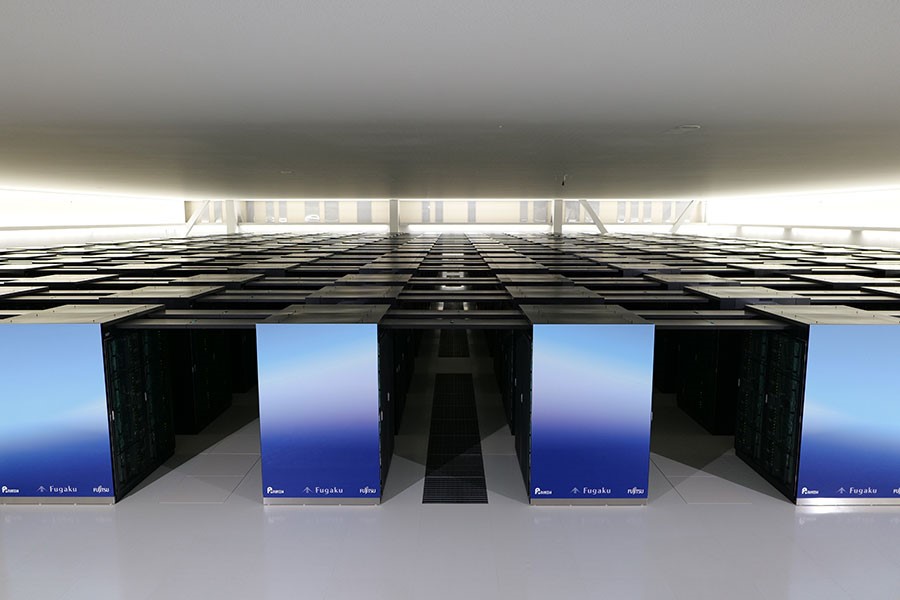
Release of “Fugaku-LLM” – a large language model trained on the supercomputer “Fugaku”
Release of “Fugaku-LLM” – a large language model trained on the supercomputer “Fugaku”
Fujitsu Global
106 points · by gslin · 2y ago · 42 comments
https://www.fujitsu.com/global/about/resources/publications/...
With that said, both GPT-4 and GPT-4o seem to do a good job at understanding the semantics of prompts written in Japanese. I would like to see how this model compares, given that it seems like it's trained with more Japanese data (but that may not necessarily be useful if all they did was scrape affiliate blogs)
Impressive advancements right?
There isn't really a figure for how much compute time it takes to train this thing, but 8x H100s have 32PF of AI compute among them. This job had 2,100 (half precision[1]) PF-in-fugaku / 158,956 nodes-in-fugaku * 13,824 nodes-in-job = 182 PF-in-job, implying it can get the job done 5.6x faster, or a little over ten days at the most optimistic.
Electricity costs for these nodes for ten days looks fairly similar to the rental costs of 8xH100s for 60 days according to my research. Lambda labs seems to have very cheap instances for 8xH100, but AWS and its ilk are much higher. However, the comparison is a little weird, as Fugaku is also a few years old now, and the contemporary GPU at the time of its release was the A100 (1/13th of an H100). The next Fujitsu chip may well narrow the power/performance gap between itself and (say) Blackwell or whatever is current at the time.
[1] https://www.fujitsu.com/global/about/innovation/fugaku/speci...
Doing it in the CPU was the whole point.
I can't seem to find a lot of technical documents regarding NEC SX processors online, but I could find outrageously priced PCIe accelerator cards(released 2021, $18k, 300W, 4.91TF FP32, 48GB VRAM) that are supposed to be its descendants, while Fugaku sits there GPU-less, maybe such is the life.
> 1,024 A100s were used for 19 days to train the model.
> NVIDIA models are trained on a diverse set of public and proprietary datasets. This model was trained on a dataset containing 3.8 Trillion tokens of text.
If you could do it, we'd already have SETI like networks for AI.
Most modern large models cannot be trained on one instance of anything (GPU, accelerators, whatever), so there's no alternative to distributed training. They also wouldn't even fit in the memory of one GPU/accelerator, so there are even more complex ways to split the model across instances.
The lack of superposition means you can't efficiently train one layer separately from the others either.
That being said, a popular non-linear function in modern neural nets is ReLU[2] which is piece-wise linear, so perhaps there's some cleverness one can do there.
[1]: https://en.wikipedia.org/wiki/Superposition_principle
[2]: https://en.wikipedia.org/wiki/Rectifier_(neural_networks)
Really depends on your problem, but in practice, the answer is usually "no".