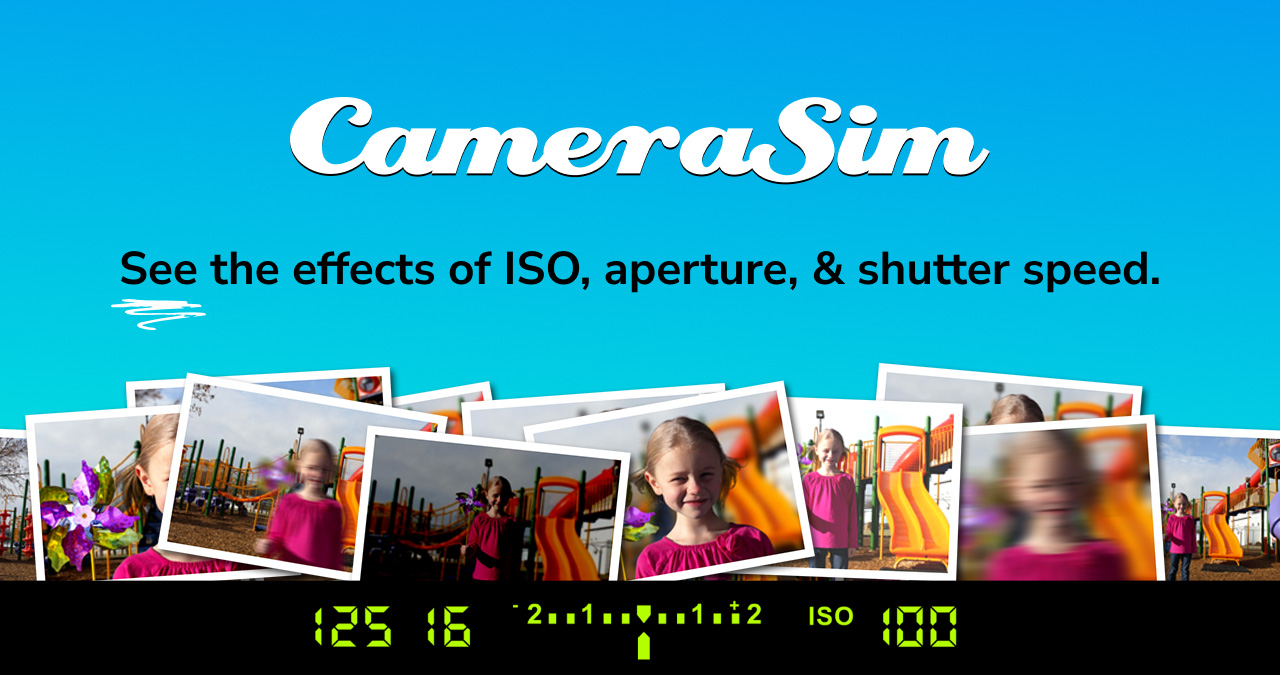
The Web's Original CameraSim
A visual guide to exposure controls for photographers
camerasim.com
134 points · by johnx123-up · 14y ago · 69 comments
Seems to me like DSLRs don't really need simulators. Pick up a DSLR, dial it to P or green or whatever, and go. It's simpler and more responsive than a point and shoot, just bigger and heavier. (My four year olds love using my smaller DSLR and have less trouble using it than a small P&S.)
Anyone wanting to learn the fine points of photography can learn them at their leisure once the key point — using a DSLR is EASIER than using a point and shoot — is absorbed, and simulators that overload the user with information are probably counter-productive.
For these people, this kind of simulator could be really helpful. It might be a little better if there was more explanatory text after you press the shutter. For example, I saw "overexposed" once; maybe that message could be more along the lines of "Your image is overexposed. Try decreasing your aperture, decreasing your shutterspeed, or adjusting exposure compensation."
I imagine a control that indicates the trade-offs (and when they're ok) as you tweak it would educate users in a better way than experimentation. Stay "inside the envelope" and your picture is probably ok. You can get outside it if you know what you're doing.
That being said, I absolutely agree that the only way to learn photography is to get out there and shoot.
Mostly agree, but I see there as being two parts of photography.
The art, which is seeing, composing, etc. For that, you do have to just get out and shoot.
The craft, which is knowing what settings to use and when. You can learn this by trial and error by "just going out and shooting", but having someone teach you, reading about it, or using an app that demonstrates what happens with a settings change will not only save time, but make the time spent shooting that much more productive.
For dancing, it's much the same, you need to get out there and do it. But there is also a lot of time spent deliberately refining your ear for the music, your feeling for the beat what position your body should be in and how a lead should feel. Each play into the other but if one is neglected, it's hard to progress.
If you're really going to learn via shooting, you need to bracket your shots, line them up side by side in an app like Lightroom or iPhoto and look at the metadata to see what changed in the scene from the setting changes. Most people aren't going to bother doing this.
If an app like this is done properly, it would let you see the DOF and exposure changes more coveniently than post-shot chimping can.
There's an even better mode one Pentax DSLRs where one dial acts as a P dial and the other controls ISO.
My girlfriend just got her first DSLR and was struggling with changing the aperture. While she understood the concepts, she wasn't familiar with working with a DSLR alone and since I wasn't physically present, it took me a while to realise over the phone she'd been changing the aperture by changing the focal length of the lens. (The D5100 has a pretty crappy and unintuitive control combination for setting aperture.) Had I been able to point her to a simulation like this it would have been clear to her that she needed a distinct method of setting aperture.
To set aperture on a D5100 switch to A and use the command dial.
(Shooting in Manual mode is simply torturing yourself unnecessarily if you don't know exactly what you're doing. In Aperture priority — or Program shift — setting aperture is simple and intuitive.)
My D7000 is more straightforward since it has a separate dial for this and no need to half depress the shutter release. (I assume you can also change the settings using the LCD, but that's of no use if you're looking through the viewfinder and trying to set manual exposure.)
While I agree that constant aperture lenses are substantially costly than their variable aperture counterparts, cameras like Canon 5D Mark III is coming with a 24-70 F/2.8L II lens as a kit.
http://www.youtube.com/watch?v=6-NhJua5NFA
The relationships between the basic elements of exposure seem so straightforward now.
Some, like shutter speed, don't make a difference until you hit the button, but it would have been nice to see the DOF changes in real time.
Still, a great little tool. Very handy.
And of course, there is virtually no way to reflect the ISO or shutter speed setting, using the optical viewfinder. Not a bad idea to "simulate" here as well, because it's not funny to shoot in the aperture-first mode and forget to reset ISO from some ridiculously high value that you had to use yesterday in the evening.
ITYM, "Why doesn't this SLR camera have burst mode?"