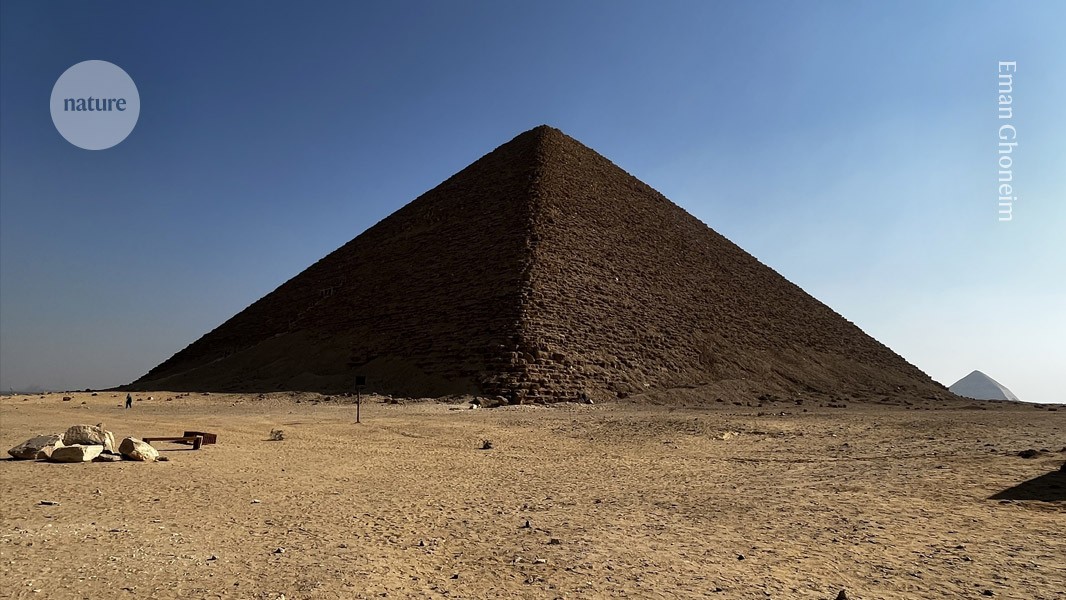
Found at last: long-lost branch of the Nile that ran by the pyramids
Geological survey reveals the remains of a major waterway that ancient Egyptian builders could have used to transport materials.
nature.com
354 points · by gumby · 2y ago · 404 comments
https://en.wikipedia.org/wiki/Diary_of_Merer
In fact it describes artificial basins, found in previous core samples.
Nice article about that, lots of pictures:
https://the-past.com/feature/records-of-the-pyramid-builders...
> The biggest unknown with my model is whether there was a major western Nile channel at the time, as modern authorities are split on this question.
Seems like what we have now is the discovery of a natural branch, which doesn't mean they didn't dig out useful extensions too.
The Nature article calls this branch a "tributary of the nile", which is the opposite thing to a branch. The paper says distributary (a branch). The tributaries are way to the south in Sudan and Ethiopia and Kenya.
Here's the paper:
The water came most of the way up to the now seasonal lake near the pyramids there.
But also the river used to flood so there were some seasons when the water was high enough to easily transport the stone directly from Tora I assume.
https://www.smithsonianmag.com/history/ancient-egypt-shippin...
>They said also that the first man who became king of Egypt was Min; and that in his time all Egypt except the district of Thebes was a swamp, and none of the regions were then above water which now lie below the lake of Moiris, to which lake it is a voyage of seven days up the river from the sea: and I thought that they said well about the land;
Later on
>Such is this labyrinth: but a cause for marvel even greater than this is afforded by the lake, which is called the lake of Moiris, along the side of which this labyrinth is built. The measure of its circuit is three thousand six hundred furlongs (being sixty schoines), and this is the same number of furlongs as the extent of Egypt itself along the sea. The lake lies extended lengthwise from North to South, and in depth where it is deepest it is fifty fathoms. That this lake is artificial and formed by digging is self-evident, for about in the middle of the lake stand two pyramids, each rising above the water to a height of fifty fathoms, the part which is built below the water being of just the same height; and upon each is placed a colossal statue of stone sitting upon a chair. Thus the pyramids are a hundred fathoms high; and these hundred fathoms are equal to a furlong of six hundred feet, the fathom being measured as six feet or four cubits, the feet being four palms each, and the cubits six. The water in the lake does not come from the place where it is, for the country there is very deficient in water, but it has been brought thither from the Nile by a canal; and for six months the water flows into the lake, and for six months out into the Nile again; and whenever it flows out, then for the six months it brings into the royal treasury a talent of silver a day from the fish which are caught, and twenty pounds when the water comes in. The natives of the place moreover said that this lake had an outlet under ground to the Syrtis which is in Libya, turning towards the interior of the continent upon the Western side and running along by the mountain which is above Memphis.
¯\_(ツ)_/¯
https://en.wikipedia.org/wiki/Pedestals_of_Biahmu
But Herodotus just reported what he was told, like with the gold-digging ants:
https://en.wikipedia.org/wiki/Gold-digging_ant
Which seem to have been real (marmots). So who knows.
This account lends some credence to theories of the pyramids functioning as some sort of ram pump in my opinion. (Check out John Cadman’s work if you’re interested).
0: https://www.newdawnmagazine.com/articles/ancient-mysteries/a...
Humans think of rivers as static things and like to use rivers as natural "borders" and forget that these are actually organic and evolving systems.
The Great Pyramid Grand Gallery locks have spots for things that roll or that rope rigging may have pulled around.
Hydrological engineering pyramid construction methods: Herodotus, Strabo, Edward J. Kunkel "The Pharaohs Pump", Steven Meyers, Chris Massey
Herodotus > Life > Early Travels: https://en.wikipedia.org/wiki/Herodotus#Early_travels
https://www.secretofthepyramids.com/herodotus :
> For this, they said, the ten years were spent, and for the underground chambers on the hill upon which the pyramids stand, which he caused to be made as sepulchral chambers for himself in an island, having conducted thither a channel from the Nile.
Sounds like the same story for the Osireion, according to Strabo.
There's a speculative map in "Water Transportation During Khufu Time" https://www.secretofthepyramids.com/projects/project-three-w... :
"Probable look at waterways of Giza during Khufu time" https://images.squarespace-cdn.com/content/v1/600615bf2f57da...
https://www.secretofthepyramids.com/latestnews references:
"Nile waterscapes Facilitated the Construction of Giza Pyramids During the 3rd Millennium BCE." (2022) https://www.pnas.org/doi/full/10.1073/pnas.2202530119
Timeline of Glaciation; the last ice age ended around 11,700 years ago: https://en.wikipedia.org/wiki/Timeline_of_glaciation
"Rock art indicates cows once grazed a lush, green Sahara" (2024) https://newatlas.com/science/cattle-rock-art-sahara-desert/
Ancient megalithic Geopolymer masonry made with electrodes and [Lingam,] electricity is apparently lost to modern day as well.
FWIU, in the Great Pyramid, there were/are copper rods in the shafts out from the King's Chamber, and the conductive gold at the top of the pyramid was added after construction over top of a perhaps more ancient well shaft (that is not as geomagnetically-aligned) that may have been a hydraulic/hydrologic water tunnel given the water erosion in the subterranean chamber.
Fairly, Demonstrate moving and then placing an 80 ton granite stone with ancient materials and tools: copper, gold, limestone, granite, probably fulgurite (sand glass due to lightning) and/or volcanic glass, obsidian, grain dust, papyrus rope, papyrus boats, barges, [variable buoyancy] crane machines, masonry forms and jigs, chemistry in jars, large sceptre tuning forks, sand, porous cliffs by the sea
What are the dates on the outer structure, and on the oldest largest object within the structure?
Well: Cyprus (8400 BC),
Wheel: Pillars, Potter's wheel (4500–3300 BCE), chariot (2200–1550 BCE), stone saw
Gears: Antikythera (200 BC), Watchmaking c. 1300 AD
But the boat, and things that float due to ballast or no; how old is that?
Aliens of similar height, from the tunnel and stair heights and sarcophagi.
Such as the [presumed] Sarcophagus of Senusret II - which has a pyramid built around it with perhaps newer and less precise masonry methods - which one might've hoped had contained instructions on how to produce spec granite at those tolerances back then; [1]
[1] "The MOST precisely made granite object of Ancient Egypt - and why it's NOT Geopolymer" https://youtu.be/d8Ejf5etV5U?si=4GfDTL-QSGE5mO05?t=11m30s
There is little evidence of advanced mechanical masonry tools at the time, except for the remaining megalithic stonework that later cultures built upon.
FWIU there are only a few examples of circular polishing, and the core drilling method leaves different signatures than known methods in modern day.
You don't say...
https://www.nationalgeographic.com/premium/article/egypt-pyr...
[0] History Channel
I also wonder how much the river moves within that flood plain. I lived in a flood plain at one point and the river even season to season seemed to "move" a noticeable amount.
Many Egyptian watercraft were made not of wood but of papyrus. Where wood was utilised, it was imported from elsewhere (Lebanon, famous for its cedars, and acacia, possibly domestic in origin).
Amongst Egyptian relics, wood stands out as a high-value material reflecting its scarcity and imported status.
Other possible shipbuilding materials, not likely to have been available or widely used, would include animal skins (as with Inuit kyaks), water-proofed cloth (unlikely, though cotton was abundant), metals (unlikely), and concrete (again, highly unlikely).
Papyrus has even poorer survival characteristics as a shipbuilding material than wood, though some relics are extant.
Of course there were no doubt a large number of boats and only a small number of temple docks.
The type of wood used maters, some wood rots much faster than others. Boats would have been made from rot resistant wood since they are in the water. I wouldn't be surprised if they used any old wood for the piers since the water course and floods mean the piers need to be rebuilt every year anyway - but this is pure speculation.
<https://en.wikipedia.org/wiki/Stream_capture>
We know that rivers change courses, and there are both known and unknown instances of this.
Edit: "capture" above originally read "crapture".
Get your mind out of the sewer, dred...
https://theconversation.com/we-mapped-a-lost-branch-of-the-n...
https://en.wikipedia.org/wiki/Sphinx_water_erosion_hypothesi...
what is with the obsession that ancient egyptians were incapable of building these monuments?
Atlantis and 11.5ky is crazy talk though.
I guess with enough mind altering (diminishing) drugs anything is possible.
Idk why it’s always these wacko types who are into this kind of ancient history. It’s annoying.
Could it simply be a question of society’s priorities and resourcing? Nah. After all the Americans were a fairly primitive culture primarily known for hamburgers and baseball. Most likely Grand Central was built by aliens or an older Native American culture.
It's part of the broader new age movement. It coincided with the rise of commodification of the identity, individualism of the 80s and 90s, and the self-care movement. People express beliefs in a higher power as a way of dealing with many things, and many new age people look either to the stars or into "other dimensions" (whatever that means) for these higher powers.
I'd also like to point out that although you could view this as being cynical about the capacity of humanity, you could also view this as hope that someone will save us from ourselves. You can also see this in political belief with eg posadism (where dolphins/aliens elevate us after we destroy ourselves with nuclear warfare and recuperate by turning to communism, which to be fair is also basically the plot of star trek) or the belief that a free market expresses superhuman collective rationalism that will save us from individual failings.
When people don't understand something they attribute it to a higher power.[0]
Many construction theories otherwise paint a picture of a labor environment that's almost impossible to imagine.
The problem is when things are ignored because they are inconvenient and you settle on attacking the individuals to the point where if you do not 100% believe in what the Egyptologist say then you must be an ancient aliens believer.
I'm sure some people are motivated by such a belief but ancient aliens is the same as giving up and saying that god did it, it does nothing to get you closer to understanding anything, if anything it gets you infinitely farther since in your eyes there is nothing to figure out.
I think this is a common misunderstanding.
Yes, there are some who think aliens built the pyramids.
But there is an equally large group of people who think that humans pre-ice age were advanced like we are today. And when the ice age happened 12,000 years ago - that knowledge was lost.
When you then look at build sites around the world from this perceptive, structures like the Sphinx and others (like Göbekli Tepe), begin to appear much older than convention teachings might imply.
https://en.wikipedia.org/wiki/Göbekli_Tepe
EDIT: for those interested more in this topic, there is a Netflix series on it (called "Ancient Apocalypse"). I can't attest to the validity of the statements made in the series, but the arguments are compelling (and not alien related).
> In his book Supernatural: Meetings with the Ancient Teachers of Mankind, Hancock (2006) explored the cultural importance of shamanism and psychedelics and the idea that nonhuman entities from other realms kickstarted human culture. Hancock draws parallels between shamanic spirit journeys, narratives of fairies, and modern alien abduction accounts. Shamanism is "nonsensical to 'rational' Western minds" as it is based on "the notion that the human condition requires interaction with powerful nonphysical beings" (Hancock 2019:220). He has also discussed this idea in public presentations. In America Before, Hancock (2019) again emphasizes access to the Otherworld of souls and nonhuman entities through psychedelic "plant allies."
- http://onlinedigeditions.com/publication/?i=634462&article_i...
He was able to do a Netflix series because his son is the "Director of Nonfiction" there (https://thetvcollective.org/breakthroughleaders/industry-exp...).
Hancock isn't just wrong, he's a fraud. https://www.reddit.com/r/AskHistorians/comments/z8p83b/is_th...
Not GP, but to me, these two theories are both wildly implausible, so "think it was built by aliens" is a handy shorthand for "believes an implausible theory about the origins of the pyramids." There's zero reason not to believe the "orthodox" theory about the pyramids. There is even an actual contemporaneous written papyrus record referring to the Giza construction project [0].
"Advanced" can mean a couple of different things. I think your comment and Graham Hancock's stuff is using it in the sense of "technologically advanced", i.e., access to earth-moving equipment or something.
But there's also "advanced" in the sense of "ability to reason", and that's much more interesting to think about!
I think there's a tendency in the modern perspective to equate technological advancement with intelligence, and so we (laypeople and dilletantes especially) tend to think of these long-ago cultures as being sort of comprised of primitive people because they built primitive things, by modern standards. Writing systems, technology, politics & governance, math, chemistry, mechanical systems, metallurgy and materials science, medicine -- minor periodic and localized variations aside, all of these were pretty darn primitive, near as we can tell, and so the people must have been, too.
But maybe advanced people do primitive things because the process of developing technology takes a long time. Think about everything that's required to reliably produce steel; maybe a prerequisite for steel is 10,000 years of agriculture.
The "Primitive Technology" channel on YouTube is a great case study. We have an individual who has access to modern knowledge and technology, but re-producing it is extraordinarily laborious and he's still in the mud hut phase of development -- and he can escape that time period at any time to get access to modern medicine and a rich, nutrient-dense diet.
I think this might be a strong argument against ancient technologically advanced civilizations (and alien claptrap). It's unlikely that things really developed that much out-of-order because it just takes too dang long to develop all the steps between basic agriculture and powered machinery. It's kind of like that counter-argument against the "moon landing was a hoax" nutters: in 1969, we didn't yet have the film technology required to fake a moon landing. It was easier to get on a rocket to the dang thing! We knew it could be possible to fake it, but we didn't have the tools to do it, yet.
So, it's fun to think of past cultures and neolithic humans as being basically us, in terms of intelligence and reasoning and capability, but without any of the modern affordances we have now.
Advanced as in late neolithic or even early bronze? Sure, I could find that tenuously plausible. Advanced as in space age, heavily dependent on petroleum products, etc... not even slightly plausible.
I can confidently say after more than 16 years of listening to his talks, reading and re-reading his books and listening to the shifts of his emphasis, that he is full of shit in regard to his many hypothesis regarding some ancient culture pre-ice age that was the Ur-culture and is responsible for building lots of things in lots of places that we now falsely attribute to other civilisations.
When you get really into to him, the problem is he isn’t even internally consistent. In fingerprints of the gods he’s all into these things, then in heaven’s mirror he’s all going Gaga first on Ur-maps and then on fixed ratios/SI units and in the sign and the seal he’s pandering ultimately to the Masonic Lodge.
It is so convenient that these civilisations would have had, in his estimation, to have the sophistication and technology level of the 20th century, but left behind only artifacts that in many instances ended up getting ‘claimed’ by other civilisations. Give me a break.
tl;dr: The evidence is simply not there, and real archeology is much, much more interesting.
The thing that sells me, besides the erosion, is the absolutely astonishing artifacts that were left behind. There is no way I could be convinced that hand-driven bronze tooling was cutting diorite to a precision we would struggle to meet today, carving schists so thin you can see light pass through, absolutely perfect symmetry, and creation of granite stoneware with multivariate surface geometry that we'd be unable to do without a precision-destroying tool change.
I find the tool marks on the partially excavated obelisk in Aswan particularly compelling. It's like they had technology that could scoop granite like warm ice cream.
One person doing somewhat interesting research here and other ancient sites is Ben from Uncharted-X. He brings a lot of first-hand content and analysis of areas many can not access, though it is pretty light on conclusions (probably for the best).
As an example, this geometric analysis of a pre-dynastic vase carved from granite belies the capabilities of a forgotten generation of this planet's inhabitants: https://unsigned.io/log/2023_02_24_Initial_Geometric_Analysi...
it has some implications on when exactly these things were really built if it would be true. the height of the water which did that would be quite preposterous, too.
One of the most batshit theories I've heard is it was actually a sort of water well on demand, the weight of the pyramid pushing down on an underground aquifer fed by a then-unknown branch of the Nile, forcing water up through a man-made well.
I wonder if they started looking for the missing tributary because of this theory.
Previous tombs were robbed and looted because the king was buried and forgotten and no one cared anymore. Probably helped their followers maintain power after their death too.
(purposefully not using any names, I am skeptical on the official story of who built what for who)
If true now THAT is amazing, personally I think the people in power in ancient Egypt simply rewrote their records.
Virtually no other ancient culture and its world-level marvels can make that claim
Great-Wall-of-China they basically used to throw slaves into the filler after they became too old or injured, people today are basically walking and taking photos on top of a mass-grave of horrors
> Virtually no other ancient culture and its world-level marvels can make that claim
That is a bold claim. My recollection of lots of historical instances of slavery is that slaves tended to be used in jobs that no one wanted to do, such as mining. Monumental buildings tend to involve a lot of skilled artisanal crafts--stonemasons are not something you'd be likely to trust to slave labor. There are also monuments that are constructed by cultures not known to have practiced slavery, such as Stonehenge or Norte Chico.
Slaves were used for all sorts of things in history, with different areas having different uses. However the most common use would have been farming as 95% of the economy was farming.
I do not know if the people who built the pyramids were slaves or not. I can see how different people would define slave differently and as a result get a different answer. However it seems highly likely slaves would be been known and used for many things in that area/time.
That said, I interpret a statement like "the pyramids were built with slaves" to refer to an idea that the vast majority of the workforce were slaves, as for example was the case for agricultural workers in the antebellum US south (although apparently it was roughly 6 free workers : 7 slave workers specifically in agriculture in the region, a somewhat lower ratio than I would have expected--I guess I'm undercounting the existence of non-slave agricultural lands.)
Stone for building is comparatively rare, so buildings that are dilapidated tend to see their stonework reused for new buildings. If we're talking about 4000 year-old architecture that has gone through several eras of state collapse and rebuilding, then you'd expect to see lots of reuse.
Note for example that the pyramids--even the great pyramids at Giza--are pretty thoroughly denuded of their outer casing blocks, and there are a few lesser pyramids whose outer structure have been entirely carted away.
I can think of many reasons slaves wouldn’t be used for the pyramids even if they existed. Politics, availability, even worse jobs to be done, etc.
But I think others here have pointed out the larger issue at hand, "slavery" isn't a monolith. The spectrum of forced labor is pretty wide and to our modern colloquial use of the word, the builders of the pyramids weren't "slaves" in the same way that those who built the Great Wall or worked in Rome's silver mines were.
Is it slavery if the pharaoh demands each family provide 1 male for labor each year? Or each person has to spend a month on the pyramid. Or there's a famine and the only way for your family to get grain is to work on the pyramid?
Doesn't really feel like an interesting point to fixate on tbh. There was undoubtedly a huge amount of coercion since Egypt funneled a ton of resources into a useless project, and the pharaoh had to pay for it somehow. Whether it was heavy taxation that forced people into labor or starve, or explicit forced labor, eh.
[1] https://www.history.com/news/egypts-oldest-papyri-detail-gre...
I can't speak to evidence that slaves weren't used but we have records of wages paid to laborers and engineers.
I don't think that's a counter-argument. Depending on context, wages can be paid to slaves, too. "Being forced to work under threat of death" doesn't imply that payment wasn't made.
As a counter-counter argument (yeah, I love arguing with myself), do these records mention any payment for the costs of food and shelter in bulk? Because generally, the food and shelter for slaves is paid for by the slave-drivers, so if slaves were used, I'd expect to see a record of bulk purchases of food and shelter.
(In reality the distinction between slave and employee is blurred over thousands of years and it's hard to use our words to talk about their setups. It's likely that both slave and non-slave labor (taking slave to be unpaid coerced labor) was used; just as our society uses both, either openly or discretely.)
The local church down the road from me can bring out a TON of people to work for free for various activities, and they're upset if they miss out.
It doesn't seem unimaginable that non slave locals in Egypt would be similarly motivated and even enthusiastic about working / being a part of it all.
"Prisoners with jobs" are becoming something more people know exist, as opposed to a niche dirty secret, which I think is probably a positive sign of reform rather than an indication of deeper normalization.
They are paid but aren't they technically slaves at that point if they cannot quit?
https://www.theguardian.com/world/2013/sep/25/revealed-qatar...
What if pyramid workers were like that? Came and started to work, realized the insanity of it all and wanted to quit but if they did they would be killed, starved or blacklisted?
So with these mega projects, you would think that moving them away would make sense although making it much harder. Easier to think that they made a canal to deliver fresh water for the project from the nearest location of the nile which is a couple of Kilometers aways (~ 8 km).
They were made to be seen; would they not be within sight of the subjects who worshipped the Pharaohs as gods?
Buddhists and Hindus talk about “miracles” often, so why couldn’t the Pyramids be one of those miracles?
It really renders the discussion meaningless when you are trying to justify the impossible with wild theories and whatnot.
No machine today can do what they did all that time ago and yet we still talk about it like there is a practical and logical answer to it.
They definitely can, just no one wants to pay for it. We can build massive buildings, huge bridges, bore through mountains, dam hundreds of millions of liters of water. We can stack some heavy rocks on top of each other.
We usually use machines powered by petroleum to do that. I've not seen human labor used for this work in my lifetime.
First, GP claimed it couldn't be done even with machines.
Second... how's that relevant?
> I've not seen human labor used for this work in my lifetime.
First, what work, building pyramids? Because people have definitely built shit by hand in your lifetime, I can assure you.
Second, why would we do things the slower, more expensive, and more dangerous way, if we don't have to? You don't get your nonsense delivered to your readers by runners, riders, or messenger pigeons, that doesn't mean they didn't exist.
But if you want an example of human hard work in the modern era, look no further than Dashrath Manjhi. Dude hammered and chiseled his way through an entire ridge over more than 20 years.
On top of that, it’s my understanding that Giza pyramids were built with special cosmic alignment also.
Again, I am only throwing “outlandish” ideas in the bucket. It’s a worthwhile discussion to have in my opinion. There are plenty of stories out there about certain places in the world being “consecrated”, so why not the pyramids?
Pyramids are a pile of big rocks. They're pretty well fitted big rocks, but engineering and construction wise they've got nothing on a Burj Khalifa, or a Millau Viaduct (below which the Great Pyramid would fit handily), or a Three Gorges Dam.
The Palace of the Parliament of Romania has a larger outer volume than the Great Pyramid, and is ~40% lighter, and is an actual building (so large it's mostly unused), and was built in just 13 years, by Romania, in the 80s.
Hell, while the Memphis Pyramid and the Luxor Las Vegas are smaller than the Great Pyramid, they're mostly usable volume, not mostly rock.
It's not that we can't build a pyramid, it's that if you have a few hundred mils lying around there are more useful and / or cooler things to build.
The Giza Pyramids are aligned to the cardinal directions [1] which is something that is done(ish) fairly often nowendays. Muslims often have their houses point towards Mecca [3] which requires you to build a house at a specific cardinal direction after determining it.
You're going to have to provide the special cosmic alignment, Wikipedia mentions Orion [4] as a theory and certainly we can build buildings today 3 in a diagonal line. We can definitely measure the location of the stars in Orion's constellation now better than before. But also keep in mind there are a gazillion stars in the galaxy, any 3 buildings are going to match up with some subset of them.
[1]: https://en.wikipedia.org/wiki/Giza_pyramid_complex#Astronomy
[2]: https://en.wikipedia.org/wiki/Mesoamerican_pyramids
[3]: https://en.wikipedia.org/wiki/Islamic_architecture#Qibla_ori...
Look up "wallywallington" on YouTube and see how trivial moving incredibly heavy things can be with simple leverage.
Just kidding, you and I both know that they are landing pads for Goa'uld starships so they probably used their tech. (Plus slaves).